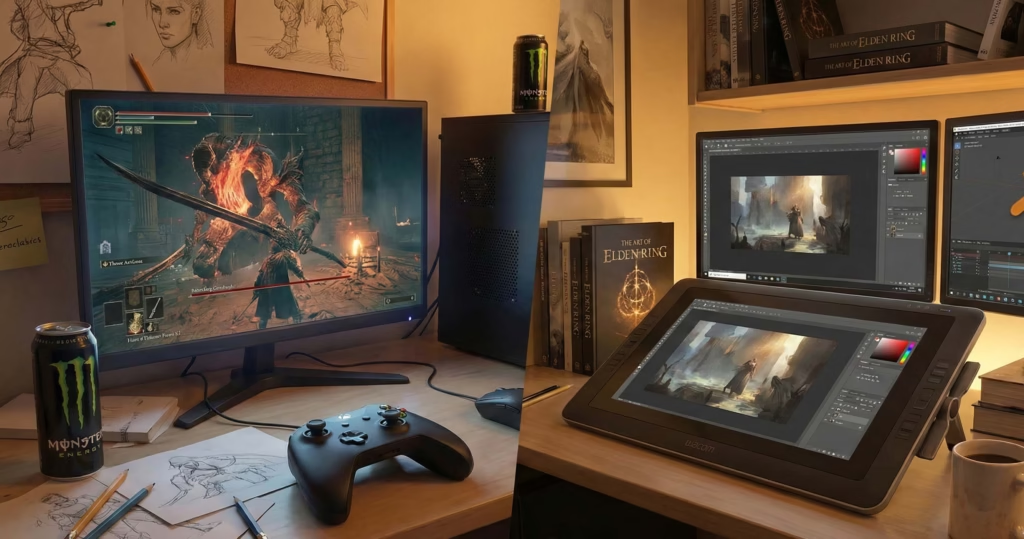
Somewhere right now, a teenager is sketching characters from Elden Ring in their notebook during lunch break. They’re carefully studying the intricate armor designs, the way light catches on weathered metal, the haunting silhouettes of towering bosses. They don’t realize it yet, but they’re doing the exact same work that concept artists at FromSoftware did years ago—the foundational creative exploration that brings video game worlds to life.
This scene is playing out in bedrooms, coffee shops, and art classrooms worldwide. Gaming passion is translating into artistic careers at an unprecedented rate. The video game industry, now worth over $200 billion globally and employing millions of creative professionals, has become the premier training ground for visual artists in the 21st century.
In this complete guide, you’ll discover how video games evolved from simple pixels to artistic powerhouses, which specific games inspire modern concept artists, and exactly how to transform your gaming passion into a professional concept art career. Whether you’re a high school student dreaming of working at Riot Games, a college graduate exploring creative careers, or a self-taught artist wondering if your gaming obsession has professional value—this roadmap is for you.
Let’s explore how the games you love can become the career you build.
The Evolution of Video Games as Artistic Inspiration
Gaming wasn’t always considered “art.” Understanding this evolution validates the medium as a legitimate creative foundation and shows how concept art emerged as a distinct profession worthy of serious pursuit.
The Pixelated Pioneers (1980s-1990s)
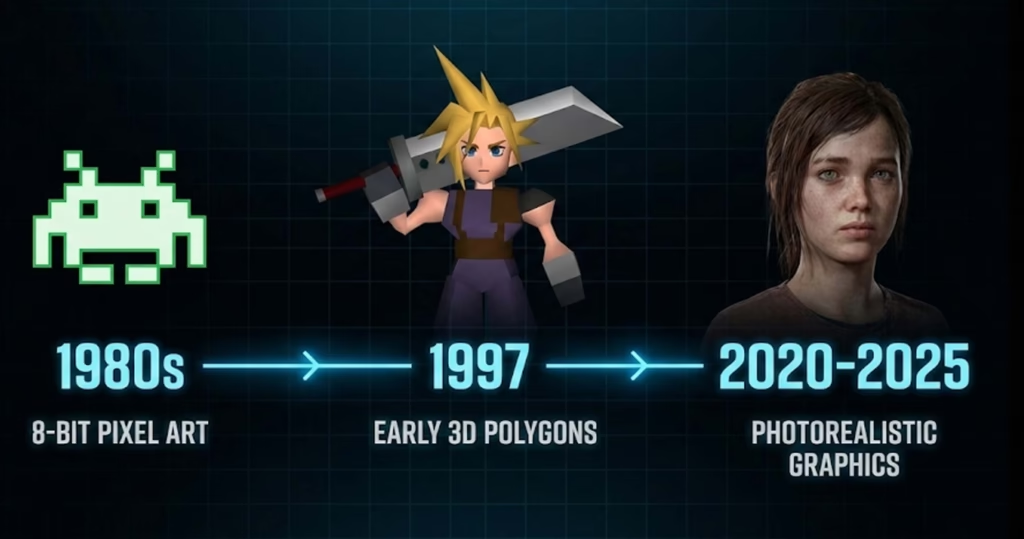
When Space Invaders landed in arcades in 1978, followed by Pac-Man in 1980, nobody called them art. Technical limitations meant artists worked with tiny grids of pixels and severely restricted color palettes—8 colors, then 16, eventually 256. Yet within these constraints, visual identity became paramount.
Early game artists were problem-solvers first, artists second. They had to convey character, emotion, and world-building with resources that seem laughable today. Shigeru Miyamoto’s Super Mario Bros. (1985) created an iconic plumber recognizable from a 16×16 pixel sprite. That’s artistic genius under constraint.
The real breakthrough came when artists like Yoshitaka Amano brought traditional illustration to gaming. His watercolor and ink artwork for the Final Fantasy series (starting 1987) elevated game packaging and marketing into fine art territory. Players bought games partly for the box art—a trend that made visual artists essential to gaming’s commercial success.
This era established a crucial principle: even with primitive technology, strong art direction sells games. That insight created the concept art profession.
The 3D Revolution and Cinematic Aspirations (1990s-2000s)
The leap to 3D graphics in the mid-1990s changed everything. Suddenly, games like Final Fantasy VII (1997) and Metal Gear Solid (1998) needed teams of artists to model characters, environments, and objects in three-dimensional space. But before a single polygon could be modeled, someone had to draw what it should look like.
Enter the concept artist.
Tetsuya Nomura’s character designs for Final Fantasy VII became cultural phenomena. His sketches of Cloud Strife, with that iconic spiky hair and oversized Buster Sword, had to be translated from 2D drawings into 3D models. The concept art served as a blueprint—establishing proportions, costume details, color schemes, and personality that 3D modelers would replicate.
Artists began borrowing techniques from animation and film production. Akira Toriyama brought his manga aesthetic to Dragon Quest and Chrono Trigger. Developers realized that strong pre-production artwork streamlined development and created visual consistency across large teams.
This era professionalized concept art. It was no longer “some sketches before we make the game”—it became a specialized discipline with its own workflows, software, and career paths.
The Artistic Diversity Explosion (2010s)
The 2010s shattered any remaining notion that games had a singular “look.” Three parallel trends converged:
Indie games proved unique art styles sell. Thatgamecompany’s Journey (2012) used watercolor-inspired visuals and minimalist design to create emotional resonance. Playdead’s Limbo (2010) went monochrome noir. Studio MDHR’s Cuphead (2017) meticulously recreated 1930s rubber-hose animation. These weren’t just artistic choices—they were marketing differentiators. Visual style became a competitive advantage.
AAA budgets enabled photorealism. Naughty Dog’s The Last of Us (2013) and Rockstar’s Red Dead Redemption 2 (2018) pushed graphics technology to film-quality. Concept artists for these games studied real-world references obsessively—abandoned buildings, facial microexpressions, fabric wear patterns. The job required observational skills on par with classical painters.
Museums legitimized gaming as art. The Smithsonian’s “The Art of Video Games” exhibition (2012) and MoMA’s permanent video game collection signaled cultural acceptance. “The Art of [Game Name]” books became bestsellers, turning concept artists into celebrities. Artists like Sparth (Nicolas Bouvier), Craig Mullins, and Jaime Jones gained followings outside gaming.
By decade’s end, aspiring artists had clear proof: video games were legitimate artistic training grounds, and concept art was a viable, respected career.
The Current Landscape (2020s-2025)
Today’s gaming landscape offers unprecedented artistic diversity. Fortnite sits alongside Hellblade 2. Hyperrealistic racing simulators coexist with pixel-art roguelikes. This plurality creates opportunities for artists with varied styles and backgrounds.
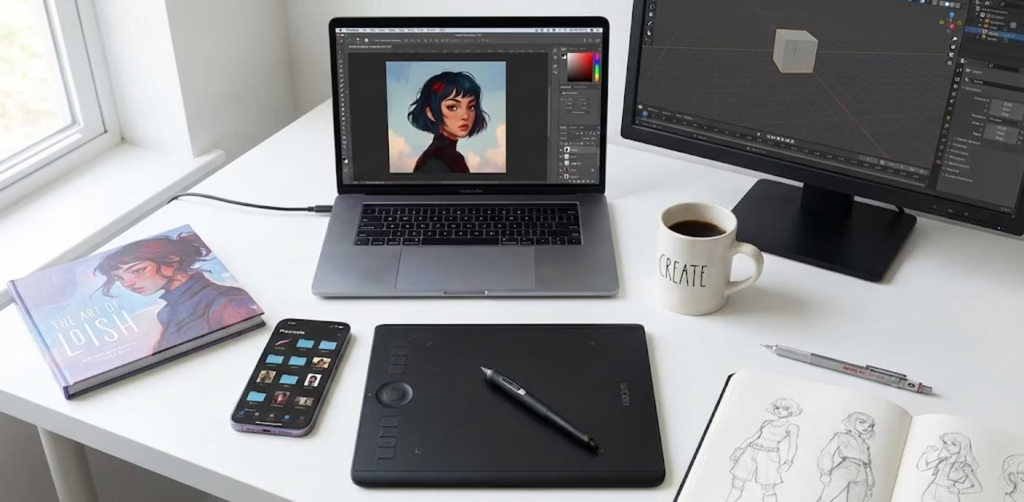
The profession has also democratized. Tools like Blender (free), Krita (free), and affordable drawing tablets mean anyone can develop professional-level skills. Online learning platforms—YouTube tutorials, Skillshare courses, Discord communities—provide education that once required expensive art schools.
Social media transformed artist visibility. ArtStation hosts millions of portfolios. Instagram and Twitter let artists build audiences directly. Studios recruit from online communities. Your geographical location matters less when remote work is standard.
The numbers tell the story: The gaming industry now employs over 220,000 people in the United States alone, with tens of thousands of those being artists. Entry-level concept artist positions receive hundreds of applications—but there’s a catch. The industry desperately needs senior artists, specialists, and art directors. The path exists; you just need to navigate it strategically.
Key Takeaway: Video games have evolved from technological experiments to the premier visual art medium of our era. This evolution created the concept art profession—and your gaming passion isn’t a distraction from artistic development, it’s foundational training.
Iconic Games That Shaped the Concept Art Profession
Specific games created visual languages that concept artists now work within professionally. Understanding these influences helps you develop marketable styles and communicate your artistic inspirations to potential employers.
BioShock – Art Deco Meets Dystopia
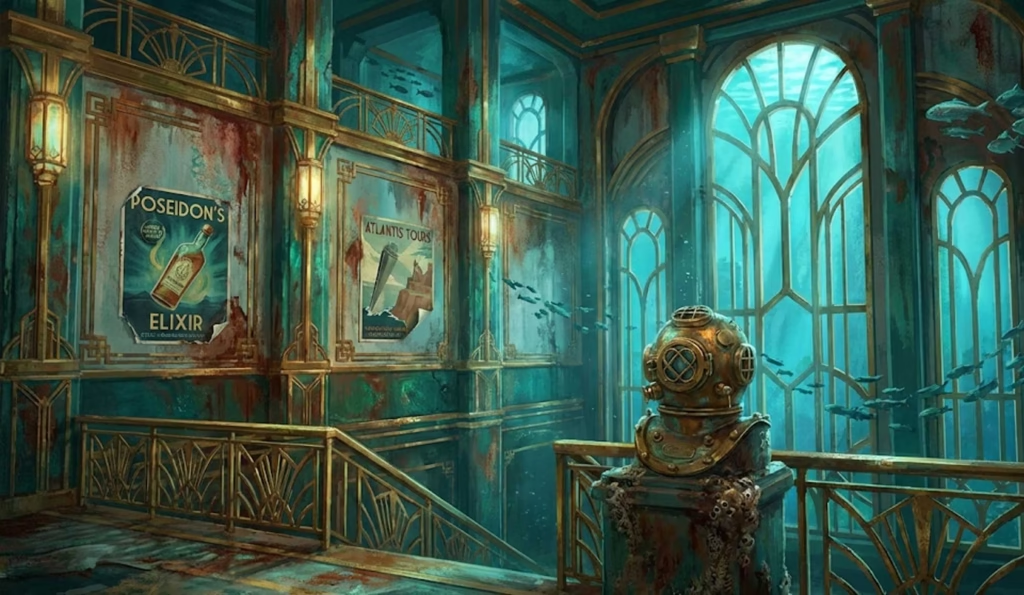
Ken Levine’s BioShock (2007) transported players to Rapture, an underwater city frozen in 1940s-1960s aesthetics. Lead artist Viktor Antonov (previously on Half-Life 2) created a masterclass in period-inspired design.
The visual language combined Art Deco architecture, retro-futuristic technology, and decay. Ornate brass fixtures contrasted with leaking pipes and crumbling plaster. Advertising posters mimicked 1940s propaganda. The aesthetic was so strong that “BioShock-inspired” became industry shorthand for Art Deco dystopias.
Career application: Period-inspired environments remain in high demand. Understanding historical design movements—Victorian, Art Nouveau, Brutalist, Mid-Century Modern—makes you valuable for projects requiring authentic aesthetic touchstones. Games like Dishonored, We Happy Few, and Deathloop all owe debts to BioShock‘s approach.
If you’re drawn to architectural concept art, study BioShock‘s environmental storytelling. Notice how every room tells a story through object placement, lighting, and decay. That’s the job—creating spaces that communicate narrative without dialogue.
Okami – Traditional Art in Digital Space
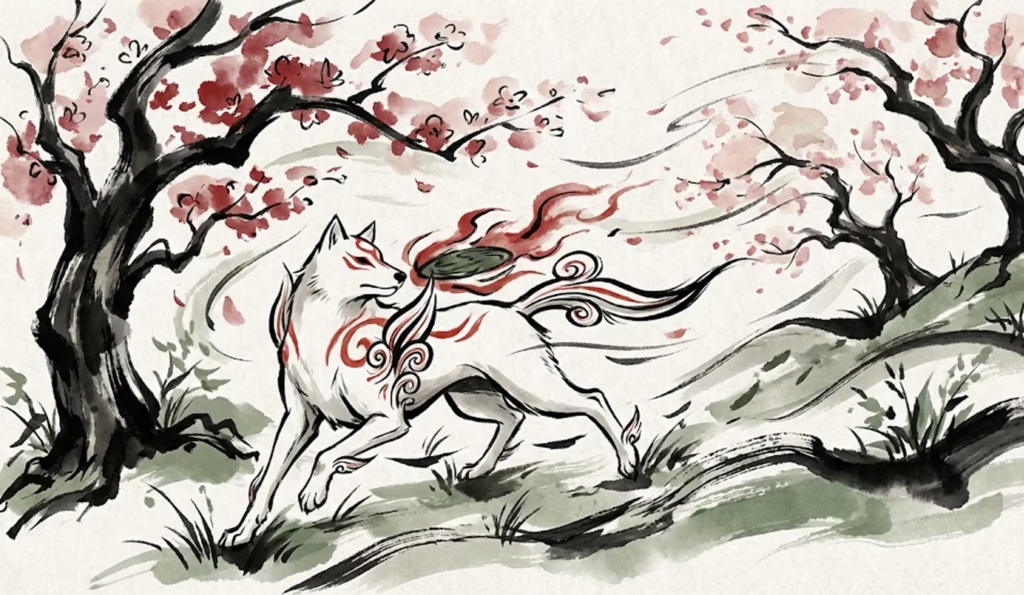
Clover Studio’s Okami (2006) remains a watershed moment for cultural art styles in gaming. Director Hideki Kamiya and his team created a game that looked like living Japanese sumi-e (ink wash) paintings.
The cel-shaded rendering applied watercolor textures to 3D models. Thick black outlines mimicked brush strokes. The color palette—dominated by whites, reds, and greens—referenced traditional Japanese painting. Even the UI elements looked hand-brushed.
Career application: Cultural art traditions remain valuable niches. Whether it’s African textile patterns, Norse illuminated manuscripts, or South Asian miniature painting, bringing authentic cultural aesthetics to gaming creates unique visual identities. Games like Hades (Greek pottery), Ashen (Northern European folklore), and Gris (watercolor illustration) prove specialized styles sell.
Artists who can authentically represent diverse cultural aesthetics—backed by research and respect—fill a real industry need as gaming audiences globalize.
World of Warcraft – Stylized Fantasy at Scale
Blizzard’s World of Warcraft (2004) proved stylized art has longer lifespans than photorealism. Lead artist Samwise Didier’s cartoon-influenced character design—exaggerated proportions, vibrant colors, readable silhouettes—created a visual language that scaled across expansions for 20+ years.
The style prioritized clarity over realism. Characters needed to be identifiable at various distances and camera angles. Armor designs used bold shapes and high color contrast. Everything was slightly caricatured—bigger shoulders, smaller heads, dramatic poses.
Career application: Stylized art is more common in gaming than photorealism, and it’s easier to maintain visual consistency across large teams. Learning to design readable silhouettes, use bold color blocking, and exaggerate for effect makes you employable across mobile games, live-service titles, and animation studios.
Study Overwatch, Valorant, Fortnite—all descended from WoW’s design philosophy. If you love stylized characters, this is your professional home.
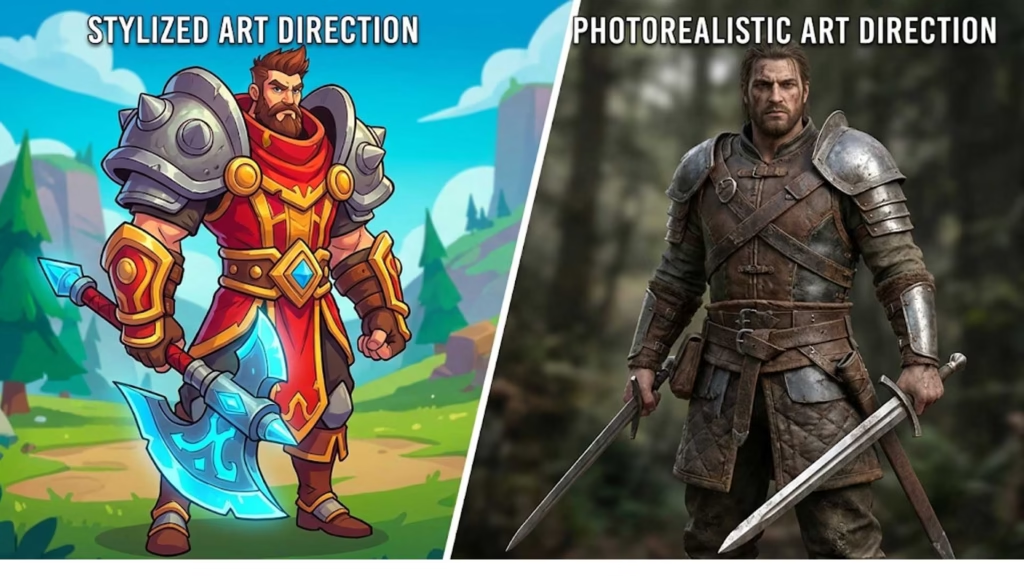
The Last of Us – Grounded Realism with Emotional Weight
Naughty Dog’s The Last of Us (2013) demonstrated how photorealistic graphics could serve emotional storytelling. Concept artists like John Sweeney and Alexandria Neonakis created post-apocalyptic environments that felt authentic and lived-in.
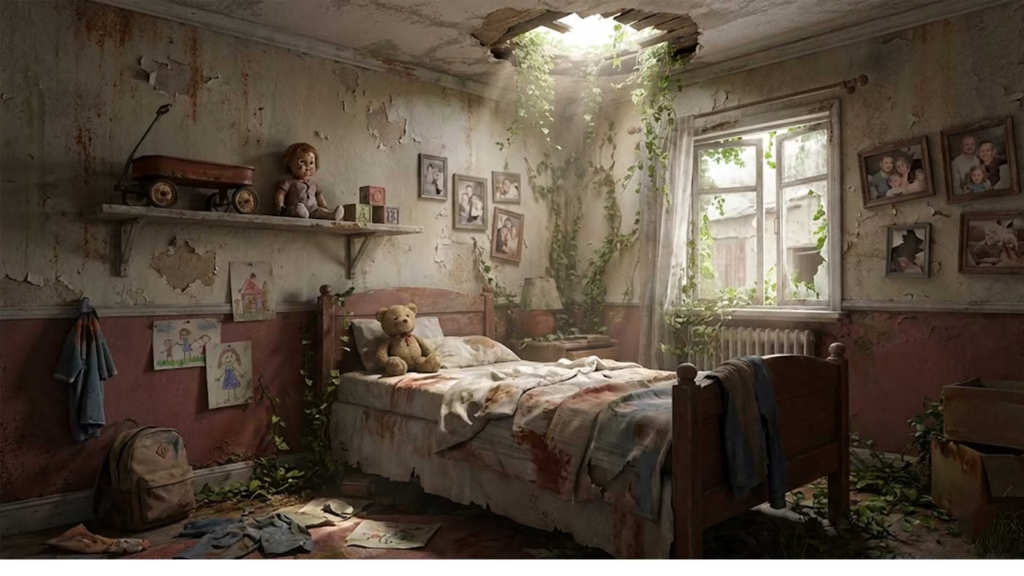
The art direction emphasized decay over spectacle. Overgrown cities, weathered clothing, realistic material aging. Every asset felt researched—from correct plant species reclaiming urban spaces to accurate rust patterns on abandoned cars.
Career application: AAA studios need artists who can create believable worlds grounded in reality. This requires strong observational skills, understanding of materials and lighting, and commitment to reference research. If you’re detail-oriented and love realism, this path suits you.
Study environmental storytelling: How does Naughty Dog convey character backstory through bedroom objects? What makes abandoned spaces feel inhabited? That attention to narrative detail distinguishes professional work from amateur attempts at photorealism.
Hollow Knight – Indie Aesthetic Revolution
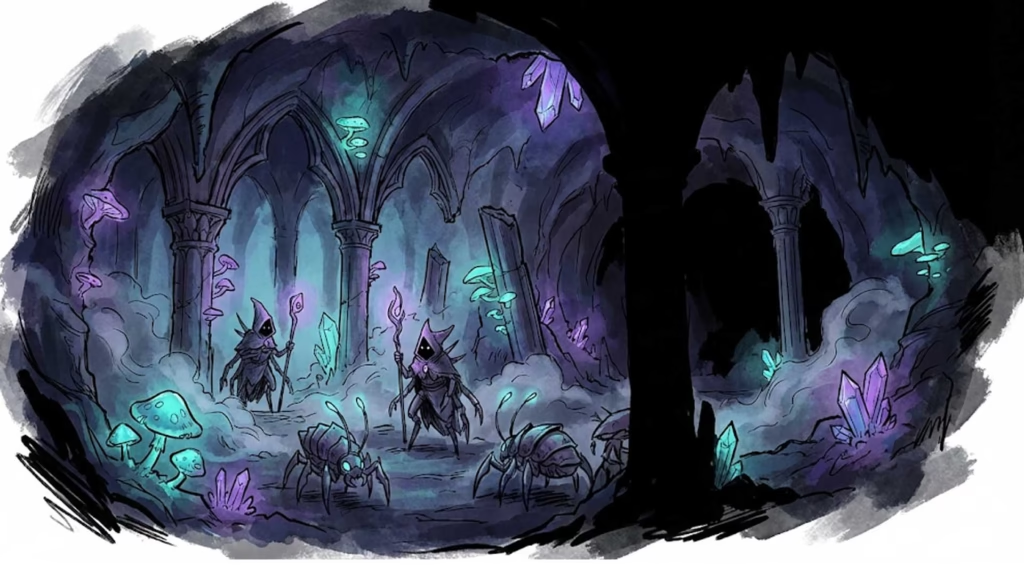
Team Cherry’s Hollow Knight (2017) proved three artists could create a visual masterpiece. Ari Gibson’s hand-drawn character and environment art combined gothic architecture, insect anatomy, and watercolor textures into a cohesive dark fantasy aesthetic.
The limited team size meant every asset had to pull triple duty—functional for gameplay, beautiful for screenshots, and narratively meaningful. The result: one of the most visually distinctive games of the decade.
Career application: The indie game boom creates specialized roles for artists who can develop unique styles and execute them consistently. Single-artist or small-team development values versatility—you might design characters, environments, AND UI.
If you’re artistically ambitious but prefer smaller teams and creative control, indie development offers genuine opportunities. Games like Hades, Celeste, Stardew Valley, and Tunic all succeeded partly on distinctive art direction from tiny teams.
Elden Ring – Dark Fantasy Grandeur
FromSoftware’s Elden Ring (2022) combined director Hidetaka Miyazaki’s gothic sensibilities with George R.R. Martin’s world-building, resulting in some of gaming’s most evocative environmental design.
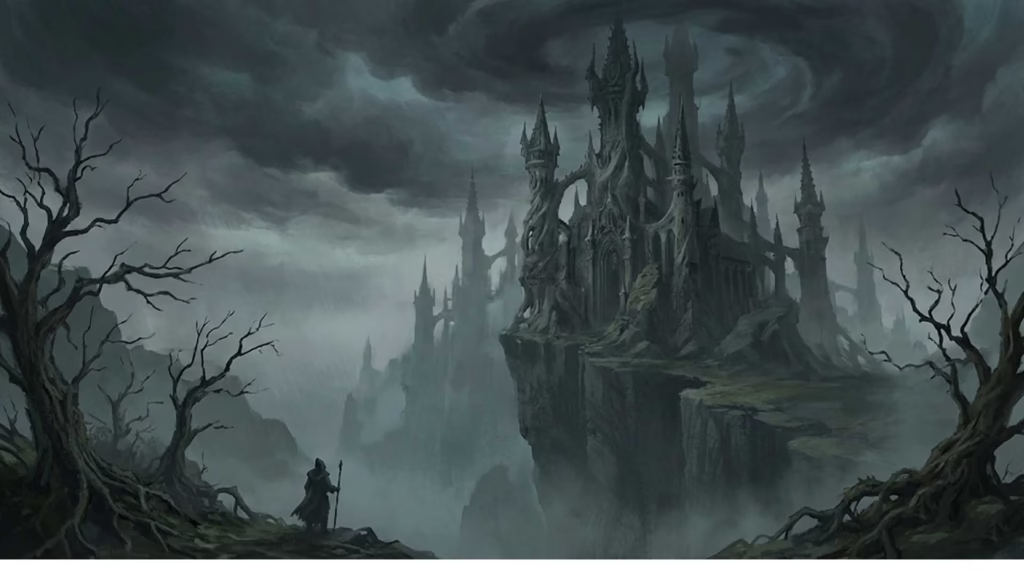
The art direction emphasized scale and mystery—massive castles in impossible positions, grotesque boss designs blending multiple creature types, armor designs that told character stories. Every major enemy felt like the culmination of extensive concept exploration.
Career application: Fantasy remains gaming’s dominant genre, and FromSoftware’s success proves audiences crave inventive takes on classic themes. Learning creature design, armor/costume development, and environmental concept art for fantasy settings keeps you perpetually employable.
Study how Elden Ring makes familiar fantasy elements feel fresh. Their dragons aren’t generic—they’re amalgamations of historical and mythological references twisted into something new. That’s the professional skill: research-driven originality.
The Indie Game Aesthetic Revolution
Beyond individual games, the indie boom (2010-present) democratized art style experimentation. Cuphead‘s rubber-hose animation. Celeste‘s pixel precision. Stardew Valley‘s nostalgic 16-bit charm. Hyper Light Drifter‘s pixel-art sci-fi. Each proved you don’t need photorealism to succeed commercially.
Career application: Specialized aesthetic skills—pixel art, hand-drawn animation, retro 3D, paper-craft designs—create niches where you can become the go-to expert. Rather than competing as average generalist, become the best at a specific style.
Key Takeaway: These games didn’t just entertain—they created visual vocabularies that define contemporary concept art. Your favorite game’s aesthetic isn’t just inspiration; it’s a professional specialization you can develop.
From Player to Professional: Real Artist Career Stories
Concrete examples of gaming-to-career pathways provide roadmaps you can actually follow. These aren’t hypothetical—they’re real trajectories from people who started exactly where you are.
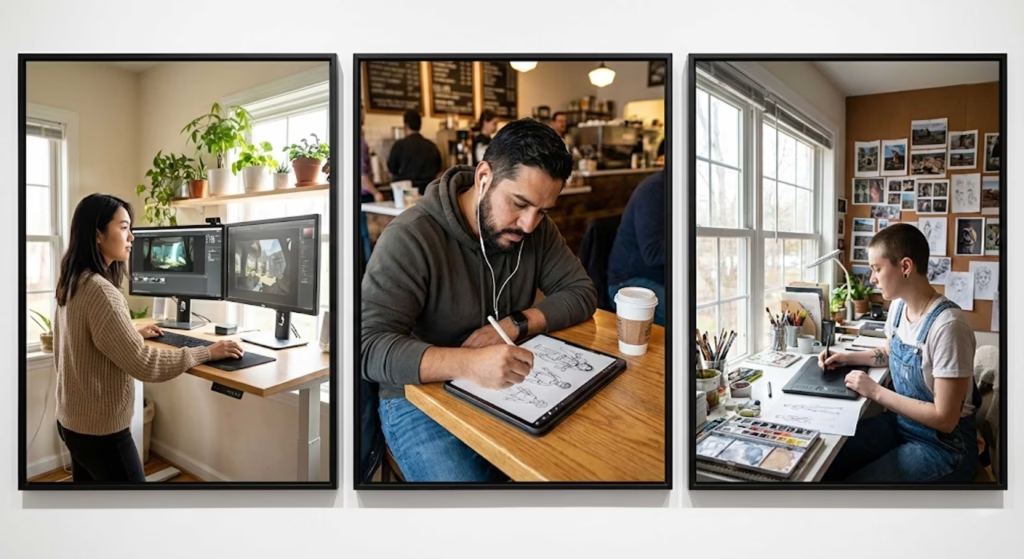
Profile 1: Sarah Chen – The AAA Environment Artist
Gaming Influence: Sarah grew up exploring every corner of Skyrim and Red Dead Redemption 2. She spent hours just riding horses through RDR2’s wilderness, studying how lighting changed throughout the day and how vegetation density varied by terrain.
Educational Path: Started with community college art fundamentals (2 years, $8,000 total). Couldn’t afford traditional art school, so she committed to self-teaching environment art through YouTube (primarily Moderndayjames and Flipped Normals) and paid Gumroad tutorials ($300 over 18 months).
Portfolio Evolution:
- Year 1: Fan environments from games she loved—recreating locations from Skyrim in Unreal Engine
- Year 2: Original fantasy environments using photobashing and 3D blocking
- Year 3: Photorealistic environments with strong narrative storytelling (her breakout piece: an abandoned fire lookout tower)
Current Work: Senior Environment Artist at a major AAA studio (4 years in industry). Works on open-world games creating natural environments—forests, mountains, deserts.
Key Advice: “Your love of exploring game worlds is professional training. All those hours noticing rock formations and tree placement patterns? That’s learning composition and environmental logic. Technical skills are teachable; artistic eye comes from observation. If you’ve spent 1,000 hours in Breath of the Wild really looking at the landscape design, you’re already training.”
Salary Trajectory: Entry: $58,000 → Mid-level (2 years): $72,000 → Senior (4 years): $95,000
Profile 2: Marcus Rivera – The Indie Character Designer
Gaming Influence: Obsessed with anime-style JRPGs (Persona, Fire Emblem) and fighting games (Guilty Gear, BlazBlue). Spent teenage years drawing fan art of his favorite characters, studying costume complexity and personality conveyance.
Educational Path: Traditional 4-year illustration degree at state university ($45,000 total debt). Realized junior year that curriculum was too fine-arts focused, supplemented with online character design courses (Schoolism’s “Character Design Techniques” by Stephen Silver – $400).
Portfolio Evolution:
- College portfolio: Mix of life drawing, personal character designs, and fan art
- Post-grad: Rebuilt portfolio with only original character sheets showing range (cute to edgy, realistic to stylized)
- First paid work: Character commissions on Twitter/Fiverr built client base and professional workflow
Current Work: Freelance character artist for indie studios (3 years). Works on 3-5 games annually, specializes in anime-influenced character design. Also runs Patreon ($800/month) teaching character design.
Key Advice: “Find your niche and own it. I tried being a generalist environment/character/everything artist and got nowhere. When I committed to ‘anime-influenced character designer for indie games,’ clients knew exactly when to hire me. Specialization isn’t limiting—it’s positioning.”
Income: Year 1 freelance: $35,000 → Year 2: $52,000 → Year 3: $68,000 (client work + Patreon + course sales)
Profile 3: Jordan Kim – The Stylized Props Specialist
Gaming Influence: Fell in love with prop design playing Overwatch—the stylized weapons, the playful color schemes, the clear readability. Started recreating favorite weapons in 3D as practice.
Educational Path: Completely self-taught using free resources. Learned Blender through YouTube (Grant Abbitt, Blender Guru), learned Substance Painter through their free tutorials. Total cost: $0 for software (Blender free), $250 for Udemy courses, $400 for drawing tablet.
Portfolio Evolution:
- First year: Overwatch weapon recreations (proved 3D competency)
- Second year: Original weapon designs in various styles (realistic military, sci-fi, fantasy, stylized)
- Breakthrough: Created full weapon pack and sold on Unreal Marketplace ($1,200 revenue)
Current Work: Senior Props Artist at mobile gaming studio (5 years in industry), focuses on weapons and vehicles. Also sells asset packs as side income ($500-$1,500/month).
Key Advice: “You don’t need expensive software or degrees. I got hired with a portfolio made entirely in free software. They cared about one thing: Can you create props that fit our art style and meet technical specs? Free tools + dedicated practice + focused portfolio = job. Don’t let cost barriers stop you.”
Salary Trajectory: Entry (mobile studio): $52,000 → Mid-level (3 years): $68,000 → Senior (5 years): $82,000 (+ side income ~$10,000/year)
Common Threads in Successful Transitions
They all started as passionate gamers with no professional background. Their “wasted” gaming time was unconscious artistic education.
Portfolio quality mattered more than credentials. Sarah had community college credits. Marcus had a degree. Jordan was purely self-taught. All three got hired based on portfolio strength.
Community involvement accelerated learning. All three mentioned Discord servers, subreddit communities, and social media connections that provided feedback, motivation, and job leads.
Specialized skills created opportunities. They didn’t try to be “good at everything”—they each developed clear specializations that made hiring decisions easy.
The timeline was realistic: 2-3 years of dedicated practice before industry-ready portfolios. Not overnight success, but achievable with consistent effort.
Key Takeaway: These artists prove gaming passion translates to professional careers. The path isn’t mysterious—develop skills, build focused portfolios, engage communities, apply consistently. Your background doesn’t matter; your work does.
Understanding Concept Art Roles in the Gaming Industry
Many aspiring artists don’t realize concept art fragments into specialized roles. Finding the right fit dramatically increases your success chances.
Character Concept Artist
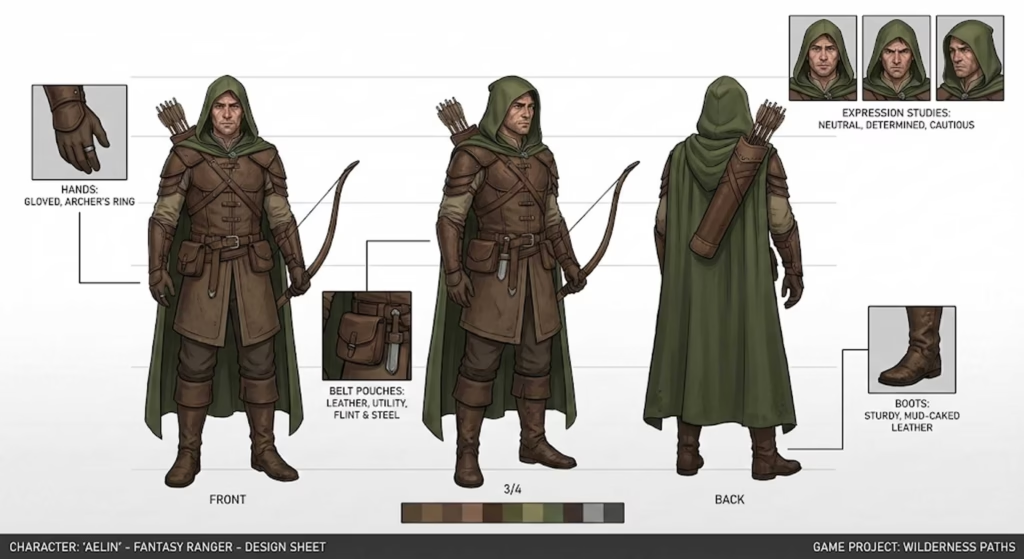
Primary Responsibility: Design playable characters, NPCs (non-playable characters), and enemies. Every human, creature, or robot players interact with starts as your sketch.
Key Skills Required:
- Anatomy: Understanding human and animal skeletal/muscular systems to create believable creatures
- Costume Design: Historical references, cultural clothing, functional armor, futuristic fashion
- Expression/Personality: Conveying character through posture, facial features, and details
- Iteration: Creating multiple variations from a single character brief
Games That Excel Here: Overwatch (30+ unique heroes with distinct personalities), League of Legends (160+ champions), Final Fantasy series (iconic protagonist designs)
Career Path: Junior Character Artist ($50,000-$65,000) → Character Artist ($65,000-$85,000) → Senior Character Artist ($85,000-$110,000) → Lead Character Artist ($100,000-$130,000) → Art Director ($120,000+)
Portfolio Priorities:
- 3-4 full character sheets (front, back, 3/4 views)
- Expression sheets showing emotional range
- Costume variations demonstrating design thinking
- Characters in environmental context (not floating in white space)
- Detail callouts for complex elements (hands, accessories, materials)
Day-to-Day Work: Receive brief (“female ranger, ages 25-30, woodlands specialist, practical gear”). Research references (historical archers, modern outdoor gear, forest camouflage patterns). Create 3-5 thumbnail silhouettes. Refine chosen direction with team feedback. Produce final character sheet with color callouts and material notes. Hand off to 3D modeler.
Salary Range 2025: $55,000-$110,000 depending on experience and studio size
Environment/World Concept Artist
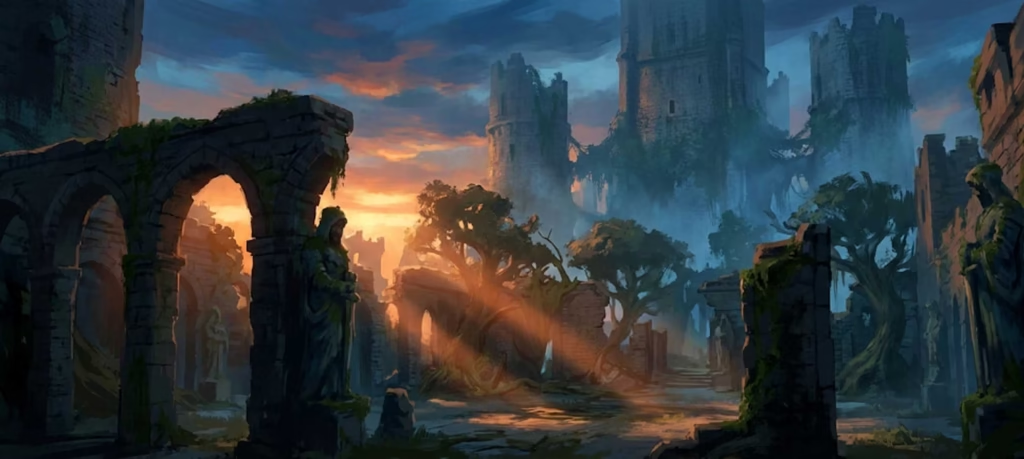
Primary Responsibility: Design game spaces—cities, dungeons, natural landscapes, interiors. You create the world players explore.
Key Skills Required:
- Perspective: Perfect understanding of 1-point, 2-point, 3-point perspective for architectural accuracy
- Lighting: How light behaves at different times of day, in various weather, with different sources
- Architectural Knowledge: Understanding structural logic so buildings feel buildable
- Mood Setting: Using composition, lighting, and color to convey emotional tone
Games That Excel Here: Elden Ring (atmospheric castles and ruins), Horizon series (post-apocalyptic wilderness), Dishonored (steampunk cities), The Last of Us (abandoned urban environments)
Portfolio Priorities:
- 3-5 establishing shots (wide environment views showing scale and atmosphere)
- 2-3 detailed interiors demonstrating narrative storytelling
- Architectural studies showing structural understanding
- Time-of-day/lighting variations of same location
- Props in context (not standalone objects)
Day-to-Day Work: Receive level design brief and gameplay requirements. Create multiple thumbnail compositions exploring different approaches. Develop chosen thumbnail into detailed concept with lighting and atmospheric effects. Work with level designers to ensure composition supports gameplay. Create callout sheets for specific areas. Collaborate with environment modelers during asset creation.
Salary Range 2025: $60,000-$120,000 depending on experience and project scale
Props and Vehicle Designer
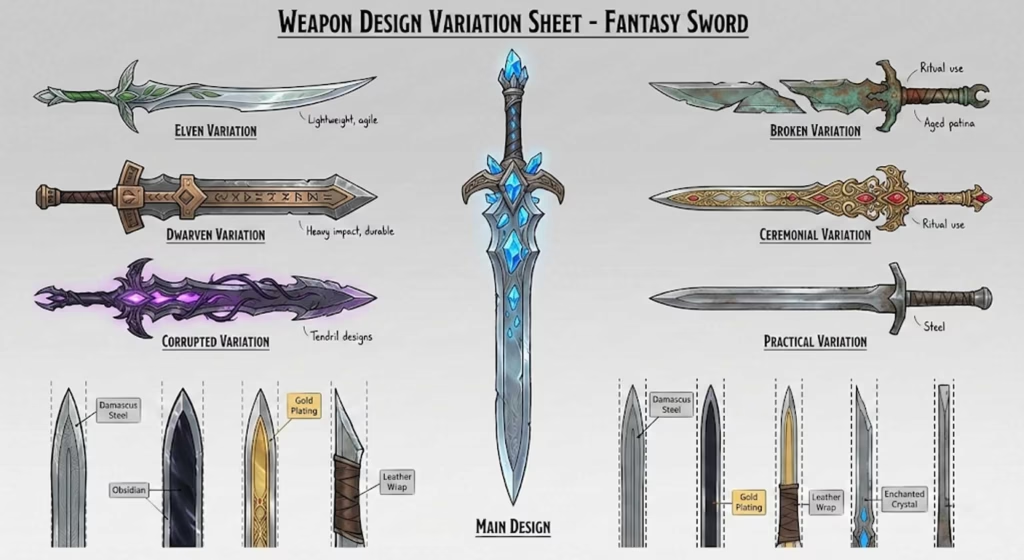
Primary Responsibility: Create weapons, items, vehicles, and objects that populate game worlds. Everything players pick up or interact with.
Key Skills Required:
- Industrial Design: Understanding how objects are manufactured and function
- Material Knowledge: How wood, metal, fabric, plastic, leather, etc., look and behave
- Functionality: Props need to make logical sense even in fantastical settings
- Style Matching: Your props must fit the established art direction seamlessly
Games That Excel Here: Destiny (exotic weapons with unique personalities), Halo (iconic vehicle design), Cyberpunk 2077 (futuristic technology and weapons), Monster Hunter (elaborate weapon designs)
Specialization Opportunities:
- Weapons-only designer (huge demand, especially for shooters and action games)
- Vehicle specialist (racing games, sci-fi games, military games)
- Fantasy items (magical weapons, armor, artifacts)
- Everyday objects (furniture, tech devices, environmental clutter)
Portfolio Priorities:
- 8-12 props showing range (weapons, vehicles, furniture, technology)
- Orthographic views (front, side, top) showing dimensional accuracy
- Material callouts and texture details
- Props in-context (character holding weapon, vehicle in environment)
- Variation sheets (same base design with modifications)
Salary Range 2025: $50,000-$95,000 depending on specialization and experience
UI/UX Concept Artist
Primary Responsibility: Design in-game interfaces, HUD (heads-up display) elements, menus, and interactive screens. You make games playable and beautiful.
Key Skills Required:
- Graphic Design: Typography, hierarchy, layout principles
- User Experience: Understanding how players interact with information
- Readability: Creating interfaces that work under various lighting and gameplay conditions
- Style Integration: UI must match game’s overall aesthetic
Games That Excel Here: Dead Space (diegetic UI integrated into game world), Persona 5 (stylized menus as part of identity), Horizon series (clear, functional HUD design), Valorant (crisp competitive interface)
Growing Field: Mobile gaming expansion creates enormous demand for UI/UX artists who understand touch interfaces, small screens, and free-to-play monetization design.
Portfolio Priorities:
- 3-5 complete UI sets (menu system, HUD, inventory screens)
- Mobile game interface designs (huge job market)
- UI animation mockups or storyboards
- Style explorations (same interface in 3 different aesthetic approaches)
- User flow diagrams showing thought process
Salary Range 2025: $55,000-$100,000, with senior roles reaching $120,000+
Technical Artist (Hybrid Role)
Primary Responsibility: Bridge art and programming. Optimize art pipelines, create shaders, develop tools, and solve technical problems that enable other artists.
Key Skills Required:
- Shaders/Materials: Understanding how rendering engines create visual effects
- Scripting: Python, C#, or other languages for tool development
- Optimization: Making art assets perform well on target hardware
- Problem Solving: Finding technical solutions to artistic visions
Why It’s Valuable: This role is chronically understaffed because it requires both artistic sensibility and technical expertise. Competition is lower; salaries are higher.
Required Knowledge:
- Unity and/or Unreal Engine workflows
- Basic programming (scripting level, not full software engineering)
- Understanding of rendering pipelines
- 3D math fundamentals (vectors, matrices)
Career Path: Often transitioned to from other art roles after developing technical interest. Many technical artists started as environment or character artists who became the “tech-savvy” person on their team.
Salary Range 2025: $70,000-$130,000, significantly higher than pure concept art roles
Key Takeaway: Concept art isn’t a single job—it’s a family of specializations. Choose based on what you love creating. Love designing characters? Character artist. Fascinated by environments and architecture? World artist. Enjoy solving technical problems? Technical artist. Specialization beats generalization.
Educational Pathways: From Gaming Passion to Professional Skills
How do you actually acquire the skills studios demand? Multiple pathways exist, each with trade-offs. Choose based on your learning style, financial situation, and timeline.
The Traditional Route: Art School / University Programs
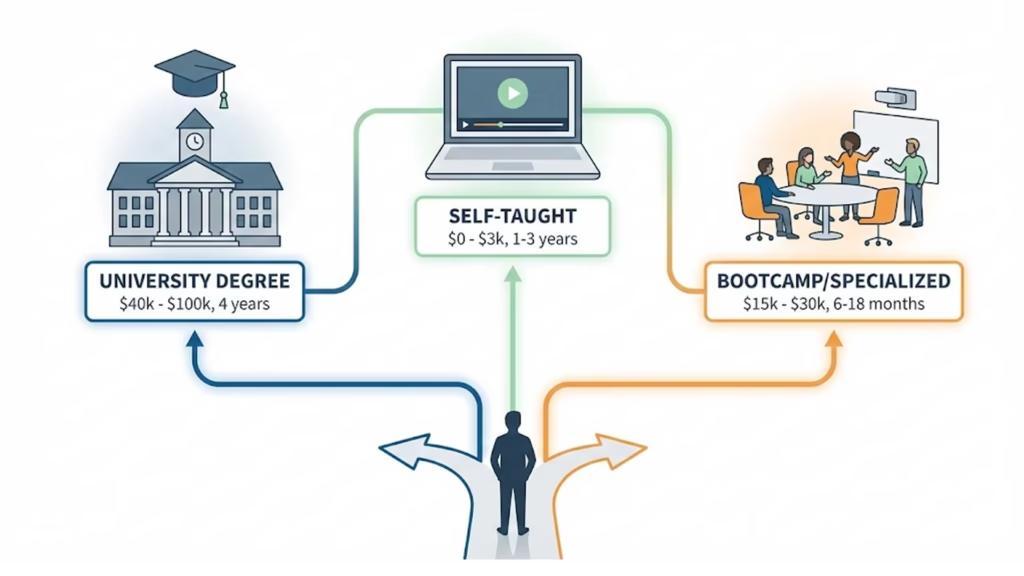
Structure: 4-year Bachelor of Fine Arts (BFA) or similar degree program at university or dedicated art school.
Pros:
- Structured curriculum covering fundamentals (drawing, color theory, composition, art history)
- Dedicated studio time and resources (equipment, software licenses)
- Networking with peers and industry-connected professors
- Credentials that some studios still value
- Access to career services and job placement support
- Financial aid/student loan options available
Cons:
- Expensive: $40,000-$100,000+ total cost (varies by public vs. private, in-state vs. out-of-state)
- Not game-specific: Most programs teach fine arts, not concept art directly
- Time commitment: 4 years is significant when industry evolves rapidly
- May include irrelevant coursework (gen-ed requirements)
- No guarantee of game industry employment post-graduation
Best Programs for Game Art:
- Art Center College of Design (Pasadena, CA): Entertainment Design department, strong industry connections
- SCAD (Savannah College of Art and Design): Interactive Design and Game Development program
- Ringling College of Art and Design: Computer Animation and Game Art
- Gnomon School of Visual Effects: 3-year program, industry-focused
What to Look For:
- Industry connections (guest speakers, studio partnerships, alumni network)
- Portfolio prep emphasis (senior thesis projects that go in professional portfolio)
- Modern software training (Photoshop, Blender/Maya, game engines)
- Small class sizes (enables individual feedback)
- Active student game development projects
Timeline: 4 years → Entry-level ready (with strong senior thesis portfolio)
Best For: Students who thrive in structured environments, can afford/finance cost, value credentials and campus experience, benefit from in-person community.
Specialized Game Art Schools / Bootcamps
Structure: Intensive, focused programs specifically for game art careers. Range from 6-month bootcamps to 2-year programs.
Pros:
- Game industry focused from day one (no irrelevant courses)
- Shorter timeline than traditional degree (6-18 months typical)
- Portfolio-centric approach (everything you create goes toward job applications)
- Industry professional instructors (working artists teaching current methods)
- Smaller cohorts enable individualized feedback
- Some programs guarantee interviews or offer job placement services
Cons:
- Still costly: $15,000-$30,000 for quality programs
- Intensive time commitment (often full-time, demanding)
- No broader liberal arts education (purely technical/artistic training)
- Less established credential than traditional degree
- Variable quality between programs (research thoroughly)
Recommended Programs:
- Brainstorm School: Character design focus, strong industry connections
- CGMA (Computer Graphics Master Academy): Online mentorships with AAA artists
- Think Tank Training Centre: Comprehensive game art program
- Game Art Institute: Online program with portfolio focus
- Vertex School: Real-time 3D art for games
What Makes Them Effective:
- Small student-to-instructor ratios (10:1 or better)
- Professional instructors working at studios (Blizzard, Riot, Naughty Dog alumni common)
- Portfolio review culture (constant feedback throughout)
- Industry standard pipelines (learn actual studio workflows)
- Job placement support (resume review, interview prep, studio connections)
Timeline: 6-18 months → Portfolio ready for applications
Cost: $15,000-$30,000 total
Best For: Career changers who can commit full-time, students who struggled in traditional academic settings, people who need structured program but want faster timeline than 4-year degree.
Self-Taught with Online Resources
Structure: No formal program. Learn through YouTube, online courses, books, practice, and community feedback.
Pros:
- Affordable: $0-$3,000 total for premium courses/resources
- Flexible pacing: Learn around work/school schedule
- Real-world skill focus: Only learn what’s directly applicable
- Builds self-discipline: Essential skill for freelance careers
- Huge resource library: Thousands of free tutorials available
- Portfolio is only credential: No expensive degree needed
Cons:
- Requires exceptional self-motivation: No external structure or deadlines
- No structured feedback: Must seek critique proactively
- Isolation: Easy to feel alone without cohort
- Networking challenges: Harder to meet industry professionals
- Overwhelming choices: Which resources to use? What to learn first?
- Longer timeline: Without structure, easy to plateau or waste time
Essential Free Resources:
YouTube Channels (Free):
- Moderndayjames: Environment art, weekly challenges
- Sinix Design: Character design, painting fundamentals
- Ahmed Aldoori: Art career advice, painting techniques
- Marco Bucci: Color theory, fundamentals
- Proko: Figure drawing, anatomy
- KNKL: Storytelling, composition
Paid Online Courses ($):
- Schoolism courses: $400 per course, industry professional instruction
- New Masters Academy: $30/month, comprehensive figure drawing
- Udemy (discounted to $10-$20): Specific software skills
- Gumroad tutorials: $20-$100, niche skills from working artists
- Domestika: $10-$40, international artist perspectives
Learning Communities (Free):
- r/learnart (Reddit): Feedback, resources
- ConceptArt.org forums: Industry professionals active
- Cubebrush Discord: Supportive artist community
- Blender Artists forum: 3D learning community
- ImagineFX forum: Traditional+digital techniques
Total Cost Examples:
- Minimum viable: $0 (all free resources, library art books)
- Recommended investment: $500-$1,500 (select paid courses, decent drawing tablet)
- Premium self-taught: $2,000-$3,000 (mentorship programs, premium courses, quality hardware)
Timeline: 1-3 years of dedicated practice → Portfolio ready (highly variable based on starting skill, hours invested, practice efficiency)
Best For: Self-motivated learners, people with financial constraints, those balancing learning with work/family, artists who prefer independent learning over classroom environments.
Success Requirements:
- Consistent practice schedule (even 1 hour daily beats sporadic binges)
- Active community participation (posting work for feedback)
- Structured learning plan (don’t just watch random tutorials)
- Portfolio focus from early on (create with job applications in mind)
Hybrid Approach (Recommended for Most)
Structure: Combine affordable formal education with online specialization and community learning.
Example Path:
- Community college art fundamentals (2 years, $5,000-$10,000)
- Get drawing, color theory, composition foundation
- Avoid expensive university tuition for basics
- Online game art specialization (6-12 months, $1,000-$3,000)
- CGMA mentorship or similar focused program
- Learn industry-specific skills (Photoshop, Blender, engines)
- Community engagement (ongoing, free)
- Discord servers, subreddit communities
- Get feedback, stay motivated, build network
- In-person workshops/intensives (1-2 per year, $500-$1,000 each)
- Weekend workshops at conventions (GDC, LightBox, etc.)
- Get face-to-face feedback, meet professionals
Total Cost: $8,000-$20,000
Timeline: 2-3 years → Competitive portfolio
Advantages:
- Foundational education at affordable price
- Specialized skills from industry professionals
- Community support throughout journey
- Networking through workshops
- Credential (AA degree) plus portfolio
This Approach Optimizes:
- Cost (much less than 4-year BFA)
- Quality (structured fundamentals + specialized training)
- Networking (hybrid online/in-person)
- Timeline (faster than pure self-teaching, slower than bootcamp)
Skills Acquisition Roadmap (Self-Taught Focus)
If pursuing self-taught or hybrid path, here’s a proven month-by-month progression:
Months 1-3: Drawing Fundamentals
- Skills: Form, perspective (1-point, 2-point, 3-point), value studies
- Practice: 50% drawing from reference, 50% from imagination
- Resources: Drawabox.com (free), Proko figure drawing basics
- Goal: Understand 3D form on 2D surface
Months 4-6: Figure Drawing & Anatomy
- Skills: Gesture drawing, skeletal/muscular anatomy, proportions
- Practice: Daily 15-min gesture sessions, weekly anatomy studies
- Resources: Proko (YouTube), Michael Hampton’s “Figure Drawing: Design and Invention”
- Goal: Draw believable characters from imagination
Months 7-9: Digital Painting Basics
- Skills: Color theory, basic composition, value control, brush techniques
- Software: Start with free tools (Krita), learn Photoshop if budgets allows
- Practice: Still life studies, simple character/environment paintings
- Resources: Marco Bucci color theory, Ctrl+Paint (free)
- Goal: Comfort with digital medium
Months 10-12: Specialization Begin + 3D Introduction
- Skills: Choose focus (character/environment/props), learn basic 3D (Blender)
- Practice: 70% chosen specialization, 30% 3D fundamentals
- Resources: Blender Guru (donut tutorial), Grant Abbitt
- Goal: Portfolio direction established
Months 13-18: Portfolio Building
- Skills: Style development, game-ready asset creation, professional presentation
- Practice: Create 2-3 portfolio pieces per month
- Resources: Join paid mentorship program or online course in specialization
- Goal: 8-10 strong portfolio pieces
Months 19-24: Advanced Techniques + Job Prep
- Skills: Advanced lighting, complex compositions, industry workflows
- Practice: Finish 5-8 more portfolio pieces, get professional feedback
- Resources: Industry professional critiques (paid ArtStation reviews, etc.)
- Goal: Job-ready portfolio, start applications
Key Takeaway: Multiple valid paths exist. Traditional degrees provide structure and networking but cost significantly. Specialized schools offer faster timelines and industry focus at moderate cost. Self-teaching costs least but demands most discipline. Most successful artists combine approaches—community college fundamentals + online specialization + community engagement.
Building a Portfolio That Gets You Hired
Your portfolio is the singular most important factor in getting hired. A strong portfolio overcomes lack of credentials, limited experience, even mediocre interviews. Conversely, a weak portfolio makes everything else irrelevant.
What Studios Actually Look For
Hiring art directors review hundreds of portfolios. Here’s what separates the “definitely interview” pile from the “pass” pile:
Fundamentals Over Flash
Studios value strong foundational skills more than trendy effects. An art director quoted in one hiring panel: “I’d rather see solid drawing with perfect perspective, values, and anatomy than flashy renders with weak foundations. We can teach software; we can’t teach seeing.”
Look at your work critically. Can you draw accurate anatomy? Do your perspectives hold up? Are your values readable in grayscale? If fundamentals are weak, effects won’t hide it.
Consistency
Your portfolio should feel like one person created it. A cohesive style across pieces signals artistic maturity and reliable output. Wildly inconsistent quality or style suggests lack of direction.
This doesn’t mean identical—show range within your specialization. A character artist can show realistic and stylized characters, but the quality level and technical approach should be consistent.
Range (Within Specialization)
If you’re a character artist: Show humans of different ages, genders, body types. Show creatures. Show different costume types (armor, casual, futuristic). Demonstrate versatility while maintaining specialization.
Environment artists: Show interiors and exteriors. Show natural and architectural spaces. Show different times of day and weather. Show you can handle various moods and settings.
Process Work
Include thumbnails, iterations, and development sketches alongside finished pieces. Studios want to see your thinking process, not just final results. Process work proves you design intentionally, not accidentally.
Tag pieces with brief process notes: “Explored 15 silhouettes before choosing direction” or “Iterated based on art director feedback to emphasize aggression.”
Professional Presentation
Clean website. High-quality images with good thumbnails. Clear navigation. Pieces properly titled and described. Contact information visible. Loads quickly.
Poor presentation signals you don’t take your career seriously. If you can’t present your portfolio professionally, why would studios trust you with their IP?
Fan Art vs. Original Work: The Balance
Fan art is a double-edged sword. It demonstrates passion and lets you practice within established aesthetics. But it can also pigeonhole you or create copyright concerns for studio work.
Recommended Portfolio Ratio: 30% recognizable fan art, 70% original concepts
Fan Art Advantages:
- Shows you understand existing IPs (valuable when applying to studios with established franchises)
- Passionate artists create better work—your love of Elden Ring will show
- Familiar characters let viewers focus on your execution rather than design choices
- Easier to build social media following (fan communities share fan art)
Fan Art Risks:
- Can pigeonhole you (“They only draw anime characters, we need realistic military designs”)
- Copyright concerns (some studios avoid hiring artists with extensive fan art)
- Harder to demonstrate original design thinking
- Might signal you can’t create without reference material
How to Do Fan Art Right:
Reimagine, don’t reproduce. Rather than drawing Geralt from The Witcher as he appears in-game, design “Geralt in Overwatch style” or “Geralt as a cyberpunk bounty hunter.” This showcases understanding of multiple aesthetics and design adaptation skills.
Use as studies, not centerpieces. Your top 3-5 pieces should be original concepts demonstrating your design thinking. Fan art can fill supporting roles, showing technical execution.
Time period or style shifts. “1920s noir Batman,” “Studio Ghibli-style Mass Effect characters,” “Pixel art Dark Souls bosses.” These demonstrate range while building on established designs.
Essential Portfolio Pieces by Specialization
Character Artist Portfolio Requirements:
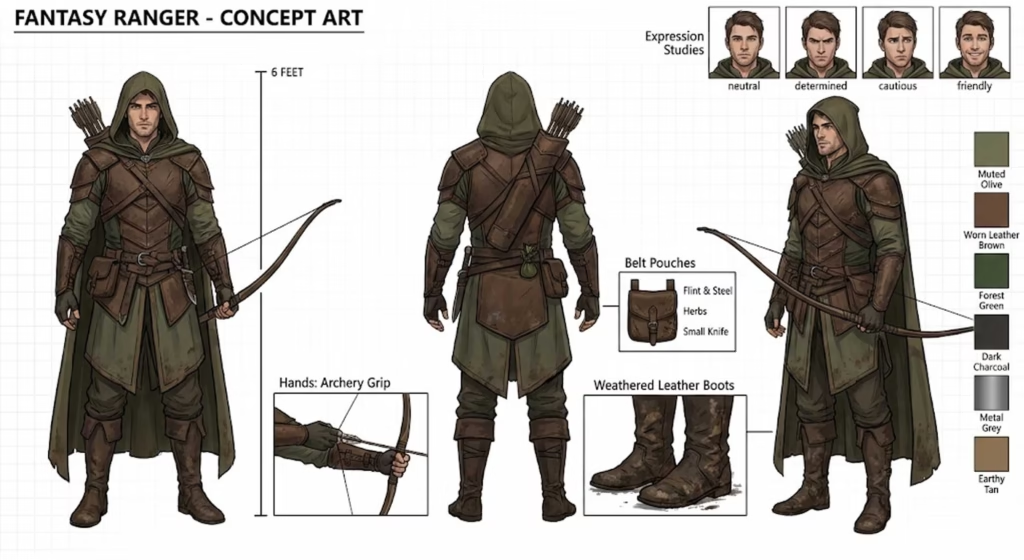
Minimum 10-12 pieces, including:
- 3-4 Full Character Sheets
- Front, back, and 3/4 views minimum
- Expression studies (neutral, happy, angry, determined)
- Height reference against standard human silhouette
- Costume/armor details with material callouts
- Color variations if applicable
- Character Lineup (2-3 pieces)
- 3-5 characters shown together at correct relative scale
- Demonstrates consistency in style and quality
- Shows range (different ages, builds, roles)
- Costume/Design Variations
- Same character in different outfits or armor sets
- Shows iterative design thinking
- Demonstrates understanding of functional costume design
- Environmental Context Shots
- Characters interacting with environment or other characters
- Proves you understand characters beyond floating in white space
- Shows storytelling ability
- Detail Callouts
- Close-ups of hands, faces, accessories
- Material and texture notes
- Shows attention to refinement
Quality Bar: Every piece should be portfolio-worthy. If you’re uncertain, it doesn’t belong. Aim for “I’d proudly show this to anyone” standard.
Environment Artist Portfolio Requirements:
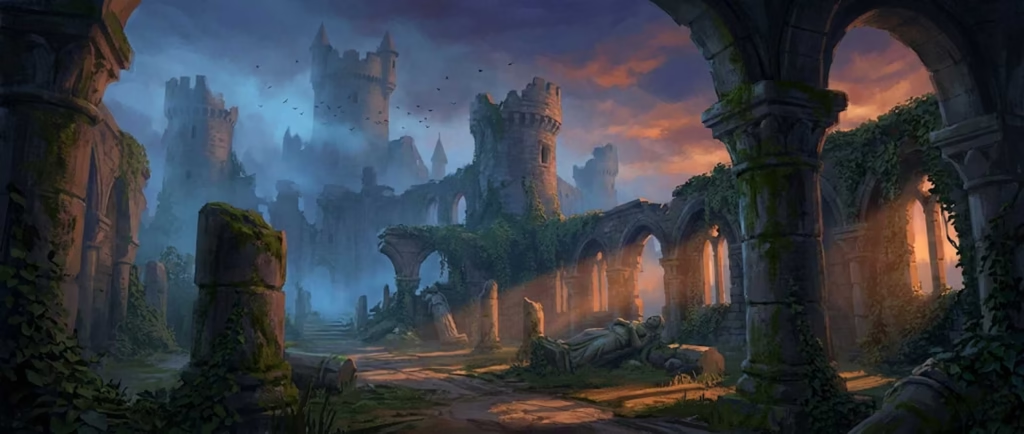
Minimum 8-10 pieces, including:
- 3-5 Establishing Shots
- Wide environment views showing scale and atmosphere
- Clear sense of place (where is this? what’s its purpose?)
- Strong composition and value structure
- Varied settings (fantasy castle, sci-fi city, natural wilderness, etc.)
- 2-3 Detailed Interiors
- Residential, commercial, or unique purpose spaces
- Narrative storytelling through prop placement and details
- Lighting that supports mood
- Architectural logic (spaces feel buildable)
- Architectural Studies
- Building designs from multiple angles
- Shows structural understanding
- Cultural or period-appropriate details
- Time-of-Day/Lighting Variations
- Same location in dawn, noon, dusk, night lighting
- Demonstrates lighting understanding
- Shows versatility in mood creation
- Props in Context
- Environmental objects that populate your spaces
- Shows you understand complete world-building
Pro Tip: Include at least one piece with architectural line work overlay or perspective grid visible. This proves your pretty paintings have structural accuracy.
Platform Strategy: Where to Showcase Your Work
ArtStation (ESSENTIAL)
Why: Industry standard portfolio platform. Recruiters actively search here. Free to use. Optimized for art presentation.
How to Optimize:
- Thumbnails are everything: They determine if people click. Test readability at small size.
- Clear titles: “Dark Fantasy Knight Character Design” beats “Character_Final_v3”
- Descriptions matter: Brief process notes, software used, inspiration. Keep under 100 words.
- Use tags strategically: “character design,” “concept art,” “game art,” plus specific styles
- Update regularly: Active accounts get more visibility in discovery algorithms
- Engage with community: Like, comment on others’ work (genuine engagement, not spam)
Common Mistakes:
- Poor thumbnails (too dark, too busy, unreadable small)
- No descriptions (missed opportunity to explain thinking)
- Inconsistent upload schedule (appears inactive)
- Mixing sketch dumps with portfolio pieces (dilutes quality perception)
Personal Website
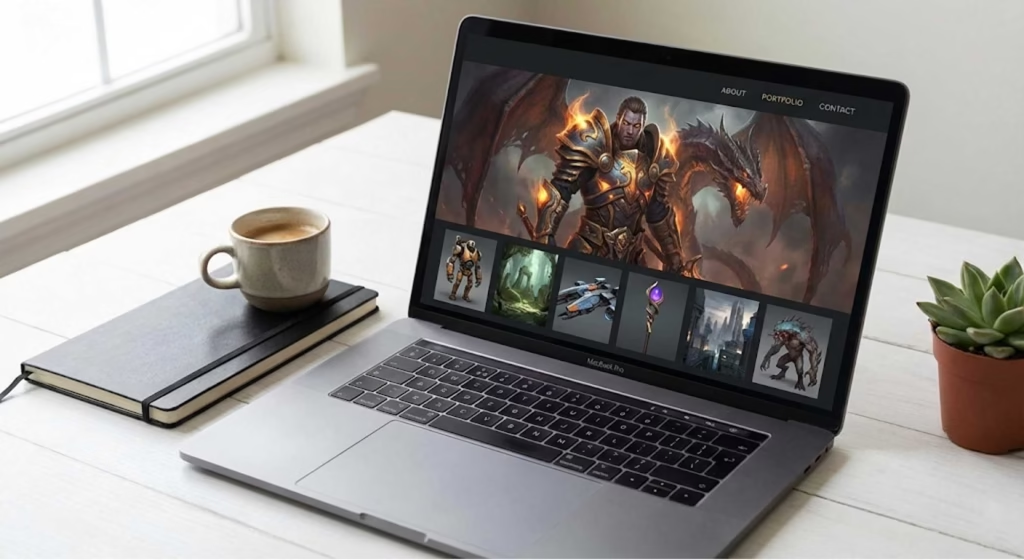
Why: Professional presentation. Full control. Easy URL to share (yourname.com).
Platforms:
- Cargo Collective: Clean, art-focused templates
- Format: Photography/art specific, beautiful templates
- Squarespace: User-friendly, professional looking
- WordPress + portfolio theme: Most control, slightly technical
Must-Haves:
- Your name prominently displayed
- Clear navigation (about, portfolio, contact minimum)
- Contact information visible on every page
- Mobile-responsive (test on phone!)
- Loads quickly (compress images appropriately)
Nice-to-Haves:
- Brief artist statement or about section
- Blog or news section (shows you’re active)
- Resume/CV downloadable
- Links to social media
URL Strategy: YourName.com ideal. If taken, YourNameArt.com or YourNameDesign.com. Avoid cutesy usernames—this is professional portfolio.
Instagram (Community Building)
Why: Largest art community. Great for process posts and building audience.
Strategy:
- Post frequency: 3-5 times per week minimum for growth
- Content mix: 60% finished work, 40% process (sketches, WIPs, breakdowns)
- Stories: Behind-the-scenes, studio setup, art struggles (builds connection)
- Hashtags: Use 15-25 relevant tags (#conceptart, #characterdesign, #gameart, #digitalpainting)
- Engage: Comment genuinely on artists you admire (builds network)
Growth Tips:
- Carousel posts (swipe for process) get higher engagement
- Reels/videos dramatically increase reach
- Consistency matters more than perfection
Twitter/X (Industry Networking)
Why: Many art directors and studio artists active here. Real-time industry conversation.
Strategy:
- Finished pieces: Post with brief description and relevant hashtags
- #conceptart, #gamedev, #PortfolioDay: Use trending art tags
- Engage with professionals: Thoughtful replies (not begging for jobs)
- Threads: Break down process or learnings (highly shareable)
- Don’t just promote: Share others’ work, discuss art topics, participate in community
PortfolioDay: Happens quarterly. Artists worldwide share portfolios with #PortfolioDay tag. Recruiters actively look. Mark your calendar and prepare your best 4 images.
Common Portfolio Mistakes That Kill Your Chances
Including Weak Pieces “to Show Range”
Students often include mediocre work thinking “it shows I can do different things.” Wrong. Every weak piece lowers perception of your entire portfolio.
Rule: If you’re hesitant about a piece, cut it. 8 strong pieces beat 15 mixed pieces every time.
Poor Presentation
Dark, muddy thumbnails. Tiny images. Slow-loading website. Broken navigation. These signal carelessness. If you can’t present your own work professionally, studios won’t trust you with theirs.
Test your portfolio on phone and laptop. Ask friend to navigate it. Fix anything confusing or broken.
No Process Work
Only showing final, polished renders suggests you either traced/copied something or got lucky. Studios want to see thumbnails, iterations, thinking process.
For each final piece, include 2-3 process images: thumbnails, rough development, maybe wireframe for 3D work.
Outdated Work
That piece from 2 years ago might have been your best then, but if your recent work is significantly better, cut the old stuff. Portfolios should show current skill level.
Every 6 months, audit your portfolio. Cut the bottom 20%. Replace with newer, stronger work.
Ignoring Current Industry Trends
You need unique style, but you also need to show awareness of industry aesthetics. If every piece looks like 2010 game art while industry has moved toward stylized diversity, you appear out of touch.
Study current game releases. What’s trending? What are studios actually shipping? Your portfolio should feel contemporary.
Art Dump Syndrome
Posting everything you’ve ever created. 100-piece portfolios with wildly inconsistent quality. This makes you look indecisive and unprofessional.
Curate ruthlessly. 10-15 pieces maximum. Every single one should be “hell yes” quality.
No Contact Information
Sounds basic, but it happens. Beautiful portfolio, no way to reach you. Include email prominently. LinkedIn profile link. Make hiring you easy.
Portfolio Evolution Strategy
Your portfolio isn’t static. It should evolve as you improve.
Year 1: Practice Pieces and Studies
- Focus: Building fundamental skills
- Content: Studies from reference, fan art for practice, early original attempts
- Goal: Complete 20-30 pieces, identify what you enjoy creating
- Public sharing: Maybe on social media for feedback, not formal portfolio
Year 2: Original Concepts and Client Work
- Focus: Developing style and professional presentation
- Content: Original character/environment designs, any freelance work, strong fan art
- Goal: 15-20 portfolio-quality pieces showcasing specialization
- Public sharing: Build ArtStation portfolio, actively share on social media
Year 3: Specialized Portfolio and Professional Presentation
- Focus: Career-ready presentation
- Content: Best 10-15 pieces showing consistent quality and clear specialization
- Goal: Portfolio that gets interviews
- Public sharing: Professional website, active ArtStation, engaged community presence
Regular Maintenance:
- Every 3 months: Create 2-3 new pieces, evaluate if they replace portfolio pieces
- Every 6 months: Cut weakest pieces, add strongest new work
- Annual: Complete portfolio audit, redesign presentation if needed
Key Takeaway: Your portfolio is your career tool. Invest time in curation, presentation, and continuous improvement. Strong portfolios open doors that credentials can’t. Quality over quantity, always. Specialization over generalization. Professional presentation signals career readiness.
Software and Tools: What Professionals Actually Use
Beginners waste thousands of dollars and countless hours on wrong tools. Here’s the definitive guide to essential software for concept artists in 2025.
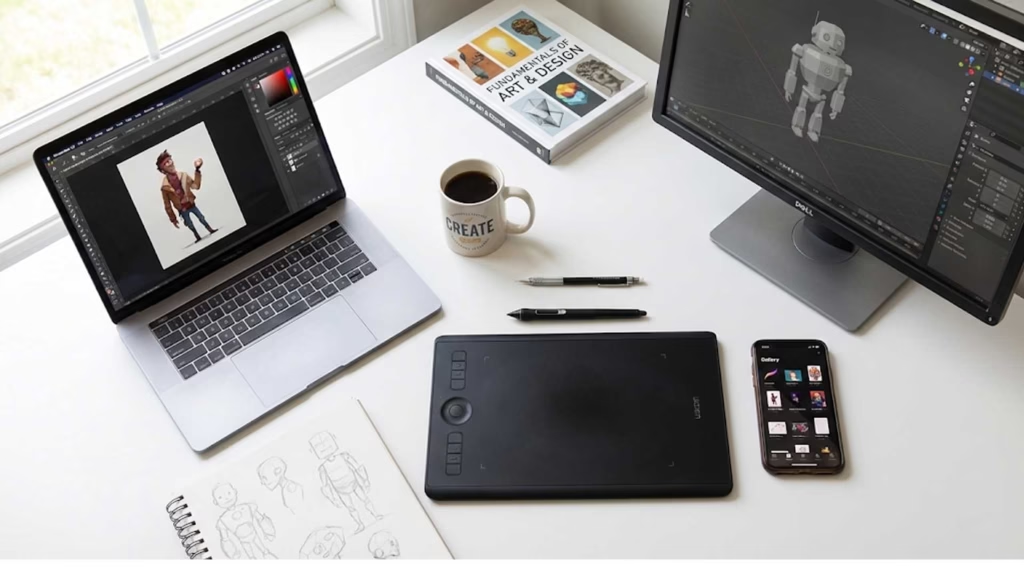
Digital Painting / 2D Concept Art
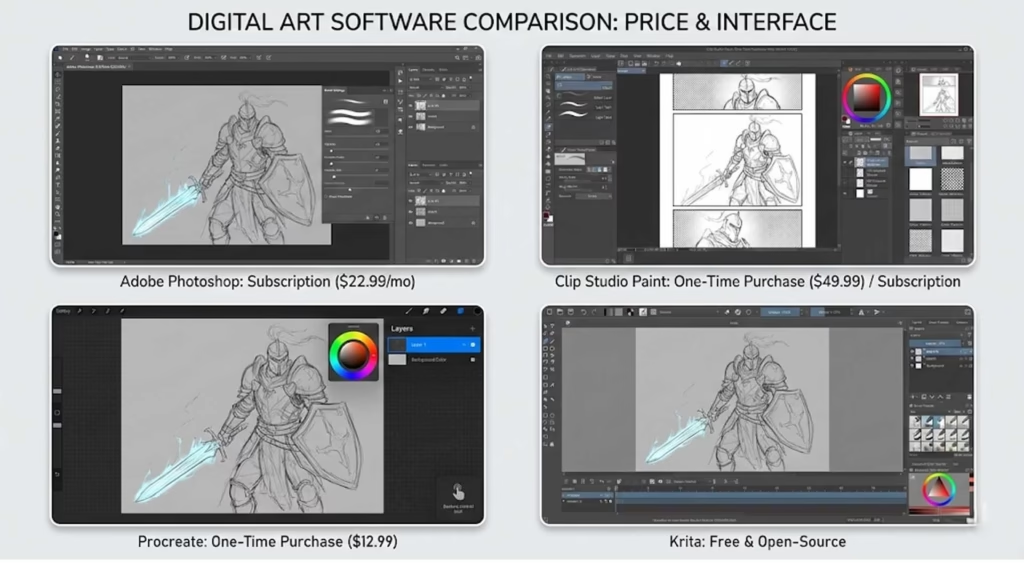
Adobe Photoshop (Industry Standard)
Why It Dominates:
- Most powerful brush engine (customization, pressure sensitivity, blend modes)
- Layer system everyone knows (easy collaboration)
- Industry ubiquity (every studio uses it, so compatibility is guaranteed)
- Extensive plugin ecosystem
- Integration with Adobe suite (Illustrator, After Effects)
Cost: $20.99/month (Photography plan with Lightroom) or $54.99/month (all apps)
Learning Curve: Medium. Interface is dense but intuitive once learned.
When to Choose Photoshop:
- You’re serious about professional career (industry standard matters)
- Can afford subscription ($240-$660/year)
- Need advanced features (adjustment layers, masks, smart objects)
- Want maximum job compatibility
Learning Resources:
- Ctrl+Paint (free basics)
- Aaron Blaise tutorials (YouTube)
- Adobe’s official tutorials
Best For: Professional-track artists, those who can budget $20/month
Clip Studio Paint (Excellent Alternative)
Why Professionals Use It:
- One-time purchase ($49.99)
- Incredible brush engine (equals or exceeds Photoshop for painting)
- Popular in manga/anime industries (powerful inking tools)
- Excellent for character illustration
- 3D reference model support
Cost: $49.99 one-time (frequently on sale for $24.99)
Learning Curve: Medium. Similar to Photoshop but some unique features.
When to Choose CSP:
- Prefer one-time purchase over subscription
- Focus on character illustration or stylized work
- Interested in manga/anime aesthetics
- Want professional results without ongoing costs
Best For: Budget-conscious artists, character specialists, illustration-focused careers
Procreate (iPad Essential)
Why It’s Everywhere:
- Incredibly intuitive interface
- Powerful despite being mobile
- One-time $12.99 purchase
- Perfect for sketching and concepting on-the-go
- Easy time-lapse recording (great for social media)
Cost: $12.99 one-time (iPad only)
Learning Curve: Low. Designed for touch, very user-friendly.
Limitations:
- iPad only (requires hardware investment if you don’t have one)
- Less powerful than desktop software for final production
- Smaller resolution limits (4K max on most iPads)
When to Choose Procreate:
- You have or plan to buy iPad
- Want mobile sketching workflow
- Value intuitive, frustration-free experience
- Use for initial concepts, finish on desktop
Best For: Supplementary tool for artists with iPads, initial concepting, travel/remote sketching
Krita (FREE Powerhouse)
Why It’s Incredible:
- Completely free and open-source
- Genuinely professional-grade features
- Excellent brush engine
- Active development and community
Cost: FREE
Learning Curve: Medium. Interface less polished than paid options but totally usable.
Limitations:
- Smaller community than Adobe (fewer tutorials)
- Some features less refined than paid competitors
- Less industry adoption (studios may not use it)
When to Choose Krita:
- Zero budget
- Want to try digital painting without financial commitment
- Comfortable learning through community forums
- Personal projects or portfolio building
Best For: Students, beginners, anyone with limited budget—completely viable professional tool
3D Modeling / Sculpting
Blender (FREE Game-Changer)
Why It’s Revolutionary:
- Fully featured 3D suite (modeling, sculpting, texturing, rendering, animation)
- Completely free forever (open-source)
- Massive community (millions of users worldwide)
- Used by professionals at studios (not just hobbyists)
- Improving rapidly (2.8+ versions are industry-competitive)
Cost: FREE
Learning Curve: Steep. Interface is unique; lots to learn. But investment pays off.
Capabilities:
- Hard-surface modeling (props, vehicles, architecture)
- Organic sculpting (characters, creatures)
- Texturing and material creation
- Rendering (Eevee real-time, Cycles ray-tracing)
- Animation and rigging
When to Choose Blender:
- You’re learning 3D for the first time (free means low-risk)
- Want complete 3D toolset
- Personal projects or portfolio work
- Can invest time in learning curve
Learning Resources:
- Blender Guru (donut tutorial—start here!)
- Grant Abbitt (beginner-friendly)
- CG Cookie (paid courses)
- Blender manual (comprehensive documentation)
Industry Reality: Studios use Maya/3ds Max/ZBrush, but increasingly accept Blender. For portfolio work and freelance, Blender is 100% viable. Learn Blender, studios will train on Maya if hired.
Best For: Everyone learning 3D. Free, powerful, future-proof skill.
ZBrush (Sculpting Specialist)
Why Sculptors Love It:
- Industry standard for character/creature sculpting
- Handles millions of polygons smoothly
- Unique tools (DynaMesh, ZRemesher) are unmatched
- Every AAA character artist uses it
Cost: $39.95/month or $895 perpetual license
Learning Curve: High. Interface is unlike any other software (quirky but powerful).
When to Choose ZBrush:
- Specializing in character/creature art
- Already have 3D foundation (learn Blender first)
- Can afford subscription or save for license
- Pursuing AAA character artist career
When to Skip ZBrush:
- Just starting 3D (learn Blender first; it has sculpting too)
- Environment artist (less critical for your work)
- Can’t afford it yet (Blender sculpting is quite good)
Best For: Character artists ready to specialize, those pursuing AAA studio positions
Maya / 3ds Max (Studio Standards)
Why They’re Industry Standard:
- Decades of studio pipelines built around them
- Powerful but specialized (modeling, animation, effects)
- Extensive plugin ecosystems
- Industry training infrastructure
Cost: $235/month or $1,875/year (student versions free)
Reality Check: Studios provide these for employees. Don’t buy them as student unless you have free student license.
Strategy: Learn Blender for personal work. If hired at studio using Maya/Max, your Blender skills transfer—studios will train on their specific tools.
Best For: Students with free edu licenses, professionals at studios providing software
Essential Supporting Tools
PureRef (FREE Reference Management)
What It Does: Infinite canvas for organizing reference images while you work.
Why You Need It: Concept art requires constant reference. PureRef lets you dump dozens of images on screen, resize, arrange, zoom—all while working in Photoshop/Blender.
Cost: FREE (pay-what-you-want)
Download: puref.com
Usage: Keep open on second monitor or alongside your art software. Drag images from browser directly.
Additional Useful Tools:
- Lazy Nezumi Pro ($35): Photoshop plugin for smooth line work
- Substance Painter ($20/month): Texturing 3D models (industry standard)
- Marmoset Toolbag ($199): Real-time rendering for portfolio presentation
- Kuadro ($10): Reference pose tool with 3D models
The Minimal Viable Free Stack
You can build professional portfolio with zero software cost:
- 2D Painting: Krita (FREE)
- 3D Modeling: Blender (FREE)
- Reference: PureRef (FREE)
- Learning: YouTube tutorials (FREE)
- Community: Reddit, Discord (FREE)
Total Cost: $0
Add affordable drawing tablet ($40-$80 for Huion/XP-Pen entry models), you have complete professional setup for under $100.
When to Invest in Paid Tools
Don’t overspend early. Free alternatives work great for learning and portfolio building.
Invest when:
- Free tool becomes productivity bottleneck (outgrew Krita’s features, need Photoshop’s advanced tools)
- Studio job requires it (they’ll often provide licenses)
- Specific paid tool dramatically improves workflow (ZBrush for character sculpting)
- Freelance clients expect certain software (PSD files, etc.)
Recommended Spending Priority:
- Quality drawing tablet ($200-$400 Wacom Intuos or Huion Kamvas)
- Your interface with digital art—invest here first
- Adobe Creative Cloud ($240/year if pursuing professional career)
- Industry standard matters for collaboration
- Online courses/mentorship ($500-$2,000)
- Knowledge compounds; invest in learning
- Specialized software (ZBrush, Substance, etc.)
- Only when specific need arises
Hardware Recommendations
Drawing Tablet:
Beginner ($40-$120):
- Huion H610 Pro ($40): Basic, functional, good starter
- XP-Pen Deco 01 V2 ($60): Slight upgrade, tilt sensitivity
- Wacom Intuos Small ($80): Brand reliability, good drivers
Intermediate ($200-$400):
- Wacom Intuos Pro Medium ($280): Professional-grade, excellent pen
- Huion Kamvas 13 ($240): Screen tablet at non-screen price
Professional ($1,000+):
- Wacom Cintiq 16 ($650): Industry standard screen tablet
- iPad Pro + Apple Pencil ($800-$1,200): Mobile powerhouse
Don’t Buy Expensive Initially: Beginners don’t need Cintiqs. A $60 Huion works for learning fundamentals. Upgrade when skill justifies investment.
Computer Requirements:
Minimum Viable:
- Mid-range gaming PC ($600-$800)
- M1 MacBook Air ($999)
- 8GB RAM (16GB better)
- Dedicated GPU helpful but not required for 2D
You Don’t Need:
- Top-end gaming rig
- Latest Mac Pro
- 64GB RAM
Concept art is less demanding than 3D animation or video editing. Moderate hardware runs Photoshop and Blender fine.
Key Takeaway: Free tools (Krita, Blender) are genuinely professional-grade. Expensive software doesn’t make you better artist—skills do. Start free, invest strategically as needs clarify. Drawing tablet quality matters more than software cost.
The Business Side: Salaries, Job Markets, and Career Progression
Artistic passion must align with financial reality. Here’s an honest breakdown of what to expect when pursuing concept art professionally.
Realistic Salary Expectations (2025 Data)
Salaries vary by experience, location, studio size, and role. These ranges reflect United States markets (California, Washington, Texas, New York primarily) in 2025:
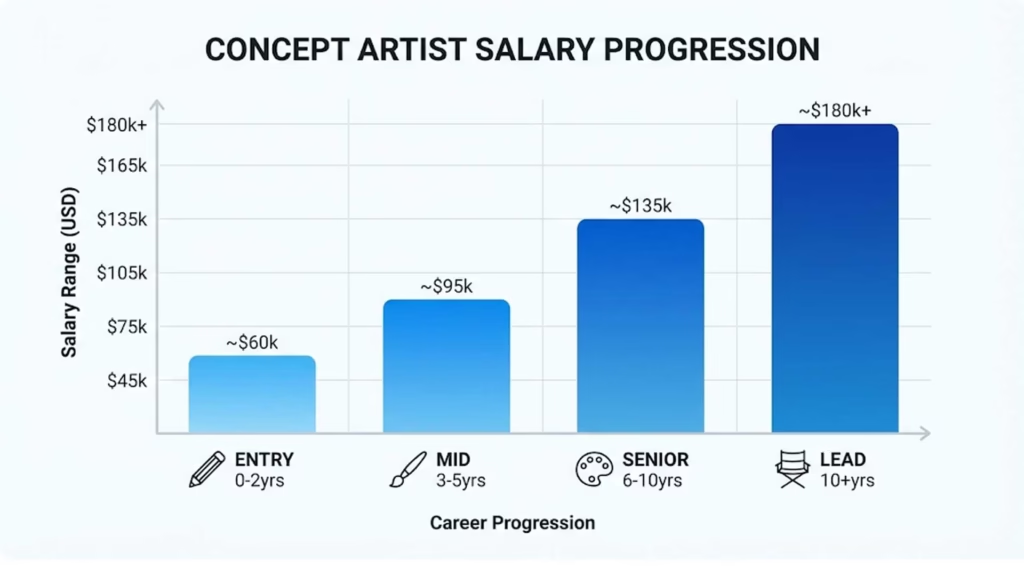
Entry-Level Concept Artist (0-2 years experience):
- Range: $45,000-$65,000 annually
- Median: ~$55,000
- Factors: Studio size (indie vs. AAA), location (SF/LA higher), specialization
- Reality: Living wage in most markets but not luxurious, especially in high-cost cities
Mid-Level Concept Artist (3-5 years experience):
- Range: $65,000-$95,000 annually
- Median: ~$78,000
- Growth: Proven track record, shipped titles, specialized skills command premium
- Reality: Comfortable middle-class income, can support family in moderate cost-of-living areas
Senior Concept Artist (6-10 years experience):
- Range: $90,000-$130,000 annually
- Median: ~$105,000
- Expertise: Deep specialization, mentorship abilities, art direction input
- Reality: Upper-middle-class income, stable career plateau if not pursuing leadership
Lead Concept Artist / Art Director (10+ years experience):
- Range: $120,000-$180,000+ annually
- Median: ~$145,000
- Responsibilities: Team leadership, visual target setting, cross-department collaboration
- Reality: High income, but demanding role (management, deadlines, pressure)
Geographic Salary Variations (2025):
- San Francisco Bay Area: +20-30% above base (but housing costs +100-150%)
- Los Angeles: +15-25% above base (entertainment industry hub)
- Seattle: +10-20% above base (Microsoft, Amazon, Nintendo of America)
- Austin, TX: Base to +10% (growing game dev hub, moderate cost of living)
- Remote positions: Typically -5 to -15% but location arbitrage possible
Cost-of-Living Adjusted Reality: $65,000 in Austin, Texas ≈ $95,000 in San Francisco in purchasing power. Factor this when evaluating offers.
Sources: Bureau of Labor Statistics (Multimedia Artists category), Glassdoor, Indeed, Gamasutra salary surveys
Freelance vs. Studio Employment
Both paths are viable. Most artists experience both across careers.
Studio Employment
Pros:
- Stable income: Predictable biweekly/monthly paychecks
- Benefits: Health insurance, 401k, paid vacation, sick leave
- Team collaboration: Learn from peers, art directors, experienced artists
- Portfolio work: Shipped titles carry weight (“Worked on God of War“)
- Professional development: Studios often provide training, conference attendance
- Equipment provided: Software licenses, hardware, office space
Cons:
- Less creative control: You execute art director’s vision, not yours
- Possible crunch: Game industry notorious for overtime before ship dates
- Relocation: Best opportunities often require moving to expensive cities
- Corporate structure: Meetings, bureaucracy, politics
- IP ownership: Your work belongs to studio
Typical Studio Trajectory:
- Junior Artist (2-3 years)
- Artist (2-4 years)
- Senior Artist (3-5 years)
- Lead Artist or Art Director (ongoing)
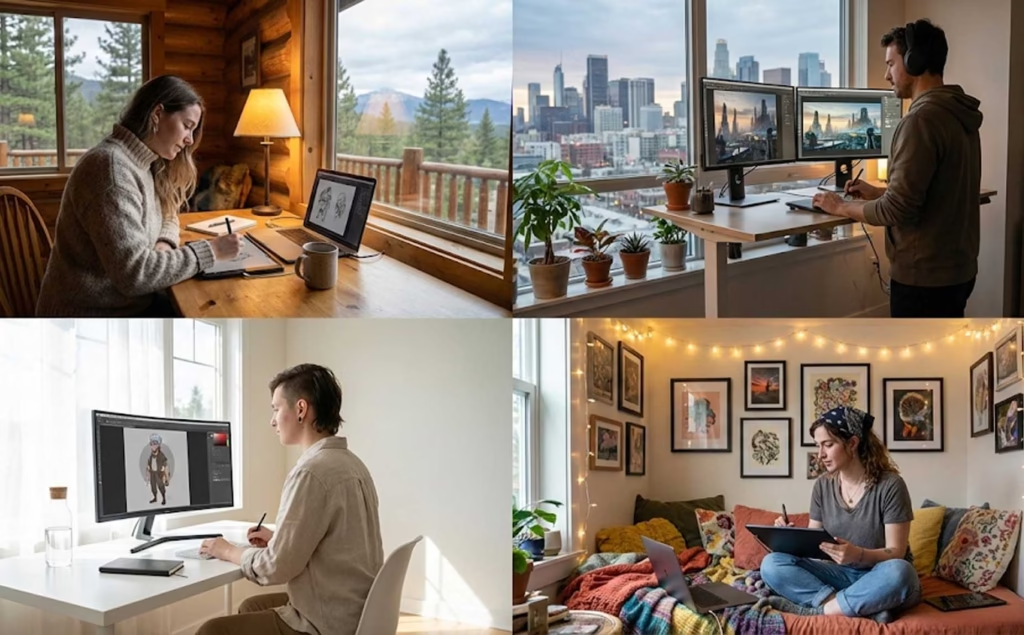
Freelance Employment
Pros:
- Flexible schedule: Work when/where you want
- Project variety: Different games, styles, clients
- Remote work: Location independence
- Higher hourly rate: $50-$150/hour vs. $30-$50/hour equivalent salary
- Tax deductions: Home office, equipment, software
- Creative control: Choose projects aligning with interests
Cons:
- Inconsistent income: Feast or famine cycles
- No benefits: Self-fund health insurance, retirement, vacation
- Self-promotion required: Constantly marketing yourself
- Isolation: Working alone without team feedback
- Administrative burden: Invoicing, taxes, contracts, client management
- Slower career growth: Harder to level up skills without mentorship
Freelance Rate Ranges (2025):
- Beginner: $25-$50/hour
- Intermediate: $50-$100/hour
- Experienced: $100-$150/hour
- Expert/Specialist: $150-$250+/hour
Freelance Annual Income Reality:
- Sustainable hours: ~20-25 billable hours/week (rest is admin, marketing, downtime)
- At $75/hour average: $75,000-$93,750 annual
- Overhead costs: ~20-30% (health insurance, software, taxes, equipment)
- Net income: Similar to $60,000-$70,000 salaried position
Hybrid Approach (Common): Many artists start studio → build reputation → transition partial/full freelance. Or freelance → studio for stability → back to freelance with savings cushion.
Career Progression Paths
Your career isn’t linear. Multiple paths exist depending on interests and strengths.
Path 1: Artist → Lead → Art Director
Timeline: 8-12 years to director level
Progression:
- Junior/Mid Artist (0-5 years): Execution focus, building skills
- Senior Artist (5-8 years): Mentoring juniors, owning sections (all characters, specific environments)
- Lead Artist (8-12 years): Team coordination, quality control, style consistency
- Art Director (12+ years): Vision setting, cross-department collaboration, final creative decisions
Skills Beyond Art:
- Team management and mentorship
- Communication with non-artists (producers, engineers, executives)
- Balancing creative vision with practical constraints (budget, timeline, tech limits)
- Handling criticism and feedback constructively
Salary Ceiling: $150,000-$200,000+ as Art Director
Lifestyle: More meetings, less hands-on art creation. Leadership is different job than artist—not everyone wants it.
Path 2: Specialist → Senior Specialist → Independent Consultant
Timeline: 5-8 years to senior specialist, 10+ to independent consultant
Progression:
- Generalist Artist (0-3 years): Broad skill foundation
- Specialist (3-5 years): Deep expertise (character, environments, specific style)
- Senior Specialist (5-10 years): Go-to expert for specific art needs
- Independent Consultant (10+ years): Hire out specialized expertise, possibly teaching
Skills Required:
- Deep mastery of specific niche (hyperrealistic characters, stylized environments, creature design)
- Efficiency through expertise (deliver faster, better than generalists)
- Building personal brand (known for specific thing)
- Eventually business/marketing skills for consulting
Salary Ceiling: $120,000-$180,000 as senior specialist in studio; variable as consultant ($100-$300/hour rates)
Lifestyle: Focus remains on creating art, not managing people. Can work as staff artist or freelance specialist.
Path 3: Generalist → Indie Developer → Studio Founder
Timeline: Variable, typically 5-10+ years
Progression:
- Artist at Studio (3-5 years): Learn pipelines, ship games, build skills
- Side Projects/Game Jams (ongoing): Develop game design sensibilities
- Indie Developer (solo or small team): Create and ship own games
- Studio Founder (if successful): Build team, create multiple titles
Skills Required:
- Multi-discipline (art, some design, basic tech understanding)
- Business acumen (marketing, finance, project management)
- Risk tolerance (income uncertainty)
- Game design understanding (art serves gameplay)
Income Reality:
- High risk, high reward: Most indie games fail financially
- Success cases: Stardew Valley, Hollow Knight, Hades made millions
- Median case: Break even or small profit
- Backup plan: Freelance while developing
Salary Ceiling: Unlimited (equity-based), but most indie developers earn less than studio salaries
Lifestyle: Complete creative control, enormous stress, irregular income
Market Realities: Saturation vs. Opportunity
Reality Check: Competition at entry level is intense. Major studio positions receive 200-500 applications.
Oversaturated Areas:
- Junior generalist positions at AAA studios in Los Angeles/SF
- Everyone wants Riot/Blizzard/Naughty Dog
- These require exceptional portfolios + networking
- “Character artist” with no specialization
- Thousands of portfolio sites with generic fantasy characters
- Differentiation difficult without style niche
Undersaturated Opportunities:
- Senior artists / Art directors
- Industry can’t train these fast enough
- 5-10 years experience creates qualification barrier
- Technical artists
- Requires art + programming hybrid skills
- Far fewer candidates, higher pay
- Specialized styles (pixel art, hand-drawn, specific cultural aesthetics)
- Niche expertise commands premium
- Less competition in specific lanes
Growing Markets Creating Opportunity:
- Mobile gaming: Expanding globally, thousands of studios
- VR/AR: Emerging platforms need content
- Indie contracting: Explosion of small studios needing freelance help
- Educational content: Online courses, YouTube, Patreon teaching
- NFT/Web3 art: Controversial but growing revenue stream
Strategic Positioning: Instead of competing for 500-applicant Blizzard position, target:
- Mid-size studios (50-200 employees) with less name recognition
- Mobile game companies (exploding market)
- Indie studios needing contract help
- Educational companies creating game-related content
- Related industries (animation, VR, film previs)
Geographic Arbitrage: Living in lower-cost area while working remotely for higher-paying markets. $75,000 salary goes much further in Austin or remote than in San Francisco.
Geographic Considerations
Top Game Development Markets (2025):
California (Los Angeles, San Francisco, San Diego):
- Studios: Riot, Blizzard, Naughty Dog, Insomniac, countless others
- Pros: Highest concentration of studios, networking opportunities, industry events
- Cons: Extremely high cost of living, competitive, expensive housing
- Average rent: $2,500-$3,500 for 1-bedroom
Washington (Seattle, Redmond):
- Studios: Microsoft/Xbox, Nintendo of America, Bungie, PopCap
- Pros: Strong industry presence, better cost-of-living than CA, no state income tax
- Cons: Still expensive housing, rainy weather
- Average rent: $1,800-$2,500 for 1-bedroom
Texas (Austin, Dallas):
- Studios: Gearbox, Retro Studios, growing indie scene
- Pros: Lower cost-of-living, no state income tax, growing industry
- Cons: Smaller industry than CA/WA, fewer major studios
- Average rent: $1,200-$1,800 for 1-bedroom
Canada (Montreal, Toronto, Vancouver):
- Studios: Ubisoft, BioWare, EA, huge industry supported by tax incentives
- Pros: Robust industry, more affordable than US coastal cities, quality of life
- Cons: Immigration requirements for Americans, CAD salaries lower than USD
- Average rent: CAD $1,500-$2,200 for 1-bedroom
Remote Work Revolution:
Post-COVID, many studios hire remotely. Geographic location matters less if you can work from anywhere.
Advantages:
- Live in low cost-of-living area, earn coastal salary
- Work for studios globally
- Lifestyle flexibility (near family, preferred climate, etc.)
Considerations:
- Some studios require occasional office visits
- Time zone coordination for meetings
- Home office setup costs
- Isolation from team
International Opportunities:
- Europe: Ubisoft (France), CD Projekt Red (Poland), Remedy (Finland)
- Asia: Mobile gaming explosion (China, South Korea, Japan)
- Remote culture: Many studios now hire globally for remote positions
Key Takeaway: Concept art is viable middle-class career with 6-figure ceiling for experienced artists. Entry is competitive but opportunities exist for specialists and those targeting growing markets. Geographic flexibility through remote work expands possibilities. Understand financial realities before pursuing—this isn’t get-rich-quick, but it’s sustainable creative career.
Modern Context: How Gaming Culture Continues to Shape the Profession
The industry isn’t static. Understanding current trends shows how gaming continues to inspire and influence concept art in 2025.
The Indie Game Renaissance and Career Opportunities
When Eric Barone (ConcernedApe) single-handedly created Stardew Valley and sold 20+ million copies, he proved small teams could compete commercially with AAA studios. When Team Cherry’s three-person studio released Hollow Knight to critical and commercial success, the blueprint was clear: unique art direction sells games.
The indie boom of the 2010s-2020s fundamentally changed concept art careers.
How Indie Games Changed the Market:
Stylistic Experimentation Became Commercially Viable
Cuphead‘s hand-drawn 1930s animation. Hades‘ bold comic book aesthetic. Celeste‘s precision pixel art. Each proved you don’t need photorealism to move millions of units. This created demand for artists with specialized, distinctive styles.
Solo and Small-Team Development
Accessible tools (Unity, Unreal, Blender—all free or affordable) mean individuals or tiny teams create professional-quality games. These developers hire freelance concept artists for specific needs: character sheet, environment concepts, UI mockups.
Career Opportunity: Thousands of indie studios worldwide need contract artists. One artist described it: “I work with 5-8 indie studios yearly, creating character lineups, key art, promotional illustrations. They can’t afford full-time artists but budget $2,000-$10,000 for concept packages. It’s sustainable income serving passionate developers.”
Kickstarter and Crowdfunding
Compelling visual concept art sells game ideas to backers. Beautiful character designs and environment paintings in campaigns directly convert to funding. This creates pre-production freelance opportunities—getting paid to create concepts for pitches.
Case Study – Hollow Knight’s Influence:
After Hollow Knight‘s success, demand exploded for “Hollow Knight-style” art—hand-drawn, gothic, insect-themed, watercolor textures. Artists who could authentically work in that aesthetic found steady contracts. This pattern repeats: successful indie game creates aesthetic niche, artists specializing in that niche get hired for similar projects.
Strategic Takeaway: Don’t just study AAA games. Indie titles showcase diverse aesthetics and prove small-team viability. Developing unique indie-friendly style can be more valuable than generic AAA photorealism.
Social Media as Portfolio and Community
ArtStation hosts 10+ million artist portfolios. Instagram has hundreds of millions of #art posts. Twitter/X connects artists and recruiters globally. Social media fundamentally changed how concept artists build careers.
Instagram Strategy for Artists:
What Works in 2025:
- Carousel posts (swipe for process) get 3-5x engagement of single images
- Reels/short videos dramatically increase reach (algorithm prioritizes video)
- Consistency (3-5 posts weekly) beats sporadic high-quality drops
- Process content (sketches, WIPs, time-lapses) builds audience investment
- Authentic storytelling (struggles, breakthroughs, journey) creates connection
Growth Examples:
Artist Loish (400,000+ followers) built audience by posting process videos and engaging genuinely with community. When she releases tutorial courses or books, existing audience converts to customers. Social following became business asset.
Concept artist Dao Trong Le posts daily sketches and studies. His 150,000+ Instagram followers include recruiters who’ve hired him for contracts without formal applications. Portfolio visibility replaces cold job applications.
TikTok for Artists:
Short-form video art content (time-lapses, before/afters, technique demonstrations) can reach millions. Several artists have been discovered by studios through viral TikTok art videos.
Twitter/X for Industry Networking:
Many art directors, studio artists, and recruiters actively use Twitter. Thoughtful engagement (not spamming with portfolio links) builds genuine connections.
#PortfolioDay (quarterly): Artists worldwide share portfolios. Recruiters explicitly look for talent. Mark calendar: February, May, August, November typically.
Discord Communities:
Real-time learning and feedback. Popular art Discords (Cubebrush, Ctrl+Paint community, various studio Discords) provide:
- Daily feedback on work-in-progress
- Accountability partners for challenges
- Direct access to professional artists
- Job leads and opportunities shared
Strategic Reality: Social media isn’t optional anymore—it’s portfolio distribution, professional networking, and community learning combined. You don’t need millions of followers, but active presence helps careers.
AI Tools and the Evolving Profession
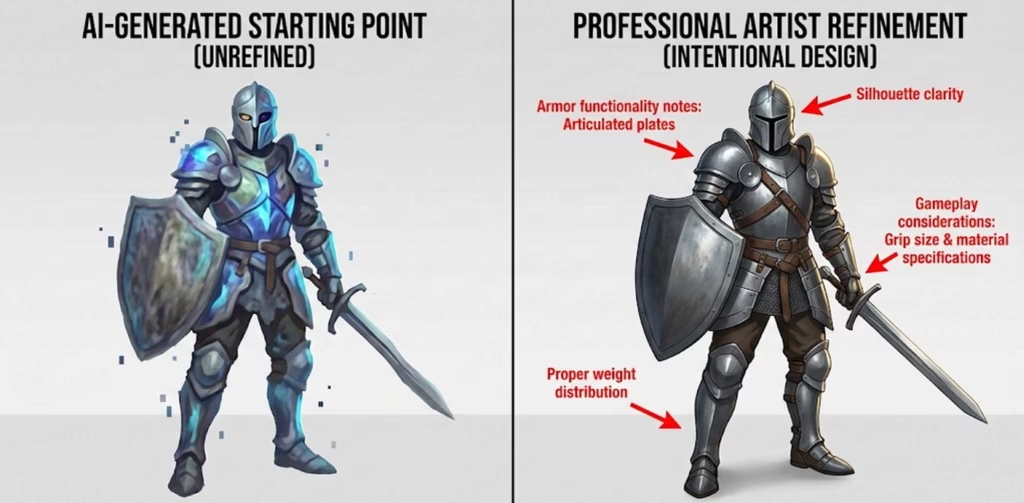
The elephant in the room: How do tools like Midjourney, DALL-E 3, and Stable Diffusion affect concept art careers?
Honest Industry Assessment (2025):
What AI Does Well:
- Rapid ideation and brainstorming (generate 20 variations in minutes)
- Reference material creation (specific poses, lighting scenarios)
- Composition exploration (“show me 10 different layouts for this scene”)
- Placeholder art during prototyping
- Texture and pattern generation
What AI Can’t Do (Yet):
- Intentional design choices based on gameplay needs
- Iteration based on nuanced art director feedback
- Technical specifications for 3D modeling teams
- Consistent character turnarounds (maintaining exact design across poses)
- Cultural authenticity and research-driven design
- Art direction (understanding why choices matter)
Industry Reality Check:
Some studios experiment with AI-assisted workflows. A lead artist at major AAA studio: “We tried using Midjourney for environment concepting. It generated pretty images but couldn’t hit specific technical requirements—door placement for gameplay, scale consistency, architectural logic. AI became reference generator, not replacement for concept artists.”
Another perspective from indie developer: “AI helped us prototype ideas quickly when budget couldn’t support concept artist during early development. Once funded, we hired proper artist because AI couldn’t iterate based on our feedback or understand our design intent.”
Career Implications:
Skills That Matter More Now:
- Artistic judgment: Why does this design work for this game?
- Iterative refinement: Taking feedback and solving specific problems
- Technical implementation knowledge: Designing for actual production pipelines
- Style consistency: Maintaining coherent aesthetic across many assets
- Cultural research: Authentic representation AI can’t replicate
AI as Tool, Not Replacement:
Forward-thinking artists embrace AI tools as part of workflow:
- Use AI for quick reference or ideation
- Refine AI output with human artistic judgment
- Paintover AI generations to meet technical requirements
- Focus energy on high-value design decisions vs. mechanical execution
Historical Parallel:
When Photoshop democratized digital art in the 1990s, traditional painters feared obsolescence. Reality: Digital tools expanded opportunities. More artists could create more work faster. The industry grew.
AI may follow similar pattern—expand what’s possible rather than eliminate careers. But artists must adapt, not deny technology exists.
Controversial Opinion from Working Artist:
“Artists who refuse to touch AI tools will be at disadvantage, similar to painters who refused to learn Photoshop in 2000s. But artists who only use AI without foundational skills will also fail. The sweet spot: Strong fundamentals + strategic AI adoption. That’s who thrives.”
Strategic Advice:
- Master fundamentals first (AI can’t replace what you don’t have)
- Experiment with AI tools (understand capabilities and limitations)
- Focus on irreplaceable skills (judgment, taste, technical knowledge, iteration)
- Stay informed (technology evolves; don’t bury head in sand)
- Emphasize human value (research, cultural authenticity, artistic intent)
Streaming and Content Creation
Artists building audiences through streaming (Twitch), YouTube tutorials, or Patreon supporter models create income diversification.
Example Model:
Primary income: Freelance concept art ($60,000/year) Secondary income: YouTube tutorials with sponsorships ($15,000/year) Tertiary income: Patreon supporters for process videos ($8,000/year) Total: $83,000 diversified income, less vulnerable to client dry spells
Artists like Ahmed Aldoori, Ross Draws, and BaM Animation built successful YouTube channels teaching art while maintaining professional careers. Teaching reinforces learning and creates alternate revenue.
Considerations:
- Content creation is separate skill requiring time investment
- Not every artist enjoys teaching or camera presence
- Can supplement income but rarely replaces it entirely
- Builds personal brand valuable for freelancing
Representation and Diverse Voices
Gaming demographics have diversified dramatically. 45% of gamers identify as female (ESA 2023). Gaming is global—China, South Korea, Brazil, India are massive markets. Players demand representation in characters they control and worlds they explore.
This creates opportunity for artists from diverse backgrounds.
Industry Needs:
Authentic cultural representation: Games set in real-world locations need artists familiar with architectural styles, fashion, cultural details. Example: Ghost of Tsushima’s success partly attributed to authentic Japanese cultural consultation.
Diverse character design: Moving beyond “default male protagonist.” Games like Spider-Verse proved diverse casts and art styles resonate commercially.
Underrepresented aesthetics: African textile patterns, South Asian architecture, Indigenous art traditions—vast visual languages underrepresented in gaming offer differentiation.
Career Advantage:
Your unique cultural perspective is asset, not liability. Studios increasingly recognize homogeneous teams create limited visions. Authentic diverse voices make games better and more marketable globally.
Artist who specializes in Afrofuturistic character design: “I worried my specific style was too niche. Turns out studios desperate for artists who can authentically design Black characters beyond stereotypes. My background is my competitive advantage.”
Key Takeaway: Modern gaming culture—indie diversity, social media visibility, AI tools, content creation opportunities, demand for representation—continuously reshapes concept art careers. Stay adaptable, embrace changes strategically, and leverage cultural authenticity as strength.
Navigating Your First Job: From Application to Offer
You’ve built portfolio, learned software, developed skills. Now what? Getting from portfolio to employed involves demystifying professional aspects artists often struggle with.
Where to Find Jobs
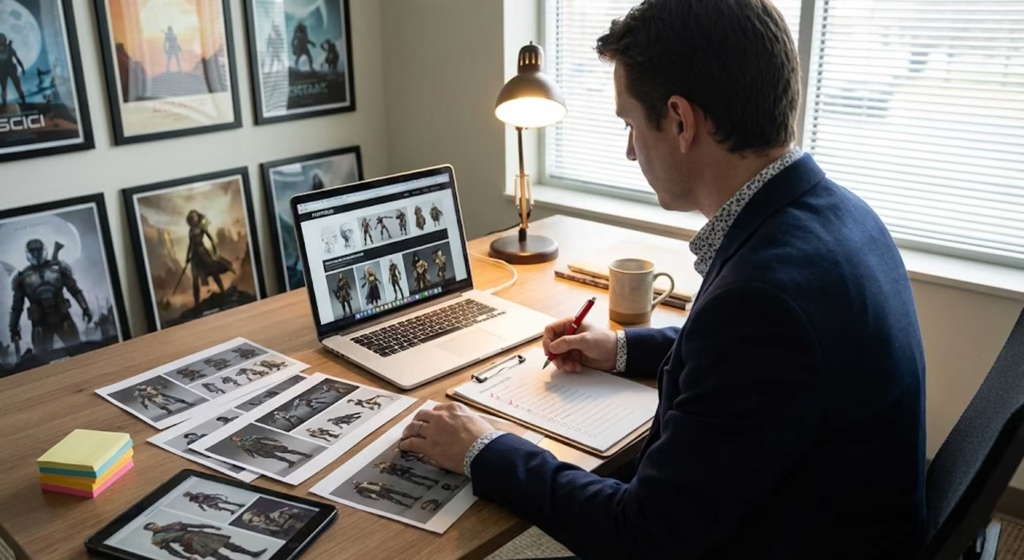
ArtStation Jobs (artstation.com/jobs)
- Industry-specific job board
- Filter by role (concept artist), location, studio
- Direct application links
- Most legitimate game industry postings
LinkedIn
- Network with industry professionals
- Many studios post jobs here
- Recruiters actively search for artists
- Set profile to “open to opportunities”
Company Websites Directly
- Riot Games, Blizzard, Ubisoft, Epic, EA all have career pages
- Apply directly rather than through third-party aggregators
- Shows genuine interest in specific studio
Game Dev Communities
- r/gameDevClassifieds (Reddit): Indie projects seeking artists
- IGDA (International Game Developers Association): Job boards and networking
- Local game dev meetups: Many cities have monthly gatherings
Networking Events
- GDC (Game Developers Conference): Industry’s largest gathering
- PAX (Penny Arcade Expo): Mix of consumer and professional
- Local game jams: Meet developers, showcase skills
- Portfolio review events: Many conventions offer these
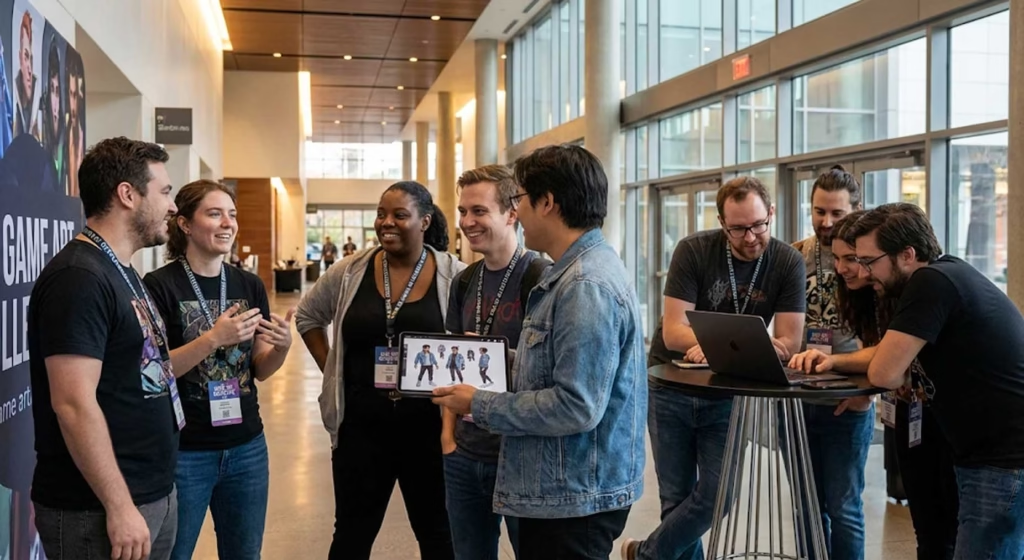
Cold Outreach (Strategic, Not Spam)
- Research artists at studios you admire
- DM on Twitter with thoughtful message (not “hire me”)
- Ask for portfolio feedback or career advice
- Build genuine connection—jobs follow relationships
Crafting Applications That Stand Out
Most applications get 10-30 seconds of attention. Make them count.
Portfolio Link FIRST
Don’t bury it in third paragraph. First line of email/cover letter should be:
“Portfolio: [yourname.com/portfolio]”
Everything else is secondary to your work. Make accessing it frictionless.
Tailored Cover Letter (3-4 Paragraphs Max)
Bad Cover Letter: “To whom it may concern, I am applying for concept artist position. I am passionate artist with strong skills. Please review my portfolio. Thank you.”
Generic. Boring. Shows zero research or genuine interest.
Good Cover Letter:
“Hi [Hiring Manager’s Name],
I’m applying for the Character Concept Artist position at [Studio]. I’ve followed [Studio’s latest game] development and love how your character designs balance stylization with readable silhouettes—exactly the aesthetic approach I specialize in.
My portfolio ([link]) focuses on stylized character design with emphasis on costume variation and personality conveyance. I’m particularly proud of [specific piece], which demonstrates [specific skill relevant to job posting].
I’d love opportunity to contribute to your team. Happy to discuss my work or provide additional samples tailored to your current projects.
Best, [Your Name] [Email] [Portfolio Link Again]”
What Makes It Work:
- Addresses specific person (researched who’s hiring)
- References studio’s actual game (proves you know their work)
- Connects portfolio to their needs
- Professional but personable
- Concise (they’re busy)
- Portfolio link appears twice
Resume Specifics:
Keep to one page. Include:
- Name and contact info prominently
- Portfolio link (again!)
- Relevant experience (freelance work counts)
- Software proficiencies
- Education (but portfolio matters more)
- Shipped titles if any (even small roles on published games)
Showcase Relevant Work:
If applying to stylized mobile game studio, emphasize stylized pieces. Applying to AAA realistic game? Lead with photorealistic work. Tailor portfolio presentation to job requirements.
The Art Test (Common Hiring Step)
Many studios assign art tests—paid or unpaid assignments demonstrating ability.
What It Is:
Studio provides brief: “Design a ranger character for our fantasy game. Focus on practical gear, earth-tone palette, ages 25-35.”
You have 3-7 days to create concept art meeting specifications.
What They Evaluate:
- Following directions: Did you meet brief requirements?
- Technical skill: Is execution professional quality?
- Design thinking: Did you explore variations or go with first idea?
- Communication: Can you explain choices?
- Fit: Would your work integrate with their style?
How to Approach:
- Clarify expectations immediately: Ask questions if brief is vague. Better than guessing wrong.
- Do genuine exploration: Don’t submit first sketch. Create thumbnails, explore multiple directions, refine chosen design.
- Submit process work: Show thumbnails, iterations, design evolution. Proves you didn’t trace something.
- Explain your thinking: Brief write-up: “I emphasized practical pouches and layered clothing for functional wilderness design. Earthy palette reflects nature connection. Avoided bright colors to maintain stealth capability.”
- Meet deadline: If you need more time, ask early. Missing deadline = auto-rejection.
Red Flags (Unethical Art Tests):
- Unrealistic timeline (24 hours for complex piece)
- No feedback after test submission (using your work without hiring)
- Highly specific to current project (suspicious they’ll use your design)
- Unpaid test for junior positions at established studios (spec work exploitation)
Ethical Standard: Studios should provide feedback regardless of hiring decision. If they ghost after art test, research that company’s reputation (Glassdoor, artist communities).
Interview Preparation
Congratulations—portfolio passed, they want to talk. Now what?
Portfolio Walkthrough (Primary Interview Component)
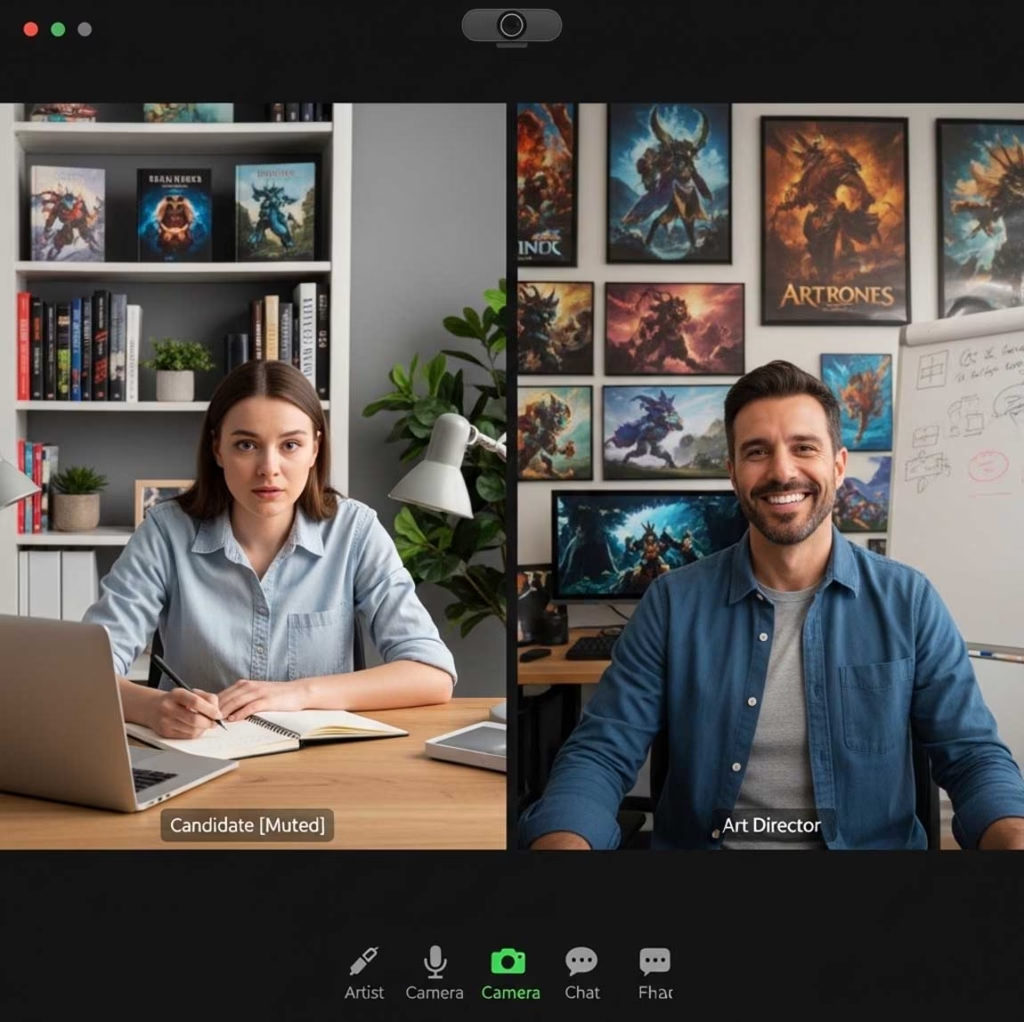
Expect: “Walk me through your portfolio and explain your process.”
Prepare:
- Can discuss every piece: What was the goal? What challenges arose? What would you do differently now?
- Focus on decision-making: WHY you made artistic choices
- Admit weaknesses in older work: Shows growth mindset
- Highlight learning from each project
Example: “This character design was for fantasy ranger concept. I started with 10 thumbnail silhouettes exploring different proportions and costume approaches. The brief emphasized ‘practical but visually interesting,’ so I balanced functional pouches and layered gear with unique color palette. Biggest challenge was avoiding generic leather armor—I researched actual historical wilderness clothing for authenticity. If I redid it today, I’d push facial expressiveness further and design more interesting secondary weapons.”
Common Interview Questions:
“How do you handle creative feedback?”
Bad answer: “I’m always open to feedback.”
Good answer: “Concept art is collaborative. I see initial designs as starting point for discussion. When art directors request changes, I ask clarifying questions to understand the ‘why,’ then explore multiple solutions. For example, [specific instance where feedback improved work]. Ego has no place when we’re all working toward best game possible.”
“What games inspire your work and why?”
Bad answer: “I like all games.”
Good answer: “I’m deeply influenced by [Specific Game’s] environmental storytelling—the way every space feels lived-in through prop placement and wear patterns. I also study [Another Game’s] character design for their approach to silhouette readability and costume variation. Recently I’ve been analyzing [Recent Indie Game] for their bold color choices and stylized approach.”
(Be specific. Demonstrate actual analysis, not casual playing.)
“Where do you see yourself in 5 years?”
Bad answer: “Art director.”
(Ambitious but unrealistic timeline)
Good answer: “I’m focused on mastering character design at a professional level. In 5 years, I hope to be senior character artist with shipped titles, potentially mentoring junior artists. Long-term, art direction interests me, but I want to earn that through years of excellent execution first.”
“What’s your biggest artistic weakness?”
Terrible answer: “I don’t have weaknesses.”
Good answer: “Hands and complex poses still challenge me. I practice daily—currently working through Bridgman’s anatomy books and doing timed gesture studies. I’ve improved significantly in past year, but it remains area I’m actively developing. I appreciate when art directors push me on anatomy because it forces growth.”
Questions YOU Should Ask:
Don’t leave interview without asking:
- “What does the feedback process look like here?” (Understand work culture)
- “How large is the art team I’d work with?” (Team structure)
- “What tools and software does the team use?” (Technical preparation)
- “What are opportunities for growth and learning?” (Career development)
- “What’s the timeline for your decision?” (Next steps clarity)
Never ask: Salary/benefits in first interview unless they bring it up.
Negotiating Your First Offer
You got offer! Exciting. Now what?
Research First:
Know market rates for your experience level and location:
- Glassdoor salary ranges
- Reddit r/gamedev salary discussions
- Artist community Discord channels
- Bureau of Labor Statistics data
Don’t Accept Immediately:
Hiring manager: “We’d like to offer you junior concept artist position at $52,000.”
You: “Thank you! I’m very excited about this opportunity. Could I have a day or two to review the offer details and get back to you?”
This is standard. They expect it.
What’s Negotiable (Entry Level):
Salary: Usually 5-10% wiggle room. If offered $52,000, asking for $55,000-$57,000 is reasonable if you have justification.
Start date: Need two weeks to finish current obligations? Totally reasonable.
Relocation assistance: If moving for job, ask if company provides support.
Remote work flexibility: Increasingly common post-COVID.
What’s Usually NOT Negotiable (Entry Level):
- Benefits package (health insurance, 401k are standardized)
- Title (junior is junior)
- Equity/stock options (rare for entry level)
How to Negotiate Salary:
“I’m thrilled about the opportunity to join [Studio]. Based on my research of market rates for concept artists with my skill set in [City], I was expecting compensation in the $56,000-$58,000 range. Is there flexibility in the initial offer?”
Professional. Factual. Not emotional. You’re not demanding; you’re discussing market reality.
They might say:
- “Yes, we can do $56,000.” (Success!)
- “Unfortunately $52,000 is our budget for this role.” (Decision time)
- “We can’t move on base salary but can offer extra vacation days or signing bonus.” (Alternatives)
When to Walk Away:
- Lowball offer significantly below market (<$45,000 for entry-level in major city)
- Contract requires unpaid trial period
- Sketchy contract terms (you own all work created ever, even personal projects)
- Red flags about company during research (Glassdoor reveals terrible culture)
- Your gut says something’s wrong
When to Accept:
- Salary is reasonable for experience level and location
- Studio culture seems healthy
- Opportunity to learn and grow
- Benefits package is standard or better
- Work aligns with interests
Trust your research. If you’ve done market homework and offer is fair, accepting is good decision even if not “dream company.” First job is learning opportunity, not destination.
Key Takeaway: Job hunting requires professional skills beyond art—researching companies, tailoring applications, interviewing well, negotiating strategically. Treat this seriously. Strong portfolio gets you interview; professional presentation gets you hired.
Common Questions About Video Games and Concept Art Careers
Do I need to be good at drawing to become a concept artist?
Drawing skill is important, but you don’t need to be a prodigy from day one. The good news: drawing is learnable through practice.
Most professional concept artists weren’t naturally gifted—they developed skills over years of dedicated practice. Anatomy, perspective, value control, composition—all these can be learned through structured study and repetition.
Focus on fundamentals first. Learn to see and construct forms in 3D space. Understand how light works. Study anatomy systematically. Technical ability will follow with patient, deliberate practice.
If you love gaming visuals enough to pursue this career, you already have the passion needed to develop drawing skills. Passion sustains practice; practice builds skill.
Timeline reality: Most artists need 1,000-2,000+ hours of dedicated drawing practice to reach professional competency. That’s 1-2 years of consistent daily practice (2-3 hours/day). Not overnight, but achievable.
Can I become a concept artist without a college degree?
Yes. Many successful concept artists are self-taught or attended specialized online programs rather than traditional universities.
Your portfolio is the primary hiring factor, not your degree. Studios care about one thing: Can you create professional-quality concept art that fits our needs? A strong portfolio from self-taught artist beats weak portfolio from expensive art school graduate.
That said, formal education provides structure, feedback, and networking that self-taught paths lack. It’s trade-off:
Degree advantages: Structure, mentorship, peer community, credential (some studios prefer it) Self-taught advantages: Much lower cost, flexible timeline, focus only on relevant skills
Hybrid approach works well: Community college art fundamentals (affordable) + online specialization courses (CGMA, Schoolism) + community engagement (Discord, Reddit feedback). You get foundational education, specialized training, and networking at fraction of 4-year university cost.
Bottom line: Degree helps but isn’t required. Portfolio quality determines your career prospects.
How long does it take to become job-ready as a concept artist?
Timeline varies by starting skill level and dedication, but realistic estimates:
Intense focus (full-time study, 40+ hours/week): 12-18 months
Part-time while working (15-20 hours/week): 2-3 years
Casual pace (5-10 hours/week): 3-5 years
The key factor isn’t time but deliberate practice quality. 100 hours of focused fundamental studies with feedback beats 500 hours of aimless sketching.
Most successful artists reach job-readiness after 1,000-2,000+ hours of dedicated practice. This includes:
- Drawing fundamentals (perspective, value, composition)
- Figure drawing and anatomy
- Digital painting skills
- Software proficiency
- Portfolio piece creation
- Style development
Don’t compare yourself to others. Some people start with stronger foundations or devote more hours. Focus on your consistent improvement.
What software do professional video game concept artists use?
Industry standard 2D: Adobe Photoshop
Photoshop dominates because of its powerful brush engine, layer system, and industry ubiquity. Every studio uses it, ensuring collaboration compatibility.
Cost: $20.99/month (Photography Plan)
Popular alternatives:
- Clip Studio Paint ($49.99 one-time): Excellent for character illustration, popular in anime/manga industries
- Procreate ($12.99, iPad only): Intuitive mobile workflow, great for initial concepts
- Krita (FREE): Fully professional features, open-source, zero cost
3D modeling: Blender (FREE), Maya, 3ds Max (studio standard), ZBrush (character sculpting)
Good news: Blender + Krita provide completely professional workflow without subscription costs. Studios provide software for employees—don’t overspend as student.
Learning any digital painting software teaches transferable skills. Master Krita, and you can switch to Photoshop easily when hired.
How much do video game concept artists make?
Salaries vary by experience and location (2025 data, United States):
Entry-level (0-2 years): $45,000-$65,000
Mid-level (3-5 years): $65,000-$95,000
Senior (6-10 years): $90,000-$130,000
Lead/Art Director (10+ years): $120,000-$180,000+
Geographic factors: California/Washington pay 15-30% higher but have 50-100% higher cost of living. Remote positions offer geographic arbitrage—earn coastal salaries while living in affordable areas.
Freelance rates vary widely: $25-$150+/hour depending on reputation and specialization. Annual freelance income typically comparable to salaried positions after accounting for inconsistent hours and lack of benefits.
Reality check: This is comfortable middle-class income, not wealth. You won’t get rich, but you can support yourself and family doing creative work you love.
Is concept art oversaturated? Can I still find work?
Honest answer: The market is competitive but not impossible.
Oversaturated areas:
- Junior generalist positions at famous AAA studios (Riot, Blizzard, Naughty Dog in LA/SF)
- “Character artist” with no specialization or unique style
- Generic fantasy character portfolios (everyone has these)
Undersaturated areas:
- Senior artists and art directors (5-10 years experience creates barrier)
- Technical artists (art + programming hybrid)
- Specialized styles (pixel art, hand-drawn, specific cultural aesthetics)
- Niche expertise (creature design, UI/UX, stylized props)
Growing opportunities:
- Mobile gaming (massive expansion globally)
- Indie game contracting (thousands of small studios)
- VR/AR content creation
- Educational content (teaching, courses, tutorials)
- Related industries (animation, film previs, marketing)
Strategy: Don’t compete as average generalist. Develop specialized skill in undersaturated niche. Rather than “concept artist,” become “stylized character designer for mobile games” or “hand-drawn environment artist for indie titles.”
Geographic flexibility (remote work) and specialized expertise dramatically improve your odds.
How is AI affecting concept art careers?
AI tools like Midjourney and DALL-E have impacted workflow but haven’t replaced concept artists.
What studios value that AI can’t provide:
- Intentional design choices based on gameplay requirements
- Iteration based on nuanced feedback (“make character feel more aggressive but approachable”)
- Technical specifications for 3D modeling teams
- Consistent style across hundreds of assets
- Cultural authenticity and research-driven design
- Art direction (understanding WHY certain choices serve game vision)
How AI is being used:
- Rapid ideation and reference generation
- Placeholder art during early prototyping
- Texture and pattern exploration
- Augmenting human artists’ workflows
Career implication: Pure “idea generation” roles may shrink, but implementation, art direction, and specialized design remain human-dependent.
Forward-thinking approach: Learn AI tools as part of your skillset, but prioritize irreplaceable skills—artistic judgment, technical knowledge, iterative problem-solving, and cultural authenticity.
Artists who adapt strategically (strong fundamentals + AI literacy) will thrive. Those who refuse to engage with technology will be at disadvantage.
Should I focus on fan art or original work for my portfolio?
Use both strategically: 30% fan art, 70% original concepts.
Fan art advantages:
- Shows you understand existing IPs (valuable for studios with franchises)
- Demonstrates passion (love for Elden Ring creates better work)
- Builds social media following (communities share fan art)
Fan art risks:
- Can pigeonhole you (studios might assume narrow range)
- Doesn’t demonstrate original design thinking
- Copyright concerns for some studios
Best approach: Reimagine rather than reproduce. Instead of drawing Cloud Strife exactly as he appears, design “Cloud in Overwatch style” or “Cloud as cyberpunk hacker.” This showcases understanding of multiple aesthetics and design adaptation skills.
Lead with original work. Your top 5 portfolio pieces should be original concepts demonstrating design thinking. Fan art can support, showing technical execution.
Can I work remotely as a concept artist?
Yes, increasingly so. Post-COVID, many studios have embraced remote work.
Remote-friendly:
- Indie studios (often fully remote)
- Mid-size studios (hybrid or remote options)
- Freelance work (almost always remote)
- Contract positions
Often requires on-site:
- Some AAA studios (want collaborative in-person culture)
- Art director/lead positions (team leadership benefits from presence)
- Early-career roles (some studios prefer training juniors in-person)
Strategy: Remote work expands options dramatically. You can live in low-cost area while working for studios globally. Geographic arbitrage (Austin salary vs. San Francisco living costs) creates financial advantages.
Considerations:
- Home office setup costs
- Time zone coordination for meetings
- Self-motivation without office structure
- Potential isolation from team
What’s the difference between a concept artist and an illustrator?
Concept artists create functional designs for production teams to build from—focused on communication, iteration, and technical specifications.
Illustrators create finished art for direct consumption—focused on polish, emotional impact, and final presentation quality.
Example: For a fantasy game:
- Concept artist designs the dragon character: multiple views, scale references, material callouts, anatomical logic, variations for art director feedback. Goal: Give 3D modeler and animator clear blueprint.
- Illustrator creates marketing key art showing hero fighting dragon: polished, dramatic composition, lighting for emotional impact, print-ready quality. Goal: Make audiences want to play game.
Many skills overlap, and some artists do both. In gaming specifically:
- Concept art happens during pre-production and production
- Illustration happens for marketing, packaging, promotional materials
Career wise: Concept artists are typically studio employees on development teams. Illustrators often freelance for marketing departments or work at advertising agencies.
The Future of Video Games and Concept Art
Looking ahead shows this career has longevity and evolving opportunities.
Emerging Technologies Shaping the Field
VR and AR Gaming
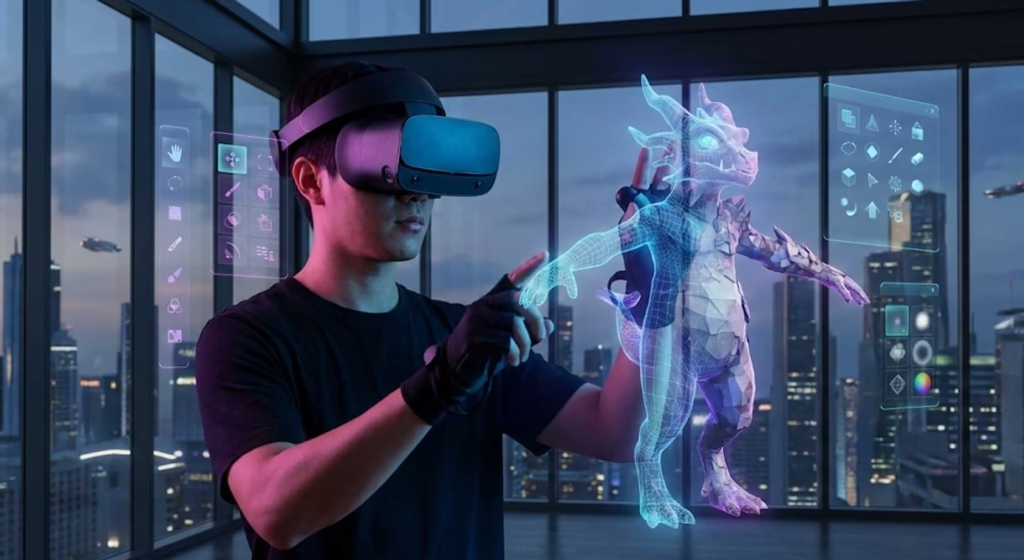
Virtual and augmented reality create new spatial design challenges. Concept artists must think three-dimensionally about environments players will physically move through. Traditional flat concept art adapts to 360-degree space design.
Opportunity: Specialized skills in VR/AR environment design are rare. Early adopters gain competitive advantage.
Real-Time Rendering
Unreal Engine 5’s Nanite and Lumen technologies blur lines between concept art and final assets. Artists can create high-fidelity environments that could ship directly in games. This changes workflow—less handoff to 3D modelers, more direct creation.
Opportunity: Artists who master real-time tools (Unreal Engine, Unity) alongside traditional concept art become invaluable hybrids.
Procedural Generation
AI-assisted world-building tools let artists define rules and systems that generate infinite variations. Rather than painting every tree, artists design “tree-ness” parameters. This shifts role toward creative direction of systems.
Opportunity: Technical artists with both creative vision and systematic thinking will be highly valued.
Cloud Gaming
Broader device access (play AAA games on phones via streaming) increases potential market size dramatically. More games means more need for concept artists.
The Democratization of Game Development
Accessible Tools
Unity and Unreal Engine are free. Blender is free. Asset marketplaces let small teams look professional. Barriers to game creation have collapsed.
Result: Explosion of indie studios globally. Each needs concept art, even if just contract work for key visuals.
Game Jams and Prototyping
Events like Ludum Dare, Global Game Jam see thousands of developers creating games in 48-72 hours. Many concepts develop into full projects—creating ongoing concept art needs.
Asset Marketplaces
Unreal Marketplace, Unity Asset Store let artists sell environment packs, character models, prop libraries. This creates passive income streams beyond direct client work.
Crowdfunding Validation
Kickstarter proves game concepts before full development. Compelling visual concept art directly converts to funding. Artists get paid for pitch art before games enter production.
Cross-Media Influence
Games Inspiring Film and Streaming
The Last of Us HBO series, Fallout Amazon series, Arcane Netflix series based on League of Legends—gaming IPs moving to prestige television. This creates additional work for concept artists as properties expand into new media.
Convergence of Aesthetics
The visual language of games influences everything. Spider-Verse‘s animation borrows from comic books AND video games. Arcane looks like playable game. Boundaries blur.
Opportunity: Game artists transitioning to animation or film previs work. Cross-industry skills become valuable.
Predictions for Next 5 Years (2025-2030)
Smaller Teams, Higher Fidelity
AI-assisted pipelines and powerful tools let 10-person teams create what once required 100. This doesn’t eliminate artists—it shifts them to higher-level creative decisions rather than mechanical execution.
Stylized Art Over Photorealism
As photorealism becomes accessible to more studios via advanced tools, stylistic distinctiveness creates competitive advantage. Expect continued demand for unique art directions like Hades, Valorant, Sea of Stars.
Remote-First Studios Standard
Geographic boundaries collapse. Studios hire globally based on talent, not location. This expands opportunities but also increases competition (competing with artists worldwide, not just locally).
Specialized Hybrid Roles
Expect growth in positions like “AI Art Director” (directing AI-generated content), “Procedural Environment Artist” (creating rule-based world generation), “XR Concept Artist” (VR/AR specialized).
Continued Industry Growth
Gaming industry projected to exceed $300 billion globally by 2027. More money, more games, more need for artists. While individual roles evolve, aggregate demand should grow.
Key Takeaway: The profession is evolving, not dying. Artists who adapt to new tools while maintaining strong fundamentals will thrive. Specialization in emerging areas (VR, procedural design, hybrid technical roles) creates opportunity. The future is bright for flexible, skilled concept artists.
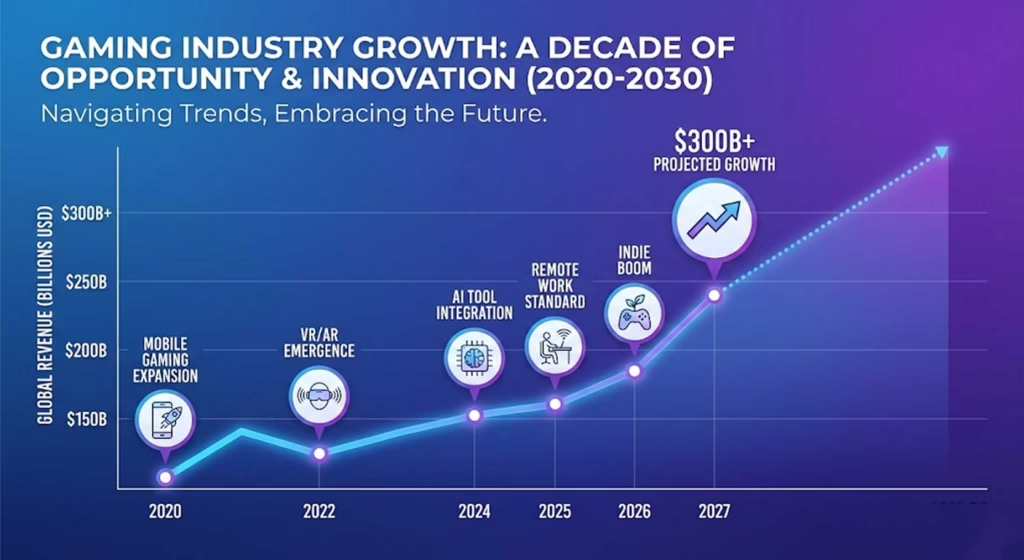
Key Takeaways: Your Roadmap to a Concept Art Career
After 8,000+ words of career guidance, here are the essential truths:
Video Games Are Legitimate Artistic Training
Your gaming passion isn’t “wasted time”—it’s unconscious study of visual language, composition, design thinking, and aesthetic development. Every hour analyzing Elden Ring‘s environmental storytelling or Overwatch‘s character silhouettes is professional preparation.
Gaming teaches you to see like a designer: Why do certain characters read well at distance? How do environments guide player movement? What makes fictional worlds feel internally consistent?
This intuitive knowledge is precisely what concept artists need.
Portfolio Quality Trumps Credentials
A strong portfolio from self-taught artist beats weak portfolio from expensive art school graduate. Every time.
Studios hire based on one question: Can you create professional-quality concept art fitting our needs? Diplomas don’t answer that—portfolios do.
Focus 80% of energy on portfolio quality, 20% on credentials. Whether you attend traditional university, specialized bootcamp, or self-teach entirely, portfolio is the credential that matters.
Specialize to Stand Out
“Concept artist” is too broad. The profession fragments into specializations: character artist, environment artist, prop designer, UI/UX artist, technical artist.
Going deeper: “Stylized character artist for mobile games” or “Photorealistic environment artist for AAA shooters” or “Hand-drawn aesthetic specialist for indie titles.”
Specialization isn’t limiting—it’s strategic positioning. Becomes easier to hire you when they know exactly what you do best.
Fundamentals Are Non-Negotiable
Perspective, anatomy, values, composition, color theory—these foundational skills never become obsolete.
Software changes. Trends shift. AI disrupts workflows. But understanding how light interacts with form, how to construct believable anatomy, how to create compelling compositions—these remain constant.
Master fundamentals first. Spend 12-18 months on core drawing skills before specializing. Every successful concept artist has strong fundamental foundation.
Software Choice Matters Less Than Skill
Photoshop, Clip Studio Paint, Procreate, Krita, Blender, ZBrush—they’re all tools. What matters is artistic vision and technical execution.
You can build professional portfolio using entirely free software (Krita + Blender). Studios care about results, not which tools created them.
Start with free tools. Invest in paid software only when specific features become productivity bottlenecks. Save money for quality drawing tablet instead.
Community Accelerates Growth
Self-taught artists who engage communities (Discord servers, Reddit, Twitter, ArtStation) progress faster than isolated students in expensive programs.
Why? Feedback loops. Post work-in-progress, get critique, apply feedback, improve. Repeat weekly. This accelerates learning far beyond solo practice.
Join communities. Share work publicly (even beginner work). Ask for feedback. Give feedback to others. Build relationships. These connections become your professional network.
The Path Is Marathon, Not Sprint
Realistic timeline to job-readiness: 1-3 years of dedicated practice.
Not 6 weeks. Not 3 months. Years. This isn’t discouraging—it’s realistic expectation management.
Most professionals invested 2,000-5,000+ hours before portfolio reached hire-able quality. If you practice 2 hours daily, that’s 3-7 years. Intense full-time study shortens timeline but requires total commitment.
Consistency beats intensity. Daily 90-minute focused practice sessions build skills more effectively than sporadic weekend binges.
Industry Evolving Creates Opportunities
AI tools, indie boom, remote work normalization, VR/AR emergence, mobile gaming explosion—all create new niches and career possibilities.
This isn’t “industry is dying” disruption. It’s “industry is transforming” evolution. Artists who adapt strategically will find abundant opportunities.
Stay informed. Experiment with new tools. Develop emerging skills. But never abandon fundamentals—they’re your foundation regardless of industry changes.
Geographic and Financial Barriers Are Lower Than Ever
You don’t need to move to Los Angeles or San Francisco. Remote work, online education, free software, global client base—geography matters less every year.
You don’t need $100,000 art school degree. Community college + online courses + self-teaching can cost $5,000-$15,000 total and produce equivalent results.
Barriers exist but they’re surmountable. Lack of money or location shouldn’t stop you. Lack of dedication and consistent effort will.
Your Gaming Background Is Asset, Not Liability
That you’ve spent thousands of hours gaming isn’t something to hide or apologize for—it’s competitive advantage.
You understand gaming from player perspective. You’ve internalized what makes visuals compelling, readable, memorable. You know what resonates with gaming audiences.
Studios want artists who understand games intuitively. Your gamer identity is professional strength.
Next Steps: Start Today
Immediate actions (This week):
- Choose specialization that excites you (characters? environments? props?)
- Start learning fundamentals (free YouTube channels: Proko, Moderndayjames, Sinix Design)
- Join online art community (r/learnart, ConceptArt.org, Discord servers)
- Create first study (draw anything—box, apple, face—post for feedback)
- Set consistent practice schedule (even 30 min/day compounds over months)
6-Month checkpoint:
- Completed 100+ hours of deliberate practice
- Basic understanding of perspective and values
- Started developing digital painting skills
- Posted work publicly for feedback 20+ times
- Evaluated progress and adjusted learning plan
12-Month checkpoint:
- Completed 300+ hours of practice
- Comfortable with digital painting fundamentals
- Created first portfolio-worthy pieces (even if rough)
- Engaged actively in art communities
- Identified specific style/specialization interests
24-Month checkpoint:
- Completed 600+ hours of practice
- 8-10 portfolio pieces demonstrating consistent quality
- Active online presence (ArtStation, Instagram)
- Started applications to entry-level positions or freelance contracts
- Portfolio showing clear specialization and professional presentation
Final Encouragement
Every professional concept artist at Riot Games, Blizzard Entertainment, Naughty Dog, FromSoftware started exactly where you are—as gamer who loved the art.
They didn’t have special gifts or insider connections. They had passion, consistent practice, and willingness to learn from feedback.
The difference between you and them is simply time and dedicated effort.
Your gaming obsession prepared you for this. The countless hours studying character designs, appreciating environmental storytelling, analyzing combat animations—that was training. You’ve been unconsciously developing the visual literacy concept artists need.
Now make it conscious. Deliberate. Structured.
Start today. Draw something. Anything. Post it somewhere for feedback. Then draw again tomorrow.
One year from now, you’ll be amazed at your progress. Three years from now, you might be employed doing work you love.
But only if you start.
The games you love can become the career you build. Begin.
This comprehensive guide covers everything from video game art evolution to practical career navigation. Whether you’re high school student exploring options or professional considering career change, the roadmap exists. Your move is simply to begin.
Concept art sits at the crossroads of the AI debate, online art communities, and the work of leading figurative artists.