
You’re selling work faster than you can make it. Material costs have doubled since you set your prices. You’re burning out from undercharging, barely covering your studio rent after gallery commissions. But every time you think about raising prices, a knot forms in your stomach. What about the collectors who supported you from the beginning? The ones who bought your work when nobody else would?
You’re not alone in this fear. The gap between knowing you should raise prices and actually doing it can paralyze even successful artists for years.
Here’s what this guide will give you: a complete system for raising prices professionally—without damaging the relationships you’ve worked so hard to build. You’ll get exact communication templates, timing strategies backed by gallery owners with decades of experience, alternative solutions for priced-out collectors, and a troubleshooting plan if sales slow after your increase.
This isn’t theory. These strategies come from gallery owners like Jason Horejs of Xanadu Gallery, art business coach Alyson Stanfield, and hundreds of artists who’ve successfully navigated price increases while keeping their collectors engaged and enthusiastic.
Let’s remove the guesswork and guilt from one of the most important business decisions you’ll make.
Why Raising Your Prices Is a Sign of Professional Growth (Not Greed)
The Scarcity Mindset That Keeps Artists Underpriced
That fear you feel about raising prices? It has roots.
Most artists can remember months—sometimes years—when sales were rare. You’d complete a painting, post it online, show it at a fair, and… nothing. Days would pass. Weeks. The silence was deafening. Those dry spells leave emotional scars that persist long after your circumstances improve.
Even when you’re selling consistently now, your brain remembers those lean times. It whispers: If you raise prices, you’ll go back to that. Nobody will buy. You’ll ruin everything you’ve built.
This is scarcity thinking, and it’s lying to you.
Here’s the truth: Your early pricing served a specific purpose. At that stage, you needed exposure, a track record of sales, and collector relationships. Lower prices helped you achieve those goals. But continuing to price as if you’re still in that stage after your circumstances have changed isn’t loyalty to your collectors—it’s loyalty to a version of your career that no longer exists.
You’ve confused price with value. The value you provide—the beauty, emotion, and meaning in your work—hasn’t decreased. In fact, it’s probably increased as your skills have grown. Yet somehow, you believe that charging what your work is actually worth will make it less valuable to collectors.
It won’t. In fact, the opposite is true.
What Collectors Actually Think About Price Increases

Let me reframe something for you: Serious collectors want your prices to rise.
Here’s why. When someone buys your $2,000 painting and your prices rise to $3,500 over the next few years, what happened? Their piece just appreciated in value. They made a smart investment. They got in early. They have something that’s now worth more than they paid—and that validates their eye for spotting talent before the market caught up.
Price increases don’t hurt your collectors. Frozen prices do.
When your prices stay stuck for years, you’re telling the market—and your collectors—that your work isn’t gaining value, that demand isn’t growing, that your career is stagnant. Even loyal collectors start to wonder if they backed the wrong horse.
Gallery owner Jason Horejs, who’s worked with hundreds of artists over his decades at Xanadu Gallery, puts it plainly: “A collector doesn’t expect to see prices frozen in time. In fact, gradual, thoughtful price increases can reinforce the perception that your work is gaining in value and importance—which is exactly what you want your collectors to believe, because it’s true.”
Think about it from a collector’s perspective. They’re not just buying decoration. They’re investing in your career trajectory. They want to watch you grow, succeed, and become more sought-after. Your rising prices are proof that their belief in you was justified.
The Business Reality: You Must Charge What You’re Worth
Here’s the uncomfortable math: If you can’t cover your materials, time, overhead, and a living wage, you don’t have an art career. You have an expensive hobby subsidized by other income.
Let’s run the numbers on a typical scenario:
You create a 24×30″ painting that takes 15 hours. Materials cost $150 (canvas, quality paints, frame). Your studio rent, utilities, and insurance work out to about $50 per painting when averaged across your monthly output. A gallery sells it for $2,000 and keeps their 50% commission ($1,000).
What do you get?
- Sale price after commission: $1,000
- Minus materials: $850
- Minus overhead allocation: $800
- Divided by 15 hours: $53 per hour
That sounds reasonable until you realize this is gross income, before:
- Health insurance
- Self-employment tax
- Marketing costs
- Website and photography
- Shipping supplies
- Professional development
Your actual take-home? Probably closer to $30-35 per hour. And that’s assuming you sell every painting within a few months of completion. If it takes a year to sell, your effective hourly rate plummets.
This isn’t about greed. It’s about sustainability. Artists who price too low burn out, grow resentful, and eventually quit—not because they lack talent, but because the economics don’t work.
Your collectors don’t benefit from your burnout. They benefit from you having a sustainable practice that lets you keep creating the work they love for decades to come.
Professional pricing isn’t vanity. It’s survival—and it’s what allows you to keep serving the collectors who believe in your work.
When to Raise Your Prices: 7 Clear Signs It’s Time
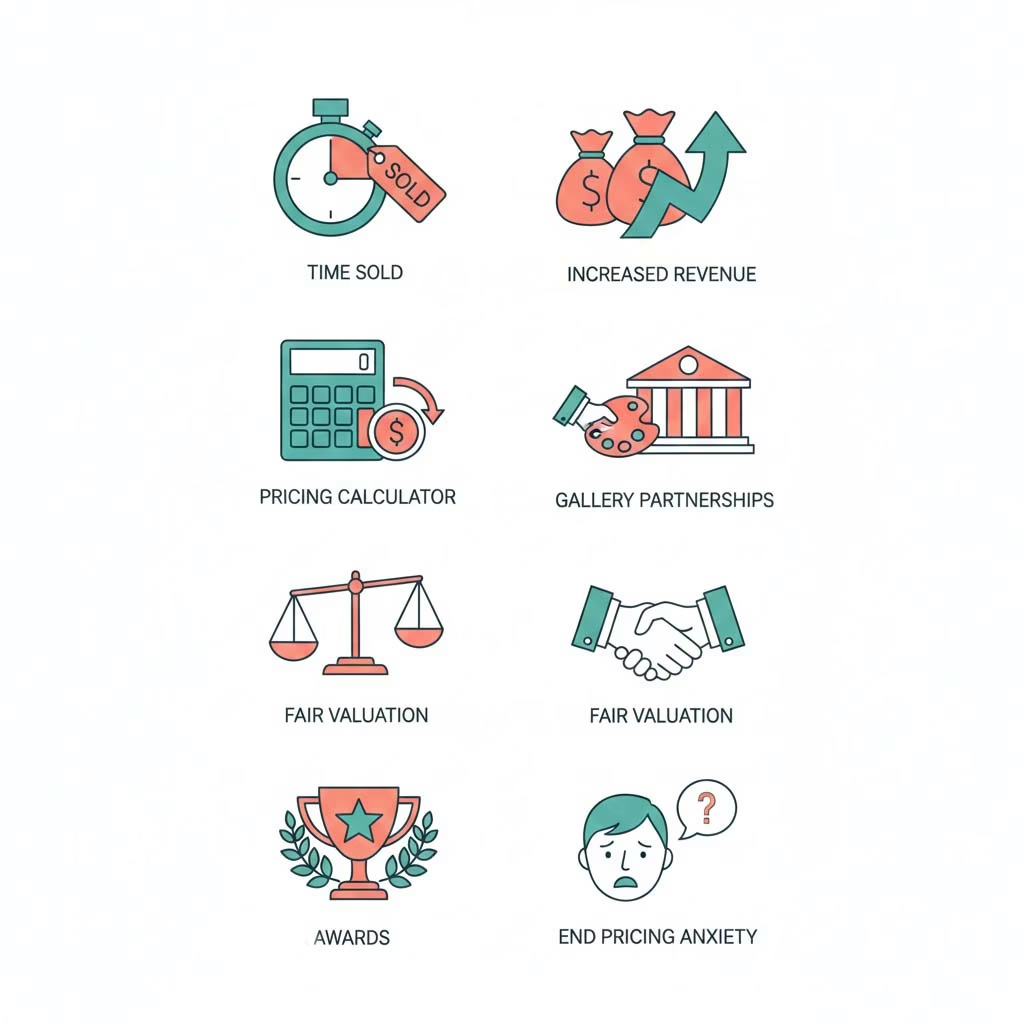
Knowing when to raise prices removes much of the uncertainty. These seven signs give you objective criteria so the decision feels less arbitrary and more like a natural response to your career evolution.
Sign #1: You’re Selling Faster Than You Can Replace Inventory
This is the clearest signal: Your work sells within days or weeks of completion. Galleries can’t keep pieces on the walls long enough for most collectors to see them. You’re turning down opportunities because you have nothing available to show.
What this means: Demand has outpaced supply. Basic economics tells us that when demand exceeds supply, prices should rise to reach equilibrium.
Gallery owner Jason Horejs reports seeing this pattern repeatedly: “If pieces are flying off the wall, your prices are likely too low.” He’s worked with artists whose work would sell out in weeks at one gallery, but because they were reluctant to raise prices, the gallery could never maintain adequate inventory. New collectors who heard about the artist often couldn’t see the work in person—it was always already sold.
Appropriate action: A 10-20% price increase is reasonable. This should slow sales to a sustainable pace where you can actually keep up with demand while galleries maintain enough inventory for collectors to discover your work.
Sign #2: Material Costs Have Increased Significantly
In 2023-2025, inflation hit art materials hard. Quality oil paints increased 15-30%. Canvas prices rose 20-25%. Professional framing costs jumped even more dramatically. If you set your prices three years ago and haven’t adjusted, you’re now making significantly less profit per piece—or losing money on materials entirely.
Art business coach Alyson Stanfield shared an example from an artist she works with who uses significant amounts of silver in jewelry. When silver prices jumped from $4.50 to $30 per ounce, the artist created a detailed graph showing the price increase and shared it with her collector base. The visual made the necessity crystal clear.
Appropriate action: Calculate the percentage increase in your material costs since you last adjusted prices. If materials have risen 20%, a 20% price increase just maintains your previous profit margin—it’s not really a “raise” at all, just keeping pace with costs.
Sign #3: You’re Not Making Minimum Wage After Gallery Commissions
Run this calculation right now:
- Take your average sale price
- Subtract 50% gallery commission (if applicable)
- Subtract materials and overhead costs
- Divide by the hours you spent creating the work
If the result is below your region’s minimum wage—or worse, below $20/hour—your pricing is unsustainable. You can’t build a career on poverty wages.
Art pricing consultant Alan Bamberger notes a common pattern: “I occasionally speak with artists who report taking weeks or even months to complete works of art that they can only realistically sell for hundreds or maybe low thousands of dollars each. For these artists, making livings from their art is difficult if not impossible.”
Appropriate action: Recalculate your pricing to ensure you’re earning at least $50-75 per hour after all costs. This isn’t luxury income—it’s professional rates that allow you to invest in your career, afford quality materials, and actually make a living from your work.
Sign #4: You’re Entering Gallery Relationships or Upscale Markets
You’ve been selling successfully at local art festivals and through your website at prices that work for direct sales. But now a gallery wants to represent you, or you’re showing in a more upscale venue. Suddenly the 50% commission means you’re working for half what you earned before.
This is one of the most common pricing crises for mid-career artists.
The solution isn’t to price differently for gallery versus direct sales (this violates most gallery agreements and damages relationships). The solution is to factor a potential 50% commission into all your pricing from the beginning, even if you’re currently selling mostly direct.
Appropriate action: If you haven’t built in gallery commissions, you’ll need to raise prices before entering gallery relationships. This might require a larger increase (30-50%) all at once if you’re starting from purely direct-sales pricing. Work with the gallery to ensure your new prices align with their other artists at your experience level.
Sign #5: Your Pricing Is Inconsistent Across Sizes or Mediums
You’ve been adding sizes and experimenting with new mediums over the years. Somehow your 16×20″ and 24×30″ pieces are only $200 apart, even though the larger one takes twice as long and uses significantly more materials. Or your framed watercolors cost the same as unframed oil paintings, even though the frame adds $150 in costs.
This internal inconsistency confuses collectors and leaves money on the table.
Appropriate action: Create a pricing matrix based on size and medium that makes logical sense. Larger works should be proportionally more expensive. Works requiring framing should account for that cost. Time-intensive techniques should be reflected in pricing. Once you’ve rationalized your structure, you’ll find some pieces need significant increases to fall in line.
Sign #6: You’ve Achieved New Career Milestones
You just won Best of Show at a prestigious juried exhibition. You earned signature status in a major art organization. A museum acquired one of your pieces. You were featured in a prominent art magazine.
These milestones aren’t just ego boosts—they’re market signals that increase your work’s perceived value. Collectors understand that award-winning, museum-collected artists command higher prices than emerging artists, even when the visual quality of the work is similar.
Appropriate action: A 10-15% increase is appropriate following significant career milestones. These achievements give you objective justification for the increase: “In light of [award/recognition], I’m adjusting my pricing to reflect this career advancement.”
Sign #7: You’re Feeling Resentful About Your Prices
This is the emotional warning sign that your pricing has become unsustainable.
If you feel a pang of disappointment or frustration when a painting sells, you’re underpriced. If you find yourself apologizing for your prices or feeling like you need to justify them, you’re underpriced. If you avoid telling other artists what you charge because you’re embarrassed it’s so low, you’re underpriced.
Art business coach Alyson Stanfield learned this lesson herself: “When I first started out, I woefully undercharged for my work. Being woefully underpaid leads to feeling woefully undervalued, and, sooner or later, resentful. In the middle of executing my third commission, which took 106 hours to create and for which I ended up earning not much more than minimum wage, I felt so resentful of the lovely and delightful young couple I was creating the piece for that I came a hair’s breadth away from never accepting another commission. Thankfully, I realized that what I needed was not to quit; what I needed was to raise my prices!”
Resentment is your psyche telling you something is wrong with the value exchange. Listen to it.
Appropriate action: Price at a level where you feel proud of the work, excited when it sells, and confident in the value exchange. If that requires raising prices 25-40% to get to that feeling, it’s justified—because the alternative is burnout and quitting.
How to Research Market-Appropriate Pricing
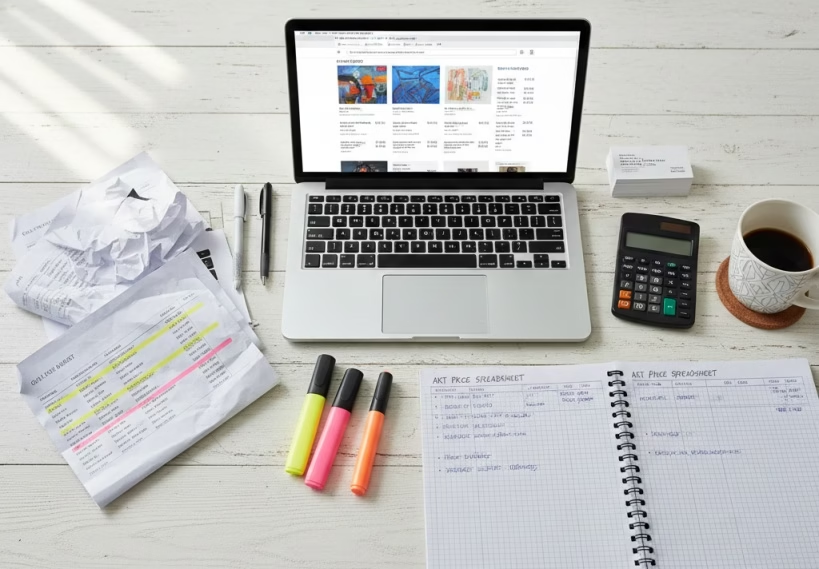
Before you change anything, you need to know where you stand in the market. Pricing isn’t arbitrary—it needs to be defensible based on comparable artists and your career stage.
Finding Comparable Artists
The key word here is comparable. You’re not comparing yourself to artists with 30 years of experience if you’ve been selling for 5 years. You’re not comparing still lifes to abstract expressionism just because they’re both paintings.
Look for artists who match:
- Experience level: Similar years actively selling and exhibiting
- Medium and style: Oil landscape painters compare to other oil landscape painters, not sculptors
- Size range: Artists working at similar scale
- Market: Same geographic region or online market presence
- Career trajectory: Similar number of shows, gallery relationships, awards
Create a simple spreadsheet with 5-10 comparable artists. For each, note:
- Artist name and years of experience
- Size of work
- Price per square inch (calculate: price ÷ [height x width])
- Gallery representation (yes/no)
- Awards or recognition
- Where their work sells (gallery, online, direct)
This research gives you a reality check. If comparable artists are charging $8 per square inch and you’re at $4, you have significant room to grow. If you’re already at the high end of your peer group, you may need to build more credentials before your next increase.
Visiting Galleries In Person
Online research only gets you so far. Visit galleries in person—particularly ones that represent artists at your level or where you’d like to show eventually.
Study the price lists carefully. Notice:
- How consistently do prices track with size? (Most galleries use fairly systematic size-based pricing)
- What’s the price range for artists at various career stages?
- How do prices differ between mediums? (Oil typically commands higher prices than watercolor at the same size, rightly or wrongly)
- What’s the “entry point” pricing—the smallest, most affordable work?
Don’t be shy about asking gallery staff questions. Something like: “I’m an artist researching pricing for my work. What price range do you typically look for when considering artists at my experience level?” Most gallery owners will give you useful guidance—they want artists to price realistically so the work sells.
Understanding Your Market Position
Be brutally honest about where you fall on the career continuum:
Emerging (0-5 years selling consistently):
- Building track record and collector base
- Likely solo shows in local venues, some group shows
- Few if any major awards
- Pricing should be accessible to encourage sales and word-of-mouth
- Typical range: $3-6 per square inch
Mid-Career (5-15 years, consistent sales and exhibition history):
- Regular gallery representation or strong direct sales
- Juried show acceptances, possibly some awards
- Growing collector base with repeat purchases
- Pricing should reflect market demand and professional sustainability
- Typical range: $6-12 per square inch
Established (15+ years, strong demand and recognition):
- Multiple gallery relationships, possibly museum acquisitions
- Award history, signature status in organizations
- Work sells consistently at higher price points
- Collectors compete for available work
- Typical range: $12-25+ per square inch
These ranges are guidelines, not rules—regional markets and mediums create significant variation. But they give you a starting point for where your pricing should fall based on career stage.
The key insight: Your pricing should reflect your career stage, not just your costs or how much you’d like to earn. Price yourself ahead of your credentials and the market won’t support it. Price yourself behind your achievements and you’re leaving money on the table.
How Much to Raise Prices: Industry Guidelines & Strategies
The percentage matters. Too little doesn’t solve your sustainability problem. Too much shocks the market and stalls sales. Here’s how to find the right number.
Standard Incremental Increases (10-20% Annually)
This is the industry norm for artists with consistent sales wanting sustainable growth over time.
Example: Your 24×30″ painting currently sells for $2,400. A 10% increase brings it to $2,640. A 20% increase brings it to $2,880.
Best for:
- Artists with steady sales who want to grow income gradually
- Maintaining momentum without shocking existing collectors
- Annual or bi-annual adjustments
Pros: Least disruptive, collectors come to expect modest increases, maintains sales velocity
Cons: Takes years to reach sustainable pricing if you’re significantly underpriced
Art business coach Alyson Stanfield recommends: “When you have a great selling year, raise your prices by 10 percent. When the economy is poor or your sales are slow, keep prices the same.” This approach ties increases to performance rather than calendar dates.
Moderate Increases (25-40%)
Appropriate when you’re catching up after years without adjustments, entering new markets, or following significant career milestones.
Example: Your 24×30″ painting currently sells for $2,400. A 25% increase brings it to $3,000. A 40% increase brings it to $3,360.
Best for:
- Artists who’ve gone 3-4+ years without raising prices
- Transitioning from direct sales to gallery representation
- After major awards or museum acquisitions
- Realigning with market rates for comparable artists
Pros: Gets you to sustainable pricing faster, signals significant career growth
Cons: Larger adjustment for collectors, may lose some price-sensitive buyers
Gallery owner Jason Horejs has seen this work well in practice: “Over the course of 18 months, we’ve raised prices by about 50% from where they were initially” for one artist whose work was selling too fast to keep in stock. “Did sales slow down by the same percentage? Not at all; in fact the tempo of sales increased!”
Aggressive Increases (50%+)
Risky but sometimes necessary when you’re severely underpriced relative to market realities.
Example: Your 24×30″ painting currently sells for $2,400. A 50% increase brings it to $3,600. A 100% increase (doubling) brings it to $4,800.
Best for:
- Artists selling out everything within weeks
- Dramatically underpriced relative to comparable artists
- Making the jump from hobby pricing to professional rates
Pros: Immediately solves severe underpricing, may actually increase perceived value
Cons: High risk of stalled sales if market won’t support the jump, shocking to existing collectors
Warning: Increases above 50% should be rare and well-justified. Artist and pricing consultant suggest this level only when demand dramatically outpaces supply or your pricing is dramatically below market rates.
The Gradual vs. Big Jump Decision
How do you choose between these approaches?
Choose gradual increases when:
- You’re within 20-30% of where you need to be
- Sales are steady and sustainable at current pace
- You want to minimize disruption to existing collector relationships
- You have time to reach target pricing over 2-3 years
Choose a big jump when:
- You’re 50%+ below where you need to be
- You’re burning out from unsustainable pricing
- You’re entering gallery relationships and need commission-friendly pricing now
- Demand so dramatically exceeds supply that sales will continue even with higher prices
Most importantly: Don’t let perfect be the enemy of good. If you need to raise prices 60% to reach sustainable rates but you’re terrified of losing collectors, raising 30% now and another 20% in a year is better than doing nothing because 60% feels too scary.
Different Strategies for Different Items
You don’t have to increase everything by the same percentage. Consider:
Increase more aggressively on:
- Your most popular sizes (the ones that sell fastest)
- Work that takes disproportionate time relative to current pricing
- Larger pieces where you have more pricing flexibility
Keep more accessible:
- Smallest available sizes (maintain entry point for new collectors)
- Work in mediums where you’re building collector base
- Studies or smaller pieces that serve as “gateway” to larger work
This tiered approach lets you raise overall income while maintaining options for collectors at different budget levels.
How to Tell Collectors You’re Raising Prices (With Templates)
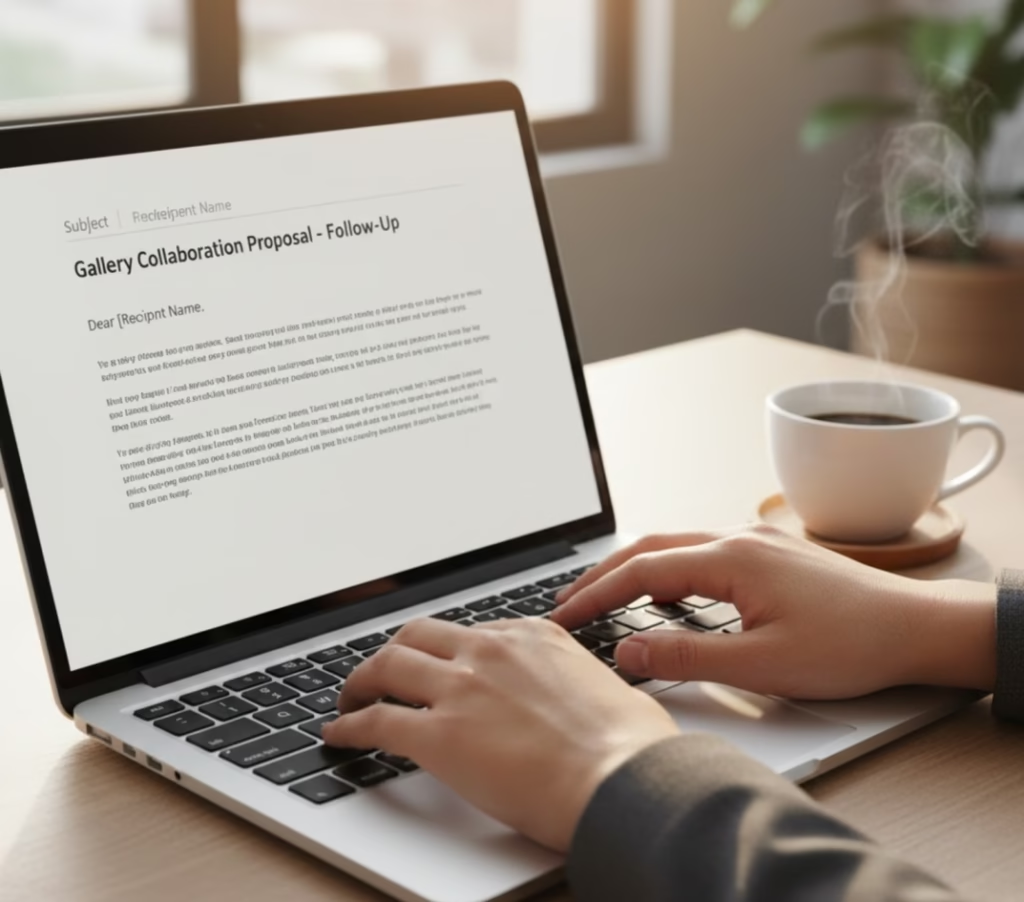
This is where most artists freeze. You know you need to raise prices. You’ve done the research. You’ve chosen your percentage. But now you have to actually tell people—and that feels terrifying.
Here’s the truth: How you communicate the increase matters as much as the increase itself. Poor communication damages relationships. Thoughtful communication strengthens them.
The 30-60 Day Advance Notice Strategy
Give your loyal collectors a heads-up before making a public announcement. This accomplishes several critical things:
- Shows respect: “I value you enough to tell you first”
- Builds trust: “I’m not trying to surprise or trick you”
- Creates opportunity: “You can add to your collection before prices rise”
- Reinforces relationship: “You’re part of my inner circle”
Timeline:
- 60 days out: Email personal collectors who’ve purchased 2+ pieces
- 30 days out: Email broader collector list and newsletter subscribers
- 2-4 weeks out: Public announcement on social media and website
- Implementation date: New prices go into effect
This staged approach means your most loyal supporters hear it from you personally first, middle-tier collectors get advance notice, and only then does it become public knowledge.
Email Template for Loyal Collectors
Here’s language you can adapt:
Subject: A personal note about my studio
Dear [Collector Name],
I wanted to reach out to you personally before making a public announcement about my work.
First, thank you. Your support over [time period] has meant so much to my growth as an artist. [Optional: Personal detail—”I still smile every time I remember you choosing the blue landscape” or “Your enthusiasm at my last opening was exactly the encouragement I needed.”]
I have exciting news: My work has been selling consistently, and I’ve recently [specific achievement—been accepted into X gallery/won X award/seen dramatic growth in demand]. This momentum is wonderful, but it also means I need to adjust my pricing to sustain my practice long-term.
Effective [date 30-60 days from now], my prices will increase by [percentage]. This reflects the growing demand for my work, the increased cost of quality materials, and my evolution as an artist.
Because you’ve been such a valued supporter, I wanted to give you advance notice and the opportunity to add to your collection at current pricing through [date]. [Optional: “I currently have [specific work] available, if you’d like to see images.”]
Whether or not you choose to purchase now, I wanted you to know first. Thank you for believing in my work and for being part of this journey.
With gratitude,
[Your name]
[P.S. Your piece from [year] has now appreciated from [original price] to [current equivalent price]—a smart early investment!]
Why this works:
- Leads with gratitude, not the price increase
- Frames increase as result of success, not desperation
- Offers opportunity without pressure
- Acknowledges relationship beyond transactions
- Optional P.S. reminds them their earlier purchase was smart
Social Media/Newsletter Announcement Template
For your broader audience:
Subject: Studio update: Pricing changes ahead
Friends and collectors,
I’m writing with some exciting news about my art practice—and an important announcement.
[Optional: Brief career update] This year has been transformative. [Specific achievement: I’ve sold X pieces, been accepted into Y gallery, won Z award]. The response to my work has exceeded my expectations, and I’m deeply grateful.
This growth means it’s time to adjust my pricing to reflect current demand and to ensure I can sustain my practice long-term. Beginning [date], prices will increase by [percentage].
If you’ve been considering adding to your collection, current pricing remains available through [date one month from announcement].
A few things to note:
- This increase applies to new work created after [date]
- Work currently available remains at present pricing until sold
- [Optional: Payment plans available for pieces over $X—contact me directly]
Thank you for supporting my work and following this journey. These adjustments ensure I can continue creating the art you love for years to come.
[Link to available work]
Warmly,
[Your name]
Why this works:
- Frames increase in context of success
- Clear, specific dates remove confusion
- Creates urgency without being pushy
- Offers solutions (payment plans) for price-sensitive collectors
- Ends on relationship note, not transaction
What to Say (and Not Say) in Your Announcement
DO say:
- “Growing demand for my work”
- “Sustainable pricing for long-term practice”
- “Reflecting current market value”
- “Thank you for your continued support”
- “Advance notice for valued collectors”
- “This ensures I can keep creating”
DON’T say:
- “I’m sorry, but…” (apologizing undermines confidence)
- “I know this is expensive…” (defensive and weak)
- “Inflation is killing me…” (negative, victim mentality)
- “My prices are still lower than…” (sounds desperate)
- “I have no choice…” (removes your agency)
- “Please understand…” (begging for approval)
The framing matters. You’re not asking permission or apologizing for running a business professionally. You’re informing people of a change and offering them an opportunity to benefit from advance notice.
Handling Gallery Communication
Critical: Discuss with galleries before announcing publicly.
Schedule a call or meeting with each gallery owner or director. Bring your research:
- Comparable artists and their pricing
- Your sales data (how quickly work sells)
- Career milestones since last price adjustment
- Proposed new pricing structure
Ask for their input:
- “Do you think the market will support these prices?”
- “How do our other artists at my level price their work?”
- “What timeline works best for implementing this change?”
Gallery owners know their collectors and market. If they express concern that your proposed increase is too aggressive, listen. They want you to succeed—higher prices mean higher commissions for them too—so if they’re worried, it’s worth understanding why.
Once you have their agreement:
- Coordinate timing so all venues update simultaneously
- Provide them with talking points for collectors who ask
- Update your own website/prices at the same time
- Confirm new work vs. existing inventory policy
Never surprise galleries with a public price announcement. It damages trust and can end relationships.
Alternative Solutions for Collectors Who Are Priced Out
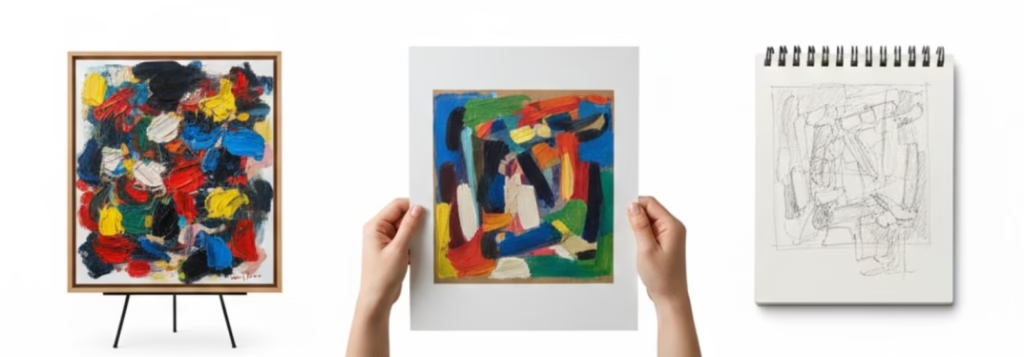
Raising prices doesn’t mean abandoning the collectors who supported you early on. Here are dignified solutions that preserve relationships while allowing your pricing to grow.
Private Payment Plans for Loyal Collectors
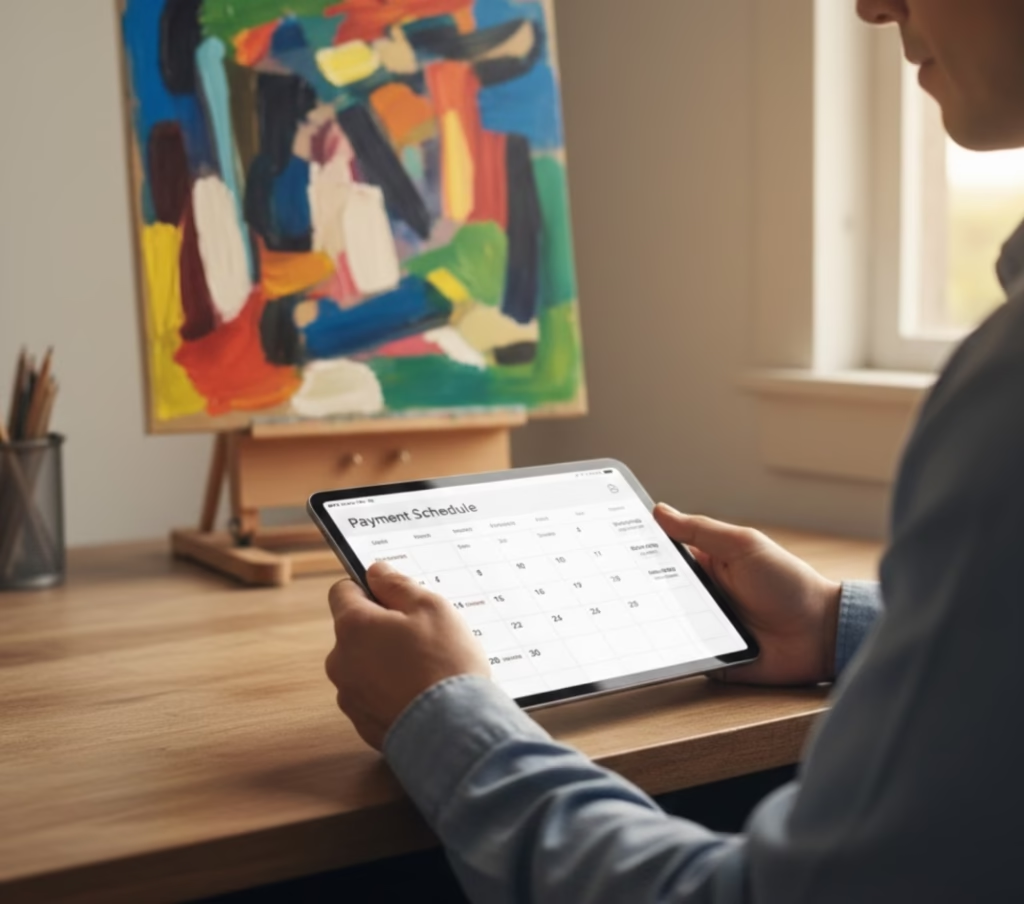
This is one of the most powerful but underutilized strategies.
How it works:
- Collector falls in love with a piece but can’t pay the full amount upfront
- You privately offer installment payments (typically 3-6 months)
- Collector pays deposit (usually 30-40%) and monthly payments
- Work is delivered after final payment (or with first payment if you trust the relationship)
Who gets offered this:
- Long-time collectors who’ve purchased before
- Collectors showing genuine interest but expressing budget concerns
- Serious inquiries where price is the only obstacle
Keep it quiet: This isn’t advertised publicly because you don’t want to undermine your pricing integrity. It’s a private accommodation for valued relationships.
One artist shared: “I cannot tell you how many paintings I’ve sold with this method, regardless of whether they are spending $200 or $2,000. When a collector is clearly in love with a work and I can ‘read’ that finances are an issue, I offer it to them privately. It turns out to be an excellent and dignified solution.”
Example structure:
- $3,500 painting
- $1,200 down payment
- $1,150/month for 2 months
- Final payment = delivery
This preserves your pricing structure while making the work accessible to collectors who have budget constraints but genuine love for the piece.
Offering High-Quality Reproductions or Prints
As your original prices rise, reproductions serve collectors who love your work but can’t afford originals at new prices.
Critical: Quality matters here. Cheap prints from a mass printer can “cheapen” your brand and turn off high-end collectors. Work with a museum-quality reproduction service.
One artist explained her strategy: “As my prices rose over the years, there was a group of individuals who loved my work but could no longer afford even my small paintings. I wasn’t willing to keep my prices low for one segment of the market. This year I began offering reproductions of my most popular pieces. The key was finding a very high quality publisher so that I didn’t ‘cheapen’ my brand and turn off the high-end collectors.”
Pricing guidelines:
- Reproductions typically 5-15% of original price
- $3,000 original → $450 limited edition print (15%)
- $5,000 original → $350 open edition print (7%)
- Clear distinction in marketing between original and reproduction
Benefits:
- Maintains relationship with priced-out collectors
- Creates new revenue stream
- Increases brand awareness (more people have your work)
- Doesn’t compete with original pricing
Creating Tiered Offerings
Not everything you create needs to be priced at your top rates.
Maintain accessibility through:
Small works at entry-level prices ($200-800):
- 8×10″ or 9×12″ studies
- Quick plein air sketches
- Smaller format pieces in less time-intensive mediums
Mid-range works at new professional pricing ($2,000-5,000):
- Your primary size range
- Studio work at sustainable rates
- Work that represents your mature style
Premium large works at top pricing ($6,000+):
- Statement pieces
- Commission-size works
- Your most ambitious projects
This tiered approach means:
- New collectors can enter at affordable level
- Mid-level collectors have plenty of options
- Serious collectors can acquire significant pieces
- You maintain healthy profit margins across the range
Grandfather Clauses for Longest Supporters
For your absolute earliest supporters—the collectors who bought when nobody else would—consider a grandfather clause.
How it works:
- Identify your first 5-10 collectors, or those who’ve purchased 3+ pieces
- Privately offer them continued access at pre-increase prices for a limited time
- Frame it as “Founding Collector” status or “Studio Circle” membership
- Set clear boundaries (e.g., one piece per year at previous pricing)
Example language: “You were one of my first collectors, and that loyalty has never been forgotten. As a founding supporter, I’d like to offer you continued access to one piece per year at pre-increase pricing. It’s my way of honoring your early faith in my work.”
Critical: This must be private, limited, and clearly bounded. You’re not advertising “discounts”—you’re honoring specific relationships with specific people.
The loyalty and word-of-mouth this generates is worth more than the difference in pricing.
Commission Opportunities
Use the transition period strategically:
“I’m raising prices effective March 1st. However, I’m accepting a limited number of commissions through February at current pricing. If you’d like to commission a piece at today’s rates, let’s talk by [date].”
This creates urgency and generates revenue during the transition period while giving committed collectors a last opportunity at previous pricing.
What to Do If Sales Slow After Your Price Increase

Not all price increases go smoothly. Sometimes sales do slow—or even stop—for a period. This doesn’t necessarily mean you made a mistake. But it does require strategic thinking, not panic.
Give It Time: The 3-6 Month Rule
Here’s what typically happens after a price increase:
Month 1-2: Sales often slow or pause. Your regular collectors are adjusting to the new prices. New collectors haven’t yet discovered your work at these rates. You start second-guessing everything.
Month 3-4: Inquiries pick up. People are getting comfortable with the new pricing. A few sales happen. You breathe easier.
Month 5-6: Sales normalize at the new prices. Your collector base has shifted slightly—you lost some price-sensitive buyers but attracted others comfortable with your new positioning.
The mistake most artists make: They panic in month 2 and reverse course, undoing all their work.
Art business consultant Alan Bamberger advises: “Having to raise prices because sales are good is always better than having to lower them because you set them too high and sales are either slow or nonexistent.”
Don’t panic and reverse course in the first 3 months. Market adjustment takes time.
Track these metrics instead of obsessing about sales:
- Website traffic (are people still finding you?)
- Inquiry emails (are collectors asking questions?)
- Show attendance (are people coming to see work in person?)
- Social media engagement (is your audience still engaged?)
- Gallery feedback (what are they hearing from collectors?)
If these metrics remain steady, sales will likely follow. The market needs time to adjust.
Diagnostic Questions to Ask
If you’ve given it 6 months and sales haven’t recovered, run this diagnostic:
1. Did I raise too much too fast?
- Compare your pricing to competitors again
- Are you now 30%+ higher than comparable artists?
- Did you jump 50%+ in a single increase?
2. Was my communication unclear or apologetic?
- Did you frame it as desperation rather than success?
- Did you apologize excessively in your announcement?
- Did collectors feel surprised or blindsided?
3. Is this economic timing?
- Is there a recession or economic uncertainty?
- Are comparable artists also experiencing slow sales?
- Is this your typical slow season (summer, holidays)?
4. Have I reached new collectors at this price point?
- Are you marketing to the same audience as before?
- Do you need to target more established collectors?
- Are you showing in venues appropriate for your new pricing?
5. Are comparable artists selling at similar prices?
- Do market research again
- Have competitors maintained sales at rates similar to yours?
- Or are they selling well at lower prices than your new rates?
Be honest in this assessment. Sometimes the answer is genuinely “I raised too much” or “I’m ahead of my credentials.” But often the answer is “I need to give it more time” or “I need to reach different collectors.”
When to Hold Firm vs. When to Adjust
Hold firm if:
- You’ve only waited 3-6 months
- Market research still supports your prices
- You’re getting inquiries, just fewer sales
- Economic conditions are temporarily challenging
- Comparable artists are maintaining similar prices
- You’re not experiencing total crickets—just slower sales
Gallery owner Jason Horejs notes: “There have been instances where sales slowed initially after a price increase, but patience proved wise. The market adjusted, and sales recovered at the higher level.”
Consider adjusting if:
- Zero inquiries after 9-12 months (not just fewer sales, but no interest)
- Comparable artists selling well at prices 30%+ below yours
- Multiple collectors specifically cite price as the only barrier
- You jumped too aggressively (50%+) and market isn’t following
- Economic data suggests prolonged downturn
- Gallery partners express serious concern about market resistance
How to Course-Correct Without Looking Desperate
If you determine you need to adjust, do it strategically—never publicly announce “I’m lowering my prices because they were too high.”
Option 1: Limited-time pricing on select pieces
- “Studio sale: Select available works at special pricing through [date]”
- Offer specific pieces at reduced rates without changing your overall structure
- Frame as clearing inventory, not admitting mistake
Option 2: Create new, smaller works at lower price points
- Don’t change pricing on existing size ranges
- Add new, smaller size category (e.g., 6×8″ studies at $400-600)
- This gives price-sensitive collectors new entry point without undermining existing pricing
Option 3: Quietly adjust future work
- Continue selling existing inventory at current prices
- Price new work 10-15% lower going forward
- Never announce this—just implement it
- “Grandfathers” previous increase without public reversal
Option 4: Offer payment plans more proactively
- Keep pricing intact but make installment options more accessible
- Advertises as “Studio payment plans now available”
- Preserves pricing structure while addressing affordability concerns
The key principle: Maintain confidence in your communication. No apologizing, no public admission of “overpricing,” no desperate discounting. Instead, make strategic adjustments that address the problem while preserving your professional positioning.
Expanding Your Collector Base at New Price Point
Here’s an often-overlooked reality: Higher prices attract different collectors.
The person buying $800 paintings is often different from the person buying $3,000 paintings. They have different income levels, different collecting habits, different buying patterns.
When you raise prices significantly, you may need to reach a new audience:
Collectors comfortable at $2,000-5,000 price point:
- More established professionals (doctors, lawyers, executives)
- Serious collectors building curated collections
- Art consultants working with high-end clients
- Corporate art buyers
Where to reach them:
- Upscale galleries (not community art centers)
- Art fairs with higher booth fees and vetted attendees
- Interior designer and architect partnerships
- Collector preview events at museums
- High-end art publications
Your marketing may need to shift. Instagram ads targeting “aspiring artists” won’t reach high-end collectors. Direct mail to interior designers might. Relationships with wealth managers and art consultants might.
As one artist put it: “I realized my market is bi-modal. There are collectors who love my work but can’t afford new prices. I had to find new collectors comfortable at this level rather than expecting my existing base to all make the jump.”
If sales slow after a price increase, ask yourself: “Am I marketing to the right audience for my new positioning?”
Handling Collector Objections & Tough Conversations

Even with perfect communication, you’ll face some pushback. Here’s how to handle the most common objections with confidence and grace.
“Your Prices Used to Be So Affordable”
What they’re really saying: “I liked being able to collect your work easily, and now I’m priced out.”
Poor response: “I know, I’m sorry, but I had to raise them…” (apologetic, weak)
Strong response:
“I’m glad you were able to collect my work early on—those pieces have appreciated nicely! When I started out, those lower prices helped me build my career and develop relationships with collectors like you. Now that demand has grown consistently, I’ve adjusted pricing to sustain my practice long-term.
The good news is that as an early supporter, your pieces have appreciated in value. Your [title] from [year] was [original price], and comparable work now sells for [current price]. You made a smart investment.”
Why this works:
- Reframes as investment win, not loss
- Acknowledges their early support
- Explains necessity without apologizing
- Pivots to their benefit
“I Can’t Afford to Collect Your Work Anymore”
What they’re really saying: “I valued our relationship, but the financial reality has changed.”
This is where you deploy alternatives:
Response Option 1 (Payment Plan):
“I completely understand, and I value our relationship. Would a payment plan make this more accessible? I can offer [3 monthly payments/other structure] to help you continue building your collection. That way you can still acquire the pieces you love without the full upfront cost.”
Response Option 2 (Smaller Works):
“I hear you—price increases are an adjustment. I do create some smaller pieces in the [$X-$Y] range. They’re studies and smaller format works, but they’re still original paintings. Would you like me to let you know when I have something in that range available?”
Response Option 3 (Reproductions):
“I understand. I’ve actually started offering museum-quality reproductions of some of my most popular pieces. They’re giclées on archival canvas at [$X]. It’s not the same as an original, but it’s a way to have the image you love at a more accessible price point.”
Why these work:
- Shows you value the relationship beyond the transaction
- Offers solutions rather than just saying “too bad”
- Maintains pricing integrity while providing options
- Keeps the collector engaged rather than losing them entirely
“Why So Expensive All of a Sudden?”
What they’re really saying: “This feels like a big jump, and I need justification.”
Poor response: “Well, everything’s more expensive now…” (sounds whiny)
Strong response:
“Great question—I’m glad you asked. Several factors: First, material costs have increased significantly—quality canvas and paint are up 20-30% in the past two years. Second, my work has been selling faster than I can replace it, which indicates demand has outpaced pricing. And third, I’ve reached some career milestones [award/gallery representation/museum acquisition] that affect market value.
The increase reflects the current market value and growing demand. I gave my collectors advance notice specifically so they could purchase at previous pricing if they wanted to. Current work is priced at these new rates going forward.”
Why this works:
- Provides objective justification
- Multiple reasons (not just “I need money”)
- Professional tone, not defensive
- Acknowledges their opportunity for advance notice
Hometown/Family/Friends Pressure
The challenge: People who knew you “when” expect affordable prices forever. Your aunt wants a painting for $300 because “you’re family.” Your high school friend expects a “friend price.”
What they’re really saying: “Our personal relationship should override your business pricing.”
This is where you set boundaries:
Response:
“I really appreciate your support over the years, and our [relationship] is important to me. My current pricing reflects my professional practice and market standards for artists at my level. To maintain professional integrity—especially with galleries and other collectors—I need to price consistently regardless of who’s buying.
What I can offer is [payment plan/first chance at new work/other non-price accommodation]. But my pricing structure needs to stay consistent to honor the professional relationships I’ve built.”
Alternative if they push:
“I’d love to gift you a small piece for [occasion—birthday, wedding, anniversary], but I’m not able to discount commissioned work or current gallery inventory. Let me know if a smaller study would be meaningful to you as a gift.”
Why this works:
- Acknowledges relationship warmly
- Holds boundary firmly
- Offers alternative solution
- Explains why consistency matters
Critical: Don’t cave on this. If family/friends get deep discounts and word gets out (it always does), you damage your credibility with galleries and serious collectors. Better to gift a small piece occasionally than to undermine your entire pricing structure.
Other Artists Saying “Your Prices Are Too Low”
Why this happens: Some artists genuinely want to help. Others have self-serving motives—when you charge less, their work looks more expensive by comparison, which benefits them.
The response:
“I appreciate your input. I’ve done market research comparing myself to artists at my experience level with similar credentials. My pricing reflects where I am in my career right now. If I jump too far ahead of my track record, the market won’t support it.”
Internal evaluation:
If one artist says you’re underpriced, be skeptical. If multiple artists, collectors, and gallery owners independently say the same thing, investigate. But always do your own research—don’t just take someone’s word for it.
Art pricing consultant Alan Bamberger notes: “The more you raise prices, the closer your prices get to theirs. The smaller the difference between your prices and their prices, the less affordable your art becomes in comparison to theirs. So I’ll throw the question right back at you. Should you?”
Do your own market research and trust your judgment.
Building Price Increases Into Your Long-Term Strategy

One-off price increases based on panic or necessity aren’t a strategy. You need a systematic approach to sustainable pricing growth over your entire career.
Annual Pricing Review Schedule
Set a specific date each year to review your pricing—treat it like an appointment you can’t miss.
Example: Every October 1st
On that date, evaluate:
- Sales velocity: How quickly is work selling compared to last year?
- Material costs: Have supplies increased significantly?
- Career milestones: Any awards, gallery additions, or recognition since last review?
- Market conditions: Is the economy strong or struggling?
- Comparable artists: Have peers at your level adjusted pricing?
Track this in a simple spreadsheet:
| Year | % Increase | Justification | Sales Impact |
|---|---|---|---|
| 2023 | 0% | Slow economy, held steady | Maintained volume |
| 2024 | 15% | Award win + material costs | Slight slowdown, recovered |
| 2025 | 10% | Consistent demand | TBD |
Not every review results in an increase. Some years, holding steady is the right call. But systematic evaluation prevents you from waking up one day realizing you haven’t raised prices in 7 years and are now catastrophically underpriced.
One artist shared: “I review and usually raise prices every October—I have done so for almost 50 years. All of my clients know this is my regular policy. I generally remind them via email, in which I also include the logic and/or good news that undergirds my reasons. I keep ALL of my pricelists from ALL of my years in business. I find it makes a superb selling tool to show someone how the prices have increased.”
Small, Consistent Increases vs. Big Jumps Over Time
Two valid strategies exist:
Consistent approach (10% annually):
- Example: Start at $2,000 → after 5 years of 10% increases = $3,221 (61% total growth)
- Benefit: Collectors come to expect modest increases, less shocking
- Challenge: Requires discipline to actually do it every year
Big jump approach (hold 2-3 years, then 30-50% jump):
- Example: Start at $2,000 → hold 2 years → jump to $2,800 (40%) → hold 2 years → jump to $3,900 (39%)
- Benefit: Gives market time to adjust between increases
- Challenge: Larger sticker shock each time
Neither is inherently better. The consistent approach works well for artists with steady gallery relationships where annual adjustments are expected. The big jump approach works for artists selling mostly direct who want to avoid frequent communications about pricing changes.
Choose based on:
- Your sales model (gallery vs. direct)
- Your comfort with frequent change
- Your collectors’ expectations
- Market norms in your niche
Coordinating Price Increases With Career Milestones
Timing matters. The same increase is easier for collectors to accept when tied to visible achievements.
Strong justifications:
- “Following my acceptance into [prestigious show/gallery]”
- “After winning [award name]”
- “In light of [museum acquisition]”
- “Receiving [signature status] with [organization]”
Weaker justifications:
- “It’s been a year” (arbitrary)
- “Inflation” (sounds like excuse)
- “I need more money” (too personal)
Plan your price increases around achievements when possible. Won an award in March? Implement price increase in April and tie them together in your communication:
“I’m thrilled to announce my work was awarded [award name] at [show name]. This recognition reflects the growing interest in my work. In light of this achievement, I’m adjusting my pricing effective May 1st to reflect my current market positioning.”
This framing makes the increase feel like a natural consequence of your career growth, not an arbitrary decision.
Economic Considerations
The broader economy affects art sales, though not always in obvious ways.
Recession timing:
- Art market often contracts during economic downturns
- Collectors with less discretionary income cut art purchases
- Strategy: Consider holding prices steady, offer payment plans, focus on smaller works
- Exception: High-end market ($10,000+) often less affected—wealthy collectors keep collecting
Boom times:
- Strong economy = collectors feel confident spending
- Market more receptive to price increases
- Strategy: This is your window—be bolder with increases
Important nuance: Art market trends lag general economic indicators by 6-12 months. The 2008 financial crisis didn’t hit art sales hard until 2009-2010. Watch art-specific data:
- Gallery sales reports
- Auction results in your medium/price range
- Art fair attendance
- Online art platform trends
Don’t raise prices into an obvious downturn, but don’t let vague economic anxiety freeze you either.
Documentation for Long-Term Growth
Keep records—they become powerful selling tools.
Save:
- Every price list you’ve ever created (dated)
- Photos of sold works with original pricing
- Press releases about shows and awards
- Gallery exhibition catalogs
- Collector testimonials
Why this matters:
You can show collectors: “When you bought this piece in 2018 at $1,200, it was a great investment. Similar work now sells for $2,800. You have excellent taste and timing.”
This documentation:
- Validates early collectors’ smart decisions
- Builds narrative of steady value appreciation
- Provides objective proof of career growth
- Creates FOMO for new collectors (“I wish I’d discovered you earlier!”)
One established artist keeps 50 years of price lists and uses them actively in sales conversations: “I show potential collectors the progression. They see my work has appreciated consistently over decades. It’s not speculation—it’s documented growth.”
Special Considerations: Existing Inventory vs. New Work
You’ve decided to raise prices. But what about the ten paintings currently in your studio that were created before the increase? This decision affects immediate revenue and collector perception.
Standard Practice: New Work Only
Industry norm: Price increases apply to work created after the announcement date. Work already completed remains at previous pricing until sold.
Benefits:
- Collectors feel increase is forward-looking, not retroactive
- Honors pricing for work-in-progress when collectors were already considering it
- Creates last-chance opportunity (urgency) for existing inventory
- Seems fair and transparent
Challenge:
- Inventory at old prices may take months to sell through
- You’re still selling “underpriced” work during transition period
- Revenue impact delayed until old inventory sells
Communication: “Effective March 1st, new work will be priced at increased rates. Work completed before this date remains at current pricing while available—these are your last opportunities at these prices.”
When to Raise Prices on Existing Inventory
Sometimes it makes sense to reprice work already completed:
Appropriate when:
- Inventory is small (fewer than 10 pieces) and demand is high
- Prices were dramatically underpriced relative to market (50%+ below comparables)
- Work was recently re-evaluated, reframed, or significantly improved
- You’re entering gallery representation and need consistent pricing immediately
How to communicate this: “Upon review of current market conditions and comparable artists, I’ve repriced my existing body of work to reflect current market value. This aligns my pricing across all available work rather than maintaining outdated pricing on older pieces.”
Warning: This can feel less fair to collectors who were considering pieces at old prices. Use judiciously and be prepared for some friction.
The Grandfather Strategy
A hybrid approach that protects relationships:
“All work created before December 1st remains at previous pricing for my collector email list only. After [date], remaining inventory will be repriced to current rates.”
This strategy:
- Creates urgency for your email subscribers
- Rewards loyal followers with access to old pricing
- Allows you to reprice remaining inventory after a reasonable window
- Honors existing collectors while not indefinitely selling underpriced work
Example timeline:
- December 1: Announce price increase effective January 15
- December 1-January 14: Email list has access to existing inventory at old prices
- January 15+: Any remaining inventory repriced to new rates, new work at new rates
This feels fairest to most collectors and gives you a defined window to clear old inventory before repricing.
Key Takeaways: Your Price Increase Action Plan

You’ve absorbed a lot of information. Here’s your actionable roadmap:
Before Raising Prices:
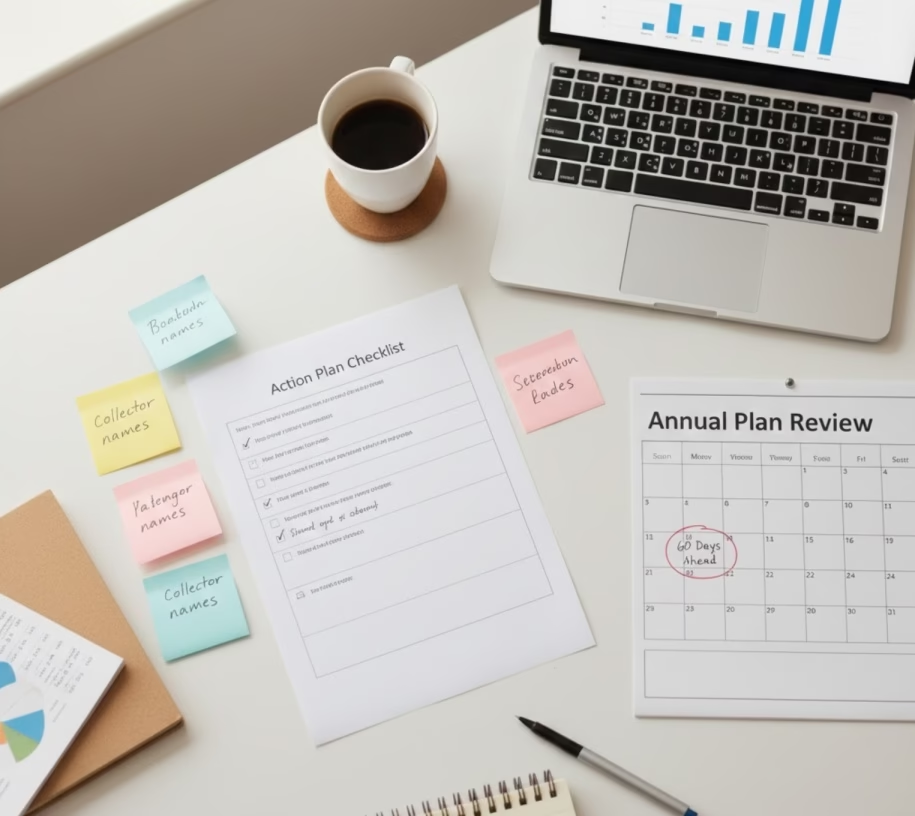
✓ Research comparable artists at your experience level
- Create spreadsheet of 5-10 similar artists
- Calculate their price per square inch
- Note their career milestones and gallery relationships
- Identify where your pricing falls relative to peers
✓ Calculate sustainable pricing that covers costs + fair wage
- Track hours per painting honestly
- Factor in materials, overhead, shipping
- Ensure you’re earning $50-75/hour minimum after all costs
- Build in 50% gallery commission even if selling direct now
✓ Identify which collectors to notify personally
- List collectors who’ve purchased 2+ pieces (personal email)
- Broader collector list (newsletter announcement)
- Determine staging: personal → list → public
✓ Prepare communication templates
- Personal collector email (gratitude-focused)
- Newsletter/social announcement (success-framed)
- Gallery talking points (coordinate timing)
Communicating the Increase:
✓ Give loyal collectors 30-60 day advance notice
- Personal email to repeat collectors first
- Thank them genuinely for their support
- Offer specific timeline for current pricing
✓ Offer last-chance purchases at current pricing
- Clear deadline (not open-ended “while supplies last”)
- Optional: Mention specific available pieces
- No pressure, just opportunity
✓ Frame as career growth, not desperation
- “Growing demand” language, not “I need money”
- Tie to achievements when possible
- Professional tone, no apologizing
✓ Thank collectors for their support
- Acknowledge their role in your journey
- Note their smart early investment if applicable
- Maintain relationship focus, not just transactional
Alternative Solutions:
✓ Payment plans for priced-out loyal collectors
- Offer privately (not advertised publicly)
- Typical: 30-40% down, 2-3 monthly payments
- Maintains pricing integrity while keeping relationships
✓ High-quality reproductions for wider accessibility
- Museum-quality giclées (not cheap prints)
- 5-15% of original pricing
- Clear marketing distinction from originals
✓ Small works at entry-level prices
- Maintain 8×10″ or small studies under $500
- Gateway for new collectors to discover your work
- Doesn’t compete with your primary pricing
✓ Grandfather clauses for earliest supporters
- First 5-10 collectors or 3+ purchase collectors
- Private offer of limited ongoing access at previous rates
- “Founding Collector” special status
If Sales Slow:
✓ Give it 6 months before adjusting
- Market needs time to adjust to new pricing
- Track inquiries and traffic, not just sales
- Don’t panic-reverse in first 90 days
✓ Evaluate: pricing, communication, market timing
- Compare to competitors again
- Review your announcement messaging
- Consider economic factors and seasonality
✓ Expand collector base at new price point
- Market to more established collectors
- Consider upscale galleries or art fairs
- Partner with interior designers and art consultants
✓ Consider smaller works, not price decreases
- Add new size category rather than lowering prices
- Offer payment plans more proactively
- Never publicly announce price reduction
Long-Term Strategy:
✓ Annual pricing reviews (don’t wait for crisis)
- Set calendar date for yearly evaluation
- Track in spreadsheet: year, increase, justification, impact
- Not every review = increase, but consistent evaluation prevents crisis
✓ 10-20% increases every 1-2 years typical
- Industry standard for consistent growth
- Collectors come to expect modest increases
- Compounds significantly over career lifetime
✓ Coordinate with career milestones
- Time increases around awards, shows, gallery additions
- Provides objective justification
- Feels less arbitrary to collectors
✓ Document growth to show collectors their smart investment
- Save all old price lists
- Can show: “Your 2019 purchase at $1,500 = work now at $3,200”
- Validates their early support
- Creates urgency for new collectors
Your Next Step
Stop reading. Start acting.
Here’s your assignment for this week:
Day 1-2: Research comparable artists. Create that spreadsheet. Calculate their price per square inch. Be honest about where you fall.
Day 3-4: Calculate your actual costs and hourly wage. Use the formula: (Sale price – Commission – Materials – Overhead) ÷ Hours. If you’re below $50/hour, you need to raise prices.
Day 5-7: If you’re underpriced by 20%+ relative to your research, schedule your price increase for 60 days from now. Draft your collector communication emails using the templates in this guide.
The uncomfortable truth: Every month you wait to raise necessary prices costs you real money—and moves you one month closer to burnout.
Your collectors want you to succeed. They want your prices to rise because it validates their investment. They want you to have a sustainable practice so you can keep creating for decades.
Stop protecting them from price increases they expect and actually welcome. Start protecting your ability to make the art they love.
The conversation you’re avoiding isn’t as scary as the burnout you’re risking.
Make the decision today. Schedule the increase. Draft the email.
Your future self—the one still creating art joyfully in ten years—will thank you.