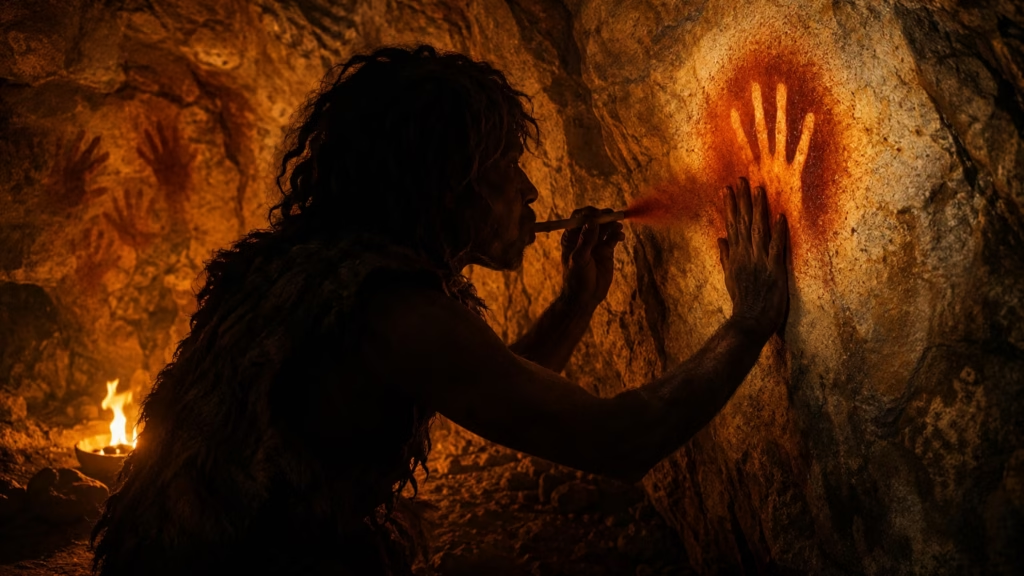
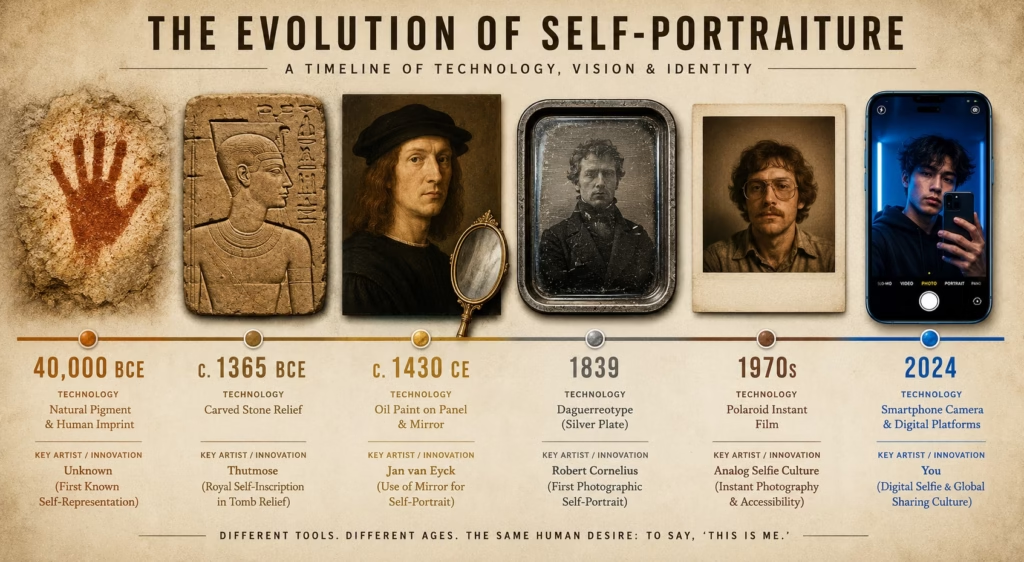
Forty thousand years ago, someone pressed their hand flat against a cave wall in northern Spain, blew red ochre powder around their fingers, and stepped back to look. The stencil of a hand — their hand — remained on the stone. I was here. This is what I look like.
Last Tuesday, approximately 93 million people did something structurally identical with a smartphone.
That continuity is not a coincidence, or a cute parallel to notice and move on from. It is, arguably, one of the most revealing facts about human nature: across every culture, every technology, every era of recorded history, people have felt the compulsion to turn the creative act inward and make themselves the subject. The self-portrait is not a genre with a beginning and an end. It is an unbroken thread running from the ice age to Instagram, from ochre on limestone to pixels on a screen.
This is the complete story of that thread — the technologies that enabled it, the artists who elevated it into one of the most psychologically rich art forms in existence, and what it tells us about the human need to say, simply: I existed. I looked like this. I felt like this.
What is a self-portrait? A self-portrait is any artwork — painting, drawing, photograph, sculpture, or digital image — in which the artist depicts themselves as the primary subject. Self-portraiture has a documented history spanning at least 40,000 years, from prehistoric hand stencils to Renaissance oil paintings made possible by affordable mirrors, to the first photographic selfie in 1839, and the smartphone selfies of today.
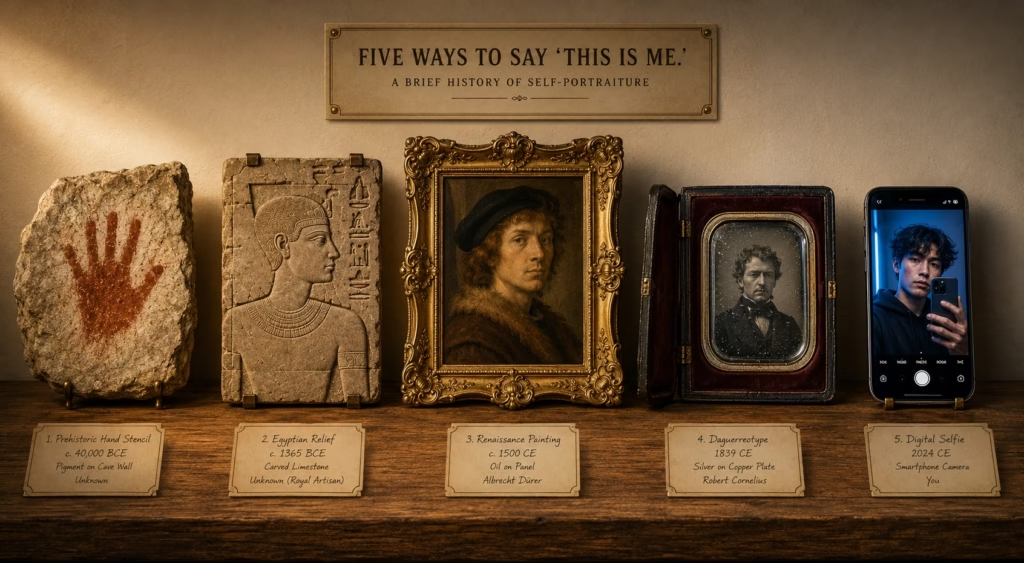
Table of Contents
Before the Canvas — Prehistoric and Ancient Origins
The earliest art historians made a mistake that took decades to fully correct: they started the history of self-portraiture in the Renaissance. This is like starting the history of music with Mozart. It misses tens of thousands of years of humans doing exactly the same thing with whatever tools they had.
The Hand on the Cave Wall
The Panel de las Manos — the Panel of Hands — sits in the cave of El Castillo in Cantabria, northern Spain. The paintings were found in 1903. In 2012, uranium-thorium dating placed some of them at more than 40,000 years old, making them among the oldest known artworks on earth.
They are hand stencils: a human pressed their palm and fingers against the cave wall, held a tube to their mouth, and blew red ochre pigment around the outline. The result is a shape defined by absence — the negative space of a living hand, fixed forever in rock.
Art historians debate how much intentionality this required, but the case for these as proto-self-portraits is compelling. The artist’s body was the subject. The artist’s physical presence — the specific shape of their hand — is what was recorded. Some 30,000 years later, the same impulse produced the famous Cueva de las Manos in Patagonia, Argentina: hundreds of hand stencils painted by indigenous peoples in both negative and positive forms. Same continent, different millennia, identical impulse.
What were they trying to say? Probably something close to what we still say in selfies: I was here. I made this. Remember me.
Ancient Egypt and the Classical World
The first self-portrait that depicts an actual recognisable individual — as opposed to just a body part — comes from ancient Egypt. Around 1365 BCE, the chief royal sculptor of Pharaoh Akhenaten, a man named Bak, commissioned (or created himself) a carved stone relief showing himself and his wife Taheri. Bak was not a pharaoh or a nobleman. He was a craftsman — and this makes the work remarkable. In a culture where monumental art was reserved for gods and rulers, a sculptor decided that he and his wife were worth commemorating in stone.
The ancient Greeks were aware of the tradition too. The historian Plutarch records that the sculptor Phidias hid a likeness of himself among the figures on the Parthenon’s “Battle of the Amazons.” No confirmed example survives, but the fact that this story was told suggests that artists inserting themselves into major works was known and notable enough to document. The impulse was there. The genre, as an independent art form, was not yet.
Non-Western Traditions That Western Art Histories Overlook
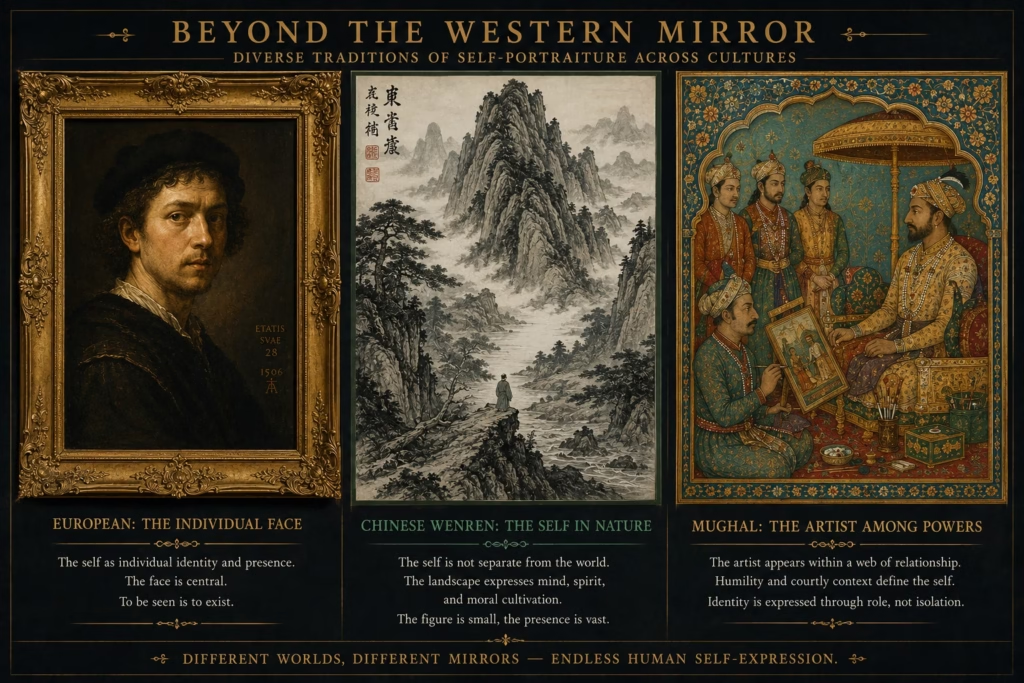
Before continuing down the European timeline — which is where most histories go and stay — it’s worth pausing on traditions that have been consistently undervalued in Western accounts of self-portraiture.
In Chinese painting, particularly within the scholar-gentleman (wenren) tradition, self-portraiture took a form quite unlike the European face-forward pose. Artists depicted themselves as tiny figures within vast mountain landscapes — a deliberate choice that communicated Confucian and Daoist values: human smallness within natural grandeur, the cultivated person in harmony with their environment. These were self-portraits, but the “self” was defined differently: not the face, but the figure’s relationship to the world around it.
The Zen Buddhist tradition produced something else entirely: lively, semi-caricatured self-portraits used as tools of spiritual self-examination. Where European self-portraiture often aimed at dignity and likeness, these images embraced distortion and even comedy as paths to truth.
Perhaps the most audacious non-Western self-portrait in history is a Mughal court painting from around 1615–1618. The painter Bichitr created an image called Jahangir Preferring a Sufi Shaikh to Kings, showing the emperor Jahangir receiving gifts from four figures: a Sufi religious leader, an Ottoman Sultan, King James I of England — and Bichitr himself. The court painter placed himself among the most powerful rulers on earth. It is a self-portrait as an act of sheer artistic assertion, carrying the same message as Dürer’s Christ-like frontal pose nearly a century earlier: the artist matters.
The Mirror Changes Everything — Medieval Precursors and the Renaissance
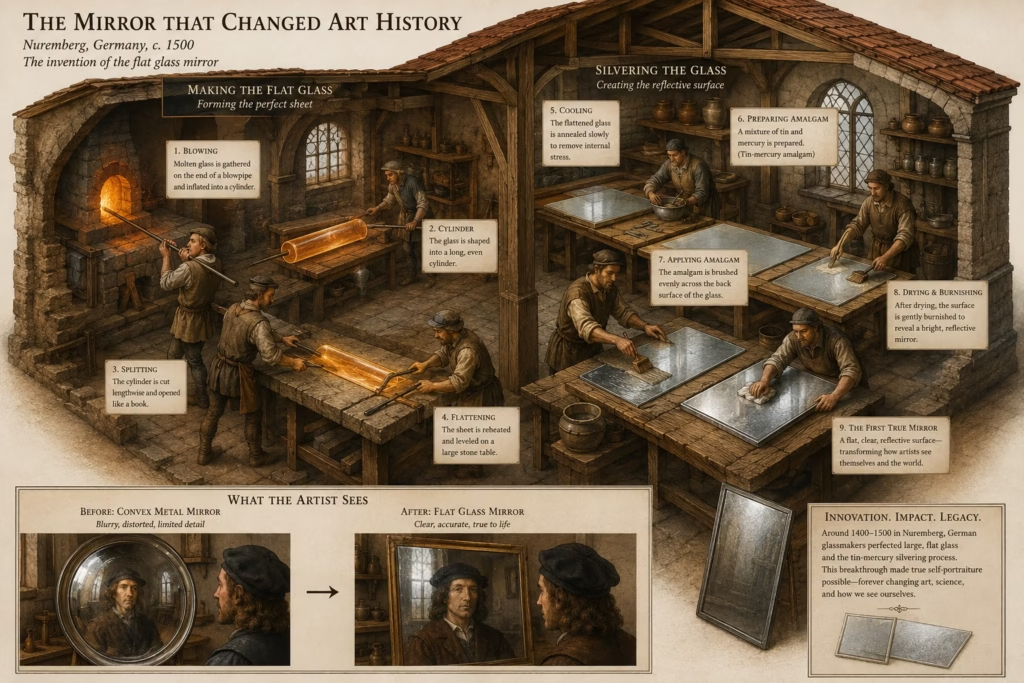
Here is a technological fact that reshapes how you understand the entire history of self-portraiture: the genre as we know it — the independent painting of one’s own face — did not become practically possible until the development of high-quality flat mirrors in early Renaissance Germany.
Before that, artists could look at themselves in water, in polished metal, or in early convex mirrors — all of which produced dim, distorted, or curved reflections inadequate for detailed study. Painting your own face with the precision that oil on panel demanded required being able to see your own face with the precision a mirror provides. When German craftsmen learned to coat glass with a tin-mercury amalgam in the early 15th century, producing flat, clear, reliable reflections for the first time, they didn’t just create a useful domestic object. They unlocked a genre.
Medieval Artists Hiding in Plain Sight
Before that mirror revolution, artists who wanted to include themselves in their work had to be creative about it. The result was a practice now called the “self-insert”: artists hiding their own likenesses within larger compositions, typically religious in nature.
The illuminated manuscript tradition includes several apparent self-portraits — Saint Dunstan (c. 10th century) and the monk Matthew Paris (c. 1200s) both left what appear to be self-images in their manuscripts. In fresco painting, the convention of inserting yourself into a scene became common enough that Giorgio Vasari — the 16th-century father of art history — could fill several pages of his Lives of the Artists cataloguing examples.
Masaccio depicted himself as one of the apostles in the Brancacci Chapel frescoes (c. 1425). Benozzo Gozzoli tucked himself into a procession in the Medici family chapel. Johannes Aquila painted himself into two church frescos in the 1370s and 1390s. Orcagna did the same in 1359.
The most famous and charming example is Sandro Botticelli’s Adoration of the Magi (1475/76), painted for the powerful Medici family and packed with their portraits. Botticelli placed himself on the far right of the composition: a blond young man in a tan robe, looking directly at the viewer while everyone else gazes at the Christ child. He’s not hiding — he’s watching us. It’s a self-insert as wink, a signature embedded in paint.
These weren’t accidents or vanity. They were the only available grammar for an impulse that didn’t yet have its own form. The independent self-portrait was waiting for technology to catch up with desire.
Jan van Eyck and the First Independent Self-Portrait
The Flemish master Jan van Eyck is associated with what many art historians consider the earliest surviving panel self-portrait: Portrait of a Man in a Turban, dated 1433. The identity of the sitter is not confirmed — the inscription says only “Als Ich Can” (As best I can), which is also a phonetic pun on “Eyck” — but the balance of scholarly opinion leans toward a self-portrait, and the intimacy of the gaze, fixed directly on the viewer, supports that reading.
Around the same time, the French artist Jean Fouquet created a self-portrait in gold on black enamel (c. 1450) — small, precious, and striking. It is almost certainly the earliest undisputed self-portrait executed as a completely independent work.
The mirror had arrived. The genre had begun.
Albrecht Dürer and the Birth of the Self-Portrait as Statement
If Jan van Eyck planted the seed, Albrecht Dürer grew the tree. The German artist and printmaker from Nuremberg was the first person in history to make self-portraiture a sustained, deliberate, and philosophically serious practice — and he started at age 13.
In 1484, as a teenager learning his father’s trade as a goldsmith, Dürer completed a silverpoint drawing of himself looking in a mirror. It is delicate, observant, and technically astonishing for a child. He would go on to create three major oil self-portraits across his career, each one a calculated statement about identity, status, and the nature of artistic genius.
The Three Major Self-Portraits
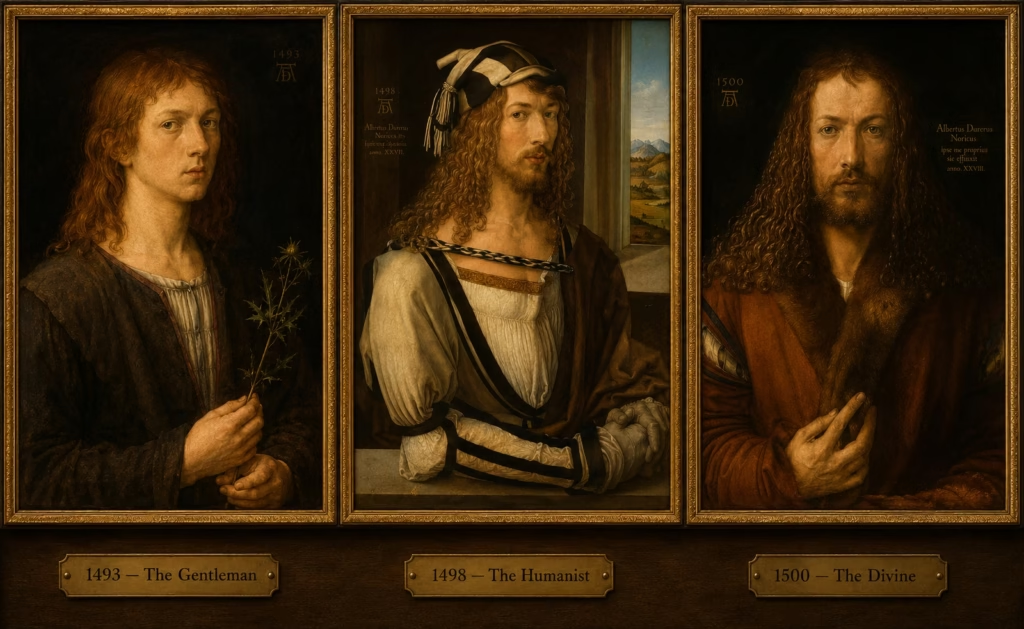
The first oil self-portrait (1493) shows a composed young man holding an eryngium — a plant associated in Germany with fidelity — possibly painted as a gift for his soon-to-be wife. Dürer presents himself as a gentleman, not a craftsman.
By 1498, after a transformative trip to Italy where he encountered Renaissance humanism firsthand, the second self-portrait shows a different Dürer entirely: dressed in fine Italian fashions, gloves, and a fashionable cap, he looks like a Venetian nobleman rather than a Northern craftsman. The message is deliberate. He had been to Italy. He was not a mere tradesman. He was an intellectual.
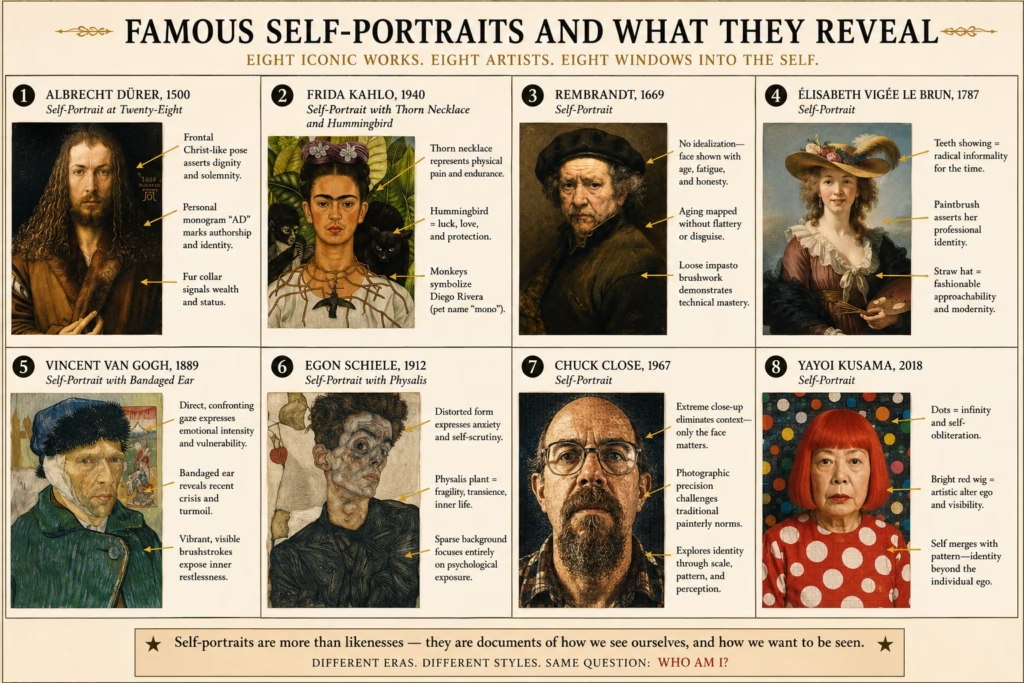
The third self-portrait, from 1500, is the most radical thing Dürer painted. He depicted himself in a completely frontal pose — the pose used, in the entire Western pictorial tradition up to that point, exclusively for images of Christ. The proportions of his face echo devotional icons. His right hand is positioned near his chest like a figure giving blessing. The large monogram “AD” dominates the upper left of the panel — a personal logo centuries before the concept existed.
What was Dürer claiming? That artistic genius is a form of divine gift. That the artist, like Christ, creates. That the maker deserves the same visual reverence as the sacred. It is an audacious, almost blasphemous statement — and it established the self-portrait as an arena for philosophical and cultural claim-making that would persist for five centuries.
The Self-Portrait as Professional Tool
Dürer’s self-portraits also served a more practical purpose that would be familiar to any contemporary freelancer: they were his portfolio. The 1500 self-portrait was likely exhibited in private showings to prospective patrons and used in demonstrations to students, according to the Visual Art Encyclopedia WikiArt. Look at what I can do. Look at how I render texture — the fur collar, the hair. Hire me.
Artists throughout the Renaissance and beyond used self-portraits this way: as a calling card demonstrating that they could paint faces, render materials, achieve likeness. The model is free (yourself), always available, and can sit as many sessions as you need. The practical and the philosophical were never as separate as they might seem.
The Dutch Golden Age — Rembrandt’s Visual Autobiography
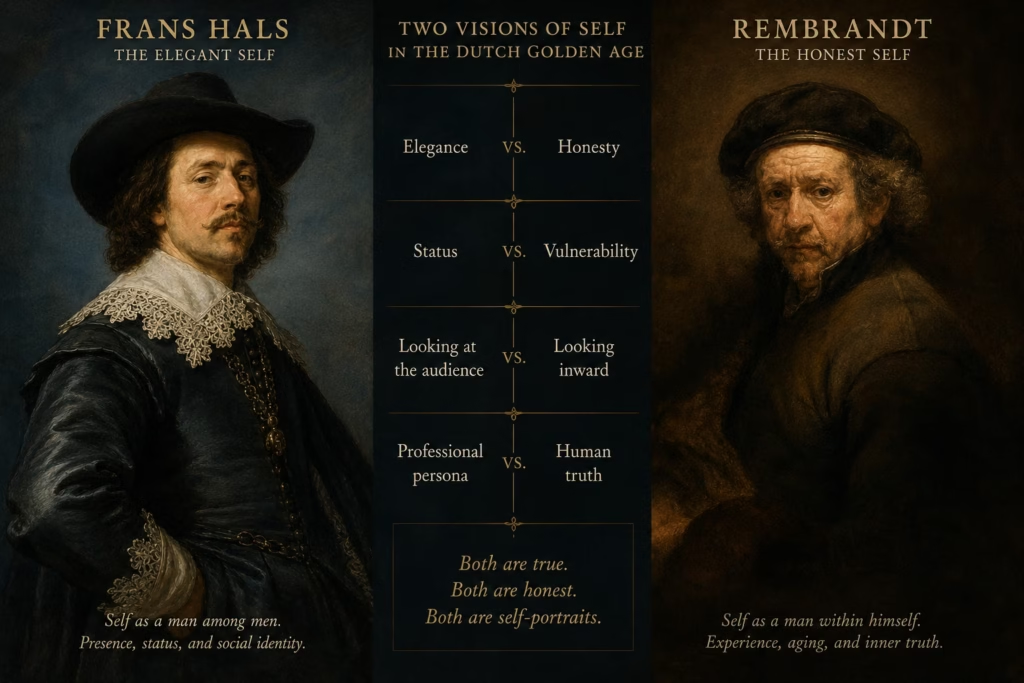
The next great leap in the history of self-portraiture belongs to a single artist working in Amsterdam in the 1600s: Rembrandt Harmenszoon van Rijn. Nobody before or since has used self-portraiture the way Rembrandt did — as a complete visual autobiography, tracking a human life from brash young ambition to devastating old-age vulnerability across four decades of work.
At one point, scholars attributed around 90 paintings to Rembrandt as self-portraits. Modern scholarship, applying rigorous technical analysis and provenance research, has refined that count to something over 40 confirmed autograph paintings, plus a few drawings and 31 etchings. That is still an extraordinary number. By comparison, Van Gogh — usually cited for prolific self-portraiture — painted around 36.
The Method and Its Technical Consequences
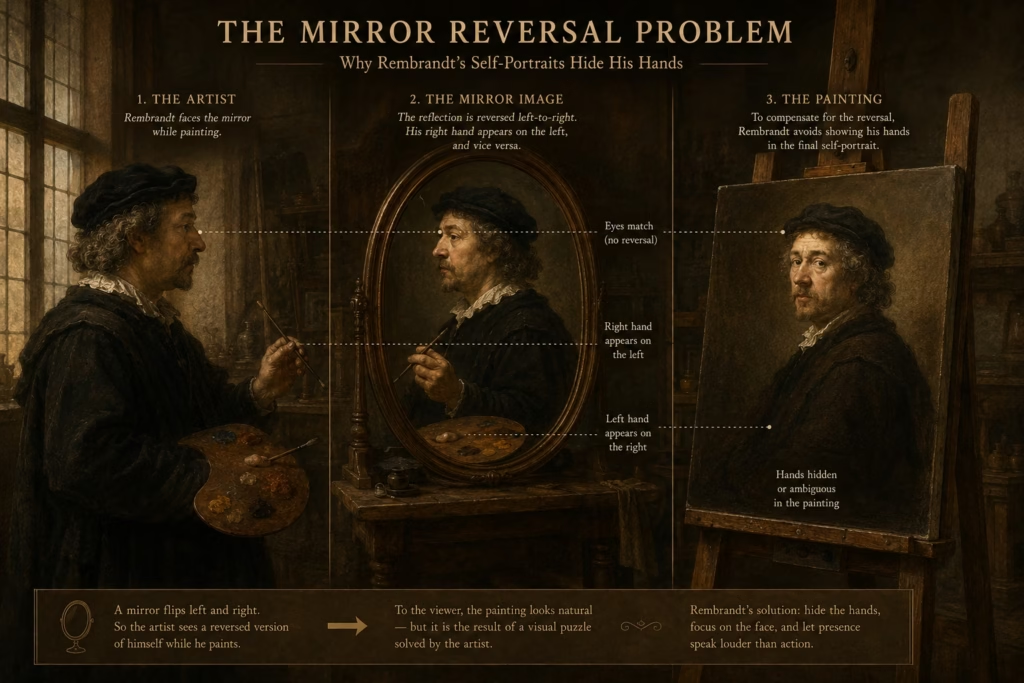
Rembrandt painted himself by looking in a mirror. This sounds obvious, but it has a consequence that rewards close attention. A mirror reverses left and right. When Rembrandt looked in the mirror and painted what he saw, he painted a flipped version of his actual face. His hands, which would appear on the “wrong” side in the reversed image, are frequently absent from his self-portraits or, as art historians note, “just cursorily described.” He compensated by omitting the most obvious tell.
His technical concerns mattered less than his emotional ones. The early self-portraits — those from the 1620s and early 1630s — are experiments in expression and light. The young Rembrandt pulled faces at himself: grimacing, squinting, mouth open, eyes wide. He was using his own face as a laboratory for the study of human expression, a skill that would serve his commissioned portraits and his biblical scenes alike.
A Life in Paint
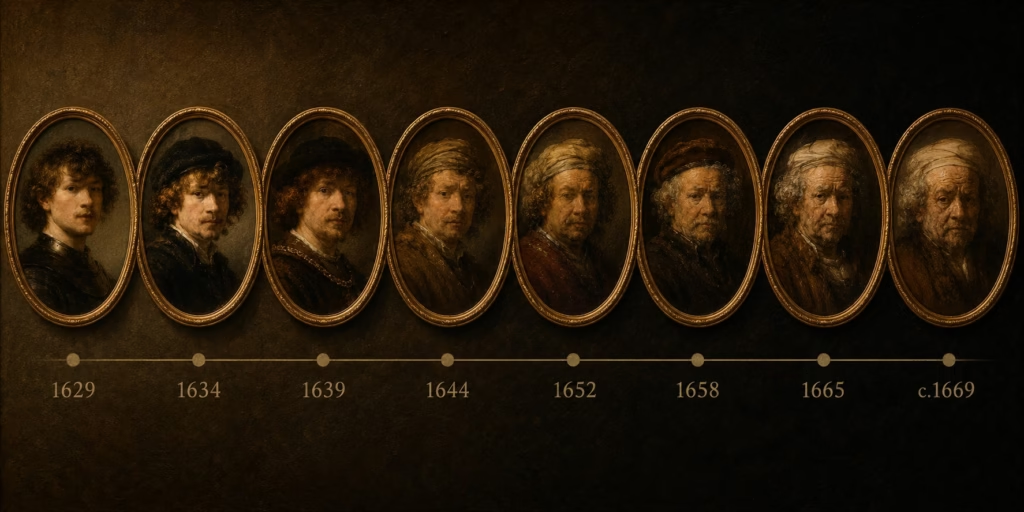
As Rembrandt aged — and as his financial circumstances swung from success to bankruptcy in the 1650s — his self-portraits changed in ways that art history has few parallels for. The comfortable middle-aged merchant of the 1640s gives way to something rawer and more searching. His 1660 Self-Portrait (now at the Metropolitan Museum of Art) shows a man in his mid-fifties who has lived hard and survived. The eyes are the achievement of the painting: watchful, tired, containing the specific intelligence of someone who has seen through most things.
Self-Portrait as the Apostle Paul (1661) goes further still. Rembrandt depicts himself in the robes and attitude of the saint who wrote most of the New Testament — a man defined by conversion, suffering, and unwavering belief. The papers in Paul’s hand (his epistles) merge with what might be Rembrandt’s own brushes and notebooks. It is not a costume portrait. It is a meditation on identity, vocation, and what it means to make things that outlast you.
The last self-portraits, from the final years of his life (Rembrandt died in 1669), are almost unbearable in their honesty. The face is mapped with age. There is no flattery, no idealization, no protective irony. Just an old man looking at himself and painting what he sees. No artist has ever left a more intimate record of a human life.
Other Dutch Golden Age Voices
Rembrandt was not alone in his preoccupation. Anthony van Dyck produced elegant self-portraits designed to confirm his status as a court painter of the highest order — impeccably dressed, self-possessed, always slightly above the viewer. The contrast with Rembrandt’s late work is instructive: same era, same genre, opposite philosophy of the self.
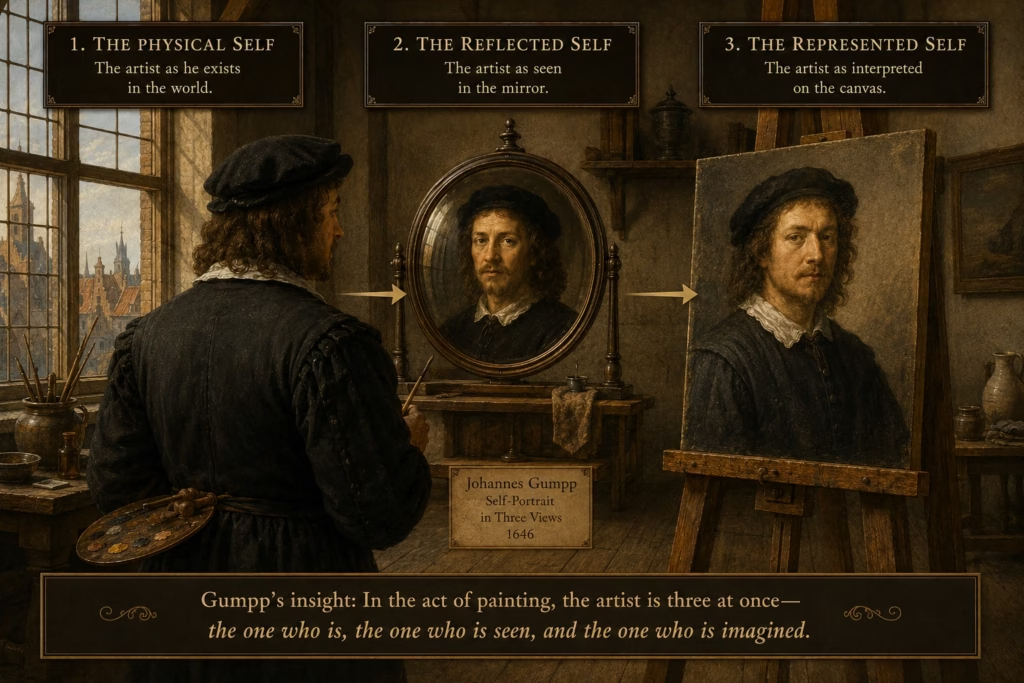
Perhaps the most conceptually witty self-portrait of the Dutch Golden Age belongs to a lesser-known painter: Johannes Gumpp’s 1646 triptych, which shows the artist seated with his back to us, facing a round mirror that reflects his face, which he is then painting on a canvas to his left. Three versions of the artist in one image — the physical body, the mirror reflection, the painted representation — neatly encapsulating everything that self-portraiture is about: the gap between how we are, how we see ourselves, and how we represent ourselves to others.
Art Movements and Their Self-Portraits — Baroque to Modernism
Every major art movement brought a new philosophy of the self, and the self-portrait was how artists made that philosophy visible. Tracking self-portraits across movements reveals something more interesting than a list of famous works: it reveals how the definition of what a “self” is, and what it means to paint one, has shifted across the centuries.
Baroque — Self-Elevation and Self-Examination
The Baroque era gave us two of the most powerful self-portraits in the Western tradition, both made by artists who had every reason to need their work to speak for them.
Artemisia Gentileschi’s Self-Portrait as the Allegory of Painting (c. 1638–39) is in a class of its own. Gentileschi — who had survived a rape, a traumatic public trial, and years of condescension from male colleagues — painted herself not just as an artist, but as La Pittura: the personification of Painting itself, as described in Cesare Ripa’s Iconologia. She wore La Pittura’s traditional gold chain with a mask pendant. She was the figure of Painting, mid-creation, arm raised, absorbed entirely in the act. It is one of the greatest acts of self-assertion in art history.
Elisabeth Vigée Le Brun, the favourite portraitist of Marie Antoinette, painted 37 self-portraits across her long career. One detail about them is quietly revolutionary: she often painted herself smiling, with her teeth showing. This was considered vulgar by the standards of formal portraiture at the time — a smile was for genre scenes and low-status subjects. Vigée Le Brun did it anyway, and in doing so created an image of a woman artist who was warm, approachable, and commercially appealing. It was personal branding before the term existed.
Romanticism and Realism — The Interior Life as Subject
The Romantic movement made a simple but profound claim: the artist’s inner experience is a valid and important subject. This had direct consequences for self-portraiture.
Gustave Courbet’s The Desperate Man (c. 1843–45) shows the artist wide-eyed, both hands clutching his head, turning toward the viewer with an expression of barely-contained panic. It looks more like a selfie taken in a moment of genuine distress than a commissioned portrait. That rawness was deliberate. Courbet was establishing his credentials as a Realist — someone who would show things as they actually are, including the interior states of the artist himself.
Impressionism and Post-Impressionism — Technique as Autobiography
The Impressionists used their self-portraits to demonstrate, as much as anything, how they saw. Monet’s Self-Portrait in Beret (1886) is defined by its restraint — the same artist who could dissolve a cathedral into coloured light presents himself with quiet dignity. The brushwork is loose and immediate, but the posture is contained.
Paul Gauguin’s Self-Portrait with Halo and Snake (1889) goes in the opposite direction. Painted the year after he left France for Brittany (and two years before his fateful departure to Tahiti), Gauguin depicts himself with a halo above his head and a snake in his hand — simultaneously Christ and Lucifer, artist and sinner, saint and rebel. The Post-Impressionist self-portrait became an arena for myth-making about the artistic self.
Vincent van Gogh — The Most Emotionally Transparent Self-Portraitist
Van Gogh’s ~36 self-portraits deserve their own extended consideration. They were born partly of necessity — he had no money for models — and partly of conviction. He wrote to his brother Theo: “If I can manage to paint the coloring of my own head, which is not to be done without some difficulty, I shall likewise be able to paint the heads of other good souls, men and women.”
What makes Van Gogh’s self-portraits uniquely revealing is that the brushwork itself changes as his mental state changes. The Paris self-portraits from 1887 are energetic but structured; the influence of Impressionism is visible, the brushstrokes confident and exploratory. The Arles self-portraits from 1888, including the famous Self-Portrait with Bandaged Ear (January 1889 — painted weeks after the incident, not during it), are defined by a different kind of intensity. The swirling, thickened impasto and the gaze — fixed, steady, not seeking sympathy — communicate something more concentrated than his earlier work.
Note, incidentally, that the bandage is on Van Gogh’s left ear in the painting. He cut his right ear. He was painting himself in a mirror.
20th Century Modernism — Fragmentation and the Mass-Produced Self
Pablo Picasso painted self-portraits from the age of 15 to 90, and if you line them up chronologically, you get the entire history of modernism compressed into one artist’s changing relationship with his own face. The 1896 portrait is academically accomplished. The Blue Period works are melancholy and elongated. The 1907 faces fragment under the pressure of Cubism. By the late self-portraits — blocky, almost cartoonish — the face has been reduced to a set of shifting planes, the self a collection of perspectives that cannot be reconciled into a single image.
This fragmentation had a philosophical point: the unified, coherent self of Renaissance humanism no longer felt credible in the 20th century. Modernism suspected it had never existed.
Andy Warhol took this further, in a different direction. His silkscreen self-portraits from the 1960s onward took his own face and subjected it to the same industrial repetition as his Campbell’s Soup cans and Marilyn Monroe prints. He was saying something that sounds almost contemporary: the celebrity self, the public self, is a commodity. When Warhol said he made self-portraits “as a reminder that I’m still around,” the joke contained the whole philosophy.
Norman Rockwell’s Triple Self-Portrait (1960), painted for the cover of the Saturday Evening Post, plays with these ideas in a warmer register. Rockwell depicts himself from the back, studying his mirror reflection, while on the canvas in front of him he renders a more idealised version of his own face. In the upper right corner of the canvas-within-the-canvas, he has pinned small reproductions of self-portraits by Dürer, Rembrandt, Picasso, and Van Gogh. It’s a love letter to the genre and a gentle joke about the gap between how we see ourselves and how we want to be seen — the same gap that every self-portrait, in every medium, is negotiating.
Women and the Self-Portrait — A Parallel History of Resistance and Reclamation
The history of women and self-portraiture is not a sidebar to the main story. In many ways, it is the most politically charged version of the story — because for women, picking up a brush and painting your own face was, for centuries, a transgressive act before it was anything else.
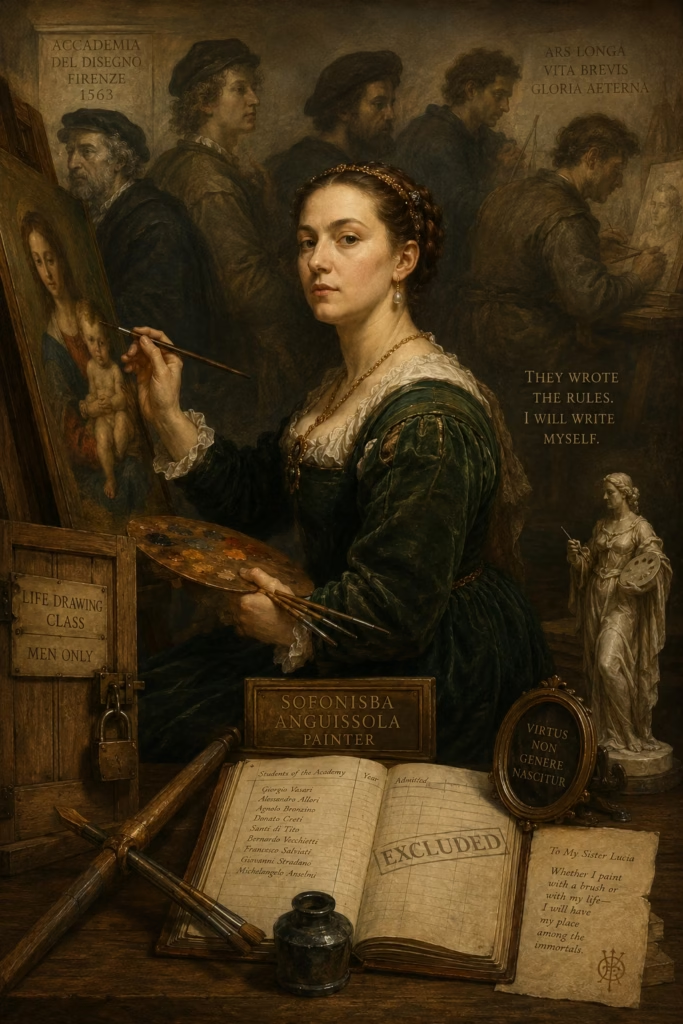
During the Renaissance, there was a well-known saying: “Every artist paints himself.” Read closely, that phrase reveals exactly who was considered a legitimate artist — and who wasn’t. Women were systematically excluded from formal art training, particularly from life-drawing classes, which required the presence of nude models. Without life drawing, ambitious figure compositions were inaccessible. Self-portraiture became, among other things, the one great subject that always remained within reach.
The Pioneers Who Made Space Before Space Existed
Caterina van Hemessen’s 1548 self-portrait is among the earliest known oil self-portraits by a woman. She depicts herself at an easel in the act of painting, looking directly at the viewer. The message is quiet but firm: I am an artist. This is what I do.
Sofonisba Anguissola (c. 1532–1625) took the argument further. Her Self-Portrait at the Easel Painting a Devotional Panel (1556) shows her modestly dressed, painting the Virgin Mary — satisfying the expectation of female piety — while simultaneously asserting her professional identity through the tools in her hands: palette, brushes, mahlstick. She locks eyes with the viewer. That gaze is the whole argument. Look away if you want. I’m still here.
Artemisia Gentileschi’s Self-Portrait as the Allegory of Painting does something else entirely. By literally embodying La Pittura — the personification of the art of painting — Gentileschi didn’t just claim the right to paint herself. She claimed that she was painting. Not a woman who painted. Painting itself.
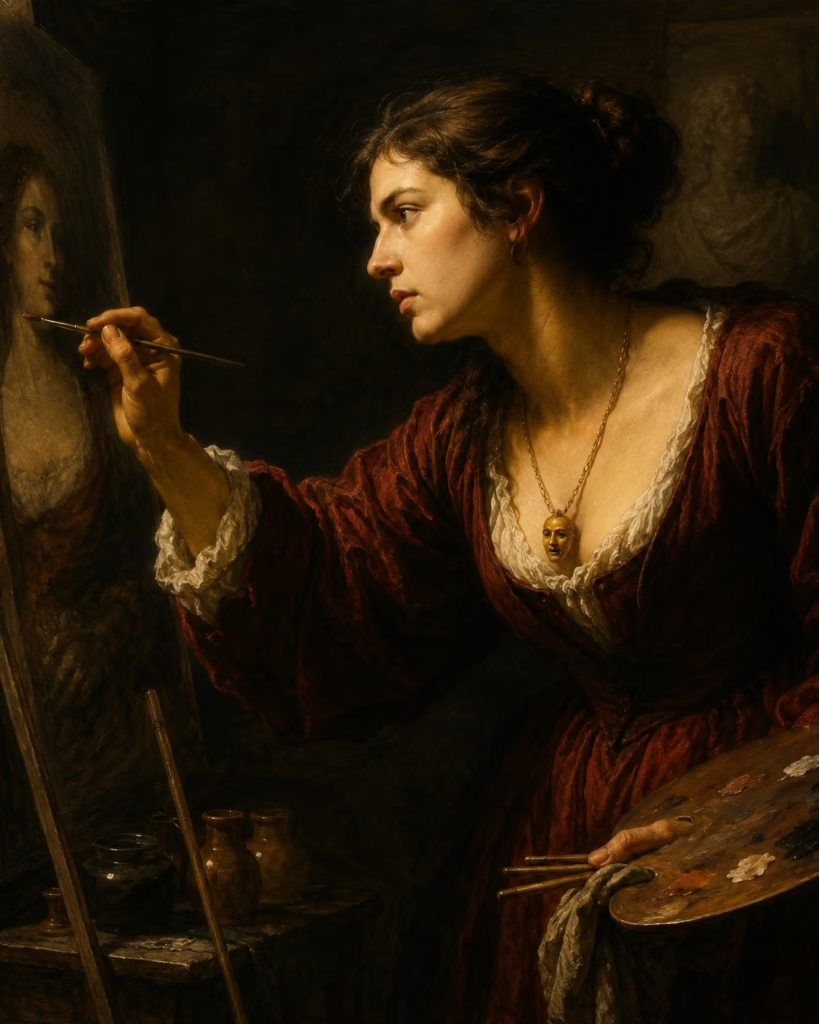
Elisabeth Vigée Le Brun, the court portraitist who would eventually paint 37 self-portraits, used each one to project a specific and carefully calculated public image. Where male artists used self-portraits to claim intellectual authority, Vigée Le Brun built something different: warmth, approachability, elegance. Her smiling portraits — radical in their rejection of formal stiffness — were effective precisely because they worked within the social expectations of the time while quietly exceeding them.
Breaking Every Taboo — Paula Modersohn-Becker
The German Expressionist Paula Modersohn-Becker (1876–1907) went somewhere none of them had gone before. In 1906, she painted a self-portrait that showed herself nude, from the torso up, pregnant — or depicted as pregnant, the pregnancy is believed to have been symbolic — in a pose that referenced Paul Gauguin’s Tahitian women but reclaimed the gaze entirely. She was not observed. She was the observer. She was not a subject. She was the painter, looking back.
It was, as far as scholars can determine, the first nude pregnant self-portrait ever painted by any artist, male or female. Modersohn-Becker died the following year at age 31. She left behind a body of work that took decades to be fully recognised, partly because what she painted was too ahead of its time for its time.
Frida Kahlo — Self-Portraiture as the Only Adequate Language
Of all the artists who have ever made self-portraits, Frida Kahlo is probably the most discussed today, and for reasons that go beyond the quality of the work alone. Her story is inseparable from her art in a way that is unusual even in the self-portraiture genre.
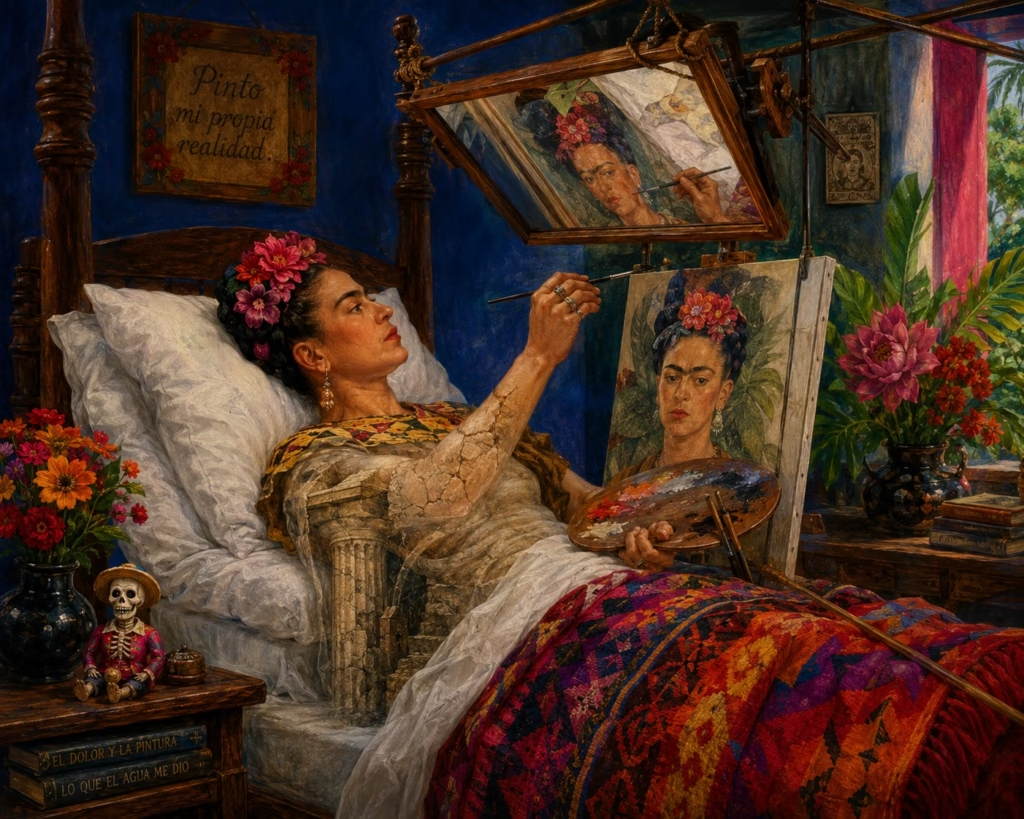
In 1925, Kahlo was 18 years old and riding a bus in Mexico City when it collided with a tram. She suffered a broken spinal column, a broken collarbone, broken ribs, a shattered pelvis, and a steel handrail that entered her body through her hip and exited through her vagina. She would survive thirty-five surgeries in her lifetime and live in chronic pain until her death at 47.
Her father installed a mirror above her bed during her recovery so that she could see herself to paint. She did not choose self-portraiture as a genre. Her circumstances chose it for her. And then she chose to stay.
Of the 143 paintings Kahlo made over her lifetime, 55 are self-portraits — more than a third of everything she created. They are not vanity. They are testimony. The spinal column replaced with a crumbling plaster column in The Broken Column (1944). The arrows and nails embedded in her flesh in Self-Portrait with Thorn Necklace and Hummingbird (1940). The two Fridas sitting hand-in-hand in The Two Fridas (1939), painted in the months following her divorce from Diego Rivera, their hearts exposed and connected by a shared artery that has been cut on one side.
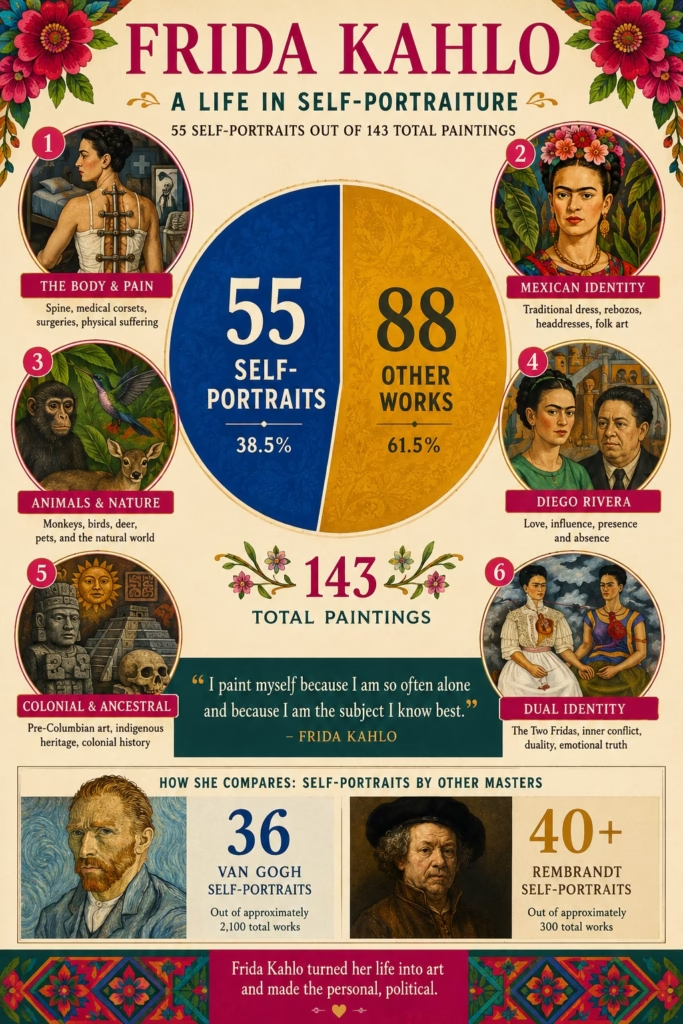
Kahlo knew exactly what she was doing. She said it plainly: “I paint myself because I am so often alone and because I am the subject I know best.” But the subject she knew best was also the subject through which she could address everything: chronic illness, Mexican identity, the female body, political history, love, loss, and fury. She used the first person because no other person could carry the weight of what she needed to say.
Photography, Feminism, and the Conceptual Self-Portrait
The second half of the 20th century brought the camera, second-wave feminism, and a group of women artists who used self-portraiture to take the genre somewhere it had never been: into explicit, sustained, sophisticated critique of the structures that had long tried to define women from the outside.
Cindy Sherman began her Untitled Film Stills series in 1977. The 69 photographs show Sherman in the guise of fictional women from Hollywood films — the ingenue, the housewife, the femme fatale, the art student. She is always the photographer and always the subject. But she is never quite “herself” — or rather, she is revealing that “herself” is a construction that can be worn and removed like a costume. The series is not a self-portrait in the traditional sense. It is something more unsettling: a self-portrait that argues the self is always already a performance.
By the 2010s, Sherman was on Instagram, using digital filters to push her face into grotesque, exaggerated versions of social media beauty ideals. The continuity from the Film Stills to the Instagram posts is direct: the medium had changed; the target had not.
Zanele Muholi, the South African visual activist, uses photographic self-portraiture to document and claim visibility for Black LGBTQ+ identity in South Africa — a country where same-sex relationships were criminalised under apartheid and where violence against LGBTQ+ people remains a serious threat. Muholi’s self-portraits are not about the individual inner life in the Romantic tradition. They are about a community’s right to exist and be seen.
From Paintbrush to Camera — Photography Transforms Self-Portraiture
The invention of photography in the 1830s is the most important technological shift in the history of self-portraiture since the glass mirror in the early Renaissance. It changed what was possible, who could participate, and what self-portraiture meant.
The First Photographic Selfie — and the Man Cheated Out of the Title
In October 1839, a young man named Robert Cornelius stepped out in front of a camera he had set up in the back of his family’s lamp store in Philadelphia. He pulled off the lens cap, ran around to stand in front of the apparatus, stood still for about a minute, then ran back and replaced the cap. He developed the daguerreotype and wrote on the back: “The first light picture ever taken.” It was both the world’s first confirmed photographic self-portrait and the first portrait photograph taken in America.
But there is a better — and more complicated — story lurking just behind that moment.
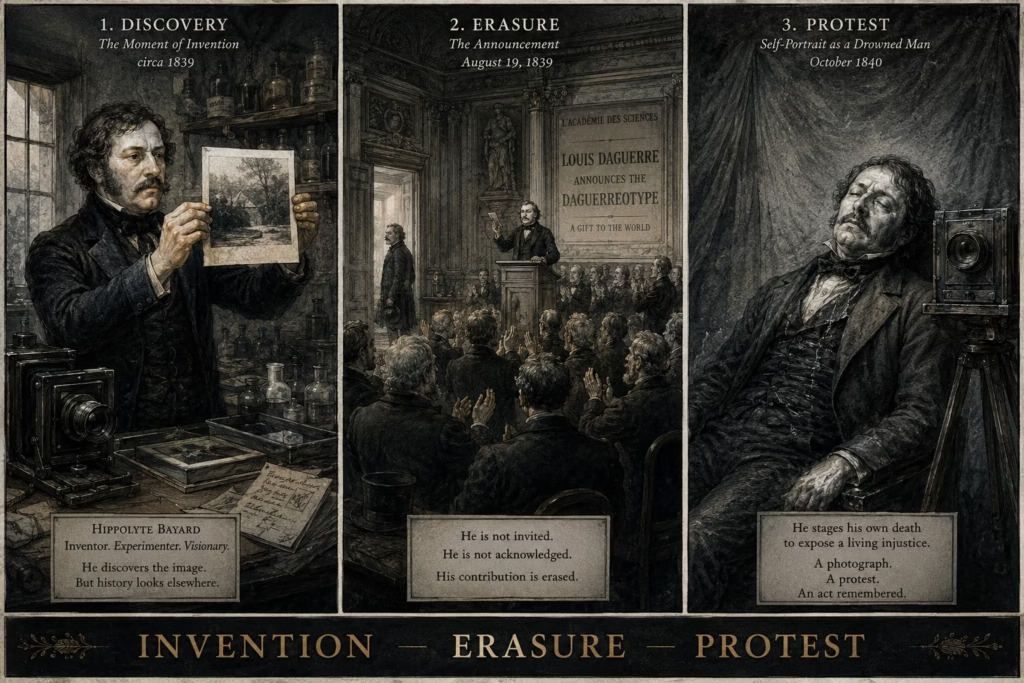
The Frenchman Hippolyte Bayard had developed his own photographic process in 1839, arguably before Louis Daguerre made his public announcement. A friend of Daguerre persuaded Bayard not to present his process to the French Academy of Sciences; Daguerre stepped forward, took the credit and the glory, and Bayard was quietly erased from the official founding mythology of photography.
The following year, 1840, Bayard made his response. He photographed himself seated, eyes closed, shirtless, posed like a corpse — his Self-Portrait as a Drowned Man. Alongside it he placed a written note, composed in the voice of the dead man himself, describing how the government had ignored him, how Daguerre had stolen his discovery, and how the poor wretch had been driven to drown himself in despair. The final instruction: “Ladies and gentlemen, you’d better pass along for fear of offending your sense of smell, for as you can observe, the face and hands of the gentleman are beginning to decay.”
It is simultaneously the first art photograph, the first photographic protest image, and one of the most darkly funny acts of self-portraiture in history. Bayard didn’t get to invent photography. But he invented the concept of staging your own image to make a political statement — which is something a significant portion of contemporary Instagram practice is doing every day.
Photography Democratises the Self-Portrait
Through the 19th century, the technology gradually became more accessible. Long exposure times shortened from minutes to seconds. Portable cameras arrived. By 1900, the Kodak Brownie — priced at one dollar — put a camera in ordinary hands for the first time in history. The self-portrait was no longer the exclusive province of trained artists with studios and mirrors.
Photographers began making self-portraits with the same seriousness that painters had brought to the practice. Man Ray’s experimental photographic self-portraits pushed the medium toward Surrealism. Dorothea Lange photographed herself in ways that showed a woman of intense professional focus. Vivian Maier — the nanny from Chicago whose extraordinary archive of 100,000 photographs was discovered only after her death in 2009 — made hundreds of self-portraits in mirrors, shop windows, puddles on the street, and the chrome surfaces of parked cars. She was using the world itself as a mirror, and the result is some of the most original self-portraiture of the 20th century.
The Selfie Era — 93 Million Self-Portraits a Day
Oxford Dictionary named “selfie” its word of the year in 2013. By then, the phenomenon had already reshaped the visual culture of multiple generations. The front-facing camera on the iPhone 4 (2010) was the technical inflection point — but the impulse, as everything in this article has established, was 40,000 years old.
The Technologies That Made It Happen
The smartphone selfie required three technologies converging: a front-facing camera good enough to produce usable images, sufficient processing power to display and store them instantly, and distribution infrastructure (social media platforms) to share them with an audience. Instagram launched in 2010. The selfie stick arrived around 2014, extending the arm’s reach and expanding what was frameable. By the mid-2010s, it was estimated that 93 million selfies were being taken and shared globally every day.
These numbers are not evidence that human beings suddenly became more narcissistic in the 21st century. They are evidence that the barrier to self-portraiture dropped to near zero. For most of human history, making a self-portrait required either artistic training (to paint) or significant resources (to commission one, or to access early photographic equipment). The smartphone eliminated both barriers simultaneously.
Is a Selfie a Self-Portrait? The Honest Answer
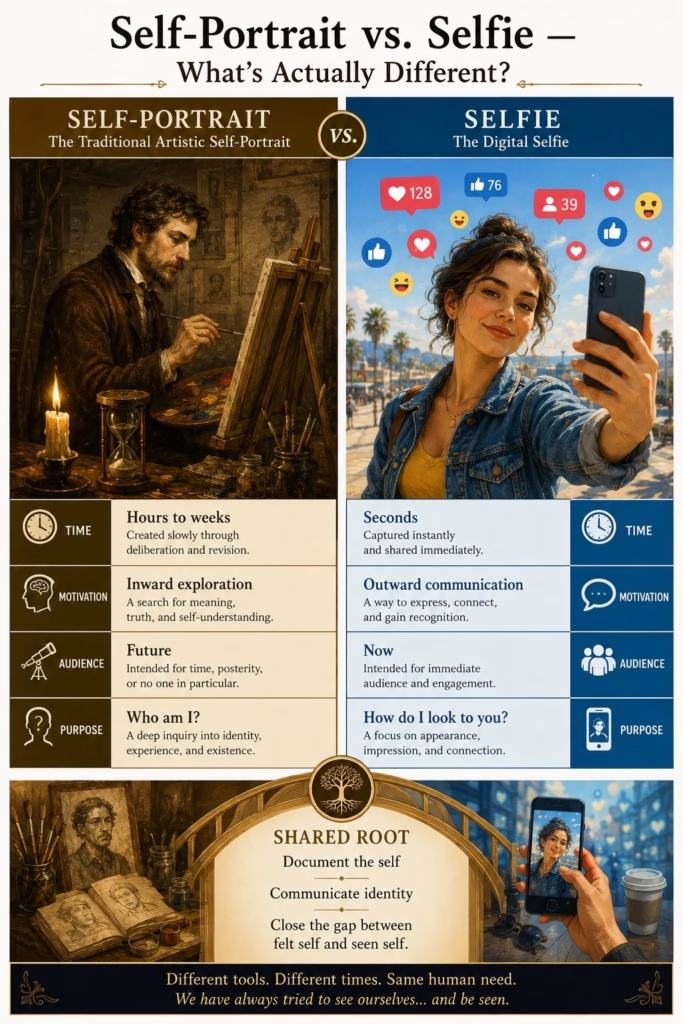
The debate has consumed a surprising amount of critical energy. Museums have hosted exhibitions on the question. Academics have written papers. The art critic Jerry Saltz offered what might be the most measured take: “They have a certain intensity and they’re starting to record that people are the photographers of modern life.”
The distinctions are real. Self-portraiture in the traditional sense requires time, technical skill, deliberate intention, and tends to be introspectively oriented — the artist looking inward, using the face as a surface for exploration of identity and inner state. Selfies are typically instant, externally oriented, shaped by social context and the desire for response. A selfie asks: How do I look to you? A self-portrait traditionally asks: Who am I?
But a peer-reviewed study published in Frontiers in Psychology in 2017 found that self-portraits and selfies share what the researchers called “universal principles” rooted in basic human cognitive and emotional needs — specifically, the need to document the self, communicate identity, and express inner states to an audience. Both forms, the researchers concluded, refer ultimately to the “conditio humana”: the basic conditions of human existence. The difference is largely one of mediation and speed, not of fundamental purpose.
The line blurs further when contemporary artists use selfies as a deliberate fine art medium. Amalia Ulman’s 2014 Instagram project Excellences and Perfections involved approximately 200 staged selfies documenting a fictional persona’s transformation through various social media tropes — the “good girl,” the “living the dream” influencer, the “recovery narrative.” It was performance art conducted entirely on a social media platform, using the selfie’s conventions to critique the selfie’s conventions. Cindy Sherman’s Instagram account does something similar with digital beauty filters, cranking them to extremes until the result is horrifying rather than flattering.
The Psychology of Why We Keep Doing This
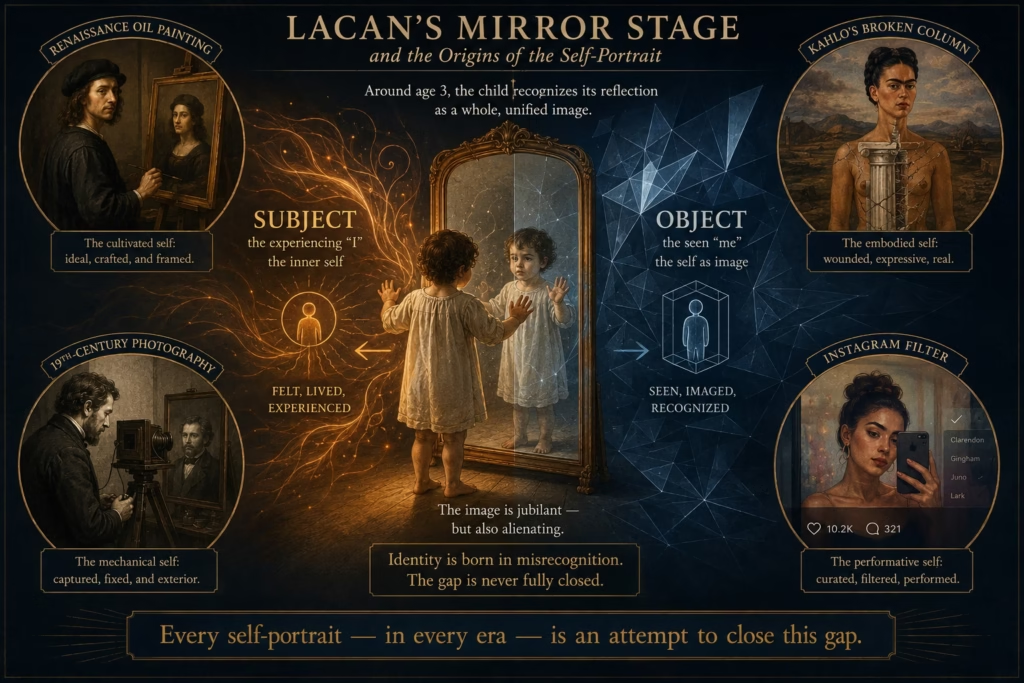
The French psychoanalyst Jacques Lacan described what he called the “mirror stage” — the moment, occurring around age three, when a child first recognises their own reflection and understands themselves as a distinct entity with a visible form. This recognition is both empowering and alienating: for the first time, you experience yourself from the outside, as an object in the world as well as a subject experiencing it.
Lacan argued that this rupture — this split between the “I” who experiences and the “me” who is seen — is never fully resolved. We spend our lives negotiating it. Self-portraiture, in any medium, is one way of working on that negotiation.
There is psychological research that supports how strange our relationship with our own image remains. A study cited by Psychology Today (2024) found that people recognise digitally enhanced, more attractive versions of their own faces faster than unaltered photographs of themselves — and are more likely to report the enhanced images as accurate. We unconsciously expect our external image to match an internal ideal that is more flattering than reality. This is not vanity in the shallow sense. It is a cognitive feature of self-perception.
Self-portraiture — whether in oil paint or on a phone screen — is, among other things, the attempt to close that gap. To make the seen self match the felt self. Rembrandt spent 40 years on this project with a brush. A teenager on TikTok is doing something structurally similar with a filter and a ring light.
AI and the Newest Mirror
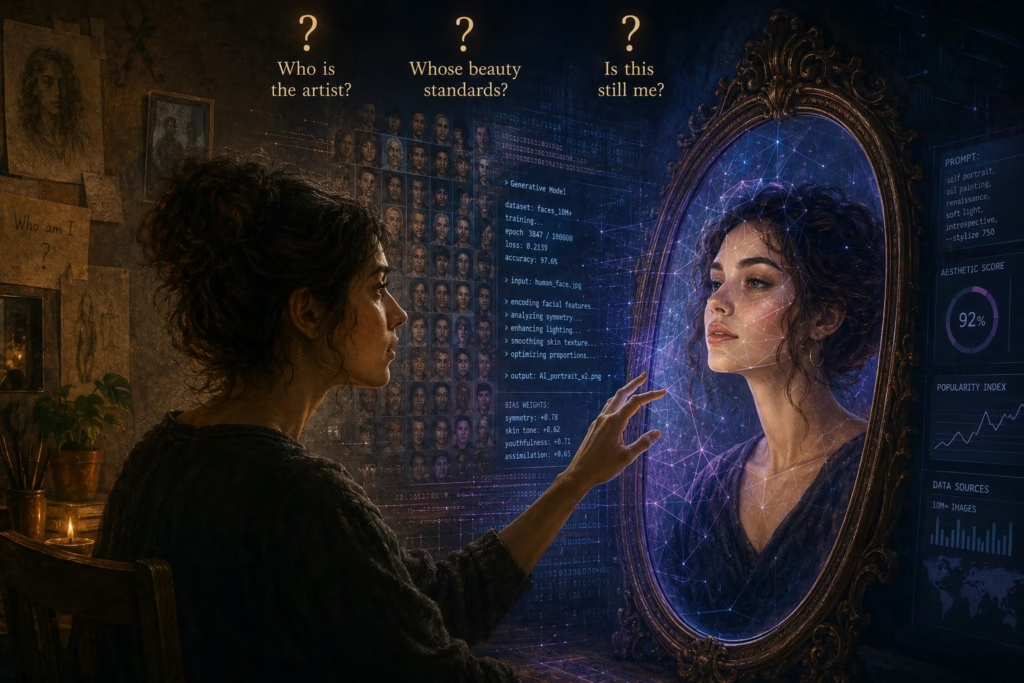
The most recent chapter in this 40,000-year story opened around 2022–23, when AI image generation became widely accessible to ordinary users.
Lensa AI’s “Magic Avatars” feature went viral in late 2022: users uploaded selfies, and the app returned idealised, hyper-stylised AI-generated versions of their faces — often more conventionally attractive, sometimes in fantasy or artistic styles. Millions participated. The response was complex: people loved the results, were unsettled by them, noticed that the AI consistently whitened skin tones and narrowed features, and began asking questions about beauty standards baked into training data.
Platforms like Midjourney and DALL-E allow artists to generate self-portraits in virtually any historical style — “in the manner of Rembrandt,” “in the style of Kahlo,” “as a Renaissance oil painting.” This raises genuinely interesting questions that art historians are still working through. Who is the artist when AI generates the image? What remains of “self” in an AI self-portrait when the parameters are set by a corporation’s training data? What is being depicted — you, or an AI’s generalisation of faces that resemble yours?
These questions are new. The underlying impulse — to see yourself reflected, transformed, interpreted — is ancient. The mirror has simply become much larger, much stranger, and much less certain about what it’s showing you.
Why Artists Make Self-Portraits — The Recurring Reasons Across History
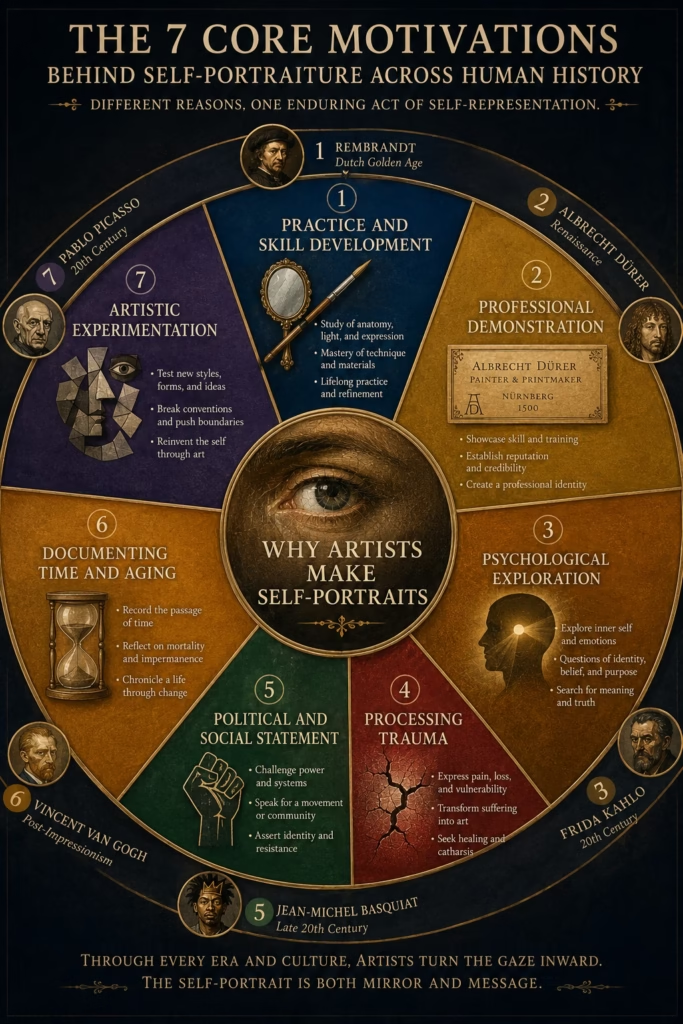
Looking across the full sweep of this history, certain motivations recur across every era and every medium. Understanding them helps make sense of why the self-portrait never goes away, regardless of what the dominant technology happens to be.
Practice and skill development. Van Gogh painted himself because he had no money for models. Dürer began at 13 as a technical exercise. The face is one of the most complex and challenging things a painter can attempt, and the artist’s own face is always available, always willing to sit for another session, and works for free. Generations of art students have used self-portraiture to develop the observational skills that figurative painting demands.
Professional demonstration. From Dürer’s 1500 self-portrait displayed to prospective patrons, to Vigée Le Brun’s carefully constructed public image across 37 paintings, to a contemporary artist posting self-portraits on Instagram to grow an audience, the self-portrait has always served a promotional function. Look what I can do. This is my range. This is who I am.
Psychological exploration and self-examination. Rembrandt’s lifetime of self-portraits is the richest example, but the tradition runs from Augustine’s Confessions through Montaigne’s essays to the contemporary therapeutic application of self-portraiture in art therapy. When you paint yourself, you have to look at yourself — really look — with the sustained attention that everyday life rarely demands. What you see is not always comfortable. Many artists have found this discomfort to be the most productive place to work.
Processing trauma and extreme experience. Kahlo after her accident. Van Gogh after the ear incident. Bayard after his professional humiliation. Self-portraiture has repeatedly served as the medium through which artists process experiences that exceed ordinary language. The work becomes both record and processing — a way of making the unbearable somehow containable in form and colour.
Political and social statement. From Anguissola’s firm professional gaze to Muholi’s documentation of Black LGBTQ+ identity, self-portraiture has been used across history by artists who needed to claim visibility that the dominant culture denied them. The self-portrait says: I exist. I am here. I deserve to be looked at on my own terms.
Documenting time and aging. Rembrandt is the supreme example, but it’s a thread that runs through many artists’ practices: the self-portrait as a form of autobiography, a record of how the face changes across decades. Time passes through self-portraiture in a way that no other subject quite captures.
Artistic experimentation. Picasso used himself as a laboratory for every style he tried. Warhol used his face to ask questions about mass production and celebrity. Sherman used hers to deconstruct identity and representation. The self-portrait is uniquely suited to artistic risk-taking because the stakes are personal and the model is infinitely patient.
Frequently Asked Questions
What is the oldest known self-portrait?
If we include prehistoric art, the oldest known self-portraits are the hand stencils at El Castillo cave in Cantabria, Spain, dated to more than 40,000 years ago. If we mean a recognisable individual face, the carved stone relief of the Egyptian sculptor Bak (c. 1365 BCE) is among the earliest. The first independent painted panel self-portrait is most likely Jan van Eyck’s Portrait of a Man in a Turban (1433) or Jean Fouquet’s small enamel self-portrait (c. 1450).
Why did artists start making self-portraits in the Renaissance?
Two causes converged. First, the humanist philosophy of the Italian and Northern Renaissance elevated the individual — including the individual artist — as a valid and important subject of study and representation. Second, high-quality flat mirrors, made with tin-mercury amalgam coatings, became available in early Renaissance Germany for the first time, giving artists a reliable way to study their own faces with the precision that oil painting demanded. Without good mirrors, detailed self-portraiture was practically impossible.
Who was the first artist to dedicate themselves to self-portraiture?
Albrecht Dürer (1471–1528) is universally recognised as the first artist to make self-portraiture a sustained, philosophically serious practice. He completed his first self-portrait at age 13 and went on to create three major oil self-portraits across his career, each a deliberate statement about the nature of artistic genius, identity, and status.
What is the difference between a self-portrait and a selfie?
Self-portraits are typically crafted over time, introspectively motivated, and primarily concerned with the artist’s inner life, identity, and creative expression. Selfies are typically instant, externally oriented, and shaped by the context of social media — they are designed to be shared and to invite response. However, the distinction is blurring: contemporary artists increasingly use selfies as a fine art medium, and a 2017 peer-reviewed study in Frontiers in Psychology found that both forms share the same fundamental psychological drivers.
Why did Frida Kahlo paint so many self-portraits?
Practical reason: a bus accident at 18 left her bedridden for extended periods; her parents installed a mirror above her bed so she could paint. Artistic reason: she found herself to be the subject she knew best and could always access. Emotional and political reason: self-portraiture gave her the only medium adequate to the complexity of her experience — chronic physical pain, emotional trauma, Mexican identity, feminism, and political commitment. Of her 143 known paintings, 55 are self-portraits.
Why did Rembrandt paint so many self-portraits?
Rembrandt’s self-portraits served multiple purposes: they were technical experiments in expression and lighting; they functioned as professional demonstrations of his abilities; they were commercially saleable; and his students copied them as training exercises. Most compellingly, Rembrandt appears to have been genuinely committed to self-examination — his late self-portraits, painted after bankruptcy and personal loss, show a psychological honesty unusual even by contemporary standards. Forty-plus confirmed autograph paintings, 31 etchings, and several drawings constitute the most complete visual autobiography in art history.
What was the first photographic self-portrait?
Robert Cornelius made the first confirmed photographic self-portrait in Philadelphia in October 1839, using the daguerreotype process — he is often credited with both the first photographic self-portrait and the first portrait photograph taken in America. However, the French inventor Hippolyte Bayard claimed to have developed his own photographic process before Daguerre’s public announcement; he memorialised this dispute the following year with the striking Self-Portrait as a Drowned Man (1840), staging his own death in protest at being denied credit.
How did mirrors change self-portraiture?
The development of high-quality flat mirrors using tin-mercury amalgam coatings in early Renaissance Germany was the direct technological cause of self-portraiture’s emergence as an independent genre. Before reliable flat mirrors, artists could only see their own faces in water, polished metal, or small, distorted convex mirrors — none of which provided adequate precision for detailed painting. Once clear, flat mirrors became available, artists could study their own features with the same exactness they would bring to any other subject.
Is a selfie a form of self-portrait?
Most contemporary art historians and psychologists say yes — selfies share the same fundamental human drives as painted self-portraits: documenting the self, communicating identity to an audience, and exploring how we appear to others. A 2017 peer-reviewed study published in Frontiers in Psychology found that both selfies and traditional self-portraits express “universal principles” rooted in the basic conditions of human experience. The selfie is a new technology applied to an ancient impulse.
What role did women play in the history of self-portraiture?
A central one — though the history has often marginalised them. Excluded from formal art training and life-drawing classes for centuries, women artists turned to self-portraiture as one of the few subjects always within reach. From Sofonisba Anguissola and Caterina van Hemessen in the 16th century through Artemisia Gentileschi, Elisabeth Vigée Le Brun, Paula Modersohn-Becker, Frida Kahlo, Cindy Sherman, and Zanele Muholi, women have used self-portraiture as a space for professional assertion, political resistance, and the reclamation of the right to define themselves on their own terms.
Key Takeaways
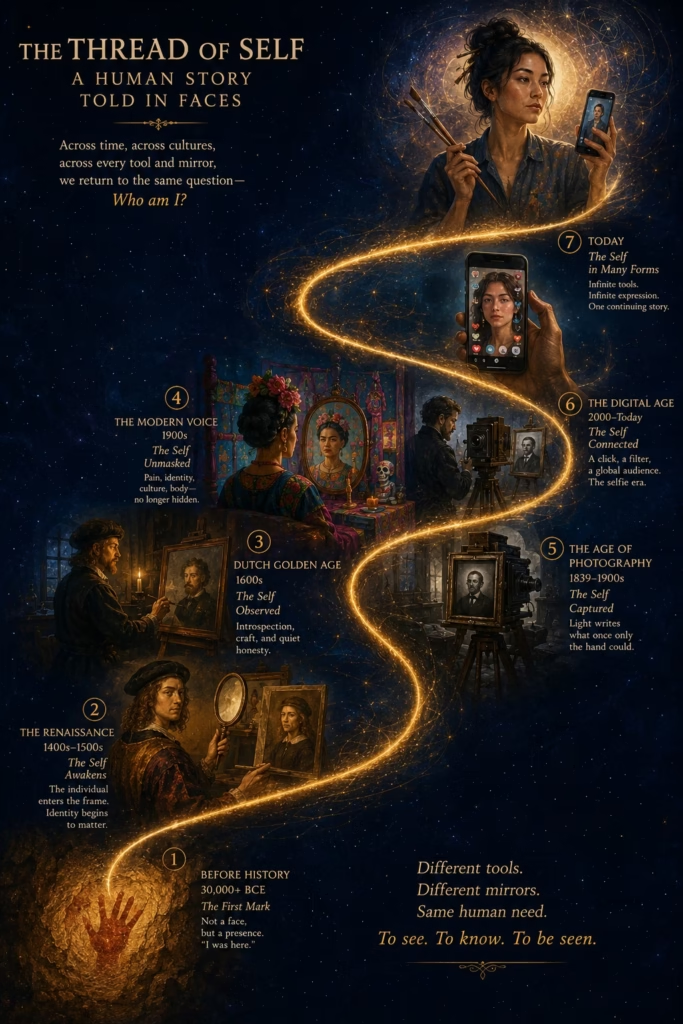
The history of self-portraits is, at its core, the history of humans insisting on their own significance. Every era, every technology, every art movement has produced its version of the same fundamental act: turning the creative gaze inward and asking, in paint or ochre or silver or pixels, Who am I? What do I look like? Was I here?
A few things emerge from following the thread from cave to camera:
- The urge to depict oneself is at least 40,000 years old and appears independently across cultures — it is not a product of Renaissance individualism. That era gave the genre its form; the impulse is much older.
- Mirror technology was the direct catalyst for self-portraiture’s emergence as an independent genre. Technology has always shaped what self-portraiture is possible, but the human desire precedes every technology that has ever served it.
- The artists who used self-portraiture most powerfully — Rembrandt, Kahlo, Van Gogh, Gentileschi — were not expressing vanity. They were working on questions about identity, suffering, time, and existence that required a first-person form.
- Women artists turned self-portraiture into a space of political resistance long before that framing had a name. The history of women and self-portraiture is inseparable from the history of who gets to be visible, and on whose terms.
- The selfie is not a rupture with this history. It is a continuation of it — faster, broader, more democratised, more complicated by social feedback loops, but driven by the same needs.
- AI is the newest mirror. It raises the oldest questions about self-portraiture — authenticity, idealisation, the gap between how we are and how we wish to appear — in stranger and more urgent forms than any previous technology. The answers are not yet clear. The conversation, like the genre itself, is ongoing.
If you’re an artist working on your own self-portraits today, you are participating in something that began when a human being pressed their hand against a cave wall and blew red ochre around their fingers 40,000 years ago. That’s not a small thing to be part of.
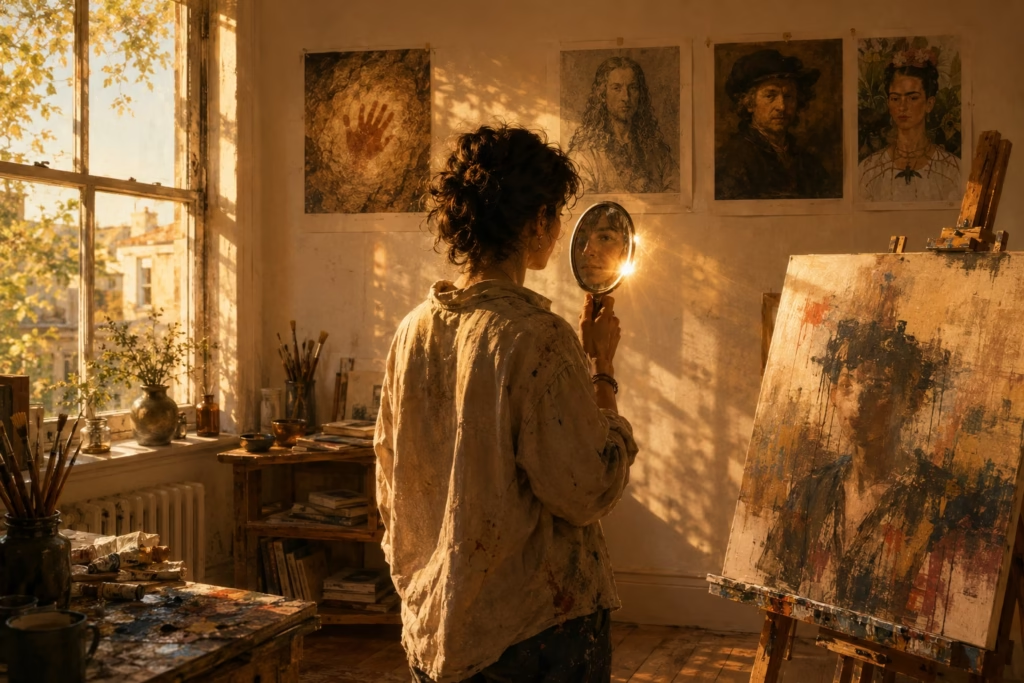
The self-portrait sits within a longer story — see our histories of anatomical drawing and how colors shape our perception, part of the broader evolution of art.