
Artist 爱画画的小智 (198606460): The Colored Pencil Painter Who Draws Good Luck
Two long braids of red chili peppers hang against white paper, drawn one waxy layer at a time. In Chinese they are not chilies. They are 红红火火 — may your life be red and blazing — and in Shandong a self-taught painter called Xiao Zhi has spent seventy-odd drawings quietly handing out good luck.
The Panda and the Denim Jacket
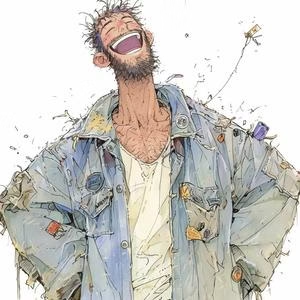
The name is 爱画画的小智 — Xiao Zhi, who loves to draw — and there is a small panda stuck on the end of it. The profile picture is not a photograph but a drawing: a bearded figure in a denim jacket and sunglasses, done in the same colored pencil as everything else on the channel. Even the face at the door is a drawing.
Underneath sits one line, and it functions as the entire artistic statement: 画画嘛,最重要的就是开心啦 — drawing? The most important thing is to be happy about it.
It sounds like nothing. It is in fact a hard position to hold, and most people who get good at drawing abandon it somewhere around the point where they start comparing themselves to other people who are good at drawing.
Artist 爱画画的小智 (198606460): The Colored Pencil Painter Who Draws Good Luck
Two long braids of red chili peppers hang against white paper, drawn one waxy layer at a time. In Chinese they are not chilies. They are 红红火火 — may your life be red and blazing — and in Shandong a self-taught painter called Xiao Zhi has spent seventy-odd drawings quietly handing out good luck.
Shandong, Thirty-Two, and Nobody Teaching
The public record runs to a province, Shandong, and a stated age of thirty-two. There is no school, no studio, no teacher. The hashtags carry the admission openly: 自学画画那些事, the business of teaching yourself to draw, and 跟着抖音学画画, learning to draw along with Douyin. Xiao Zhi is not an instructor with an audience. Xiao Zhi is a student who left the door open.
That distinction shapes everything that follows. A teaching channel shows you the finished technique and hides the years. A learning channel shows you the middle of the road, which is where every viewer actually is.
Artist 爱画画的小智 (198606460): The Colored Pencil Painter Who Draws Good Luck
Two long braids of red chili peppers hang against white paper, drawn one waxy layer at a time. In Chinese they are not chilies. They are 红红火火 — may your life be red and blazing — and in Shandong a self-taught painter called Xiao Zhi has spent seventy-odd drawings quietly handing out good luck.
Artist 爱画画的小智 (198606460): The Colored Pencil Painter Who Draws Good Luck
Two long braids of red chili peppers hang against white paper, drawn one waxy layer at a time. In Chinese they are not chilies. They are 红红火火 — may your life be red and blazing — and in Shandong a self-taught painter called Xiao Zhi has spent seventy-odd drawings quietly handing out good luck.
Artist 爱画画的小智 (198606460): The Colored Pencil Painter Who Draws Good Luck
Two long braids of red chili peppers hang against white paper, drawn one waxy layer at a time. In Chinese they are not chilies. They are 红红火火 — may your life be red and blazing — and in Shandong a self-taught painter called Xiao Zhi has spent seventy-odd drawings quietly handing out good luck.
Artist 爱画画的小智 (198606460): The Colored Pencil Painter Who Draws Good Luck
Two long braids of red chili peppers hang against white paper, drawn one waxy layer at a time. In Chinese they are not chilies. They are 红红火火 — may your life be red and blazing — and in Shandong a self-taught painter called Xiao Zhi has spent seventy-odd drawings quietly handing out good luck.
Artist 爱画画的小智 (198606460): The Colored Pencil Painter Who Draws Good Luck
Two long braids of red chili peppers hang against white paper, drawn one waxy layer at a time. In Chinese they are not chilies. They are 红红火火 — may your life be red and blazing — and in Shandong a self-taught painter called Xiao Zhi has spent seventy-odd drawings quietly handing out good luck.
Eighteen Days for One Rose
One line gives away what the cheerfulness actually costs: a single study he notes took eighteen days.
Eighteen days for a rose is not slowness, it is arithmetic. Colored pencil deposits an almost invisible amount of pigment per pass, which is precisely why it can be pushed to photographic depth — the medium lets you creep up on a value in twenty increments rather than committing to it in one. The cost of that control is time, and the cost of time is that the maker must stay interested in one rose for eighteen days.
Which is why the happiness rule is not decoration. In a medium where a single drawing takes three weeks of evenings, the only workable fuel is enjoying it. Anyone drawing for admiration gives up in week two.
The Hardest Color to Keep Alive
Look across the work and it is overwhelmingly red. Cherries by the bowlful. Chilies in braids. Roses so dark they go almost black at the fold. Pomegranates, apples, persimmons, koi.
Red is the most punishing hue in colored pencil. Warm reds are strong, greasy pigments that reach full saturation in two or three passes and then stop — the tooth of the paper fills, the surface goes waxy and slightly shiny, and every subsequent stroke skids instead of biting. The painter who wants a deep crimson shadow next to a bright scarlet highlight discovers there is no room left to go darker, because they spent the paper getting the bright part bright.
The way out is to build the darks first in colors that are not red at all — greens, violets, deep blues under the shadow side — and let red arrive last and thinly, over a structure that already has its full value range. Look at the dark rose and you can see it: the shadows are not dark red, they are cold, and the red is sitting on top of them.
A Bowl of Cherries Is a Sentence
Now the part that makes this channel unlike any other still-life feed.
Xiao Zhi does not choose subjects for their shape. The captions give the game away: the chilies are 红红火火, may you blaze. The apple is 平平安安 — 苹 sounds like 平, so an apple is peace. The persimmons are 事事如意 — 柿 sounds like 事, so persimmons are may-all-your-affairs-go-well. The koi under lotus is 岁岁平安, peace year upon year. The pomegranate, split to show its hundred seeds, is the old wish for many children and much fortune. The fish, endlessly, because 鱼 is 余 — surplus, having more than enough.
These are not still lifes. They are 吉祥话 — spoken good wishes — rendered as objects. Xiao Zhi is working in a folk tradition that is thousands of years old and belongs to New Year paper cuts, embroidered pillowcases and the picture your grandmother hung above the door, and is doing it in a Western hobbyist medium on a short-video app.
It also changes what the realism is for. On a channel like this, an object must be recognizable enough to be named, or the pun collapses and the blessing goes with it. A vaguely round red thing is a design. A persimmon — with its four-lobed calyx, its specific squat sag, its skin somewhere between orange and rust — is a wish. The accuracy is not showing off. It is grammar.
Bloop Bloop
The goldfish are the other recurring cast, and they arrive with sound effects. One is captioned 咕噜咕噜 — bloop bloop — and another is simply 大金鱼儿, big goldfish, with the diminutive 儿 ending that Northern Chinese speakers add to things they are fond of.
There is a betta suspended in a plain glass tumbler of water, which is a properly difficult picture: the fish is behind glass, behind water, with a refracted rim cutting across its body and a meniscus at the top, and the fins are translucent veils that have to read as thinner than the water they are in. Xiao Zhi does not announce any of that. The caption is a noise a fish makes.
The Veil Tail
The goldfish keep coming back, and the part of a goldfish that makes it worth drawing is the part with almost nothing in it.
A fancy goldfish’s tail is a translucent veil. It has a faint color of its own, it has fine ribs running through it, and everything behind it shows through — including, at the folds, the fish’s own body. It also has no outline. Nowhere on a living fish is there a line; the tail simply thins until it stops being distinguishable from the water.
Colored pencil is a line medium with a hard point, which makes this the least natural thing it can be asked to do, and the difficulty is not the transparency. It is the edge.
Draw the tail with any consistent boundary at all and the fish immediately becomes a sticker — a flat shape laid on the paper. What is required instead is an edge that changes character continuously along its own length: firm where the tail leaves the body and the membrane is thick, softening through the middle, and dissolving entirely at the trailing tips, where the correct treatment is to stop before the shape is finished and let the paper take over.
That last instruction is the hard one, because stopping early looks like failing. Every instinct says to complete the shape. A tail drawn to its full extent is a tail made of plastic, and the fish that reads as alive is the one whose fins were abandoned a few millimeters short.
A Betta in a Drinking Glass
One of the pieces is a betta in an ordinary tumbler — the kind of glass anybody has in a cupboard, half full, sitting on a plain surface. The fish is inside it.
Two of the hardest things in representational drawing are stacked on top of each other here, and the second one is the one people get wrong.
The glass itself is the familiar problem: no color of its own, edges made entirely of what is behind them, a bright vertical highlight down one side and a darker line down the other where the wall thickens.
The second problem is refraction, and it is the reason most drawings of a fish in a glass look subtly fake without anyone being able to say why. Water bends light. Anything seen through the water sits in a slightly different place than the part of it seen through air — so at the waterline, everything jumps sideways. The rim of the glass is offset from itself. A fin crossing that line is displaced. The far wall of the tumbler, seen through the water, is wider than the same wall seen above it.
Draw the glass as one continuous object with a fish inside and it reads as a fish in a cylinder. Break every horizontal at the waterline — shifting the section below it slightly, and widening it — and the water appears, without a single mark having been made for the water itself.
It is also, characteristically, an ordinary kitchen glass and not a display tank. The showing-off is entirely in the drawing.
Unfinished Project #1
A succulent sits in an iridescent glazed pot, unresolved, and the title is 烂尾工程 1# — abandoned construction project, number one. The joke is a Chinese property-development joke and it is on the artist.
Numbering it is the interesting part. There will be a number two. Publishing the failures with a serial number rather than deleting them is a decision about what the channel is: a record of the process, including the parts of it that stalled. Most people showing their drawings online post the eighteen-day rose and never the pot they gave up on.
“You Have No Talent At All For This”
In the comments under one drawing, somebody wrote: 你画画根本一点天赋都没有 — you have absolutely no talent for painting.
The reply, from the artist: 好吧,我会努力的. All right, I’ll work harder.
That exchange is the most instructive thing on the channel, and it is not a drawing. Talent is the standard excuse a beginner uses to quit, and it is the standard insult a stranger uses to make them. Answering it with a shrug and an eighteen-day rose is a better argument than any tutorial, because it declines the premise entirely: nobody who has spent three weeks on one flower is relying on talent.
Painting Is Actually This Simple
Another recurring caption insists that painting is actually this simple, and it sits in a nice tension with everything visible on the page — the work plainly is not simple, and the frames the finished pieces sit in are the frames you use for something you mean to keep.
But the claim survives the tension, because Xiao Zhi means something specific by it. Not that the drawing is easy. That the entry is easy: pencils, paper, a bowl of cherries from the kitchen, and a willingness to be bad at it in public for a while. Everything after that is just days.
Two of Them Are Framed
Most of the sheets are photographed loose, on a desk, sometimes with a hand still in shot. Two are not. Two are inside a white card mount, behind a thin frame, photographed straight on.
That is a small thing and it marks a real threshold.
A mount is the cheapest and most effective intervention available in the whole craft, and almost nobody who is teaching themselves knows it. A window of plain white card around a drawing does two things that no amount of extra work on the drawing itself will do. It puts a clean, absolutely straight, unambiguous edge around an image whose own edges are soft and irregular, which lets the eye settle. And it separates the paper from whatever is behind it — a desk, a wall, a room — so that the drawing stops being an object lying on a surface and becomes an image being looked at.
The effect on an amateur sheet is genuinely disproportionate. The same rose, loose on a table, reads as practice; in a mount, it reads as a picture, and nothing about it has changed except that somebody decided it was one.
Which is what the framing is actually recording. Somewhere in a run of seventy-odd drawings made by a self-taught person in Shandong who says the point is to enjoy it, two of them got promoted. Nobody asked for them. They were not commissions and there is no shop. He simply looked at two of his own drawings and concluded they had stopped being exercises.
Small Gifts of Good Luck
What accumulates here is not a portfolio. It is a stack of blessings — peace, surplus, a blazing year, may all your affairs go as you wish — made by hand, slowly, by someone who never claimed to be an artist and simply kept drawing the things they liked.
There is a version of this channel that would be bigger if the captions were techniques instead of wishes and the subjects were chosen to impress. Xiao Zhi drew a persimmon instead, because a persimmon means may everything go well for you, and gave it away to whoever scrolled past.