Artist Kang Sir / 康Sir彩铅 (kangsirart): Two Hundred and Thirty Hours for One Portrait
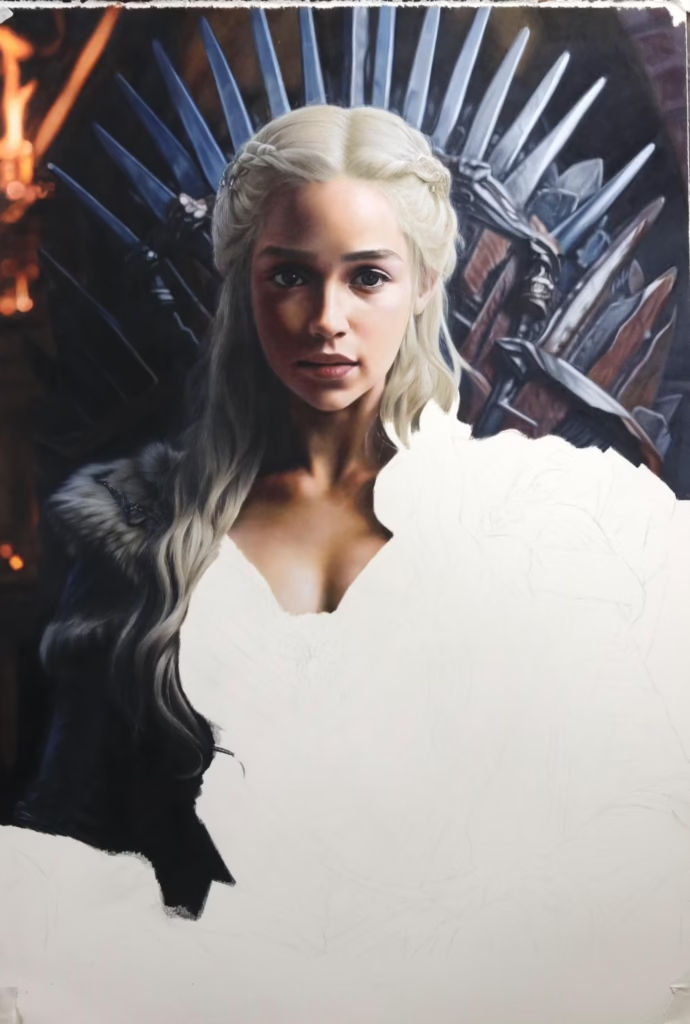
Kobe Bryant, in colored pencil, on white paper — the purple of the jersey, the wet light on a cheekbone, the exact brown of a man’s skin under stadium floodlights. Two hundred and thirty hours, by the artist’s own count, for a tribute to someone he never met.
The Slowest Medium, in the Fastest Format
康Sir彩铅 — Kang Sir, colored pencil — works in Liaoning in the least hurried realist medium there is, on a platform built for speed.
Colored pencil gives up nothing quickly. A petal that reads as velvet is fifteen passes of pigment. A portrait is weeks. There is no wet edge to exploit, no glaze to pour, no broad brush to cover ground with; there is one small point of wax deposited over and over until the paper stops being paper. Short video rewards the exact opposite, and he has simply declined to adapt to it.
What he adapted instead was the purpose of the work. His profile states it in seven characters: 作品均为网课范画 — all the pieces here are demonstration paintings for the online course.
临画 — These Are Copies, and He Says So
Under his name is a line most realist accounts would never write: the works here are all 网课临画 — study copies made for the online course.
临 is a specific word. 临摹 is the practice of working directly from an existing image or a master’s work in order to learn it, and in Chinese art education it is not a confession of weakness — it is the foundation, the thing every calligrapher and every ink painter does for decades. But it does mean something precise: the composition is not his, the subject was chosen by whoever made the photograph, and what is on offer is the execution.
Declaring it changes the terms on which the work should be read, and it is worth respecting him for making the declaration.
An enormous amount of photorealist drawing online is done from other people’s photographs and simply presented without comment, letting the viewer’s assumption do the work. The assumption is generous — that the artist saw this, framed this, decided this — and the silence that permits it is very close to free.
He closes that off in advance. Which is also, sensibly, the correct framing for what he actually sells. Nobody signing up to a colored-pencil course is buying his eye for a subject. They are buying the ability to get a lion’s face out of a box of pencils, and a demonstration piece is honestly described as a demonstration piece.
Nothing Here Is Just a Drawing
范画 is a specific word from the Chinese studio tradition. It means the picture the teacher makes in front of the class — not a masterpiece, an example, produced so that students can see where the road ends before they set out on it.
Declaring the whole body of work to be 范画 collapses a distinction most artists guard carefully. There is no separate portfolio here, no personal practice held back from the teaching. The finished drawing and the lesson are the same object.
The structure behind it is real: cohort classes with successive intakes — a flowers course with a first class and a second — and a dedicated short course on desserts. Students start together and finish together. That is a curriculum, not a link in a bio.
The Two Things Colored Pencil Is Worst At
Look at what he actually chooses to draw, and a pattern emerges that is not about subject matter at all.
Dark skin, repeatedly. Saturated purple, repeatedly. Those are the two hardest problems in the medium, and he has built his signature out of both.
Take the skin first. The instinct with a dark passage is to press harder, or to reach for a black pencil. Both destroy it. Pressure burnishes the tooth of the paper flat, and a burnished passage goes slightly shiny and slightly gray — the sheen of the wax starts reflecting the room, and skin turns to slate. A black pencil is worse: black is achromatic and it kills whatever hue sits under it, so a face built with black reads as a gray mask rather than as a brown-skinned person.
The only way through is chromatic. The darks have to be constructed from color — deep reds under the cheek, blue and violet in the temple, olive at the jaw — layered until they resolve as darkness without ever being gray. Meanwhile the specular highlights on a sweating athlete’s brow have to survive as untouched paper from the first stroke, because there is no white to put back.
Purple is the other trap, for a duller reason: violet pigments are among the weakest in a pencil set. A dark purple rose needs a shadow deeper than any purple pencil can physically reach, so the shadow has to be built underneath in something else entirely and the purple laid over it at the end. Draw the rose in purple and it comes out chalky and flat every time.
Kobe, Four Times
The same Kobe Bryant portrait appears on his page four separate times, and the roses appear four times, and the cherry cake three, and the horse twice.
Scrolled quickly this looks like an obsession, or like padding. It is neither. It is a syllabus, spread out across a feed.
A colored-pencil portrait at this level takes days. There is no honest way to present it as a single satisfying clip, and compressing it into thirty seconds of time-lapse produces the one thing a teacher must not produce — the impression that it happened quickly, and that the viewer’s own slow, ugly middle stage means they are doing it wrong.
So each drawing gets broken into posts. The block-in and the placement. The first passes of color, when the drawing looks its worst. A later stage where it is nearly there and still visibly unfinished. Then the completed thing, and separately the full process from start to end.
What that gives a student is the part almost nobody films: the ugly middle. Every long drawing goes through a stage where it looks flat, patchy, and worse than the sketch it came from, and beginners abandon at exactly that point because they have only ever seen finished work and reasonably conclude that theirs has gone wrong. Posting the same Kobe at four stages says, without saying it, that this is what mine looked like too.
Two Hundred and Thirty Hours
The Kobe portrait is the piece that explains him, and the number is the point.
Two hundred and thirty hours is roughly six working weeks. Nobody needs to do that. It is the opposite of efficient and it cannot be justified on any commercial ground — and it is the most persuasive thing on the whole channel, because a teacher who asks students for patience has to have spent it himself first.
He returns to the same face more than once: the tribute, the process shots, a study so tightly cropped he jokes that it gave him trypophobia. The Mamba tribute is not a one-off tactic to catch an audience. It is a subject he keeps going back to.
The Grief of Finishing
One of his most-loved posts is not a drawing at all. It is a line about one: 有些画,总不舍得结束 — some pictures you can never bring yourself to end.
Only somebody who works this slowly could say it. When a picture takes six weeks it stops being a task and becomes a place you go every evening, and the last stroke evicts you. Most artists feel this and do not mention it, because it sounds precious. Putting it up on a teaching channel does something useful: it tells a student that the tedium they are dreading turns, at some point, into something they will not want to leave.
Fur, and Why Colored Pencil Was Built for It
A lion. A white horse, twice. A sleeping calico cat. Of everything on his page, the animals are where the medium is doing something no other medium does as well.
Fur is the one subject where the size of the mark and the size of the thing being depicted are the same. A pencil point lays down a line about as wide as a hair. Every other medium has to fake this — a brush deposits a stroke far too broad and has to suggest fur rather than describe it, which is why painted animals so often read as beautifully lit upholstery.
But the trap is thinking that means you draw the hairs.
An animal drawn hair by hair from the start comes out looking like wire wool. What actually reads as fur is the mass first: the coat treated as a soft solid with a light side, a shadow side and a form that turns, established in broad soft layers as if the creature had no hair at all. Only then, and only in specific places, do the individual hairs go in — along the silhouette where they break the edge, at the direction changes where the coat parts and swirls, and in the small bright ones that catch the rim light.
The edge is the part that separates the good animal drawings from the rest. A lion’s outline is not a line; it is a soft, broken, irregular fringe of hairs that are individually darker or lighter than what is behind them. Draw a clean contour and fill it with texture and the animal is a cutout. Break the contour with a few dozen stray hairs crossing it and the whole thing becomes warm and alive.
Roses, Cakes and a Lion
The subjects sort into three territories, and the sorting is deliberate.
Flowers first — roses above all, purple and pink, and hydrangeas; 画花真能让人心情愉悦, drawing flowers really does lift the mood. Then food: glossy desserts, cherry-topped cakes, a cupcake with blue flowers on the frosting, a 五仁 mooncake, all taught through their own short course. And then the ambitious end — Kobe, a lion whose mane is his most-liked piece of all, a white horse, three cats including one asleep against a graffiti wall, Sun Wukong from Black Myth, Nezha and the dragon Ao Guang.
The range is doing a job. The icons show the ceiling; the flowers and the cakes show the way up. A beginner frightened by a two-hundred-hour portrait can still start with a rose, and the reassurance is that the same hand made both.
May You Have Money On Horseback
The white horse comes with a pun — 祝大家马上有钱, may everyone have money 马上. It means immediately, and it literally means on a horse’s back, and the drawing is of a horse.
It is a small thing and it says something about the register he works in. This is not a solemn atelier. It is a man in Liaoning wishing his students good fortune with a joke his grandmother would have made, attached to a horse he spent days on.
Answering the Shopping Question First
Among the things his audience rewards most is a patient multi-part guide to the materials he actually uses — which pencils, which paper, what to buy first.
That guide is a small act of generosity with an outsized effect, because it removes the obstacle that quietly ends most attempts before they begin. Beginners in this medium do not usually stall on technique. They stall in the shop, paralysed between a twelve-color tin and a hundred-and-fifty-color one, and give up before a single mark is made. Answering it plainly, for free, in advance of anyone paying him anything, is the most practical teaching on the channel.
Raising the Ceiling
Realistic colored pencil is a settled discipline and he is not reinventing it. What he contributes is breadth married to structure: gentle still life and monumental portraiture taught by the same person, arranged into progressive cohorts, with the practical scaffolding given away openly.
The monumental work matters more than it looks. A teaching channel that only ever demonstrates achievable things quietly teaches students that achievable things are all there is. Putting a two-hundred-and-thirty-hour portrait on the same page as a cupcake lesson tells a beginner that the distance between the two is time, not talent — and that they are already standing on the road.
What the Demonstration Is For
Everything on this page is a 范画, made to be shown to somebody who is about to try. That is a modest way to describe six weeks of work on one face, and it is also the whole argument.
The lion, the roses, the Mamba — none of them were made to hang in a gallery. They were made so that a stranger in a class that starts next month can see, before they buy a single pencil, exactly what the far end of patience looks like.