Artist Art Hacker / 艺心骇客 (39351589909): Trompe-l'oeil Illusions and Glowing Colored Pencil
彩铅在黑卡纸上能发光 — colored pencil can glow on black card. It is a caption, and it is also the most useful sentence about materials on the whole platform, because on black paper everything a person has learned about drawing runs backwards.
“A Painting Nobody With No Fixed Style”
艺心骇客 — Art Hacker — works out of Shanghai and describes herself in nine characters that translate roughly as: someone trying every different style and method, a painting-nobody with no fixed style.
It is the least accurate modest statement on the platform, and it is also a precise description of the practice. Most artists spend a career narrowing — finding the subject, the medium and the handwriting that are theirs, and deepening them. She has done the opposite on purpose, across two hundred and eighty-nine pieces, and the restlessness is not a failure to settle. It is the method. She is not looking for a signature. She is looking for the next thing a flat sheet of paper can be made to do.
Black Card, and the Inversion
Her most distinctive body of work is drawn on black card, and it is worth explaining why that is a genuinely different discipline rather than a change of background.
On white paper, drawing is subtractive. You begin at maximum brightness — the paper — and every mark you make takes light away. The lightest thing in a finished picture is the part you never touched, which is why every colored-pencil teacher on earth repeats the same instruction: protect your highlights from the first layer, because there is no white to put back.
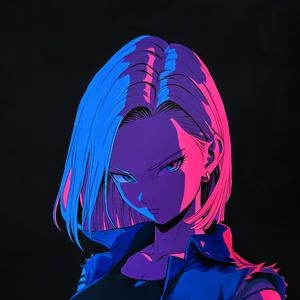
On black card that entire logic inverts. You begin at maximum darkness. Every mark now adds light. The highlight is not something to be defended; it is the last and heaviest thing you apply, and the shadow is simply the paper you left alone. A drawing on black is built from dark to light, in the order a photograph develops, and every reflex a trained hand has is wrong.
Why a Bright Mark on Black Reads as Emission
The glow is not a metaphor and it is not the pigment. It is contrast.
The eye judges brightness locally rather than absolutely. A pale yellow on white paper is surrounded by something almost as bright, so it reads as a pale surface. The same pale yellow surrounded by true black is the brightest thing for some distance in every direction — and at that ratio the eye stops interpreting it as a lit surface and starts interpreting it as a source. That is the whole trick behind her Zootopia study and the rim-lit figures: the subject is not glowing, the paper is simply refusing to reflect anything, and the mind fills in the rest.
What Black Paper Forbids
The inversion costs something, and it is the reason most colored-pencil artists never try it.
Layering on white works because pencil is semi-transparent: a yellow laid over a blue reads as green, because light passes through both films, bounces off the white sheet and comes back up through them. Nothing shows through black. There is no bounce. Every transparent glaze you put down on black card simply disappears into it.
So the whole optical-mixing toolkit is gone, and the work has to be done with high-opacity pencils, pastel and white-based pigment, building from mid-tones upward in solid, physically thick layers. Colors have to be mixed before they touch the sheet, not stacked on it. It is closer to painting on a toned canvas than to any normal pencil practice — which is presumably exactly why somebody with no fixed style found her way there.
Episode Seven, Episode Twelve
The black-card work is not a scattering of one-off pieces. It is a numbered series — 黑卡纸彩铅绘画过程, the black-card drawing process — and the posts are labeled episode seven, episode eight, episode nine, and onward.
Numbering does two things, and both of them are deliberate.
The obvious one is retention. A viewer who arrives at episode ten immediately knows there are nine behind it, and the number is a small standing invitation to go and find them. An unnumbered post is a thing you saw; episode ten is a thing you are in the middle of.
The less obvious one is what it does to her. A series has to keep its ground fixed. Having declared that this is the black-card sequence, every entry has to be on black card, which turns the whole run into an investigation of a single variable rather than a feed of unrelated pictures. Episode eight is a jellyfish, episode nine is a mecha, episode eleven is a glass ornament — completely different subjects, all being asked the same question: what does this look like when the only thing you can add is light?
That is a much more disciplined structure than it appears from any single video. Most people posting spectacle move on to the next spectacle. She committed to a constraint in public and then had to keep finding things that fit inside it.
The Floating Glass Sphere
One drawing explains her better than any list. A glass sphere sits on an open sketchbook and refuses to sit on it — reading so completely as an object that the eye keeps insisting there is something on the desk. It has traveled further than anything else she has made.
The mechanism is a correctly computed cast shadow, and it works for a reason worth stating: shadow is spatial information, not decoration. Detach a shadow from the base of an object and offset it correctly for the light, and the eye has no choice but to lift the object off the surface. The sphere itself is drawn no differently from a sphere that sits flat. Everything that makes it hover is happening on the paper around it.
That is the difference between realism and illusion, and it is the harder of the two. Realism only has to be accurate. An illusion has to be accurate and then has to beat the viewer’s own eye, which is actively trying to work out where the paper is.
A Delivery Box and a Lined Notebook
The surfaces wander as much as the media. She has painted Hatsune Miku onto a flattened cardboard delivery box under a caption about turning junk into treasure. Spider-Man climbs out of a page of ruled notebook paper. A three-dimensional diamond sits on a plain sheet. A plush toy lies on a spiral pad.
Using a lined notebook is quietly the boldest of those. Ruled lines are a fixed, regular grid that fights every curved form drawn over them and instantly announces that the surface is flat — which makes it the worst possible ground for an illusion of depth, and therefore the most impressive one to beat.
Foxes, Footballers and Miku
Her subjects are chosen to delight rather than to impress the initiated. Judy and Nick from Zootopia glowing on black. Characters from Genshin Impact and Honkai: Star Rail. Hatsune Miku repeatedly, including a fisheye wide-angle version and one rendered in gold marker. Asuka from Evangelion in ballpoint. Messi. A World Cup trophy in three dimensions. An emerald pendant, a koi, an elf, a fawn.
The instinct is shrewd. A familiar face brings people in; the impossible execution keeps them there. And because she documents the build, every piece works twice — once as a spectacle, once as a demonstration.
Three Different Media, One Ground
Read the tags across the series and the materials keep changing. The jellyfish is colored pencil. The mecha is drawn with acrylic markers. The Christmas globe is oil pastel. The fire creature is pencil again.
On white paper that would be incoherent — three unrelated bodies of work. On black card it holds together completely, and the reason is worth understanding because it is the whole logic of the ground.
On white paper, everything is subtraction. The page is already the brightest thing available, and drawing is the act of taking light away from it. Under those conditions the medium is the picture: graphite subtracts differently from charcoal, which subtracts differently from ink, and the character of the mark — its grain, its edge, its transparency — is most of what the viewer is responding to. Swap the tool and you have made a different kind of object.
On black card, everything is addition. The page is the darkest thing available and every mark is light being put in. What matters then is only whether a material can sit opaque and bright on top of black — and colored pencil, acrylic marker and oil pastel can all do that. Their differences in transparency, which dominate on white, stop mattering, because none of them are being asked to be transparent.
So the ground does the unifying that a consistent medium normally does. She can pick up whatever tool the subject wants — a marker for the hard metal edge of a mecha, a pastel for the soft bloom around an ornament, a pencil for the fine filaments of a jellyfish — and the series still reads as one thing.
Ballpoint, and the Other Extreme
At the far end from the black card sits a run of ballpoint drawings — anime figures built out of what she cheerfully calls scribbling.
Ballpoint is the cheapest possible instrument and it has exactly one value: the blue-black of the ink. Every tone in a ballpoint drawing is a ratio of covered paper to bare paper, achieved by the density of a tangle, and none of it can be erased. Setting that beside luminous pigment on black card is not eclecticism for its own sake. It is the same question asked twice — how little does the tool matter, and how much is just the decision about where the dark goes.
Giving the Trick Away
The striking thing is that she explains the method. A magician who does that usually loses the room. She films the build instead — the layers going down, the glow assembling, the flat page turning dimensional — and tags it for anybody who wants to draw along.
That reframes the whole enterprise. The illusion stops being proof of her talent and becomes a technique in circulation, something a viewer might reasonably attempt on a Sunday afternoon. She is not hoarding the magic; she is handing out the deck.
沉浸式 — Immersive Drawing
One of the tags she uses on herself is 沉浸式画画: immersive drawing. Another is 治愈系, the healing genre. Neither is a description of technique.
They describe what the video is for, and it is not instruction.
Watch one. The frame is close and dark. There is no voice, no captioned steps, no reference photo in the corner, no explanation of what is happening or why. Bright filaments appear out of black in near silence, one after another, and the picture assembles itself without ever being narrated.
Almost everyone else on this site is making teaching material, and the whole shape of it follows from that — the caption is a question the viewer has, the video is the answer, and the success condition is that somebody goes away and does it themselves. This is a different product. The success condition here is that somebody watches to the end and feels better.
The black ground is what makes it possible. A drawing emerging on white paper is a picture being built; you can see the whole page the entire time, and the pleasure is analytical. A drawing emerging out of black is closer to something being revealed by a torch — the eye has nothing to look at except the marks as they land, and each new one arrives as a small event rather than as a correction to what was there before.
It is a genuinely different use of the same craft. Not a lesson, and not a performance of skill either. Something closer to a fire to sit in front of.
Wonder Travels, Polish Doesn’t
The pieces of hers that escape are always the most technically astonishing ones. Not the prettiest, not the most personal — the ones that make a stranger stop and look twice to work out how it was done.
She has understood something about an audience that many better-trained artists never grasp: wonder travels and polish does not. A beautifully finished portrait earns respect and a scroll. A sphere that will not lie flat on the page earns a second viewing, which is the only currency that matters here.
An Appetite, Not a Style
There is no exhibition record here and no institution, and she claims none. What there is instead is a genuinely contemporary kind of artist — one who could not have existed before short video, whose identity is not a look but a hunger for the next effect she has not yet pulled off.
She calls herself a painting-nobody with no fixed style. On the evidence, the absence of a fixed style is the style, and black card was simply where it led her.