Artist Li Zheng 李正素描 (24966966996): Building the Head From Geometry
A Sphere, a Block, Two Cylinders
His signature is a construction method rather than a mark.
Before a single feature is drawn, the head is reduced to solids: a sphere for the cranium, a block for the jaw, cylinders for the neck and the limbs. Only when that scaffold sits correctly in space does the pencil begin to describe skin and hair. He states it in the title of one of his most-watched lessons — 用几何形体画美女人像, drawing a portrait with geometric solids — and it is pinned to the top of everything else.
The reason it works is unglamorous. A beginner drawing a face draws the things they can name: eye, eye, nose, mouth. Each one is placed by feel, relative to the last, and the errors compound, so by the time the mouth arrives the whole head has quietly gone wrong and no amount of careful rendering will rescue it. A sphere and a block cannot be drawn by feel — they either sit in space or they visibly do not — so the error is exposed in the first thirty seconds, while it still costs nothing to fix.
教你画看垃圾的眼神 — I’ll teach you to draw the look someone gives a piece of garbage. It is a real lesson, numbered among five hundred others, published by a man who spends his working life training teenagers to draw faces with no expression at all.
Rainbow Studio, Guangdong
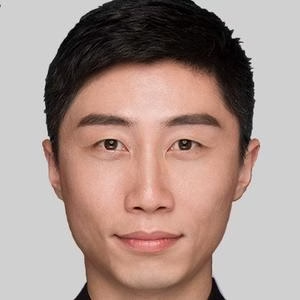
李正素描 — Li Zheng Sketch — puts a photograph of his own face on his profile, which on this platform is already a statement. Most drawing instructors hide behind their hands or a cartoon. He does not, because he is not building a persona; he is a teacher with a studio and a queue of students, and the face is the same one that stands at the front of the room.
The single line under it does the rest: founder of 彩虹画室, Rainbow Studio, and a long-serving front-line instructor for the 美术高考 — China’s fine-arts college entrance examination. Guangdong. Five hundred and forty-one published lessons.
That phrase, 一线名师, front-line teacher, is not modest. In the Chinese exam-prep world it means the person actually in the room with the candidates in the final year, not an administrator and not a brand — the one whose students’ scores are the record.
185th in the Country
He has published his own examination results, and they are the closest thing to a biography he offers: 185th nationally at the Central Academy of Fine Arts, 22nd at Tsinghua’s Academy of Arts and Design, 45th at the China Academy of Art, 26th at the Sichuan Fine Arts Institute. No year, no major. He has also described work as a lead artist at listed companies.
Whatever those numbers are worth, they explain the shape of everything he makes. A person who has been ranked four times against tens of thousands of other candidates does not think of drawing as self-expression. He thinks of it as a solvable problem with a known method and a clock running, and that is precisely the pedagogy he exports: not here is a beautiful drawing, but here is where the line goes, and here is why it goes there.
The move visible in his work is not from artist to influencer. It is from a classroom to a feed — the same lesson, rebuilt so a stranger with no training can follow it in ninety seconds.
Three Courts and Five Eyes
Layered onto the geometry is the older canon every Chinese art student meets early: 三庭五眼, three courts and five eyes. The face divides into three equal bands from hairline to brow, brow to nose base, nose base to chin; and across, into five eye-widths. He returns to it constantly under the heading 五官定位, feature positioning, and has given an entire twenty-four-episode series to nothing else.
Twenty-four episodes on where the features go is an extraordinary allocation of effort, and it is the correct one. Feature placement is the single failure that ruins the most drawings, and it is invisible to the person making the mistake — you cannot see that your eyes are too high, you can only see that the face looks wrong and not know why.
The Look You Give a Piece of Garbage
And then there is the other half of his output, which sits in flat contradiction to the day job.
教你画微笑的表情 — the smiling expression. 教你说话的表情 — the face of someone mid-sentence. 教你画看垃圾的眼神 — the look you give a piece of garbage. Surprise. Laughter. The battle-worn 战损 look the anime audience asks for. A figure caught playing a flute, another pointing, another mid-swagger.
The examination he trains students for does not want any of this. A scored portrait is a rest-state head: three-quarter view, neutral mouth, eyes level, because a rubric can only reward what it can specify, and an expression is unscoreable. Candidates are drilled, correctly, to remove exactly the thing that makes a face belong to somebody.
So the teacher who does that for a living has spent five hundred videos publishing a catalog of everything the exam forbids.
It is also the harder skill by a distance, because an expression is not a shape — it is a difference from a rest state, produced by a few muscles dragging skin across bone. A smile is not a curved mouth. It is the cheek mass lifting, the lower lid rising to squeeze the eye from underneath, the fold from nose to lip corner deepening and shortening. Draw the curved mouth alone and you get a mask: a neutral face with a shape stuck on it. Which is precisely why the geometry has to come first. You cannot move a structure you have not built. Geometric solids and facial-positioning portrait tutorial — original Douyin post
A Gaokao Teacher, Drawing Game Characters
Look at what is actually on the page and it is not what a studio founder’s page is supposed to contain.
A character in flowing robes playing a flute. A cute cartoon flashbang. An ancient-style girl with hair ornaments. A grinning anime boy. A chibi in a bear hat. Hand poses. Interspersed with these, and outnumbered by them, are the realist portrait heads you would expect from somebody who trains candidates for the art examination.
The mismatch is deliberate and the logic behind it is sound.
His examination students are not the audience. They are already in the building, paying fees, being taught in person, several hours a day. Nothing he posts changes what happens to them.
The audience for the feed is the thirteen-year-old who likes a game and has started drawing its characters in the back of an exercise book, and who has not yet decided whether they are the sort of person who draws. That person will never open a video about a plaster cast.
And the method survives the transfer completely intact. One of his most-watched pieces is titled: use geometric solids to draw a beautiful portrait. That is not an anime technique. It is the first thing the examination syllabus teaches — reduce the head to a sphere and a block, establish the masses before the features — applied to a fantasy face with a gold headdress.
So the character is the packaging and the syllabus is the contents. A student who follows twenty of these has been taught construction, proportion, mass and light without once being told they were doing foundations.
Hair as a Mass, Not as Hairs
His graphite is deliberately plain — mid-range pencils, soft even gradients across the planes of the face, edges kept simple enough that a beginner copying along can watch the decision being made rather than admire the finish.
Hair gets its own sixteen-episode run, and his handling of it is the clearest example of his instinct. He lays the dark mass down first, as a single shape with a silhouette, and lifts the strands out of it afterwards. Beginners do the reverse: they draw hairs. Individually. Hundreds of them, on white paper, until the head is wearing a wig made of wire. Hair reads as hair because of how the mass turns and where the light band crosses it, and almost never because of any single strand.
Hands, and Why They Are Worse Than Faces
Around the portraits cluster the things students fear, and hands lead the list — a hand that will survive a portfolio, a hand catching a butterfly. There is a thirty-two-episode human-anatomy series behind them.
Hands are worse than faces for a specific reason. Everyone has a mental template for a face and it is roughly right, so the eye can at least tell when a drawing is off. Nobody has a template for a hand, because a hand has almost no fixed shape — it is nineteen bones that re-form completely with every gesture, and it foreshortens brutally, so the fingers pointing at you occupy almost no paper at all. It cannot be learned by memorising a hand. It can only be learned as structure, which is why the anatomy series exists.
Side-profile graphite portrait construction and shading tutorial — original Douyin post
Geometric solids and facial-positioning portrait tutorial — original Douyin post
A Gaokao Teacher, Drawing Game Characters
Look at what is actually on the page and it is not what a studio founder’s page is supposed to contain.
A character in flowing robes playing a flute. A cute cartoon flashbang. An ancient-style girl with hair ornaments. A grinning anime boy. A chibi in a bear hat. Hand poses. Interspersed with these, and outnumbered by them, are the realist portrait heads you would expect from somebody who trains candidates for the art examination.
The mismatch is deliberate and the logic behind it is sound.
His examination students are not the audience. They are already in the building, paying fees, being taught in person, several hours a day. Nothing he posts changes what happens to them.
The audience for the feed is the thirteen-year-old who likes a game and has started drawing its characters in the back of an exercise book, and who has not yet decided whether they are the sort of person who draws. That person will never open a video about a plaster cast.
And the method survives the transfer completely intact. One of his most-watched pieces is titled: use geometric solids to draw a beautiful portrait. That is not an anime technique. It is the first thing the examination syllabus teaches — reduce the head to a sphere and a block, establish the masses before the features — applied to a fantasy face with a gold headdress.
So the character is the packaging and the syllabus is the contents. A student who follows twenty of these has been taught construction, proportion, mass and light without once being told they were doing foundations.
Hair as a Mass, Not as Hairs
His graphite is deliberately plain — mid-range pencils, soft even gradients across the planes of the face, edges kept simple enough that a beginner copying along can watch the decision being made rather than admire the finish.
Hair gets its own sixteen-episode run, and his handling of it is the clearest example of his instinct. He lays the dark mass down first, as a single shape with a silhouette, and lifts the strands out of it afterwards. Beginners do the reverse: they draw hairs. Individually. Hundreds of them, on white paper, until the head is wearing a wig made of wire. Hair reads as hair because of how the mass turns and where the light band crosses it, and almost never because of any single strand.
Hands, and Why They Are Worse Than Faces
Around the portraits cluster the things students fear, and hands lead the list — a hand that will survive a portfolio, a hand catching a butterfly. There is a thirty-two-episode human-anatomy series behind them.
Hands are worse than faces for a specific reason. Everyone has a mental template for a face and it is roughly right, so the eye can at least tell when a drawing is off. Nobody has a template for a hand, because a hand has almost no fixed shape — it is nineteen bones that re-form completely with every gesture, and it foreshortens brutally, so the fingers pointing at you occupy almost no paper at all. It cannot be learned by memorising a hand. It can only be learned as structure, which is why the anatomy series exists.
Side-profile graphite portrait construction and shading tutorial — original Douyin post
Geometric solids and facial-positioning portrait tutorial — original Douyin post
Geometric solids and facial-positioning portrait tutorial — original Douyin post
Five Hundred Lessons, Numbered
The archive is organized the way a curriculum is, not the way a feed is: twenty-four episodes on feature placement, thirty-two on anatomy, sixteen on hair, twenty-four on animals, a floral set, and a strand of anime and game characters that surged when Nezha and Ao Bing were in cinemas.
Every title begins the same way — 教你画, I’ll teach you to draw. Not watch me draw. The grammar of the whole channel is second person and imperative, and after five hundred repetitions it stops being a title format and becomes a promise about who the video is for.
How to Draw a Smile, and How to Draw Talking
Two of his tutorials are about something the examination will never ask for: how to draw a smiling expression, and how to draw a face that is speaking.
The exam sitter is neutral by rule. A candidate is given a face at rest, and expression is not on the mark scheme in any form. Which means these lessons are aimed squarely at the audience that wants something the syllabus does not supply — and they are harder than they look.
The mistake everyone makes with a smile is that they put it in the mouth. Widen the mouth, curve it up, done. What that produces is a grimace, and the reason is that a real smile is not a mouth shape at all. It is the whole lower face moving: the cheek mass lifts and bunches, that bunching pushes up on the lower eyelid so the eye narrows from below rather than from above, the crease from nose to mouth corner deepens and swings outward, and only then does the mouth change. Draw the eye unchanged and the mouth wide and the face reads as somebody being polite about bad news.
Talking is harder again, and it is a problem of frame selection. Speech is continuous motion, and a drawing gets one instant of it. The instinct is to pick the widest moment — the mouth fully open — which is exactly the least readable one, because a wide-open mouth reads as a shout or a yawn. What reads as speech is an asymmetric mid-position: the mouth partly open, off-center, the jaw dropped rather than the lips stretched, and — the part that sells it — the eyes doing something, because a person who is talking is looking at somebody.
What the Exam Cannot Ask For
The tension between the two halves of his output is not a contradiction. It is the argument.
The exam method is not the enemy of expression; it is the delivery system for it. Three courts and five eyes, a sphere and a block, a jaw that sits correctly in space — that scaffolding is what makes a smile possible, because a smile is a deformation and you can only deform something that has a shape. The candidate drilled to build a neutral head under time pressure is, without being told so, being given the machinery for every face they will ever want to draw afterwards.
What he publishes is the afterwards. Same method, released from the rubric.
Front-facing short-haired graphite portrait tutorial — original Douyin post
Side-profile graphite portrait construction and shading tutorial — original Douyin post
Side-profile graphite portrait construction and shading tutorial — original Douyin post
教你画 — The Grammar of the Title Cards
Read the yellow cards across the page and almost all of them begin the same way: 教你画. I will teach you to draw.
That is a specific construction and it was not the only one available. The natural phrasing for a tutorial is a topic — how to draw a smile, the drawing method for hands — a label with no people in it. 教你画 puts two people in the sentence: a first person who teaches and a second person who is taught.
The same voice shows up in the other captions. Anyone can draw this one. Have you all been drawing properly? These are not the words of somebody publishing material. They are the words of somebody addressing a class.
Which is, of course, exactly what he is. A person who spends the working day in front of teenagers with pencils does not stop using the second person because the room has become a phone. The grammar simply came with him.
It also does something the topic phrasing cannot. A title that names a subject is a search result — useful, retrievable, and completely impersonal. A title that says I will teach you to draw this establishes, in three characters, that there is somebody on the other end who has taken responsibility for whether you can do it by the end. That is a small promise, repeated several hundred times, and it is most of the difference between a library and a teacher.
Front-facing short-haired graphite portrait tutorial — original Douyin post
The Teacher Who Kept Teaching After Class
Most people who leave the exam-prep grind leave the method behind with it, treating those years as a rite of passage best forgotten. He did the opposite: took the most rigorous thing about the system, stripped out the scoring, and gave it away in ninety-second pieces to an audience that will never sit the test.
Five hundred and forty-one lessons in, the effect is a full drawing course scattered across a scroll feed — free, sequential if you look for the sequence, and taught by someone who still has to face a room of teenagers on Monday. Somewhere in it is a lesson on how to draw the look a person gives a piece of garbage. That one is not on the syllabus anywhere.
Front-facing short-haired graphite portrait tutorial — original Douyin post