
Artist Qianqian Colored Pencil / 芊芊彩铅 (98427397923): The Teacher Who Starts From What Went Wrong
The paper is taped to a desk at its corners. Four or five faint pencil lines stand where a lantern will be — nothing more. Then a red pencil traces the curved ribs, and a little yellow goes into the middle, very lightly, with the paper left almost bare at the centre. A few minutes later the red is darker at the edges than in the middle, and the flat drawing has started to glow as if there were a candle inside it.
The Artist
芊芊彩铅 — Qianqian, colored pencil — is a colored-pencil artist and teacher who has worked in the medium for about ten years. She graduated from an art academy and now teaches colored pencil online. Her drawings are small and bright: a red lantern, a rose, a persimmon on its branch, a tulip, a pudding, a pomegranate. Each one is chosen so that a beginner could try the same thing the same day.
A Teacher Who Wants to Teach
The clearest picture of why she teaches is a short note under a cartoon of a little round creature in a scarf. It is headed 我太想教人彩铅了 — I want so badly to teach people colored pencil.
In it she explains that she graduated from an art academy, teaches colored pencil online, has had time on her hands lately, and wants to take on a small group of students and teach them from zero. The trial lessons are free. The only requirement is an interest in colored pencil; complete beginners are welcome. Her reason, in her own words, is to keep herself sharp and pass on what she knows.
There is no hard sell in it and no promise of overnight results. It reads like what it is: someone who has spent ten years learning how a medium behaves and doesn’t want that knowledge to sit unused.
One Lantern, From First Line to Tassel
The red lantern shows how she builds a drawing. It starts with a few light graphite lines — 先画几条线代表灯笼的轮廓, first a few lines to stand for the lantern’s outline. No detail, just the height, the width and the centre line.
Then color takes over from graphite. The curved ribs go in with a red pencil, as outlines first. The middle of the lantern gets a soft wash of yellow, kept very light so that the paper still shines through it; that bare centre is what will later read as the light inside. Orange comes next, then red, pressed a little harder towards the edges of each panel and lighter towards the middle, so the color deepens as the surface curves away.
Once the body glows, she draws a branch of plum blossom across it in darker red and brown, the flowers following the curve of the panels. The top and bottom caps go in black, with a speckled texture so they read as metal rather than flat ink. Last of all come the hanging cord, a few red beads and a tassel underneath.
The whole lantern takes only a few minutes, and every step is something a beginner can copy: leave the light where you want light, build the color in layers, and let the darkest red sit where the form turns away.
Why the Colors Stop Layering
A large part of Qianqian’s teaching starts from the moment a drawing goes wrong. She has whole lessons on 彩铅叠不上色的原因 — why your colored pencil won’t take another layer — and 彩铅去噪点方法, how to get rid of the speckled look.
Both come from the same piece of physics. Paper has tooth, a tiny landscape of peaks and pits. A colored pencil is pigment held in wax or oil, and dragged across the paper it only touches the peaks. The pits stay white, so a first layer always looks grainy — 颗粒感 — however careful it is.
The beginner’s instinct is to press harder. That crushes the wax on the peaks into a smooth, slightly shiny skin. Once the surface is sealed like that, there is no tooth left for the next layer to grip, and the color simply won’t go on any more. The drawing stops where it is.
Her answer is the same in lesson after lesson: many light passes, in different directions, with less pressure than feels useful. The pits fill slowly, the tooth stays open, and the color can be layered until it is as smooth and deep as the picture needs. A student who understands that stops reading the grain as proof they can’t draw.
Structure Before Color
Colored pencil forgives very little about a shape drawn wrong; twelve careful layers on a badly shaped petal are twelve wasted layers. So Qianqian spends real time on the line drawing.
For a single red rose, she rules a light grid over the paper and keeps a reference photo of the rose in view. Then she draws the flower square by square: the outer petals first, then the spiral of the inner ones, then the stem, the sepals and two leaves. It is slow, careful work — around ten minutes for the outline alone — and it means that by the time color goes on, the shape is already right.
Dark Under Red
The colored rose shows a habit worth copying. She does not start with red. She starts with black, laid very lightly into the darkest parts of the petals — 先用黑色画出玫瑰花的暗部区域. Only then does the red go over the top. The black underneath gives the red depth without muddying it, and the folds of the petals appear almost by themselves.
The leaves get the same treatment: a light layer of black first, pressing gently, then green layered over it. The darker side of each leaf keeps more of the black; the lit side stays clean green. The result is a rose with real weight, built from only a few pencils.
A Course Built Around Problems
Her beginner course is laid out like a list of things that go wrong and how to fix them: the tools a beginner actually needs, how oil-based and water-soluble colored pencils differ, which paper to use, how to make a color chart, how to erase pencil guidelines without damaging the paper, how to remove speckle, how to use hatching, and how the three primary colors mix. Between those come small projects to practise on — a bookmark, a heart, a ginkgo leaf, a butterfly that seems to lift off the page, a red spider lily.
Alongside them run lessons on flat, even color (平涂技法), on layering (叠色技法), on getting a fine, delicate surface, on making color look transparent, and on the right order to put color down (正确的上色思路). She also pairs colored pencil with graphite drawing to teach volume, because color alone is not what makes an object look solid. For students who want a push, she sets a one-month practice plan: work through it every day and the improvement will show.
A Persimmon on a Branch
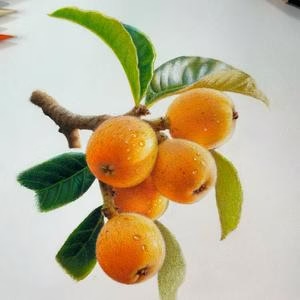
A pair of persimmons shows the whole approach in a few minutes. The branch goes in first, in brown, knotted and twiggy. The single leaf is laid in yellow, then marked with brown veins and spots so it reads as dry and late in the year. The fruit gets a first layer of pink over its whole surface, with the highlight left as bare paper. Red goes into the shadow side only. A sheet of tissue sits under her hand the whole time, so her palm doesn’t smear what is already there. At the end, two bright orange persimmons hang from the branch with a curled autumn leaf beside them.
Small Enough to Try Today
Qianqian’s subjects are chosen with care: a tulip, a crème caramel pudding, a small tree, the red lantern, a pomegranate, a peach cut to the stone, dumplings, a tomato, a bird, a squirrel, a persimmon. None of them is meant to impress from a distance. Each is sized so that someone who has just bought their first box of pencils could sit down and try it the same afternoon.
Three ideas hold her teaching together. A useful lesson starts from the mistake, not from the masterpiece. A subject should be small enough to finish today. And structure comes before color, always.
Somewhere at a desk, a sheet of paper is taped down at its corners and a red pencil is moving lightly around a centre left bare on purpose. In a few minutes, if the layers stay light and patient, it will look like a lantern with a candle inside.
See her work on Douyin: 芊芊彩铅 (98427397923) · red lantern · rose line drawing · red rose in color · persimmons · rose on a grid. All artwork and video © 芊芊彩铅, shown with credit.