Artist Shiguangji / 时光机手绘 (Shiguangji92): The Fineliner Artist Who Cannot Take a Line Back
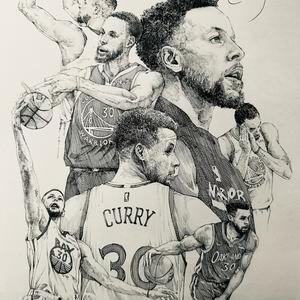
A basketball player, built out of nothing but black lines on white paper, hangs at the top of the page as the artist’s own face. Behind it sit one thousand four hundred and fifty-six drawings made in a pen that cannot be erased.
Fineliner tools, paper and original drawings — original Douyin post
One-go profile character drawing — original Douyin post
The Artist Who Chose the Instrument With No Undo
Most artists pick a medium that lets them change their mind. 时光机手绘 — Time Machine Hand-Drawing — picked the one that does not.
The 针管笔, the technical pen, puts down ink of a single fixed width and leaves it there. No eraser. No lifting. No pressing harder for a darker line, because the nib does not care how hard you press. No pencil underdrawing on most pages, which means no rehearsal either. Every value in a finished picture has to be manufactured out of the density of countable marks, and every one of those marks is permanent from the instant it touches the paper.
Working from Fujian, thirty-four years old, the practice fits in one line: fineliner drawing is the specialism, there are courses online and offline, and the pens are linked below. That is the entire pitch. Everything else is the work — posted, more or less daily, for years.
Fineliner tools, paper and original drawings — original Douyin post
One-go profile character drawing — original Douyin post
Tone Is Arithmetic
What fourteen hundred drawings demonstrate is the vocabulary the constraint forces into existence.
Parallel hatching for a flat plane. Cross-hatching where the form turns away. Stippling and broken line where a surface needs to dissolve into air. Solid black laid down in slabs, so that untouched paper does all the work of light. The contrast is pushed hard — deep blacks against bare white, with very little of the comfortable middle gray a pencil artist leans on.
This is the real difference between pen and pencil, and it is not a matter of taste. A pencil produces tone by pressure: one stroke can be any value you like. A fineliner produces one value only — the black of the ink — and everything else is a ratio between covered paper and bare paper. A gray is not a gray. It is thirty lines per centimeter. Shade a face and you are not shading, you are counting.
Fineliner tools, paper and original drawings — original Douyin post
One-go profile character drawing — original Douyin post
Deciding the Darkest Passage Before the First Mark
Because ink is final, all the thinking has to happen before the mark rather than during it.
Working from light to dark is the natural way to draw, and in graphite it is also recoverable — go too far and you lift it back. In ink there is no back. The artist has to know where the darkest passage in the finished picture will sit before the first line goes down, because every highlight is simply paper that has been protected, and once it is gone it is gone for the life of the drawing.
Watching a face emerge here is not watching a drawing be rendered. It is watching one be assembled by irreversible decisions, in an order that had to be worked out in advance.
Armored character fineliner drawing — original Douyin post
Spider-Man Without Lifting the Pen
The nerve this produces shows up in two recurring formats that come at it from opposite ends.
The 一笔画 pieces — Spider-Man drawn without the pen leaving the paper once — look like a party trick and are in fact the purest form of the discipline. A continuous-line drawing has to be solved as a single path before it is begun: every contour must connect to the next in an order that never traps the pen somewhere it cannot leave. The picture is finished in the head, then transcribed.
At the other end are the compositions that run fifteen to eighteen hours, straight into ink, with nothing underneath. In a medium that punishes hesitation, sitting inside one for two working days is a remarkable statement of confidence.
三视图 — Front, Side, Back
One of the studies is an Ultraman drawn three times across a single sheet: from the front, from the side, from behind.
That is a 三视图, an orthographic three-view, and it does not come from fine art at all. It comes from engineering drawing, and from the character sheets that animation and game studios produce before anybody is allowed to draw a frame — the reference document that guarantees the same figure looks like the same figure from any angle.
Doing one in fineliner is a peculiar form of self-punishment, and a very revealing exercise.
In a three-view, the drawings are not independent. Every horizontal in one has to agree with the same horizontal in the others: the shoulder line, the belt, the knee and the crown of the head must all sit at identical heights across all three, or the figure is not one object seen three ways, it is three different figures. Widths have to correspond too — the depth you invent in the side view is a commitment that the back view has to honor.
Which means errors surface late. A front view can look entirely convincing on its own, and only when the side view refuses to line up does it become clear that the chest was drawn too high. In pencil that is a nuisance. In ink it is fatal — there is nothing to move, and the sheet either gets abandoned or gets finished dishonestly.
Nobody sets themselves this for fun. It is what a person does when they have decided the point is not to produce a good picture today but to be unable to hide from an error.
Armored character fineliner drawing — original Douyin post
Armored character fineliner drawing — original Douyin post
Faces Everyone Already Knows
A large share of the work is fan art — Naruto, Tokyo Ghoul, Demon Slayer, Chainsaw Man, Evangelion, Final Fantasy, Ultraman — alongside portraits of real people and, running through everything, basketball.
It is worth being precise about why this is harder than it looks. When the subject is a known character, the likeness cannot be fudged: the entire audience knows exactly what that face is supposed to do, and a small error reads instantly as wrong rather than as style. Worse, the source is usually flat cel-shaded color animation, which has no tonal structure at all. There is nothing to copy. The artist has to invent a black-and-white light logic that the original never had, then be judged on it by people who have the original memorized.
Fineliner portfolio and process montage — original Douyin post
“If You Draw Badly, Blame the Tools”
One of the most-watched things on the channel is a joke at the audience’s expense: 画画不好就赖工具不行 — if your drawing is bad, blame the tools.
The joke has an edge, because the same person also publishes a carefully sorted breakdown of which fineliners actually do what, and links the pens below the videos. Both things are true at once, and holding them together is the honest position: the tools genuinely differ — nib sizes, ink flow, whether a line survives a wash — and none of that will save a drawing whose structure is wrong. Sell people the right pen, then tell them the pen is not the problem.
Sakura, Copic, and a Price in Yuan
Pinned near the top of everything is a card with no drawing on it — just typed text, a materials list.
It names the pens by brand, gives the nib sizes and says what each one is for: the fine sizes for outline and light structure, the heavier ones for building hatched mass, the largest for filling black. It names the paper each pen wants, and notes plainly that a good pen on ordinary paper is a waste of the pen. It ends with a warning about pressure — do not bear down, do not drag fast.
And beside each pen, in brackets, is what it costs. About ten yuan for one. About twenty-eight for the other.
That last detail is the generous part, and it is the one most teachers leave out.
The barrier for a fourteen-year-old is not really knowing which pen. It is not knowing whether the answer is going to be affordable. Materials advice in art is delivered with a certain grandeur — you must use good paper — that leaves a beginner assuming the good version is out of reach, and the safest response to that feeling is to not go into the shop at all. Attaching an actual number ends it. Ten yuan is a bubble tea. The decision stops being about worthiness and becomes a small, ordinary purchase.
The pressure warning is doing something similar, in a smaller way. A technical pen is a thin metal tube with a fine wire inside it, and bearing down splays or pushes in the tube — permanently, invisibly, and after that the line width is never right again. A beginner whose pen has been quietly ruined in the first week does not conclude that the pen is broken. They conclude that they cannot draw.
Fineliner portfolio and process montage — original Douyin post
Fineliner portfolio and process montage — original Douyin post
In Your Own Style
A phrase recurs across the titles: 用自己的画风 — in your own drawing style. Draw this character in your own style. Draw that one in your own style.
It is a small thing and it is the pedagogy. The natural way to teach copying is to teach copying, and a channel full of anime characters could very easily produce a generation of people who can reproduce someone else’s line. Framing every prompt as your version quietly refuses that. The character is the exercise; the handling is supposed to be the student’s.
Alongside it sit the plainest possible drills — 针管笔三视图练习, three-view practice; 一周练笔, a week of pen exercises; 放松下,画一笔, relax, draw one stroke. The last of those is the whole philosophy in five characters.
Three-hour hatching exercise — original Douyin post
“Relax, Draw One Line”
Look at how he captions the drawings and the register is startlingly low.
Relax, draw a line. A calming one, made out of shaky lines. A one-minute share of some ordinary practice. Nothing about mastery, nothing about discipline, no exhortation of any kind.
That is worth taking seriously rather than reading as modesty, because it is the correct treatment for the specific problem his medium creates.
Ink produces paralysis. Not difficulty — paralysis. Every other medium lets a nervous hand hedge: pencil can be laid in faintly and confirmed later, paint can be adjusted, charcoal can be lifted. A fineliner offers none of that. The mark is at full strength the instant it lands and it is there forever, so the hand hovers, and the longer it hovers the worse the eventual line is, because a line drawn from a stationary hover is slow and wobbly and dead. The drawing needs speed and confidence at exactly the moment the drawer has least of both.
And there is no way to concentrate your way out of it. Trying harder increases the stakes, and the stakes are the problem.
The only workable fix is to make the individual sheet not matter — to have so many of them that this one is obviously disposable, and to say so out loud in the caption before starting. Relax, draw a line. That is not a pleasantry. It is the technique.
A Sketchbook Left Open
The volume is not incidental, it is the point. Fourteen hundred and fifty-six pieces is not a highlight reel; it is a working artist posting what they drew today and then doing it again tomorrow, for years. The two-hour line drills go up. So do the pages that did not quite come off.
That changes what an audience is actually watching. Not a masterpiece unveiled monthly, but the accumulation itself — the part most artists keep private. A sketchbook, in public, with the boring bits left in. Anyone who has tried to learn to draw knows that the boring bits are where the drawing actually happens, and almost nobody films them.
Three-hour hatching exercise — original Douyin post
Three-hour hatching exercise — original Douyin post
A Life Kept Off the Page
Almost nothing personal appears. No name, no academy. A Chinese encyclopedia entry describes the person behind the work as a drawing enthusiast who teaches children’s and youth art, and places them in Zhangzhou; a sole-proprietor art studio registered under the same name sits in Dehua County, Quanzhou, several hours away. The two records do not agree, and nothing settles whether the registered proprietor is the artist, a relative, or a partner.
Recognition has come only from the platform — a placing on a Douyin handicraft and hand-drawing creator chart in early 2021, and recurring appearances on Fujian regional creator charts since. No interviews, no books, no exhibitions.
Twenty-hour Rudy family fineliner composition — original Douyin post
Twenty-hour Rudy family fineliner composition — original Douyin post
What Accumulates
The name is a time machine, and after years of daily posting it has become literal. Scroll far enough back and the line is stiffer, the blacks are less confident, the hatching does not yet turn the form. Nobody deleted those. They sit underneath the recent work like sediment, and they are the strongest argument the channel makes — stronger than any single drawing, and certainly stronger than any lesson.
You cannot take a line back. What you can do is put down another one tomorrow, fourteen hundred times, until the hand is different.
Biographical note: 时光机手绘 publishes under a studio name. The province, age and teaching practice are as stated on the artist’s own channel; no real name, formal training, exhibition or award record is independently documented, and none is claimed here.
Twenty-hour Rudy family fineliner composition — original Douyin post