
Artist Yang Shaonan 长兴阁画艺 (409462940weixin): Forests Across the Wall
He stands on a metal scaffold in a hard hat and a yellow high-visibility vest, reaching up into a wall of bamboo. Below him, on the bare concrete floor, are buckets of paint and a scatter of bowls. A fern is half-painted at the foot of the wall, each frond laid in with one flick of a flat brush. From a few steps back, it is a grove you could walk into.
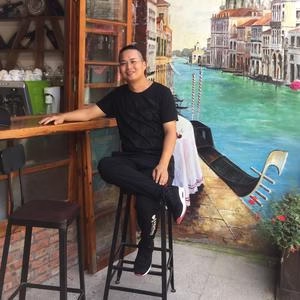
The Artist
Yang Shaonan, who works under the name 长兴阁画艺, is a mural painter. His walls turn into bamboo groves, wetlands, waterfalls, mountain meadows and fields of rapeseed in flower, in homes, museums, offices and along public roads.
His story starts with sugarcane. By his own account, his parents sold eighty thousand jin of it — forty tonnes, field after field cut by hand — to pay for him to go and study art when he was young. He did not become a gallery painter. He became the man who paints the wall.
He describes his work modestly: art brightens life, and what he shares is simply a record of the pictures he paints day to day, with a promise to keep doing better. What that covers is bamboo ten metres tall, an agricultural-heritage hall in a museum, a corridor for a power company, and a battle scene on a public history wall.
Where the Garden Meets the Picture
Many of his murals are built to join the real world in front of them. In a reeds-and-swans wall, clouds open above warm grasses, the swans cut across the blue, and the reeds run along the foreground with their warm tips against the cooler field behind. In a garden, real leaves stand in front of painted water and trees, and for a moment you can’t tell where one stops and the other begins. One of these, he says, is a wall of more than six hundred square metres around a residential equipment room, designed to continue the planting already there.
What makes the join work is that the painted water sits at the height of the real planting and takes its color from it, and the painted trunks are darker and harder-edged than the real ones behind them.
One Bamboo Grove, From Bare Wall to Finish
The bamboo wall shows how he builds a picture. The sky and the far distance go on first, pale and cool. Then the big masses of bamboo, painted from a scaffold: tall stems in yellow-green and olive, leaning slightly off the vertical so the grove never looks like a row of fence posts, with clusters of leaves broken against the light. The farther stems lose their edges and drift toward the color of the sky; the near ones keep hard, dark contours.
Then he comes down to the floor. A dirt path, a few rocks, patches of lit ground, and the fern in the foreground — each frond a single stroke from a loaded flat brush, the paint taken straight from a bowl at his feet. In the last stage he moves along the whole wall adding small bright leaves where the light falls. Step back and the grove has depth, air and a path that seems to lead somewhere.
Many Different Greens
He has said himself that forests are hard, because color, form and layering all have to be solved at once. A forest has no single subject. A portrait has a face; a wall of trees has forty roughly equal verticals and nothing to say which one matters. What holds his together is usually a slanting trunk cutting across the uprights and a few patches of lit ground — one diagonal and a scatter of bright shapes.
It also comes down to 环境色, ambient color: the color a surface picks up from everything around it. Inside a green grove, nothing keeps its own color. The pale stems are green on one side; the ground is green; even the light has come down through leaves. Paint yellow bamboo against a green background and you get a cut-out. Let the green into everything and you get a place.
Painting for a Viewer Who Isn’t There Yet
Look at what he wears in his work: a hard hat, a yellow high-visibility vest, sometimes the blue vest of a power company. He stands in a scissor lift or on a scaffold, with a building site below him.
That changes the craft. An easel painter checks their work by stepping back, again and again. Ten metres up, stepping back means lowering the platform, driving it clear of the wall, turning round, looking, and going back up. So the checking has to happen in his head. He has to know, with his face a hand’s width from the paint, what a mark will do to someone standing across a courtyard. Up close his strokes are bigger and blunter than the finished wall suggests, and the color is a shade stronger than looks right. He is painting for a viewer who isn’t there yet.
Height, Light and the Shape of a Site
In one wall, tall trunks make the room feel higher, with a path slipping between their bases. In another, a real window interrupts a valley of green hills and purple flowers; he paints the country right around it, and the window stays an honest window. A canvas can hang anywhere. A wall has fixed daylight, a fixed distance people stand at, and doors and pipes that are part of the picture whether the painter likes it or not. It has to be designed for its site, and it will never be seen anywhere else.
Painting Beside the Road
A mountain meadow on a roadside wall runs from grass at your feet out to snowy peaks. He leaves the edge of the real road visible at the bottom, so the painting is a view from somewhere rather than a hole in the wall.
The rapeseed wall goes further. Under the tiled eaves of a village building, yellow flowers run the whole length of the wall above a freshly planted verge, with hills and a pale sky behind. He paints standing on the bare soil, with a tray of colors at his feet, while villagers plant the border and a real dog wanders past the painted one on the path. That is the whole case for public painting: a wall beside a road is met by people walking to work, and its only reward is whether anyone slows down.
Painted Habitats
Some walls are designed to meet the room in front of them. A wetland with birds over water and ducks on it, with fish under the surface, is meant to join a real foreground built out in front of the wall. An underwater scene carries pale light down through blue onto a busy seabed, and the painting continues around the corner of the room — something no framed picture can do. For these to work, the painted distance has to be cooler and softer than instinct says, so it reads as air rather than as a backdrop.
Busy, But Not Chaotic
A good description of his bamboo walls is the phrase 杂而不乱,静中有动 — busy but not chaotic, stillness with movement in it. Both are precise. A grove of near-identical stems easily becomes wallpaper; his stems differ in ways you never consciously notice — cooler, grayer, thinner and more overlapped as they go back. And nothing in the picture is moving, yet a few leaning stalks and gaps of bright ground keep the eye from settling.
Public Walls
He is careful about credit. Of a large battle mural in Hengyang, he says he took part in making it, not that it is his — an honest note in a field where a photo of a finished wall usually implies one author. A city-avenue wall shows buildings and a road receding between planted verges, architecture reduced to marks a few centimetres across.
The biggest project to reach the press was a painted corridor beside East Ring Road in the Yulin high-tech zone, reported by the Yulin Daily in July 2025, which named Yang Shaonan as the project’s leader: a wall 1,010 metres long, thirty separate works on the themes of city building and industry, painted by a team between mid-May and mid-July. That is roughly seventeen metres of finished wall a day, outdoors, in a Shaanxi summer, beside live traffic, with a team who all have to paint alike so the corridor reads as one thing. At that scale, mural painting is as much about scheduling and teamwork as it is about drawing.
Sugarcane Country
Sugarcane grows in hot, wet country, and much of his work is full of that kind of green: bamboo, wetland, waterfalls, rapeseed in flower, forests so dense you can’t see through them. He doesn’t make a story out of it, and it would be wrong to invent one. But it is hard not to see the line from those forty tonnes of cane to a man on a scaffold, years later, painting a green grove onto a concrete wall.
See his work on Douyin: 长兴阁画艺 (409462940weixin). The captions under each video link to the original. All artwork and video © Yang Shaonan / 长兴阁画艺, shown with credit.