Artist Yang Shaonan 长兴阁画艺 (409462940weixin): Forests Across the Wall
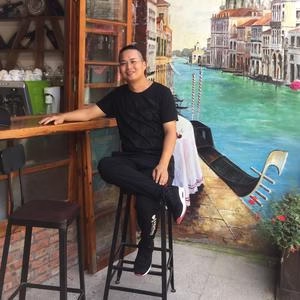
A wall becomes a bank of reeds, a forest opening or a stream that seems to continue the planting in front of it. Yang Shaonan’s murals work at this meeting of painted distance and physical place. The painter remains visible in his films: reaching from scaffolding, loading a brush, and returning to the small marks that make a large landscape readable.
Paid for in Sugarcane
The post he keeps pinned at the top of everything is not a painting. It is a sentence about his parents.
Twenty-five years ago, he says, they sold eighty thousand jin of sugarcane to send him to study art. Eighty thousand jin is forty tonnes. That is not a figure of speech and it is not one season’s luck; it is field after field, cut by hand, stacked, hauled and weighed, converted into a fee, and handed to a twenty-one-year-old so that he could go and learn to draw.
Everything that follows on this page should be read with that in the background. He is forty-six now. He did not become a gallery painter. He became the man who paints the wall.
His own description of what he does is deliberately small: art brightens life, this is a record of the pictures I paint day to day, thank you for liking them, I will try to do better. What that modest line covers is bamboo groves ten meters tall, wetlands with ducks on them, a waterfall, a rapeseed field in flower, an agricultural-heritage hall in a museum, a corridor in a power company, and a battlefield.
Where the Garden Meets the Picture
The reeds-and-swans mural starts with the plain labour of reaching a high wall. Cloud opens above warm grasses, the swans break the blue, and the reeds run along the foreground with their warm tips cutting into the cooler field behind them.
The garden-stream work uses a different kind of connection. Real leaves stand in front of painted water and trees; the camera moves between them until their edges briefly share a frame. In another post showing this same work, Yang describes a residential equipment-room wall of more than 600 square meters, designed to connect with the existing greenery. That figure is his own description of the commission, not an independently measured survey.
What makes it hold is that the painted water sits at the height of the real planting and takes its colour from it, and that the painted trunks are darker and harder-edged than the ones behind them. The pleasure is in finding the join, then seeing how carefully the two sides have been brought together.
A Forest Is Many Different Greens
In the bamboo film, Yang’s caption discusses nodes, leaf groupings, warm and cool color, and the spacing of dense and open passages. The brushwork gives those concerns a visible form. A fern sits low in the composition, the bamboo rises in narrow stems, and a lighter passage of ground makes room between the overlapping greens. The small leaf marks matter because they belong to an organized mass.
The woodland stream is the most ambitious of them, and he says so himself: forests are hard, because color, form and layering all have to be solved at once.
He is right, and the reason is that a forest has no single subject. A portrait has a face to organize around; a wall of trees has forty roughly equal verticals and nothing to say which one matters. What holds his together is a slanting trunk cutting across the uprights and a few patches of lit ground on the floor — one diagonal and a scatter of bright shapes, which is the entire structure. Take those out and the wall reverts to wallpaper.
The depth comes from a single discipline consistently applied: the far trees lose their edges and drift toward the color of the background, while the near ones keep hard dark contours. Nothing in the picture is smaller in the distance in any way a viewer would notice. It is all edge and temperature.
Height, Light and the Shape of a Site
The tall-tree mural uses upright trunks to make the wall feel higher. A path slips between their bases; bright foliage breaks up the dark forest behind it. The painter standing at the foot of the picture supplies a human measure. His question to followers about the tree’s height is playful, but the change of scale is central to the image.
The flowered-valley work has another architectural condition: a real window interrupts the painted country. Hills and clouds extend around it, while a strip of purple flowers holds the lower edge. The aperture stays plainly visible. Looking at the finished passage means moving between an actual opening in the building and an imagined opening into landscape.
He notes somewhere that northern and southern landscapes are not the same color, which is true and is not really what the valley mural is doing. Pale sky, green slopes, violet flowers — that balance was chosen for this wall, in this light, at this size.
Which is the difference between a mural and a painting, and the thing that never appears in a photograph of one. A canvas can be hung anywhere and carries its own conditions with it. A wall has a fixed orientation, a fixed source of daylight that changes across the day, a distance at which people actually stand, and interruptions — a downpipe, a doorway, a bench — that are part of the composition whether the painter wants them or not. The picture cannot be designed and then sited. It has to be designed for the site, and it will never be seen anywhere else.
The Lift, the Vest, and the Ten Meters
Look at what he is wearing in his own pictures. A hard hat. A yellow high-visibility vest with reflective bands. In one, the blue vest of the state power company. He is standing in a scissor lift with the guardrail at his waist, or out on a suspended plank with a bucket hooked beside him, and below him is a site — cones, cable, a floor not yet finished.
This is the part of mural painting that gets left out, and it changes the craft completely.
An easel painter checks their work by stepping back. It costs nothing: two paces, a squint, two paces forward, correct. A working painter does this perhaps a hundred times an hour, and that constant loop is where most of the quality actually comes from — almost nobody judges a passage correctly from thirty centimeters away.
Ten meters up in a lift, that loop is gone. To step back he has to stop, lower the platform, drive it clear of the wall, turn around, look, form a judgment, drive back in, raise the platform, find his place again. Minutes, not seconds — and on a site with other trades working, sometimes not possible at all. So the correction has to happen in his head. He has to know, while his nose is a hand’s width from the paint, what that mark will do to a viewer standing across a courtyard, and he has to be right, because he will not find out for another half hour.
That is why a mural painter’s mistakes are so much more expensive than a canvas painter’s, and why the ones who can do it develop a strange, slightly flat-looking touch up close that resolves perfectly at distance. Watch his brush in any of the close shots: the strokes are bigger and blunter than the finished wall suggests, and the color is laid on a shade stronger than looks right. He is painting for a viewer who is not there yet.
Painting Beside the Road
The mountain meadow works the other way round, from grass at your feet out to snow peaks. He paints the foreground low on the wall, close in, and the scale only registers when you step back and the small strokes turn out to be a sweep of country.
The edge of the road is left visible at the bottom. He could have carried the meadow down to the pavement and did not, and the choice is a good one: keeping the real ground in view means the painting is a view from somewhere rather than a hole in the wall. The imagined country stays attached to the street it is standing on.
The rapeseed wall is where the work stops being decoration and becomes a place. Yellow flowers run the length of it beside a planted verge, and he has painted a dog on the path through them.
His caption jokes that the painted dog brought company — and in the photograph there is a real dog, and people, standing in front of it.
That is the whole argument for public painting in one image, and it is not sentimental. A picture in a gallery is visited deliberately, by people who have decided to look at art. A wall beside a verge is met by people walking to work, and the only currency it has is whether anyone slows down. A painted dog at a real dog’s height, on a path, is a small joke aimed exactly at the person passing it, and it worked.
Painted Habitats and Physical Foregrounds
The wetland is the technically hardest thing here, because it is designed to meet the room. Birds over water, green ducks, the land receding to low hills — and, he says, fish under the surface, with the painting intended to join a physical foreground built out in front of it.
That join is the hardest seam in representational painting. The painted horizon is on a flat wall; the sculpted reeds or rocks sit a meter or two in front of it; and the viewer’s eye is focusing on two things at genuinely different distances at once. For the illusion to hold, the painted transition has to be lower in contrast and cooler than instinct says, so it reads as air rather than as a backdrop — and the real objects have to be lit from the same direction the paint claims the light is coming from, or the whole thing collapses the moment somebody stands where they were always going to stand.
In the underwater work, pale light filters down through blue over a populated seabed, long marine forms cross the foreground, and smaller creatures keep the middle distance from going empty. The painting carries on around the corner of the room, which is the thing a framed picture can never do.
杂而不乱 — Busy, But Not Chaotic
Under the bamboo-grove wall, someone left him a comment he liked well enough to mark: 杂而不乱,静中有动,环境色把握的到位 — busy but not chaotic, stillness with movement in it, the ambient color judged exactly right.
It is worth stopping on, because it is not flattery. It is three separate technical claims from someone who has clearly painted, and each one names a real trap.
Busy but not chaotic is the bamboo problem specifically. A grove is dozens of near-identical vertical stalks, and the natural result of painting dozens of near-identical verticals is wallpaper — a texture, not a place. Making it read as depth means the stalks have to differ in ways the viewer never consciously notices: slightly cooler and grayer as they go back, thinner, more overlapped, less sharply edged. Get that wrong and it does not look wrong, it just looks flat.
Stillness with movement in it is the harder one, and it is the reason his groves do not read as diagrams. Nothing in the picture is doing anything, and yet the eye is not allowed to settle. That comes from a few stalks leaning off the vertical and a few gaps of bright ground between them, which is the entire drama.
Ambient color — 环境色 — is the technical term for the color a surface picks up from everything around it. Inside a green grove, nothing is its own color. The pale stalks are green on one side. The ground is green. The light itself has come down through leaves and is green before it lands. A painter who ignores this paints yellow bamboo in front of a green background and produces a cutout. He does not, and the commenter noticed.
Public History and the Cultural Wall
Where the Hengyang battle mural is concerned he is careful about his own role: he says he took part in making it, not that it is his. That is a small and unusual piece of honesty in a field where a photograph of a finished wall implies sole authorship by default, and it is consistent with everything else about how he presents the work — the vest, the lift, the team, the kilometer of concrete.
The city-avenue wall is the contrasting public subject: buildings and a road receding between planted verges, architecture scaled down to marks a few centimetres across.
The largest of these to reach the press is a wall a kilometer long. In July 2025 the Yulin Daily reported on a painted corridor running beside East Ring Road in the Yulin high-tech zone, and named Yang Shaonan as the leader of the project: 1,010 meters of wall, thirty separate works planned across it, on themes of city building and industry, executed by a working team. They started in mid-May and expected to be finished by mid-July.
Two months. A kilometer. Thirty compositions. Work that out per day and the arithmetic is brutal — roughly seventeen meters of finished wall every single day, in a Shaanxi summer, outdoors, beside live traffic, with a team who all have to paint enough alike that the corridor reads as one thing. Nothing in easel painting prepares anyone for that. It is closer to running a small construction crew that happens to produce pictures, and it is the reason a muralist’s real skill is as much scheduling, sequencing and paint chemistry as it is drawing.
Sugarcane Country, and Then the Northwest
Sugarcane grows in the hot, wet south of China. He does not live there. His location shows as Xinjiang — the far northwest, dry, enormous, two thousand kilometers of desert and mountain away from any cane field.
He does not make a story out of it, and it would be wrong to invent one for him. But it is there in the work, quietly, in the form of what he chooses to put on walls. Bamboo. Wetland with ducks on it. A waterfall coming down through wet rock. Rapeseed in flower. A forest so dense you cannot see through it. In a place where the natural view out of the window is dry ground and hard light, a very large amount of his output is green, humid, and full of water.
Some of that is simply what clients ask for; green sells everywhere. But he chose the pictures he pinned to the top, and one of them is a bamboo grove that a stranger told him was judged exactly right, and behind both of those is forty tonnes of cane that his mother and father cut so that he would be able to do it.
A Practice That Can Be Followed
The films let a mural reach people who will never stand beside it, and they keep the labour a finished wall hides: the platform, the palette, the tenth return to the same passage of leaves.
That is finally what makes him worth a page. The wall stays where he put it. The people who walk past it every morning will mostly never know who painted it, and the picture will outlast the phone that filmed it — a kilometer of concrete beside a ring road that somebody’s parents paid for with forty tonnes of sugarcane, twenty-five years before anyone thought to look.