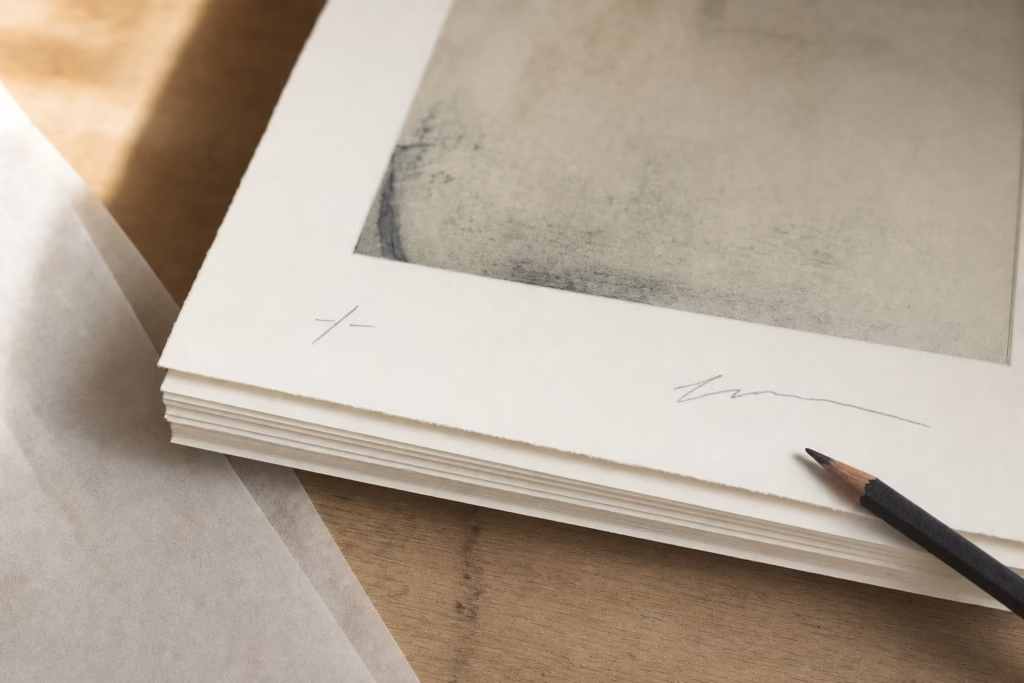
You sit down to write the email. The print drop goes live Friday. There are forty pieces in the edition. You know the words you’re supposed to use — don’t miss out, last chance, only a few left, hurry — and every one of them makes your skin crawl. So you write something vague and apologetic instead, hit send, and three days later the drop quietly underperforms because nobody understood it was a real deadline.
If this is you, the problem isn’t that you’re bad at marketing. The problem is that almost everything written about urgency and scarcity was written for people selling tote bags and SaaS subscriptions. None of it accounts for what it actually feels like to sell your own art — where the work is you, where the audience is small enough that every collector has a name, and where one cringe-inducing email can make you want to delete your whole mailing list.
This guide is the version nobody wrote for you. It’s not a list of clever urgency hacks. It’s a framework for understanding why scarcity feels different when you’re an artist, where the line actually lives between honesty and manipulation, and what to say — word for word — when the deadline is real and you need to tell people about it.
The core idea is this: scarcity isn’t a tactic you bolt onto your art business. It’s already true. Your time is finite. Your editions are finite. Your studio capacity is finite. The “salesy” feeling almost always comes from manufacturing urgency that isn’t real, or from using language borrowed from people who are manufacturing it. Fix those two things and the discomfort largely disappears.
Let’s get into it.

Why “Salesy” Feels Different When You’re an Artist
For most businesses, marketing is a layer on top of the product. The product is the running shoe; the marketing is the campaign about the running shoe. The two things are separable. If the campaign feels gross, the founder can wince a little, blame the agency, and move on.
You don’t have that separation. The work is you. Your eye, your hours, your body’s small motor control, your decisions about color and edge and silence. When you write a “last chance” email about your own painting, you’re not pushing a product — you’re applying pressure tactics to a thing that came out of your interior life. That’s why it feels different. That’s why other people’s frameworks bounce off you.
There’s a second thing happening too. Most working artists have small, intimate audiences. You probably know who bought your last three pieces. You may have exchanged DMs with them. The gap between “marketing to a list” and “writing a personal note to twelve specific humans” is much narrower for artists than for almost any other kind of business. Pushy language reads as personally insulting in that context, in a way it doesn’t when it’s coming from a stranger’s bathroom-tile brand.
So the discomfort is real, and it’s tracking something true. It’s not a sign you’re too sensitive for business. It’s information. The trick is to listen to what it’s telling you without concluding that the only ethical move is silence.
The Distinction That Solves Almost Everything: Inherent vs. Manufactured Scarcity

Here is the single most useful frame in this whole piece. Once you have it, most decisions become obvious.
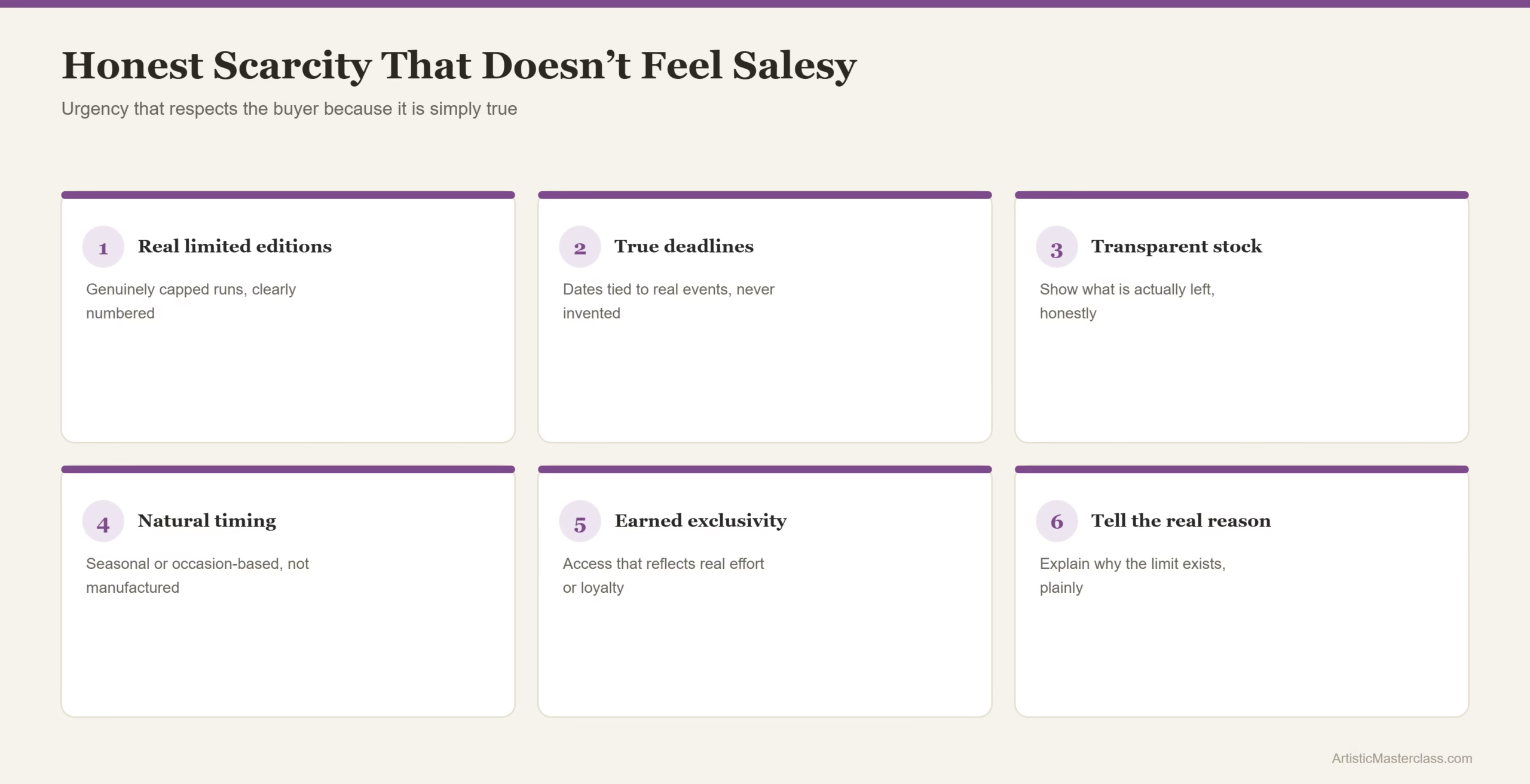
Inherent scarcity is real. It exists whether or not you mention it in your marketing. You only have so many studio hours in a week. Your edition of fifty really is limited to fifty — you said so when you printed it, and you’d be defrauding the people who already bought one if you printed more. You can only take eight commissions before the year’s calendar fills up. The watercolor paper you used for the original series is discontinued. The framer needs the pieces by the third or they won’t be ready for the show. None of these limits were invented to motivate buyers. They were already there. You’re just telling the truth about them.
Manufactured scarcity is invented. A countdown timer that resets when the page reloads. “Only 2 left!” when you have fifty in the back. A “48-hour flash sale” you run every other Friday. An “exclusive” code shared with everyone on the internet. These tactics borrow the language of real constraints to apply pressure without bearing the cost of an actual constraint. They work — for a while — and then they corrode trust, both with your audience and with yourself.
Here is the thing nobody tells you clearly enough: the salesy feeling is almost always your conscience flagging manufactured scarcity. You’re not allergic to deadlines. You’re allergic to lying. When you write “last chance!” about something that will, in fact, still be available next week, some part of you knows you’re saying something false, and the language feels gross because it is. When you write “the commission books close December 15th and I won’t reopen them until June,” that same internal alarm doesn’t go off, because you’re describing reality.
The whole rest of this guide is downstream of this distinction. Use inherent scarcity. Skip the manufactured kind. That’s almost the entire ethical question, solved.
The Ethics Test: Three Questions Before You Hit Send
Before you publish any deadline, drop, sale, or “limited” anything, run it through these three questions. If you can answer yes to all three, you’re on solid ground. If you can’t answer yes to one, fix that thing before you send anything.
1. Is the constraint real? Would this limit exist if I weren’t trying to sell anything? Is the edition genuinely closed at this number? Will the deadline actually pass and the offer actually end? If a buyer somehow showed up the day after, would I tell them no — and mean it? If the answer is no to any of these, the scarcity isn’t real and you shouldn’t use the language of scarcity to describe it.
2. Am I being specific? “Limited time only” is vague to the point of dishonesty. “Available through Sunday, March 9th at 11:59 PM Pacific” is specific. “Edition of 25, hand-numbered” is specific. “Commission slots open until I’ve booked eight, then closed until autumn” is specific. Specificity is how readers tell the difference between a real constraint and a marketing word. Vague urgency reads as manipulation even when it isn’t, because it sounds like the manipulative version. Be precise enough that someone could test you on it.
3. Would I be comfortable explaining the constraint to a buyer in person, in plain words, with no cleverness? This is the “look them in the eye” test. If you imagine a collector you actually like asking “wait, why is this a limited edition?” — and your honest answer is “so people will buy it faster” — that’s manufactured scarcity wearing a costume. If your honest answer is “because I only made twenty-five and I’m not making more,” you’re fine. The test isn’t whether your reasoning is commercial — of course it’s commercial, you’re running a business — it’s whether the reasoning is true.
Where Real Scarcity Already Exists in Your Art Practice
Most artists I’ve talked to about this have been surprised by how much inherent scarcity their work already contains. They thought they had nothing scarce to talk about, when in fact almost every part of their practice has natural limits they could be honest about. Here are the most common sources, with notes on each.
Studio time and capacity. This is the most universally available form of inherent scarcity, and the most underused. You have a finite number of hours you can spend painting, drawing, sculpting, or shooting. If you take commissions, there’s a real ceiling on how many you can accept before the calendar collapses. A working oil painter might genuinely only be able to deliver six commissioned portraits per year. Saying so out loud is not a marketing tactic. It’s a calendar fact.
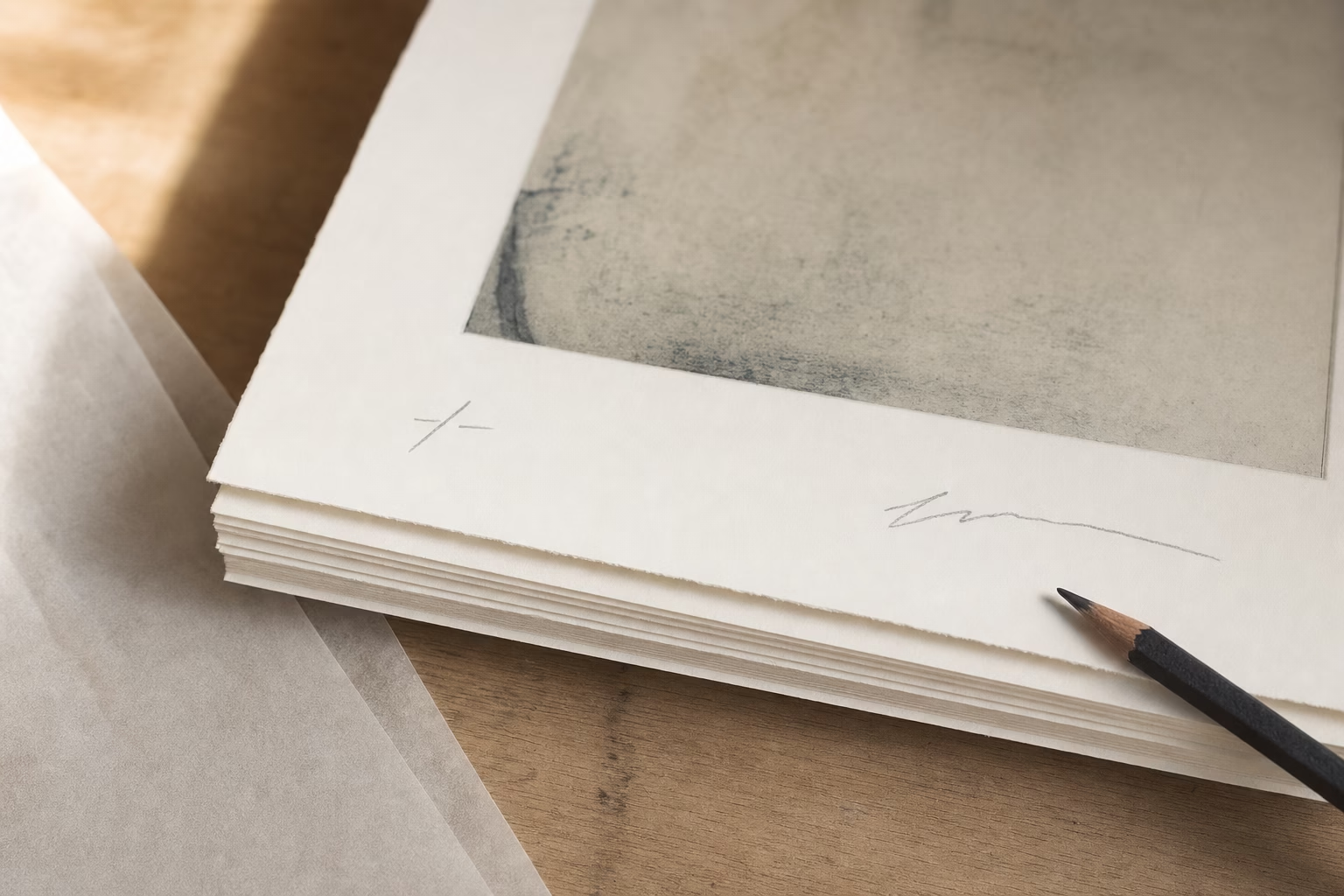
Edition sizes. If you sell prints, the edition number is the cleanest, most defensible scarcity you have — if you actually honor it. The integrity of limited editions depends entirely on you not reprinting after the run sells out. Resist the temptation. The collectors who bought into your edition of fifty deserve for that fifty to mean fifty. If you want flexibility, do open editions and call them open editions. Don’t muddy the difference.
Original work as inherently one-of-one. An original painting is the purest form of scarcity that exists in commerce. There is one of it. There will only ever be one of it. You don’t need a countdown timer for an oil painting. You need a clear “available” or “sold” status and a way for people to inquire. The scarcity is built into the medium.
Commission slots and booking windows. Opening a finite number of commission slots and announcing when they’ll close is a deadline buyers respect, because it tracks an obvious truth: you can only do so much work. “Books open Monday for the spring quarter, closing as soon as eight slots fill” is informative, not aggressive.
Workshops and seats. A workshop has a real number of chairs in the room. An online workshop has a real cap you’ve set so it stays small enough to be useful. Saying “twelve seats, registration closes April 30th” is just describing the room and the calendar.
Seasonal and event-bound availability. Open studio weekends, holiday markets, gallery shows with run dates, residencies that end on a specific Friday — all of these have built-in deadlines that exist whether you market them or not. You’re not creating urgency. You’re announcing an event that has a beginning and an end.
Materials and process limits. Sometimes the materials themselves create scarcity. The handmade paper run is finished. The pigment got discontinued. The kiln only fits so many pieces per firing. The framer’s turnaround is two weeks and you need pieces ready for the show. These are real and worth mentioning when they’re relevant.
If you have a practice, you have at least three of these. Probably more. The work isn’t to invent scarcity. It’s to notice the scarcity that’s already there and learn to mention it without flinching.
How to Talk About Deadlines Plainly (Language Patterns That Don’t Feel Gross)

Most of the queasy feeling comes from the language, not the underlying message. “Last chance!” feels manipulative because it’s the standard marketing-speak of people trying to manipulate. The same information delivered in plain, specific language reads completely differently.
Here are the patterns that work, and why.
State the constraint, then state the reason. “The commission books close on December 15th. I take eight commissions a year so I can give each one the time it needs.” The reason is the antidote to the pressure. You’re not just telling the reader to hurry — you’re explaining why the limit exists, which transforms the message from a push into an explanation.
Use specific dates and times, not “limited time.” “Available through Sunday, March 9th, 11:59 PM Pacific” is unimprovable. There’s no marketing trick in it. It’s just information.
Use specific numbers, not “going fast.” “Edition of 25” or “12 of 25 remaining” tells a buyer exactly what’s true. “Going fast!” tells them you’re trying to make them anxious. The specificity is the ethics.
Lead with the work, not the deadline. Open the email with what the piece is, what it took to make, what it’s about. Put the deadline lower, as a logistical note. You’re an artist sharing work, who happens to also be telling people when it’s available — not a salesperson with a timer who happens to be selling art.
Skip the manipulative verbs. No “don’t miss out,” no “act now,” no “hurry,” no “what are you waiting for.” These phrases are the linguistic fingerprint of pressure marketing. Even when your underlying offer is honest, using this language makes it sound dishonest by association. Replace with neutral verbs: opens, closes, available, ships, ends, releases.
Tell the truth about your own ambivalence when it’s relevant. If you’re nervous about a drop, you can say so. “This is the first edition I’ve released in two years and I’m a little nervous about it.” That kind of plain humanness is the opposite of salesy, and it builds the trust that makes future deadlines land harder.
Don’t apologize for selling. This is a trap a lot of artists fall into. They write the deadline email, then bury it under three paragraphs of “sorry to bother you” and “feel free to ignore this.” That apologetic tone reads as more uncomfortable than a confident announcement. You make the work, you sell the work, you’re allowed to mention when it’s available. Say the thing.
Scripts You Can Actually Use
Theory is fine. What you really want is words you can copy. Here are templates for the most common situations, written in the plain register described above. Adapt them to your voice; the structure is what matters.
Print drop announcement (email or newsletter):
Subject: New edition: [Title], 25 prints
The new edition is up. It’s called [Title] and it’s based on [one sentence of context — what it’s about, where it came from, what you were thinking]. Twenty-five prints, hand-signed and numbered, archival paper, [size]. $[price] each.
They’re available now at [link]. The edition closes when the twenty-five are gone — I won’t be reprinting it.
If you have questions, just hit reply.
[Your name]
What makes this work: it leads with the work, the number is specific, the closing condition is clear and honest, and there’s a human signoff. No “don’t miss out,” no countdown, no urgency theatrics. The scarcity is in the second-to-last sentence, stated as fact.
Commission books opening:
Subject: Commission books open through April 30th
I’m opening commission slots for the summer. Eight slots, first come first served, books close on April 30th or whenever the eight are filled — whichever happens first.
A few details: – [Medium and typical size] – [Price range] – [Typical turnaround] – [Anything you don’t take commissions for]
If you’ve been thinking about commissioning a piece, this is the window. Reply to this email with what you have in mind and I’ll get back to you within a couple of days.
[Your name]
What makes this work: the constraint is real (you can only do eight), the deadline is real and specific, the framing is informational (here’s what’s available) rather than pressuring (don’t miss your chance!).
Studio sale or “available works” announcement:
Subject: A few originals available from the studio
I’m putting six originals up for direct sale from the studio this week. These are pieces from [body of work / time period] that I’ve been holding back. Sizes and prices below.
[List with image, title, size, price, and “available” / “sold” status]
Available through [specific date]. After that they go back into storage until [whatever’s true — the next show, next year, etc.].
First come first served. Reply to this email or DM me if you’d like to claim one.
[Your name]
What makes this work: every claim is verifiable. Six pieces. Specific date. Real next step.
Workshop registration:
Subject: [Workshop name] — 12 seats, registration through May 15th
Registration for [workshop] is open through May 15th. Twelve seats total — I keep it small so everyone gets real attention and feedback.
[Workshop details: dates, location or platform, what you’ll cover, who it’s for, price]
Sign up here: [link]
Questions welcome — just reply.
[Your name]
Last-day reminder (the one that feels riskiest, but is fine if the deadline is real):
Subject: Last day for [thing]
Quick note: [the print edition / commission books / workshop registration / studio sale] closes tonight at [specific time and timezone]. I’m not going to send another email about it.
If you’ve been on the fence and want to grab one, [link]. If not, no worries — there’ll be more work soon.
[Your name]
What makes this work: the deadline is specific, you commit to not nagging further, and you give the reader explicit permission to not buy. That last move is the secret. Permission to decline is what separates an honest reminder from a guilt trip.
What Never to Do (Even When It’s Tempting)
A short list. These are the moves that turn ethical urgency into the manipulative kind, and they’ll erode your audience’s trust faster than they’ll grow your sales.
Fake countdown timers. If the timer resets, or if the offer continues after it hits zero, you’ve lied in pixels. Don’t. Modern audiences can smell this from across the internet, and the few who can’t will eventually figure it out and feel humiliated for falling for it. Either there’s a real deadline or there isn’t.
Inventing “limited” runs you intend to extend. If you describe a piece as “limited edition” and then quietly print more when the first run sells out, you’ve defrauded the people who bought into the original edition. Their copy was supposed to be one of fifty. Now it’s one of a hundred. You’ve devalued their purchase and broken something you can’t repair. If you want flexibility, sell open editions and call them that.
“Only 2 left!” when there are fifty. Same problem in a different shape. The number on the page should match the number in the box.
Urgency on every single post. If every email is a deadline, every product is “limited,” and every week is the “last chance” for something, your audience will stop reading. They’ll either tune out entirely or learn to wait you out, knowing the next “last chance” is six days away. Cumulative urgency cancels itself.
Borrowing the language of pressure marketing even for honest offers. “Don’t miss out!” “Act now!” “Hurry!” These phrases make even truthful announcements sound dishonest, because they’re the standard vocabulary of dishonest ones. Use plain verbs.
Apologizing for the deadline while also pushing it. “I’m sorry to bother you but you really don’t want to miss this it’s almost gone please hurry.” This is the worst of both worlds — you sound both desperate and manipulative. Pick a register and stick with it. Plain confidence beats anxious pressure every time.
How Often Is Too Often?
Frequency is where a lot of artists who are otherwise doing things right still manage to make their audience tired. The general principle: deadlines and scarcity language should mark real events, and real events don’t happen every week.
A working rule is one urgency-driven send per month at most, and ideally less. Print drops, commission books opening, workshops launching, studio sales — these are events with natural cadences. If you’re inventing new ones every week to keep the pipeline moving, your audience will notice and disengage. They’ll start to perceive your account as a sales channel rather than an artist’s account, which changes how they read everything you post.
In between deadline-driven sends, send work. Send process shots, studio updates, half-finished pieces, things you’re thinking about, things you’re reading, mistakes, weather. The non-sales content is what makes people care enough to act when there is a deadline. If you’ve been a presence in their inbox for six months and then you announce a print drop, that’s a different transaction than if they only ever hear from you when you want money.
This is also the answer to the question artists with small audiences often ask — does scarcity even work when my list is tiny? It works better, actually, but only if the rest of the relationship is built. With a list of three hundred people who actually know you, an honest deadline can move twenty pieces. With a list of thirty thousand strangers who only hear from you when you’re selling, the same email moves five.
When Scarcity Still Feels Icky (Even When You’re Doing It Right)
Sometimes you’ll do everything in this guide — real constraint, specific language, plain delivery, infrequent use — and it’ll still feel a little uncomfortable to hit send. That’s worth talking about, because the standard advice (“just push through!”) is wrong, and so is the opposite (“if it feels bad, don’t do it”).
Some of the discomfort is real conscience flagging something that needs fixing. Some of it is residue from years of seeing manipulative marketing and not wanting to be associated with it. And some of it is just the discomfort of asking other people to give you money for something you made — which is a deep, old ambivalence a lot of artists carry, and which doesn’t actually go away with the right framework.
For the first kind: trust it. If sending the email feels wrong, look at the offer again with the three questions from earlier. Usually you’ll find one of them isn’t a clean yes, and that’s the thing to fix.
For the second kind: notice that the form you’ve chosen doesn’t share anything with manipulative marketing. You’re not using countdown timers. You’re not lying. You’re not borrowing the gross verbs. The discomfort is pattern-matching to a thing you’re not doing. You can let it pass.
For the third kind — the deep ambivalence about being paid for art at all — the framework can’t fix that, and it shouldn’t try to. That’s a longer conversation with yourself about what you think art is for, what you think you’re worth, and what kind of working life you want. What this guide can offer is the assurance that nothing about telling people the print drop closes Friday is incompatible with taking your work seriously. If anything, it’s the opposite. People who don’t tell anyone when their work is available are not protecting the work’s dignity. They’re just selling fewer pieces and getting quietly resentful about it.
The Long Game: Why Honest Scarcity Builds Collector Trust

Here’s the part you don’t see in the first month, or even the first year, but which compounds over time and is the actual reason this approach wins.
When you use scarcity honestly — real edition sizes you don’t extend, real deadlines that actually pass, real commission books that actually close — you teach your audience that your words mean what they say. The first time someone buys from a print edition you described as “twenty-five, hand-signed, no reprints” and then watches you actually not reprint it, you’ve moved from “person selling stuff” to “person whose claims are reliable.” That trust is the most valuable thing in any artist’s business, and almost nobody invests in it the way they should.
The artists who are still selling out drops in year ten are the ones whose collectors learned, over years of small interactions, that everything they were told turned out to be true. The deadline really was Friday. The edition really was fifty. The book really did close. None of this is glamorous. It’s just true, repeatedly, over years. That’s the asset.
The opposite is also true. Artists who fudge — who extend “limited” editions, who run perpetual “last chance” sales, who use the language of urgency without the substance — train their audiences to discount everything they say. The damage is invisible at first and catastrophic at scale. By the time you notice your open rates falling and your drops underperforming, the trust has been gone for a while.
Pick the long game. The short game has worse short-term returns and worse long-term ones, which is a rare combination, and it’s also the one most marketing advice quietly recommends.
Frequently Asked Questions
Is using scarcity in marketing manipulative?
It depends entirely on whether the scarcity is real. Telling people that your edition of fifty prints closes when the fiftieth one sells is honest information, because the number is true. Saying “only 2 left!” when you have a stack of fifty in the back is manipulation. The same word, scarcity, covers both, which is why the topic is confusing. The question to ask is whether the constraint exists independently of your wanting to sell more.
How do I announce a print drop without sounding desperate?
Lead with the work, not the deadline. Open the email by talking about the piece — what it is, what it’s about, what went into it. Treat the logistics (price, edition size, when it closes) as a paragraph near the bottom, not the headline. Use plain, specific language for the deadline (“available through Sunday March 9th”) rather than marketing verbs (“hurry,” “don’t miss out”). Confidence reads as confidence, and apologizing reads as desperation more often than asking does.
Should I use countdown timers as an artist?
Probably not, and almost certainly not for evergreen work. Countdown timers are the visual fingerprint of pressure marketing, and your audience will read them that way even if your deadline is real. You can communicate the same information by writing the date and time in plain text, which feels completely different. Save timers for genuine, rare events with hard deadlines (like a print drop closing at a specific moment), and even then, consider whether a sentence would do the job better than a ticking clock.
What’s a good edition size for limited prints?
It depends on your audience size and what you’re trying to accomplish. Smaller editions (10–25) feel more exclusive and let you charge more per print, but make less revenue overall. Larger editions (100–250) are more accessible and generate more total income but command lower per-piece prices. A common starting point for emerging artists is 25–50 for the first few editions, with the option to scale up or down based on how they sell. The most important thing is that whatever number you pick, you honor it — never extend an edition after the fact.
How often can I send urgency-driven emails before my list gets tired?
The honest answer is: less often than you think. Once a month is a reasonable ceiling for most artists, and many do well with even less. The rest of the time, send work, process, thinking, life — the non-sales content that builds the relationship that makes deadlines actually move pieces. If every email from you is a deadline, your audience will tune out, and your urgency language will stop working.
Does scarcity marketing work for artists with small audiences?
Yes — arguably better than for artists with large audiences, because the relationship is closer. With a list of two hundred people who actually know your work, an honest announcement that commission books are open until April 30th can fill all eight slots. With a list of twenty thousand strangers, the same email might fill two. The size of the audience matters less than the quality of the relationship you’ve built with it, and small, engaged lists tend to convert at much higher rates than large, distant ones.
Is it okay to remind people on the last day of a deadline?
Yes, if the deadline is real and you don’t make a habit of nagging beyond it. A single, plainly-worded reminder on the final day (“quick note: registration closes tonight at 11:59 Pacific”) is helpful information for people who meant to act and forgot. What you want to avoid is a multi-day countdown sequence with escalating urgency — that’s the thing that wears out an audience. One reminder, real deadline, then silence.
What if my deadline passes and someone still wants to buy?
This is the test that separates real scarcity from the manufactured kind, and it’s worth having a clear policy before it happens. The clean answer is: if you said the edition closed at 25, and you sold 25, you’re done. Tell the person no, kindly, and offer them the next thing — a spot on the waitlist for the next drop, a notification when commission books reopen, an alternative piece. Holding the line is what makes the next deadline credible. Bending it once might feel generous, but it teaches your audience that your deadlines are negotiable, which devalues every future one.
Key Takeaways
Scarcity isn’t the enemy. Lying is. The salesy feeling is almost always your conscience flagging something dishonest in the offer or the language — and the fix isn’t to stop using deadlines, it’s to only use real ones and describe them in plain words.
The framework, in one breath: use inherent scarcity, not manufactured. Be specific about dates and numbers. Lead with the work, not the deadline. Skip the pressure verbs. Don’t apologize. Don’t nag. Honor your own constraints when buyers test them. Trust that the long game beats the short one, because it does.
If you take one thing from this piece, take the three-question test. Before any deadline, drop, or “limited” announcement, ask: Is the constraint real? Am I being specific? Would I be comfortable explaining it in plain words to a buyer in person? Three yeses and you can hit send without flinching. Anything less, fix the offer before you fix the copy.
The artists whose work you most respect almost certainly use scarcity. They just use it honestly enough that you never noticed it as marketing — you just noticed that the show closed on the 30th, the edition was small, the books were full. That’s the standard. It’s available to you. It doesn’t require becoming someone you don’t want to be.
Now go write the email.