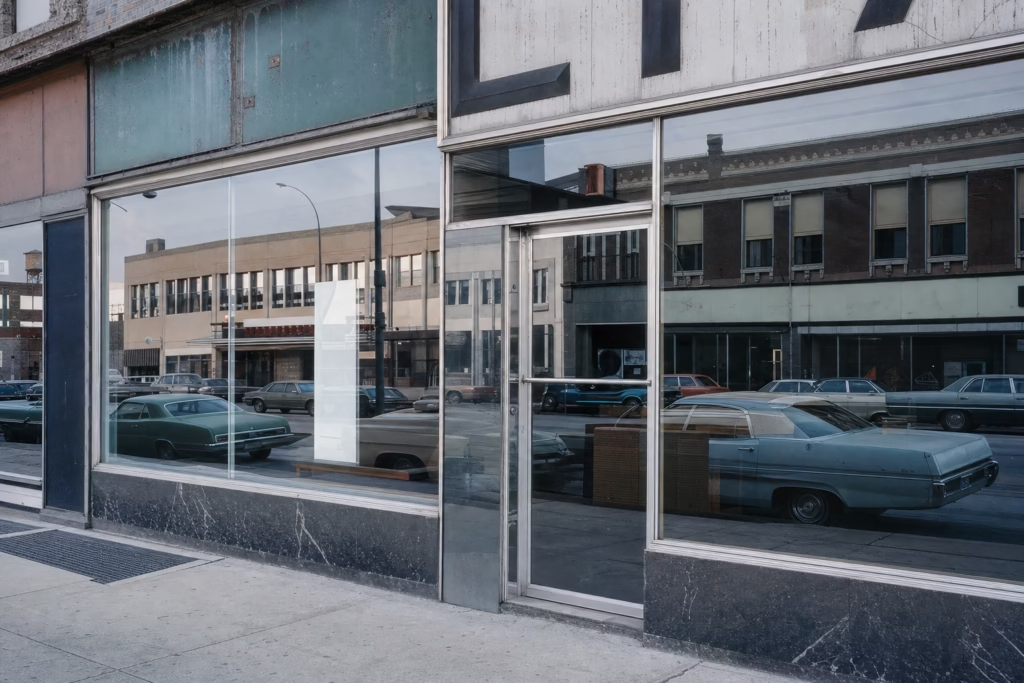
Photorealism is an art movement in which painters and other artists reproduce a photograph as exactly as possible in another medium, so that the finished work looks photographic. It emerged in the United States in the late 1960s and early 1970s, grew out of Pop Art, and rejected the gestural spontaneity of Abstract Expressionism in favour of meticulous, machine-like precision.
The movement was a deliberate provocation. At a moment when abstraction dominated serious painting, a loose group of artists chose to copy the everyday world exactly as a camera saw it — chrome bumpers, diner counters, storefront glass, gumball machines. This guide explains what Photorealism is, when and where it began, the five principles that define it, how Photorealists actually work, the artists and paintings that made it famous, and the honest answer to the question every viewer eventually asks: isn’t this just copying a photo?
What is Photorealism?
Photorealism is a genre of painting, drawing, and sculpture that takes a photograph — not direct observation of nature — as its source, and translates that photographic image into another medium with painstaking, near-mechanical accuracy. The term also names the specific American movement of the late 1960s and 1970s that made this practice into a coherent style. Its hallmarks are visual coolness, emotional detachment, smooth un-painterly surfaces, and banal, recognisably American subject matter.
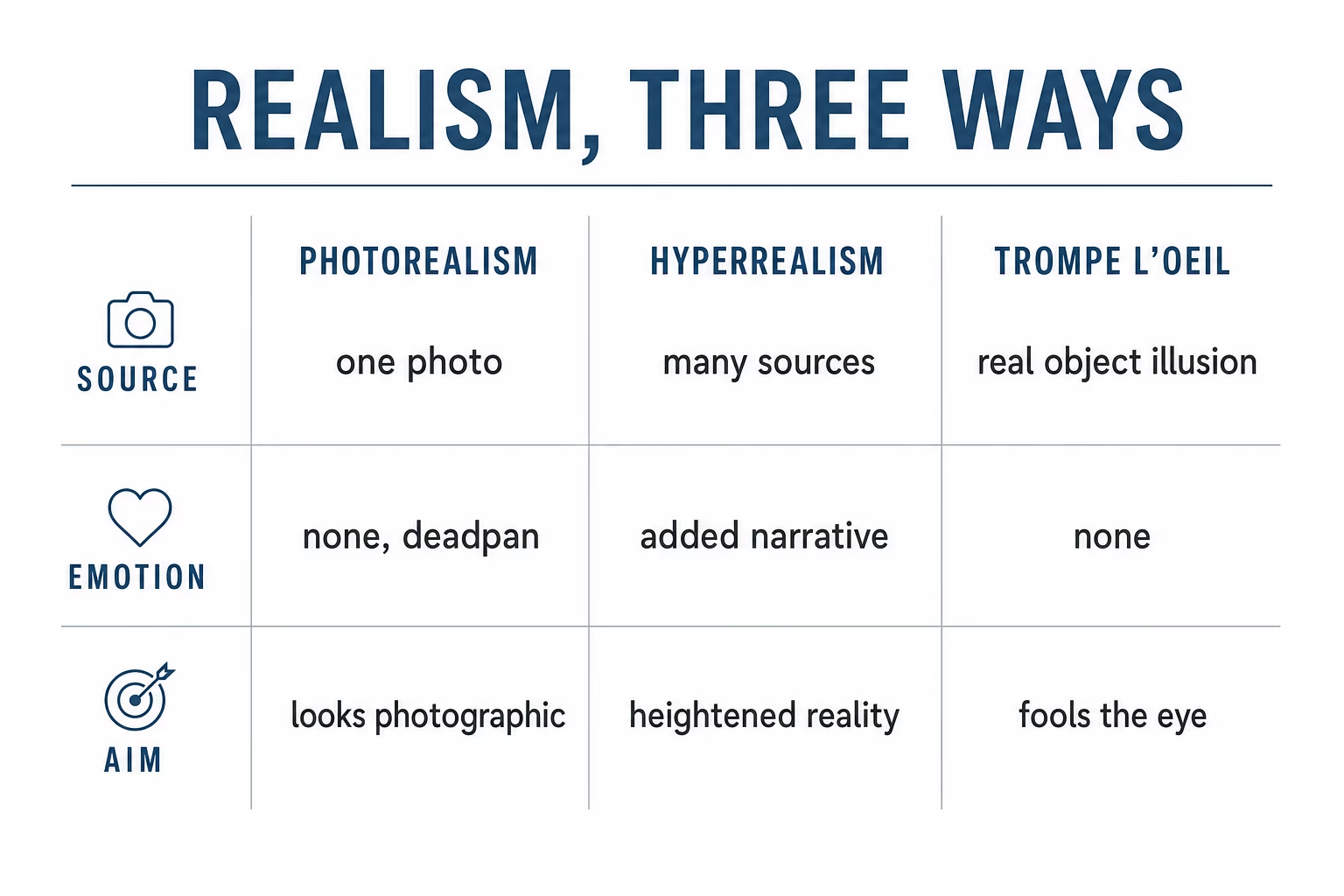
Crucially, a Photorealist painting is not meant to deceive you into thinking it is a real object. You are always aware you are looking at a painting — and often a painting of a photograph. That awareness is central to the effect, which distinguishes Photorealism from older illusionistic tricks such as trompe l’oeil. The style is sometimes labelled Super-Realism, New Realism, Sharp-Focus Realism, or (loosely) Hyperrealism, though each of those terms carries its own shade of meaning.
Photorealism at a glance
| Attribute | Photorealism |
|---|---|
| Also known as | Super-Realism, New Realism, Sharp-Focus Realism, Superrealism |
| Period | Late 1960s – 1970s (peak); continues today |
| Origin | United States (chiefly New York and California) |
| Term coined by | Louis K. Meisel, 1969 |
| Grew out of | Pop Art and Minimalism; a reaction against Abstract Expressionism |
| Source material | The photograph (slides, snapshots), not direct observation |
| Core techniques | Slide projection, grid transfer, airbrush, fine hand-painting |
| Typical subjects | Cars, storefronts, diners, signage, still life, portraits, urban scenes |
| Key painters | Richard Estes, Chuck Close, Ralph Goings, Audrey Flack, Robert Bechtle, Charles Bell |
| Key sculptors (Verists) | Duane Hanson, John De Andrea |
When and where did Photorealism begin?
Photorealism began in the United States in the mid-to-late 1960s and reached its height in the 1970s, emerging chiefly in New York and California. It was never founded as an organised group with a manifesto; instead it arose organically as a scattering of largely unconnected artists independently arrived at the same idea — painting directly from photographs — at roughly the same time.
The movement was a response to two forces. First, photography had become the dominant means of reproducing reality by the mid-twentieth century, saturating everyday life with images. Second, the reigning styles in American art — the spiritual, gestural canvases of Abstract Expressionism and then the austerity of Minimalism — had pushed representational painting to the margins. Like the Pop artists, the Photorealists reacted against the individualism and improvisation of Abstract Expressionism, favouring planned, impersonal, exacting work. According to Tate, the style emerged in both Europe and the USA, and saw a renewed surge in the early 1990s as new camera and digital technology allowed even greater precision.
Where Pop artists such as those in the Pop Art movement often mocked the absurdity of commercial imagery, the Photorealists took the opposite stance — they wanted to reclaim and exalt the value of the ordinary image rather than satirise it.
Who coined the term “Photorealism”?
Louis K. Meisel, a Brooklyn-born art dealer who ran a gallery in SoHo, coined the word “Photorealism” in 1969. It appeared in print for the first time the following year, in the catalogue for the Whitney Museum of American Art’s 1970 exhibition Twenty-two Realists. Meisel went on to become the movement’s leading dealer, collector, and scholar, and the Louis K. Meisel Gallery still operates in New York.
The style gained a wider international audience in 1972, when the Swiss curator Harald Szeemann included several Photorealists — among them Chuck Close, Richard Estes, Ralph Goings, and Robert Bechtle — in documenta 5 in Kassel, Germany. The exhibition was controversial, but it placed Photorealism on the world stage and secured its association with the modernist canon, even if as an outlier.
Meisel’s five principles of Photorealism
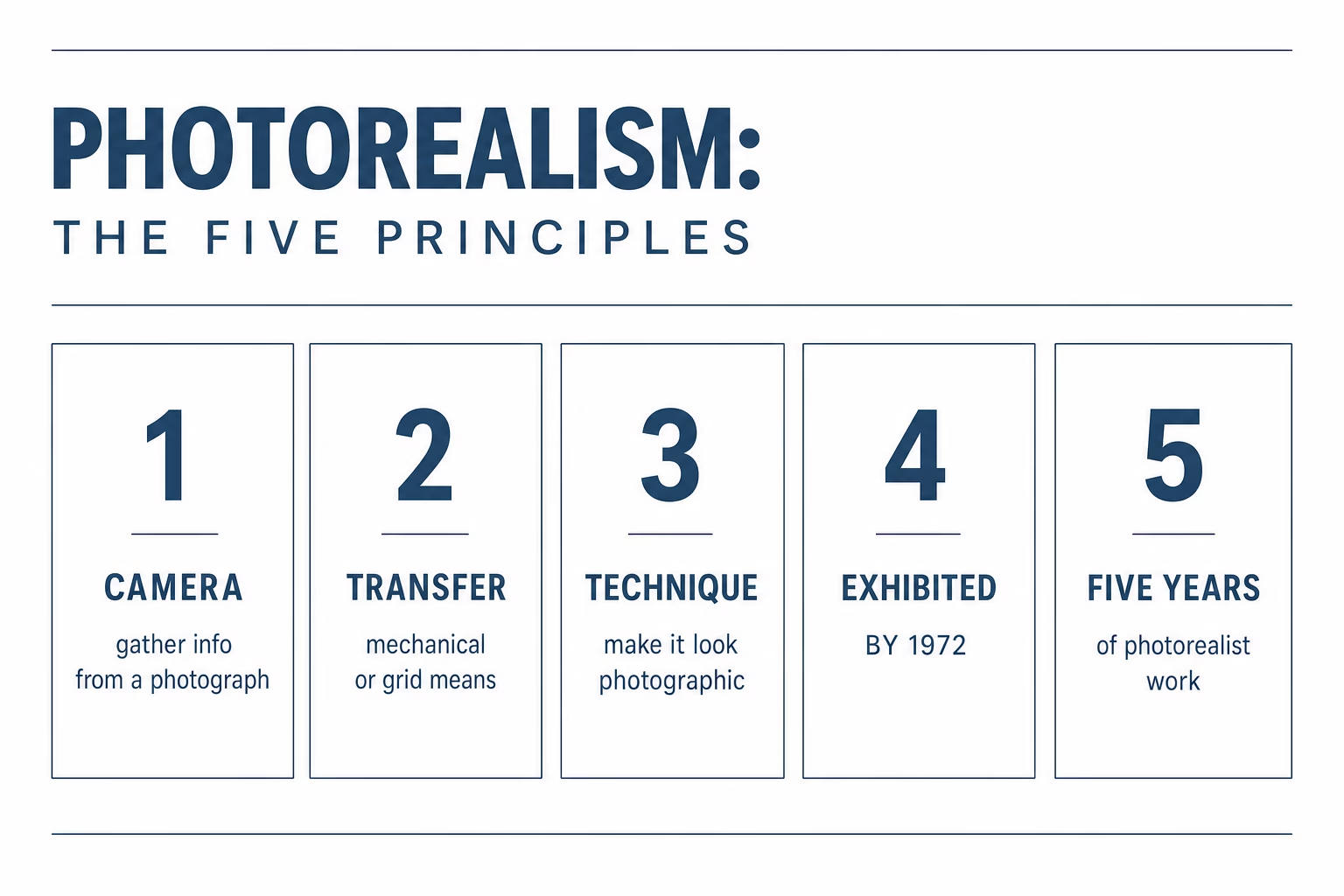
Meisel’s five-point definition, written in 1972 at the request of the collector Stuart M. Speiser, is the closest the movement has to an operating rulebook. Speiser had commissioned the largest collection of Photorealist works to date, later donated to the Smithsonian Institution in 1978. Meisel’s criteria deliberately drew a tight boundary around who counted as an “original” Photorealist. A Photorealist, by his definition:
- uses the camera and photograph to gather information;
- uses a mechanical or semi-mechanical means to transfer that information to the canvas;
- must have the technical ability to make the finished work appear photographic;
- must have exhibited work as a Photorealist by 1972 to be counted among the central figures; and
- must have devoted at least five years to developing and exhibiting Photorealist work.
As with most modern movements, adherence was elective — the British painter Malcolm Morley, for instance, often worked from toy models rather than photographs, and Meisel did not classify him as a Photorealist. Still, the five points capture the movement’s essence: the photograph is the indispensable source, and the transfer to canvas is a disciplined, repeatable process rather than an act of spontaneous invention.
How Photorealists actually work
Photorealist technique is a systematic pipeline that turns a photograph into a large painting. The artist first gathers imagery with a camera, usually developing the picture onto a photographic slide. Because a Photorealist painting cannot exist without the photograph, the crucial step is transferring that frozen moment onto canvas as accurately as possible — and the movement developed two dominant methods for doing exactly that.
Slide projection and the grid method
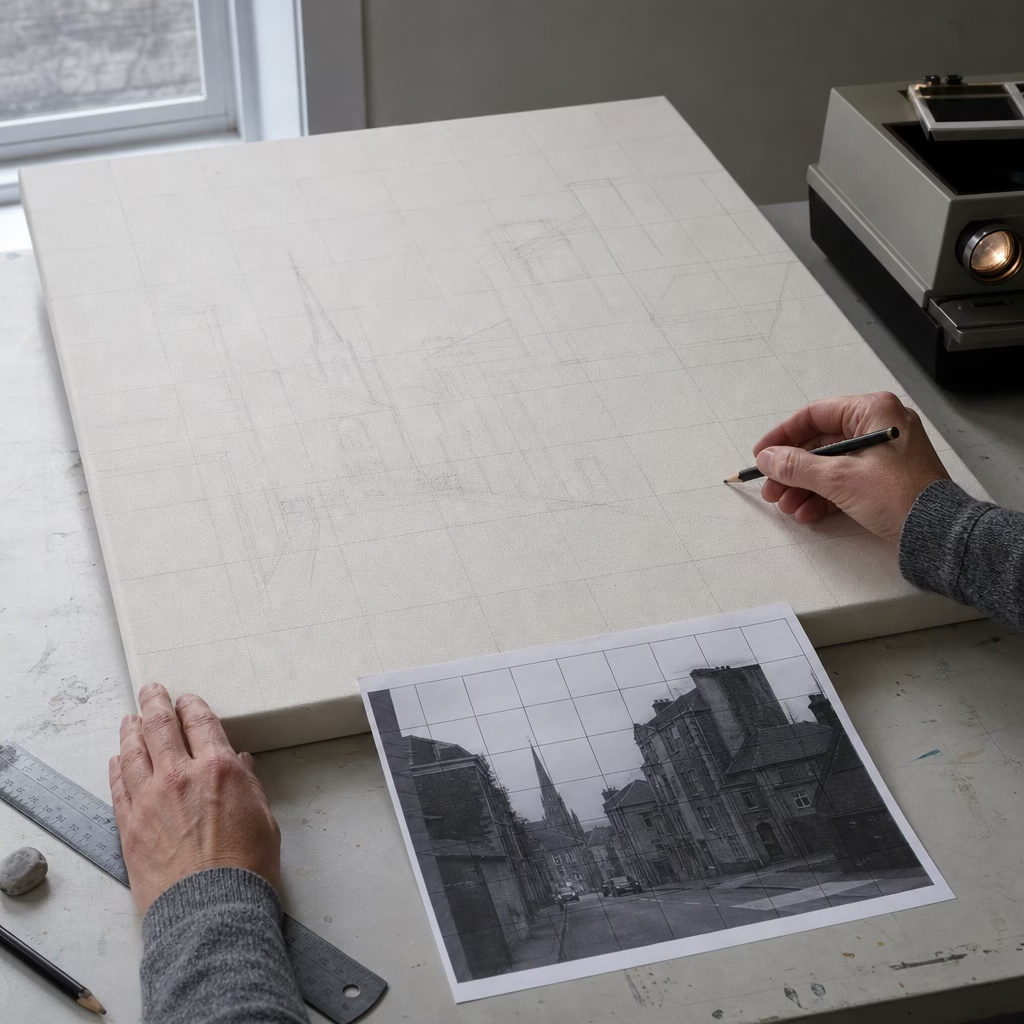
Projection and gridding are the two workhorses of Photorealist transfer. In projection, the artist casts the slide directly onto a bare canvas — sometimes inverted or upside down — and traces the shapes. In the grid method, both the photograph and the canvas are divided into a matching grid, and the artist copies the image one small cell at a time, focusing on tiny patches of tone, line, and shadow much as one might examine the pixels of a digital photo. Chuck Close famously built his monumental portraits this way, working cell by cell from the top-left corner, so that the image accumulated slowly across the surface.

The airbrush and fine hand-painting
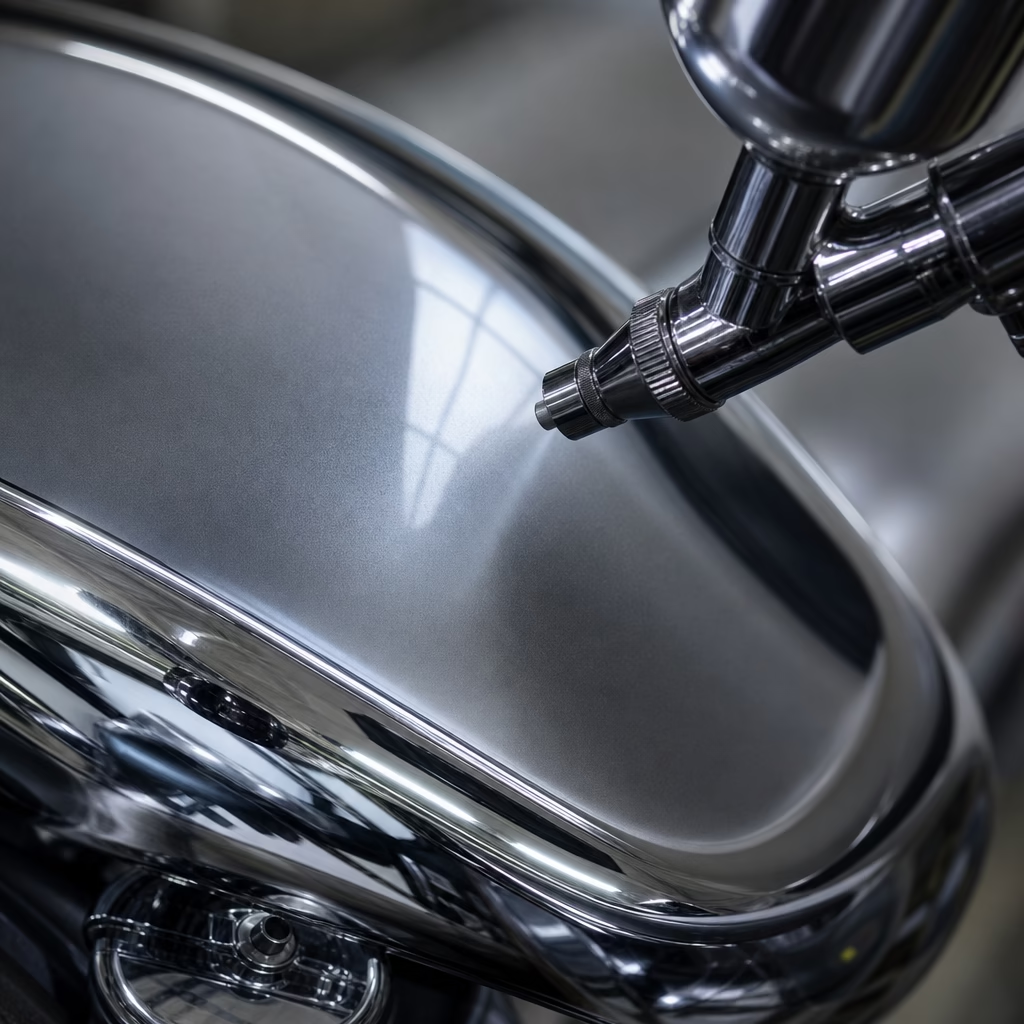
The airbrush — a tool originally invented to retouch photographs — became emblematic of the style because it lays down smooth, gradated colour with no visible brushstroke, echoing the seamless surface of a photographic print. Artists such as Ralph Goings and Robert Bechtle used airbrush techniques to capture the crisp veneer of American car culture, while Chuck Close first sketched with an airbrush and then finished the many details by hand. The goal throughout is to erase the artist’s individual “handwriting,” so that the finished picture reads as machine-made rather than hand-made. Richard Estes, notably, used neither a grid nor a projector, relying instead on freehand skill and multiple photographs of the same New York street.
What did Photorealists paint?
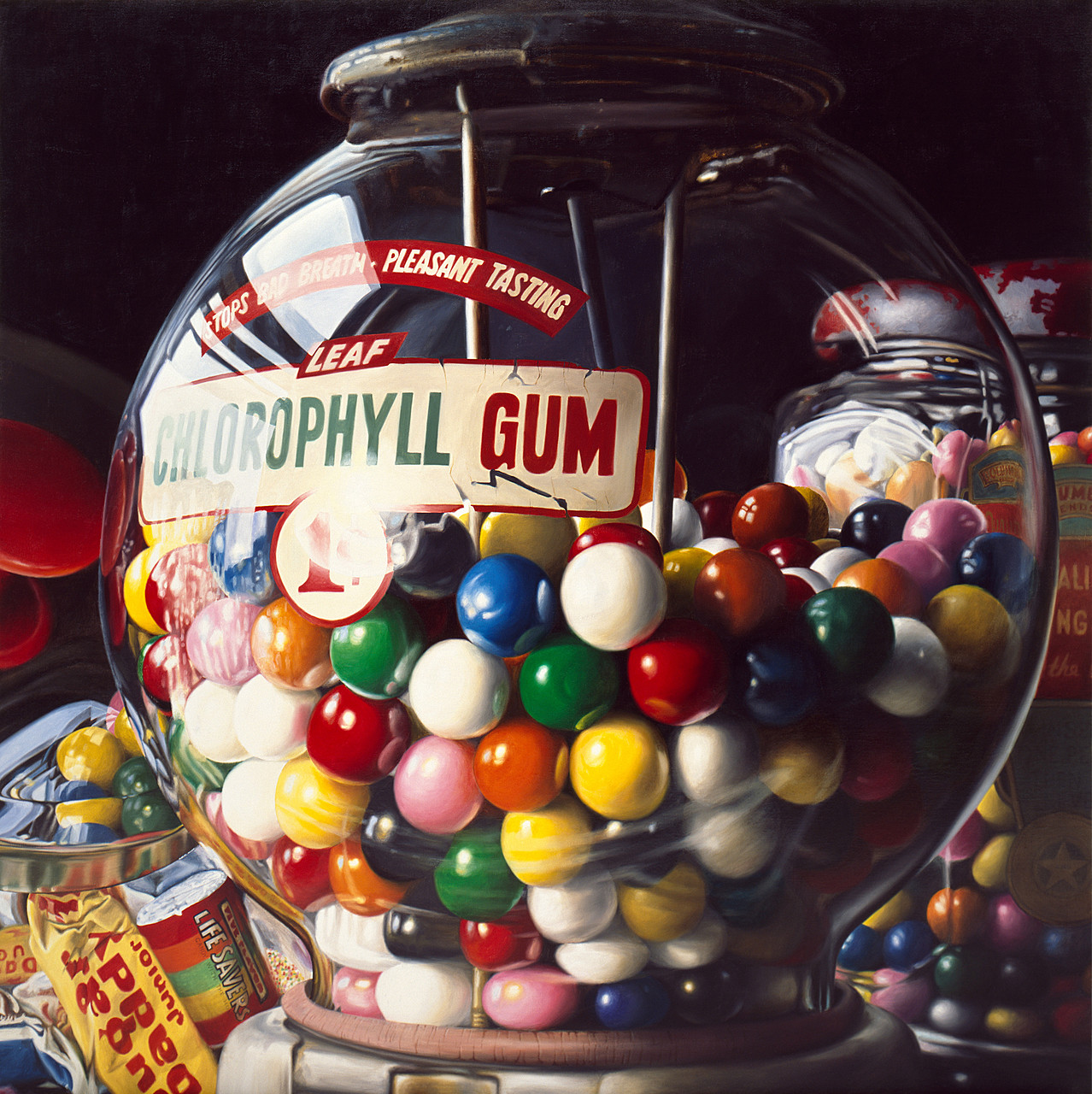
Photorealist subject matter is deliberately mundane: the everyday, commercial, and overlooked corners of American life. The original Photorealists tackled traditional genres — landscape, portrait, and still life — but stripped of grandeur. Landscapes were urban rather than natural: parking lots, low-rise buildings, gas stations, and shopfronts. Portraits were frontal and unglamorous. Still lifes featured gumball machines, toys, glassware, and diner condiments.
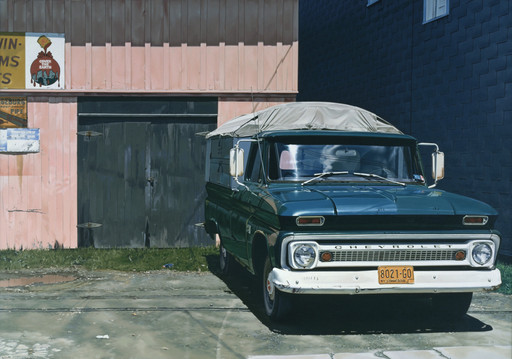
Reflective, light-catching surfaces became a signature challenge and a shared obsession — the chrome of a motorcycle, the plate glass of a storefront, the enamel of a pickup truck. These surfaces let painters demonstrate the virtuosity the style demanded, and they gave the work its cool, gleaming, distinctly modern look. The imagery is saturated in nostalgic Americana, which is why a Ralph Goings diner or a Robert Cottingham neon sign feels like a document of a vanishing national landscape.
Key Photorealist artists
The first generation of American Photorealists worked largely independently but shared a devotion to the photographic image. The following painters and sculptors defined the movement and remain its most collected figures.
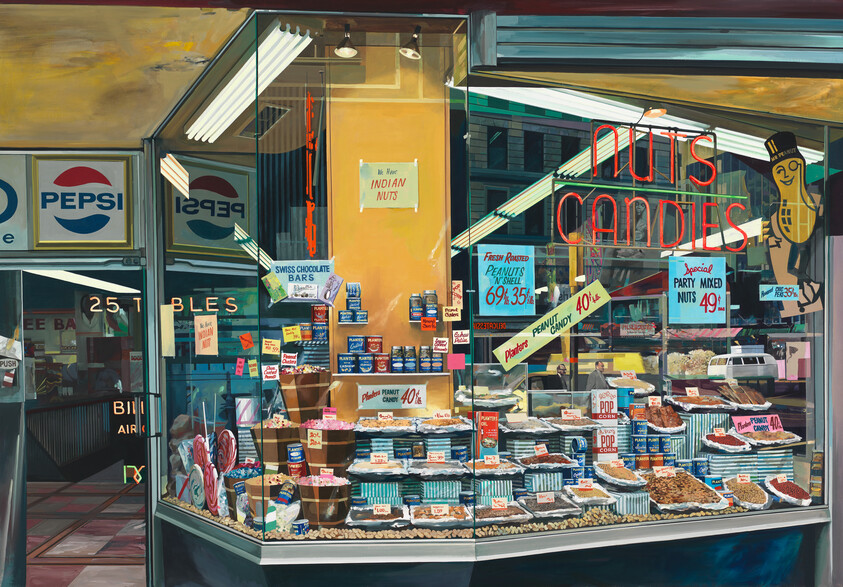

- Richard Estes (b. 1932) — the master of the gleaming urban cityscape, painting New York storefronts and reflections with such command of glass and light that his surfaces reveal more than the eye naturally sees. As of recent years he is regarded as the last of the original Photorealists still working in the style.
- Chuck Close (1940–2021) — introduced the human face to Photorealism with his monumental gridded “mug-shot” portraits, beginning with his Big Self-Portrait (1967–68). His methodical grid links his work to Minimalists such as Agnes Martin and Sol LeWitt.
- Ralph Goings (1928–2016) — painted pickup trucks, banks, fast-food restaurants, and diner still lifes, turning the roadside ordinariness of America into cool, deliberate images such as McDonald’s Pickup (1970).
- Audrey Flack (1931–2024) — the sole woman among the first-generation Photorealists and the first Photorealist whose work entered the Museum of Modern Art’s collection. Her lush, symbol-laden still lifes, such as World War II (Vanitas) (1977–78), revived the seventeenth-century vanitas theme with modern emotional force.
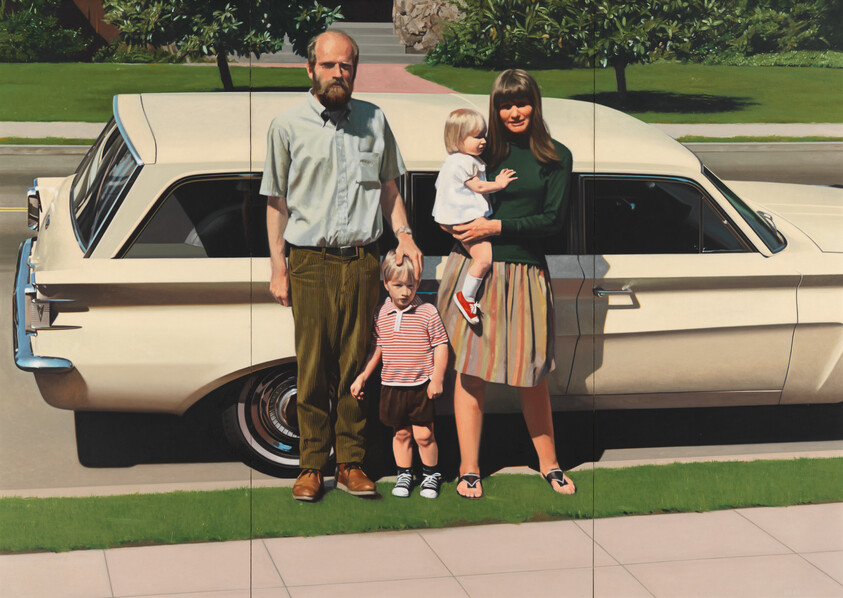
- Robert Bechtle (1932–2020) — drew on his family and the sunlit street scenes of the San Francisco Bay Area, painting parked cars and suburban calm with delicate restraint.
- Charles Bell (1935–1995) — enlarged gumball machines, pinball games, and childhood toys into glossy, large-scale still lifes that play high art against low culture.
- Robert Cottingham (b. 1935) — known for radically cropped compositions of neon signs, movie marquees, and shop facades.
- Don Eddy, Malcolm Morley, and John Salt — further first-generation figures who painted, respectively, reflective glassware and cityscapes, postcard and ship imagery, and the wrecked cars of American scrapyards.
Photorealist sculpture and Verism
Photorealist sculpture translates the movement’s obsession with lifelike accuracy into three dimensions, producing eerily convincing figures of ordinary people. Its practitioners are sometimes called Verists. The American sculptors Duane Hanson and John De Andrea cast their works from live models and finished them with real clothing, real hair, and everyday props — coffee cups, shopping bags, cafeteria trays.
Duane Hanson’s The Woman Eating (1971), in the collection of the Smithsonian American Art Museum, seats a plainly dressed woman alone at a table; only up close do the faint brushstrokes reveal the figure is not real. Unlike most Photorealist painters, Hanson admitted a social message — his figures convey the loneliness and resignation of ordinary suburban life, and placing them in the refined space of a museum forces viewers to reconsider who is worthy of being an artistic subject.
Photorealism vs Pop Art, Minimalism, and trompe l’oeil
Photorealism shares DNA with its contemporaries but is not identical to any of them. Understanding the differences clarifies exactly what the movement was doing.
Photorealism and Pop Art
Both movements drew on the flood of photographic and commercial imagery in postwar culture, and both painted cars, signage, and consumer goods. The difference is attitude. Pop Art tended to poke fun at commercial imagery and treat it ironically; Photorealism sought to validate the same imagery as worthy subject matter, presenting it with cool neutrality rather than satire.
Photorealism and Minimalism
Despite their opposite appearances — one figurative, one geometric — Photorealism sits surprisingly close to Minimalism. Both suppressed the artist’s individual mark, both prized planning and industrial-style fabrication over spontaneity, and both shared a flat, affectless coolness. The Minimalist’s use of industrial process and the Photorealist’s mechanical transfer of a photograph are two versions of the same impulse to remove the artist’s ego from the work.
Photorealism and trompe l’oeil
Photorealism is frequently, but wrongly, equated with trompe l’oeil. A true trompe l’oeil painting tries to fool you into believing you are seeing a real object. Photorealism does the opposite: the viewer is meant to remain fully aware that the surface is a painting — often a painting of a photograph. Consciousness of the medium is the point, not its concealment.
Photorealism vs Hyperrealism
Photorealism and Hyperrealism are closely related but distinct. Photorealism came first, focused strictly on reproducing a photographic source in paint with deadpan neutrality. Hyperrealism, whose name derives from the French Hyperréalisme coined by the Belgian dealer Isy Brachot in 1973, grew out of Photorealism a generation later and pushed in a different direction: it works across more media (including sculpture), often invents scenes from multiple sources rather than copying one photo, and deliberately injects narrative, emotion, and social commentary that the original Photorealists worked hard to strip out.
In short, Photorealism replicates the photograph coolly; Hyperrealism heightens reality and adds feeling. For a full side-by-side breakdown of technique, intent, and leading artists, see our dedicated guide to Photorealism vs Hyperrealism.
Is Photorealism just copying a photograph?
The charge that Photorealism is “just copying” is the oldest and most persistent criticism of the movement, and it deserves a straight answer rather than a dismissal. When the style first gained momentum in the late 1960s, artists’ open admission that they worked from photographs drew intense criticism — even though painters had quietly used optical aids since the fifteenth century. The objection still surfaces constantly among working artists: browse a forum such as WetCanvas and you will find long threads debating whether a photorealistic painting is genuine creativity or “just a production transfer.”
Two points cut through the debate. First, there is a real distinction between craft and art: exacting reproduction is a formidable craft, and craft and artistry do not always travel together, but the presence of one does not cancel the other. Second, choosing what to photograph, how to frame and crop it, what to leave out, and how to render light and surface are all creative decisions — the same decisions that make one photograph arresting and another forgettable. Richard Estes routinely deleted pedestrians, litter, and puddles from his street scenes; Audrey Flack loaded her still lifes with personal and historical symbolism. The Photorealists’ own defence was simpler still: as several put it, the photograph is just another tool for getting an idea into material form, and the artistry lies in how that form is expressed. Whether that satisfies you is, fittingly for this movement, a matter of what you choose to see.
Photorealism today and its legacy
Photorealism’s influence has continued to grow well beyond its 1970s peak. Newer painters build on the founders — the influence of Estes echoes in the work of Anthony Brunelli, and Ralph Goings and Charles Bell in that of Glennray Tutor — while the style has become thoroughly international, with European artists such as Franz Gertsch, Roberto Bernardi, Bertrand Meniel, and Raphaella Spence emerging since the 1980s and 1990s. Advances in digital photography have let contemporary artists dissect their subjects in ever finer detail.
Just as importantly, Photorealism won a lasting argument: it broke the taboo against the camera in “high” art. The photograph, once dismissed as cheating, is now an accepted tool in the painter’s process, and Photorealist tendencies ripple through the work of later artists as varied as Gerhard Richter, Richard Prince, Chuck Close’s successors, and Kehinde Wiley. What began as a defiant rebuke to abstraction has become part of the permanent vocabulary of contemporary art. To place the movement in the wider story of Western style, explore our full hub of art movements.
Frequently asked questions about Photorealism
What is Photorealism in simple terms?
Photorealism is a style of painting, drawing, and sculpture that copies a photograph so precisely that the finished artwork looks like a photograph itself. It began in the United States in the late 1960s and focuses on ordinary, everyday subjects rendered with cool, exacting detail.
Who founded the Photorealism movement?
No single person founded Photorealism; it emerged independently among several artists. Richard Estes, Chuck Close, and Ralph Goings are often named as pioneers, while the dealer Louis K. Meisel coined the term “Photorealism” in 1969 and defined the movement’s five principles in 1972.
What is the difference between Photorealism and Hyperrealism?
Photorealism reproduces a single photograph with deadpan neutrality and no added emotion. Hyperrealism, which grew out of it in the 1970s, works across more media, often combines multiple sources, and deliberately adds narrative, emotion, and social commentary, taking realism to a heightened extreme.
What techniques do Photorealists use?
Photorealists gather imagery with a camera, then transfer the photograph to canvas using a projector or a grid system. They frequently use an airbrush — originally a photo-retouching tool — along with fine hand-painting to produce smooth, brushstroke-free surfaces that mimic a printed photograph.
Is Photorealism still relevant today?
Photorealism remains active and influential. New generations of American and European artists continue to work in the style, digital photography has expanded its precision, and its core achievement — making the camera an accepted tool in fine-art painting — shapes contemporary art from Gerhard Richter to Kehinde Wiley.
Why did Photorealists paint from photographs instead of life?
Photorealists painted from photographs because the photograph freezes a fleeting moment and captures light, reflection, and detail exactly as a camera records them. Working from a slide let artists replicate that specific, mechanical way of seeing — distinct from natural human vision — which was central to the movement’s aesthetic.