The best colored pencils for artists are Faber-Castell Polychromos, Caran d’Ache Luminance 6901 and Derwent Lightfast: artist-grade pencils with dense pigment, a lead of about 3.8 to 4 mm and colours rated lightfast to a published standard. Polychromos is an oil-based pencil that keeps a sharp point for detail, Luminance is a wax-based pencil that blends like a soft pastel, and Derwent Lightfast is rated 100% lightfast to ASTM D-6901. Prismacolor Premier is the softest and most widely sold wax pencil, but many Prismacolor colours fade faster than the 3 leaders.
Colored pencil choice comes down to 3 attributes of the pencil (core, lightfastness and range) and 1 question about the drawing. The sections after the comparison table describe each pencil, explain wax and oil cores and lightfastness ratings, and match a pencil to portraits, detail work, blending, archival work and beginners.
The 10 best colored pencils for artists are compared in the table below by the drawing each pencil suits, its core, lead diameter, number of colours and lightfastness.
| Pencil | Best for | Core | Lead | Colours | Lightfastness |
|---|---|---|---|---|---|
| Faber-Castell Polychromos | Detail and layering | Oil-based | 3.8 mm | 120 | 101 of 120 at the top rating |
| Prismacolor Premier | Blending and burnishing | Wax-based, very soft | Not stated | 150 | Many colours not lightfast |
| Caran d’Ache Luminance 6901 | Portraits and archival work | Wax-based | 3.8 mm | 100 | ASTM D-6901: 81 LFI, 19 LFII |
| Derwent Lightfast | Archival work | Oil-based | Not stated | 100 | 100% lightfast, ASTM D-6901 |
| Caran d’Ache Pablo | Linework and fine detail | Firm, water-resistant | 3.8 mm | 120 | No rating published |
| Holbein Artists’ | Soft pastel tones | Oil and wax | 3.8 mm | 150 | Lightfast, no rating published |
| Derwent Coloursoft | Soft blending at mid price | Soft | Not stated | 72 | No rating on the product page |
| Koh-I-Noor Polycolor | Value artist grade | Oil-based, hard | Not stated | 144 | No rating on the pencil |
| Lyra Rembrandt Polycolor | Waterproof oil pencil | Oil-based | 4 mm | Sets from 12 | Lightfast, no rating published |
| Arteza Professional | Budget practice | Wax-based | Not stated | 72 | Ratings not listed |
Lightfastness decides whether a colored pencil drawing can be sold or framed, and the core decides how the pencil feels on paper. The 10 pencils below are described in that order.
What are the 10 best colored pencils for artists?
The 10 best colored pencils for artists are Polychromos, Prismacolor Premier, Luminance, Derwent Lightfast, Pablo, Holbein, Coloursoft, Polycolor, Rembrandt Polycolor and Arteza Professional. The 10 are ordered by how often guides to colored pencils name them, and each pencil is described in the same order: what the pencil is, its core, lead, colours, lightfastness, the drawing it suits and its 1 limit.
1. Faber-Castell Polychromos
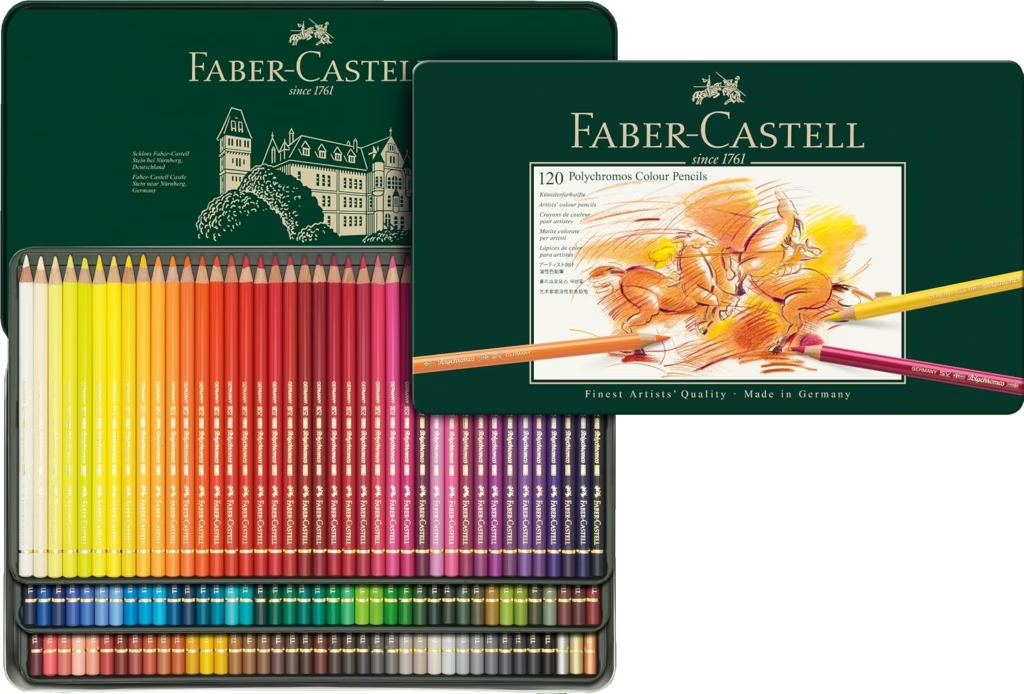
Faber-Castell Polychromos is an artist-grade colored pencil made in Germany by Faber-Castell. Blick describes Polychromos as having “pigment-rich, oil-based cores” in thick 3.8 mm leads, and Faber-Castell glues the lead along its whole length to protect it against breakage. Polychromos comes in 120 colours. In Blick’s lightfastness table, 101 of the 120 colours carry the top rating of III, 17 carry II and 2 carry I. Polychromos suits botanical drawing, animal fur, hair and any work built from many thin layers with a sharp point. The limit is blending: the firm oil core needs more pressure and more layers than a soft wax pencil to reach a solid, burnished colour.
Artist @lea.creates.art layering Polychromos in a drawing:
2. Prismacolor Premier
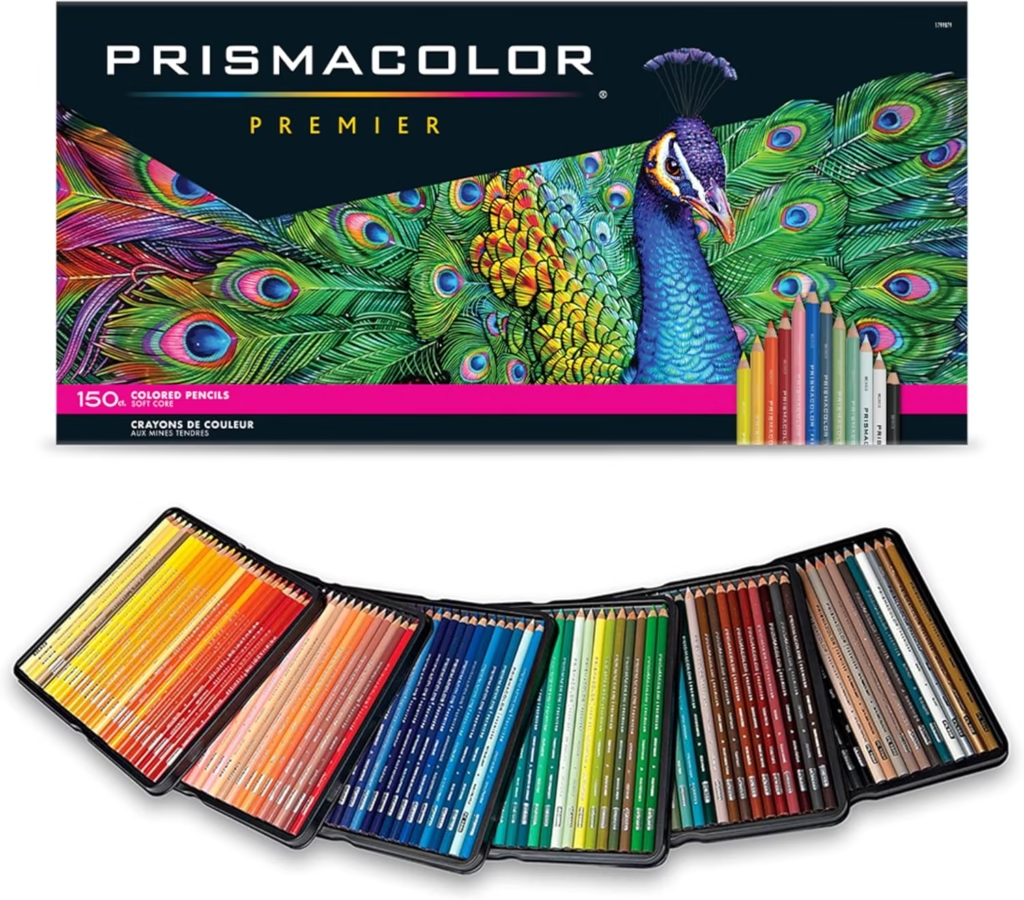
Prismacolor Premier is a soft, wax-based colored pencil sold by Prismacolor, now made in Mexico. Artist Lachri’s review on Parka Blogs describes Premier as “a wax based pencil” with a soft, brittle lead that blends and layers easily. Prismacolor Premier comes in sets of up to 150 colours, and every colour is sold as a single pencil. Lachri’s review states that “a large portion of those colors are not lightfast”, so a Premier drawing for sale needs a check against Prismacolor’s colour-by-colour lightfast chart. Premier suits burnished, saturated colour, portraits and blending practice. The limit is breakage: the same review describes off-centre leads and pencils that lose half their length to sharpening.
Artists @ms_fineart and @deelydrawings blending with Prismacolor Premier:
3. Caran d’Ache Luminance 6901
Caran d’Ache Luminance 6901 is the artist-grade colored pencil of the Swiss maker Caran d’Ache, designed and made in Switzerland. Caran d’Ache describes the Luminance lead as “smooth, wax-based” and 3.8 mm in diameter, in FSC-certified cedar. Luminance comes in 100 colours. Caran d’Ache rates the range to the ASTM D-6901 standard, with 81 colours at LFI, the highest level, and 19 at LFII. Luminance suits portraits, skin tones and finished work for sale, because the soft core blends like a pastel and the colours do not fade. The limit is price: Caran d’Ache’s US store lists a box of 12 at $70.65, about $5.90 per pencil.
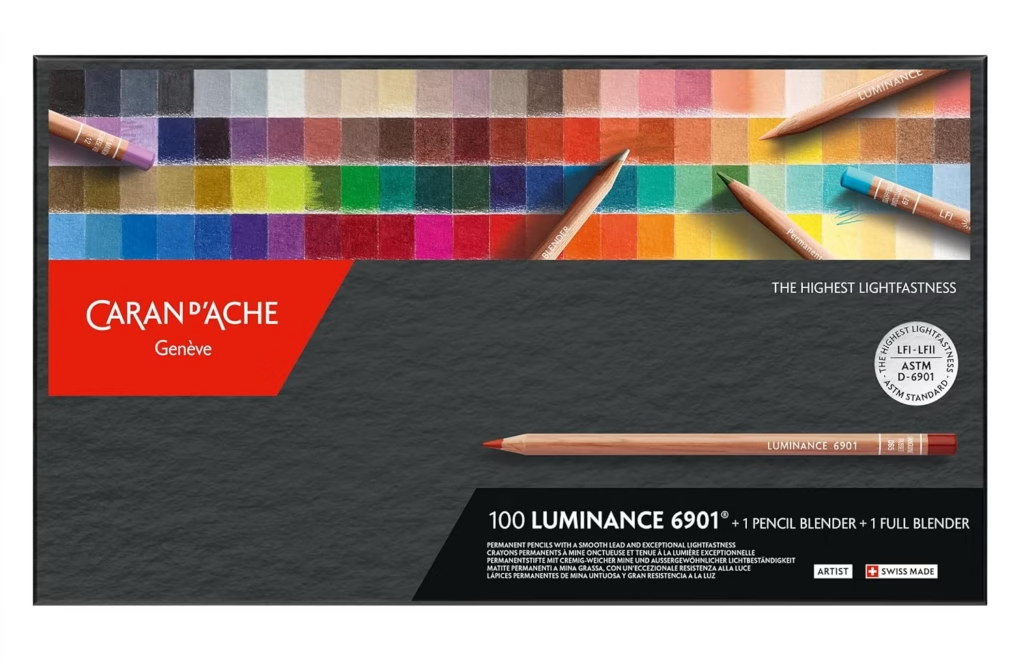
Artists @hannahlipsey_ and @heather12ooney drawing with Luminance:
4. Derwent Lightfast
Derwent Lightfast is an oil-based artist pencil made by the British company Derwent. Art Supplies UK describes Derwent Lightfast as “a 100% lightfast oil-based pencil” with a thick core that gives dense colour. Derwent Lightfast comes in 100 colours. Derwent states that every colour complies with ASTM D-6901 and the Blue Wool Scale ISO 105, and will not fade for up to 100 years under museum conditions. Derwent Lightfast suits commissions, gallery work and any drawing that hangs in daylight. The limit is the range: 100 colours is fewer than Polychromos or Prismacolor, so some mixes need more layers.
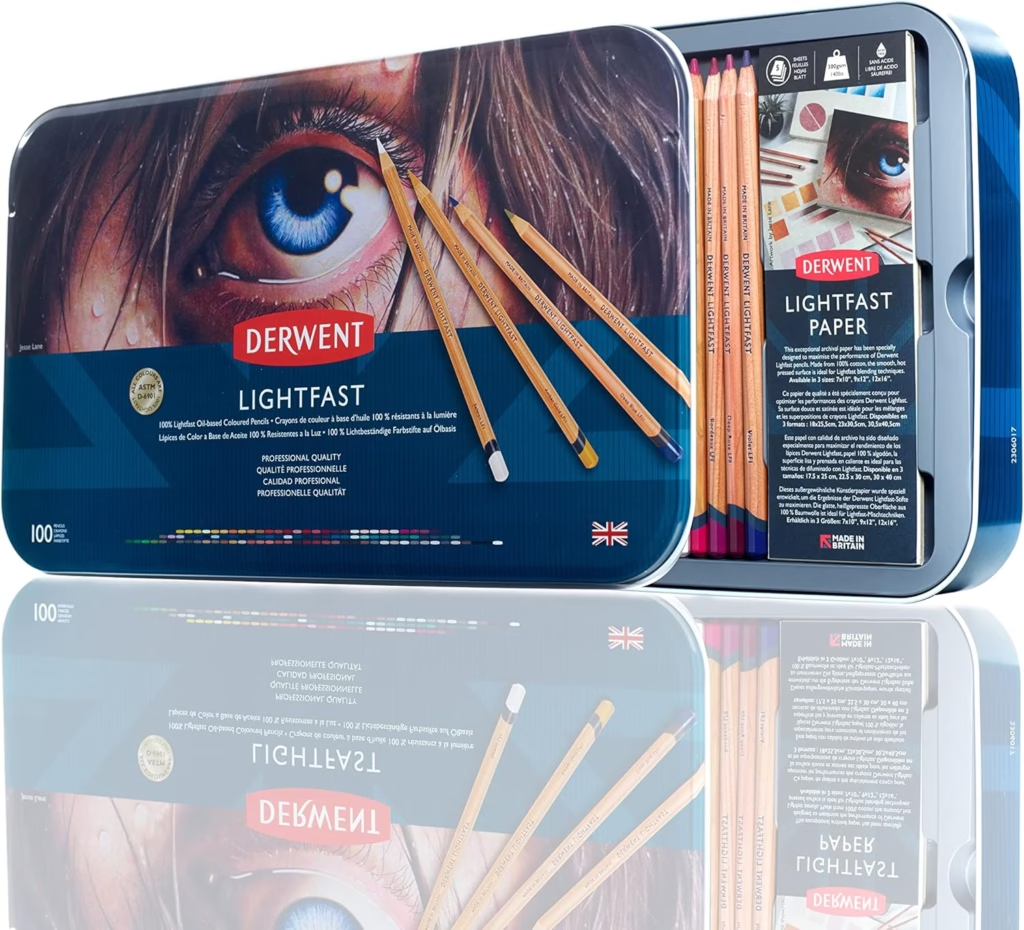
Artist jennifermorrisonart drawing with Derwent Lightfast:
5. Caran d’Ache Pablo
Caran d’Ache Pablo is the firmer, water-resistant colored pencil of Caran d’Ache. Blick describes Pablo as having “firm, break-resistant 3.8 mm leads”, and retailers sell Pablo as water-resistant, so a wash over the top does not lift the colour. Caran d’Ache sells Pablo in boxes of 12 to 120 colours. Caran d’Ache does not publish an ASTM rating for Pablo, and Blick describes the lightfastness only as “impressive”. Pablo suits linework, small detail and drawings that combine colored pencil with watercolour. The limit is the price per pencil: Caran d’Ache’s US store lists a box of 12 at $47.75, close to Polychromos for a pencil with no published rating.
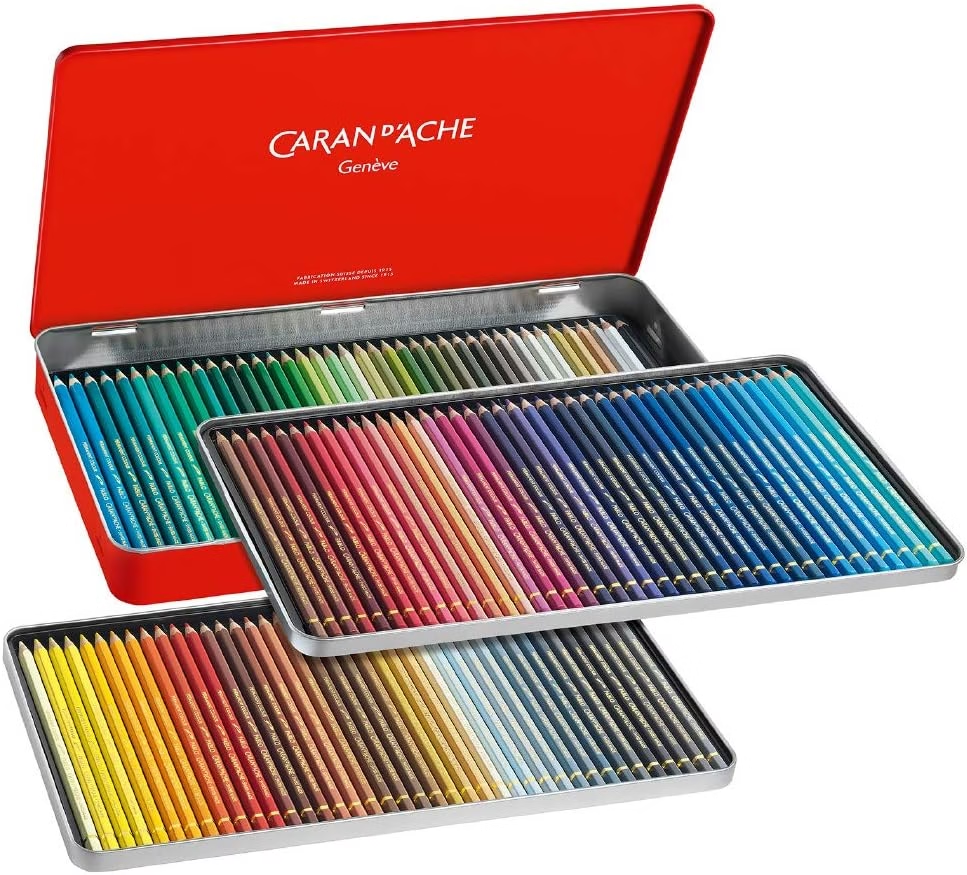
6. Holbein Artists’ Colored Pencils
Holbein Artists’ Colored Pencils are artist-grade colored pencils made in Japan by Holbein. Blick lists the core as “oils, waxes, and premium pigments” in a “thick, medium-soft 3.8 mm core”. Holbein makes 150 colours, with a large share of soft pastel tints that other ranges lack. Holbein states that the colours are lightfast and permanent, without a published ASTM rating. Holbein suits soft, light-filled drawings, florals and pastel skies. The limit is availability: Holbein is sold by fewer shops outside Japan than Faber-Castell or Derwent.
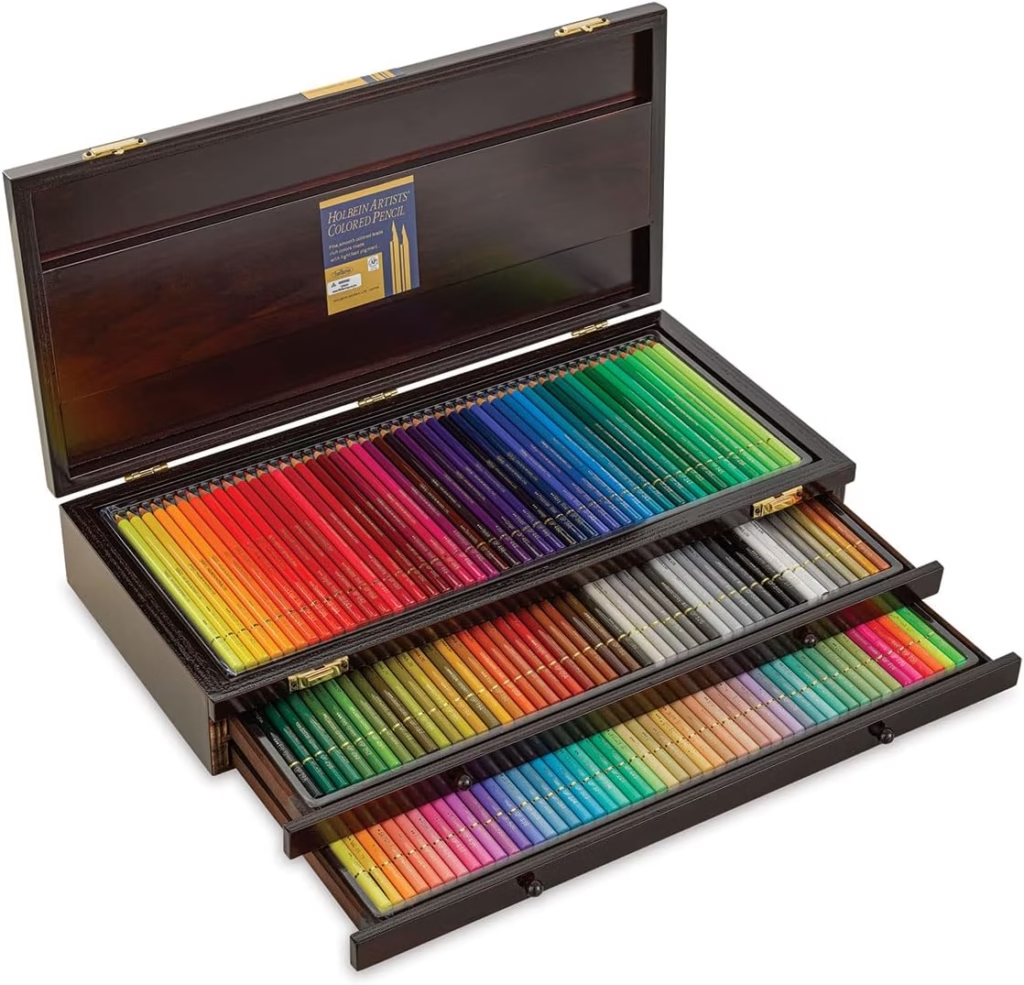
7. Derwent Coloursoft
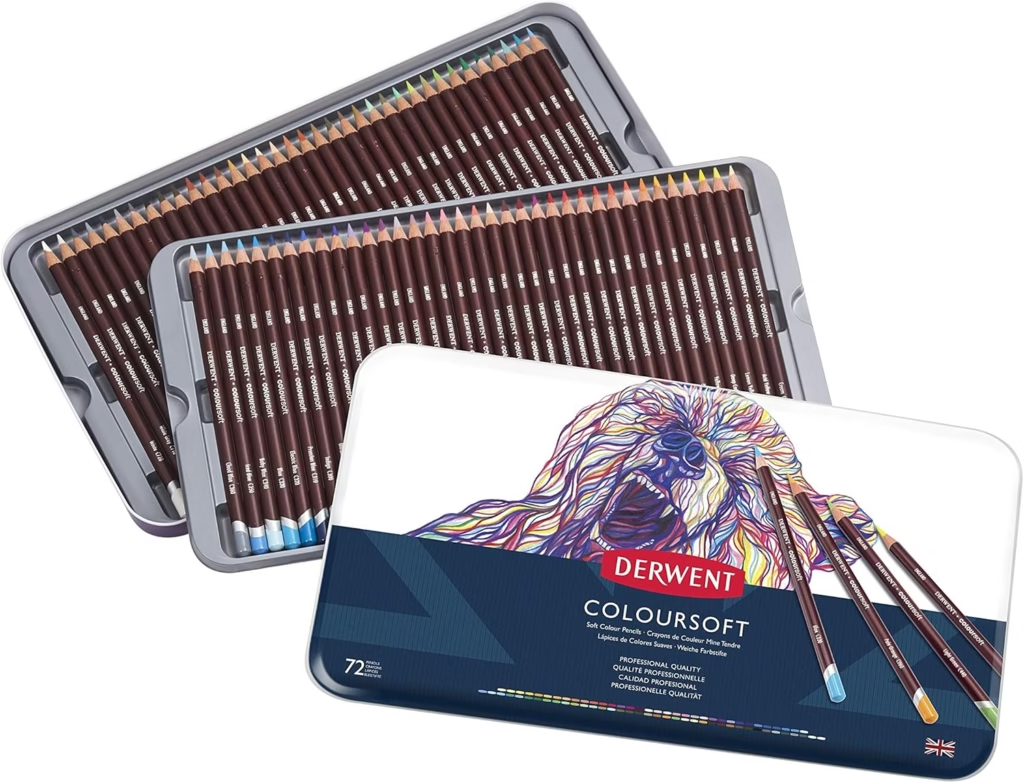
Derwent Coloursoft is a soft colored pencil made by Derwent. Derwent’s own description calls Coloursoft “our softest pencil ever”, with an “ultra-soft core formulation” for rapid, dense colour. Coloursoft comes in 72 colours. Derwent publishes Coloursoft lightfastness in a separate chart, and the ratings are not on the product page. Coloursoft suits blending, skin tones and artists who want a soft pencil between Prismacolor and Luminance in price. The limit is the range: 72 colours is half the Holbein or Prismacolor range.
8. Koh-I-Noor Polycolor
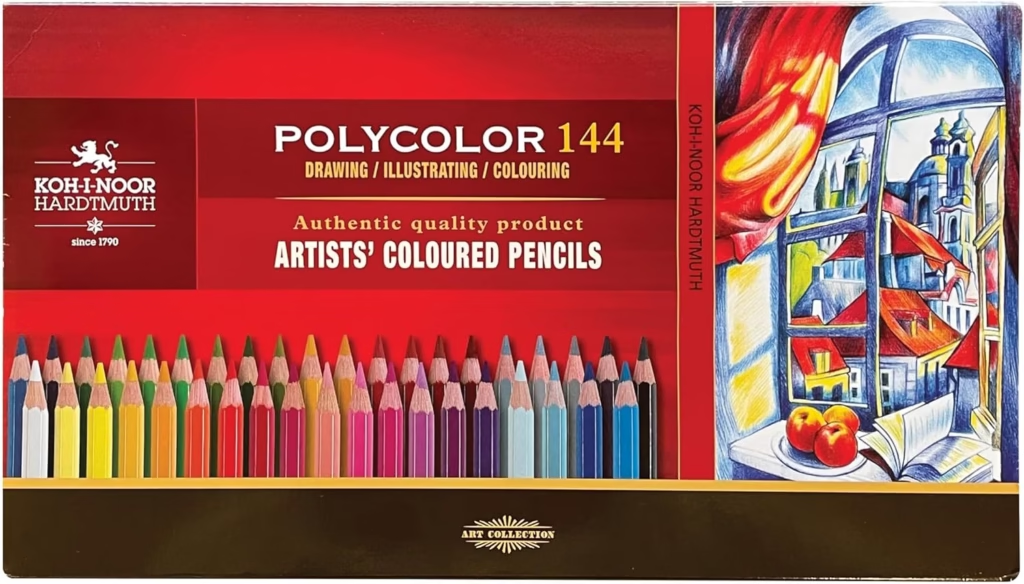
Koh-I-Noor Polycolor is an oil-based colored pencil made by the Czech company Koh-i-noor Hardtmuth. Parka Blogs’ review of Polycolor states that the brochure lists the pencils as oil-based, and that “the core is much harder” than Faber-Castell’s. The Polycolor line has 144 colours, in sets of 12, 24, 36, 48, 72 and 144. Koh-i-noor prints no lightfast rating on the pencil or the box. Polycolor suits beginners and artists who want an oil pencil for linework at a low price. The limit is layering: the hard core lays down colour less easily than Polychromos, and single colours are hard to find.
9. Lyra Rembrandt Polycolor
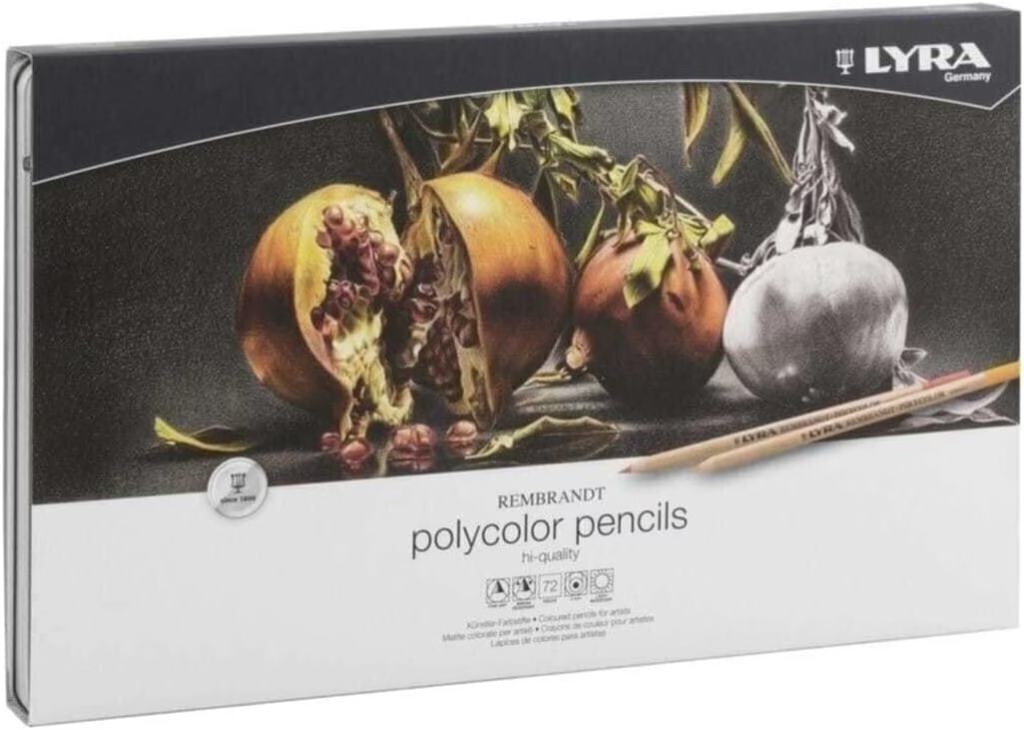
Lyra Rembrandt Polycolor is an oil-based artist pencil made in Germany by Lyra. Retailer listings describe Rembrandt Polycolor as having a 4 mm “oil-based lead, professional artist-grade, waterproof, lightfast”. Rembrandt Polycolor is sold in tins from 12 colours, including a tin of 12 grey tones. Lyra describes the colours as lightfast without a published ASTM rating. Rembrandt Polycolor suits greyscale studies, underdrawings and artists who want a German oil pencil below the Polychromos price. The limit is availability: fewer shops stock the full range than stock Polychromos.
10. Arteza Professional
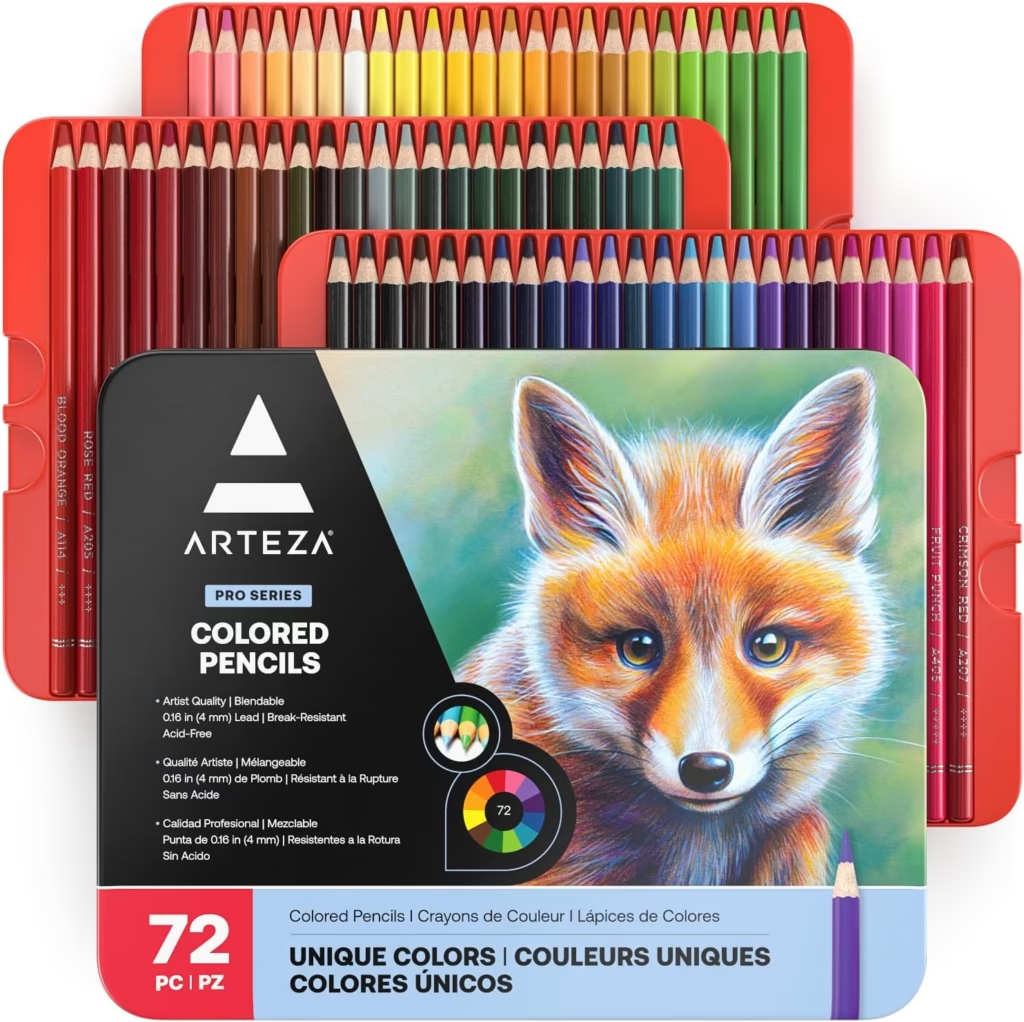
Arteza Professional is a budget wax-based colored pencil sold by the US brand Arteza. Arteza describes the pencils as having a “smooth, wax-based core” with break-resistant leads. Arteza sells the set in 72 colours, listed at $32.99, about $0.46 per pencil. Arteza states that each pencil shows a lightfastness rating, but the ratings are not listed on the product page. Arteza Professional suits colour studies, sketchbooks and learning to layer before buying artist-grade pencils. The limit is permanence: without published ratings, Arteza is not a pencil for work you sell.
What makes a colored pencil artist grade?
A colored pencil is artist grade when 3 attributes meet a professional standard: a dense pigment load, a core that layers without breaking, and colours rated for lightfastness. Every pencil in the table has the first 2 attributes; the lightfastness rating is the attribute that separates them most.
Are wax-based or oil-based colored pencils better?
Wax-based colored pencils are better for blending and burnishing, and oil-based colored pencils are better for detail and many thin layers. Every colored pencil binds its pigment with a mix of wax and oil; a wax-based pencil such as Prismacolor Premier or Luminance has more wax, and an oil-based pencil such as Polychromos has more oil. A wax core is softer and lays colour faster, but a heavy wax layer can form a white haze called wax bloom. An oil core keeps a sharp point and does not bloom. The guide to the best oil-based colored pencils compares 10 pencils of this kind.
How is colored pencil lightfastness rated?
Colored pencil lightfastness is rated by ASTM D-6901, the American standard specification for artists’ colored pencils, and by the Blue Wool Scale of ISO 105. Caran d’Ache rates Luminance as LFI or LFII under ASTM D-6901, and Derwent rates every Lightfast colour to both ASTM D-6901 and the Blue Wool Scale. Faber-Castell uses its own scale of 1 to 3 stars, shown in Blick’s table as I to III. A pencil without a published rating has no proof that the colour will last in a framed drawing.
Does lead diameter matter in colored pencils?
Lead diameter matters in colored pencils, because a thicker lead breaks less and covers a larger area per stroke. Polychromos, Luminance, Pablo and Holbein all use a 3.8 mm lead, and Lyra Rembrandt Polycolor uses a 4 mm lead. Student pencils usually have thinner leads, which break more often in a sharpener.
Which colored pencils are best for each type of drawing?
The best colored pencils for each type of drawing depend on how much blending, detail and permanence the drawing needs. The 5 common types are portraits, detailed drawings, blended and burnished drawings, archival work for sale and practice.
Which colored pencils are best for portraits?
The best colored pencils for portraits are Caran d’Ache Luminance 6901 and Derwent Coloursoft. Luminance blends skin tones smoothly, and Caran d’Ache sells a 20-colour “Portrait” assortment of Luminance. Coloursoft is sold in a 6-pencil Skintones pack of cream, blush pink, pink, ochre, dark terracotta and brown earth. Polychromos adds the sharp details of eyelashes and hair on top of either.
Which colored pencils are best for detailed drawings?
The best colored pencils for detailed drawings are Faber-Castell Polychromos and Caran d’Ache Pablo. Both use a firm 3.8 mm lead that holds a sharp point across many strokes, so fur, feathers and botanical veins stay crisp. Polychromos has the wider range at 120 colours and the published ratings.
Which colored pencils are best for blending and burnishing?
The best colored pencils for blending and burnishing are Prismacolor Premier and Caran d’Ache Luminance. Burnishing means pressing a final layer hard enough to fill the paper’s tooth, which gives a smooth, polished surface. Soft wax cores burnish with less pressure, Prismacolor offers 150 colours to burnish with and Luminance 100, and a solvent such as odourless mineral spirits blends the layers further.
Which colored pencils are best for archival work you sell?
The best colored pencils for archival work you sell are Derwent Lightfast and Caran d’Ache Luminance 6901. Derwent rates all 100 Lightfast colours to ASTM D-6901, and Caran d’Ache rates all 100 Luminance colours at LFI or LFII. Polychromos is the third choice, because 101 of its 120 colours carry the top rating.
Which colored pencils are best for beginners on a budget?
The best colored pencils for beginners on a budget are Koh-I-Noor Polycolor and Arteza Professional. Polycolor gives an oil-based core and 144 colours at a low price, and Arteza gives 72 wax-based colours for about $33. A beginner can then add single artist-grade pencils, such as Polychromos, for the colours used most.
What else should you know before buying colored pencils?
Before buying colored pencils, you should know which brands professionals compare, whether brands mix, how many colours you need, which paper the pencils need and how to sharpen soft cores. The 6 questions below answer those points.
Which colored pencils do professional artists use?
Professional colored pencil artists most often use Faber-Castell Polychromos, Caran d’Ache Luminance 6901 and Derwent Lightfast, often together. Artist Jasmina Susak’s top 3 for 2026 are Prismacolor Premier, Luminance and Polychromos, and the artist videos in this guide show the same brands at work.
Is Faber-Castell or Derwent better?
Faber-Castell Polychromos is better for detail and range, and Derwent Lightfast is better for guaranteed permanence. Polychromos has 120 colours with 101 at the top rating, while Derwent Lightfast has 100 colours, all rated lightfast to ASTM D-6901.
Can you mix wax-based and oil-based colored pencils?
Yes, you can mix wax-based and oil-based colored pencils in 1 drawing. Lay the firmer oil pencil first for structure and detail, and finish with the softer wax pencil for blending and burnishing, because a hard core skids over a heavy wax layer.
How many colored pencils do you need to start?
You need about 24 colored pencils to start: the primaries, secondaries, 2 or 3 earth tones, a white and a black. Most artist-grade ranges are sold in sets of 24, and open stock lets you replace the colours you use most.
What paper do colored pencils need?
Colored pencils need a smooth to fine-toothed paper of 150 gsm or more that takes 10 or more layers. Hot-pressed watercolour paper and Bristol vellum are common choices, and the guide to the best paper for colored pencil drawing compares them.
How do you sharpen soft colored pencils without breaking them?
You sharpen soft colored pencils without breaking them by using a sharp blade and light, even pressure, or a helical electric sharpener. Lachri’s review of Prismacolor notes that electric sharpeners broke fewer leads than handheld ones. The guide to electric sharpeners for colored pencils compares them. Pencils, paper and solvents are covered across the site’s colored pencil supplies guides.