
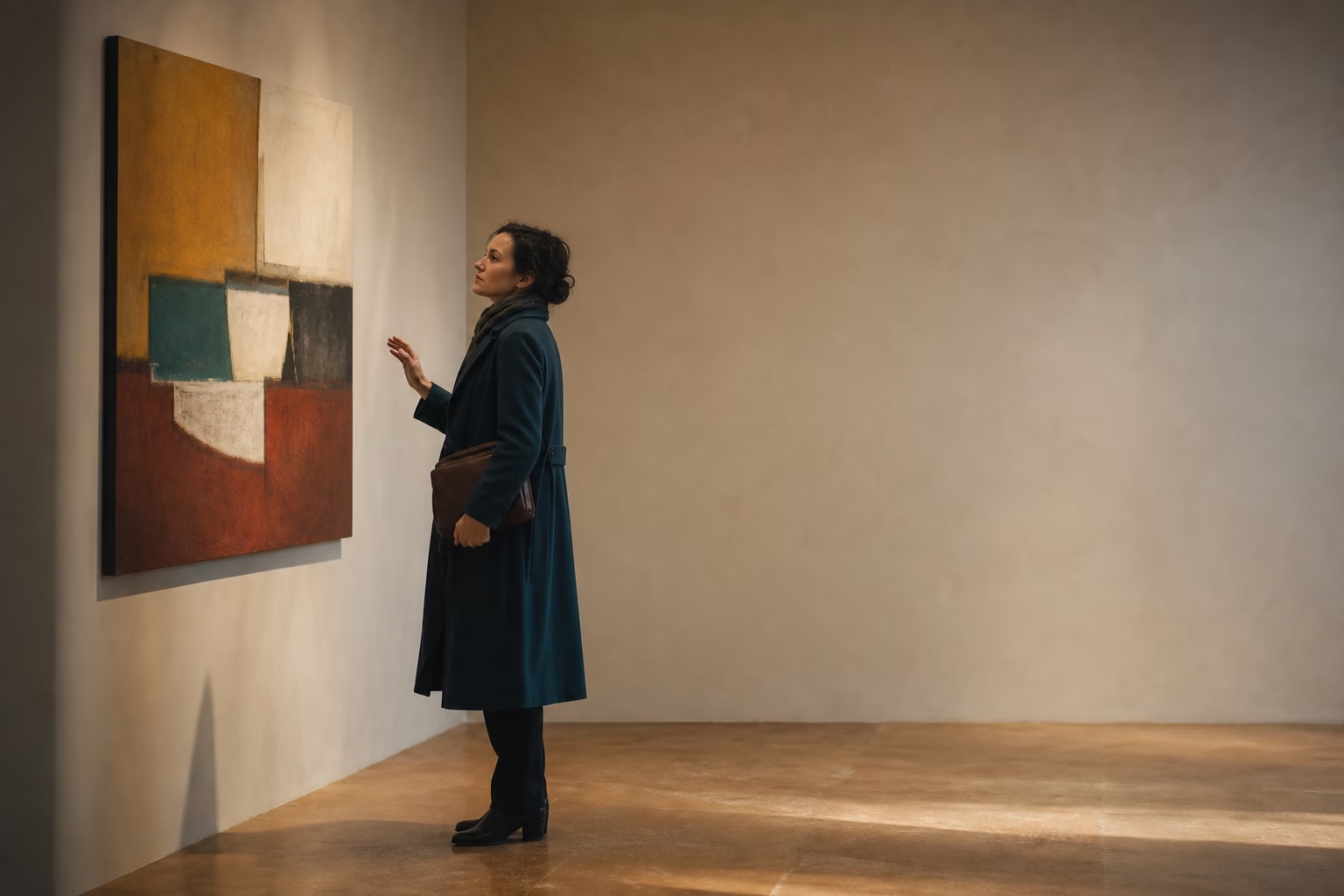
You know the moment. A visitor stops in front of one of your paintings. Their face changes. They lean in, they take a photo, they ask the title, they ask the price. They tell you it would look perfect above their dining table. And then they say, “Let me think about it,” and they walk out of your studio, and you never hear from them again.
If you’ve been making and selling work for any length of time, you’ve lived through that scene more times than you’d like to count. And if you’ve gone looking for answers, you’ve almost certainly run into the same advice everywhere: people buy art with their hearts, not their heads. True enough. But it doesn’t help you, because it doesn’t explain what you really want to know — which is why a buyer whose heart was clearly engaged still walked away.
This article is going to take you somewhere different. Instead of asking why people buy art, we’re going to ask the harder, more useful question: why do people almost buy art and then hesitate? The answer lives in a small handful of well-studied cognitive and emotional patterns — loss aversion, ambiguity aversion, choice overload, identity risk, trust friction, decision postponement, and plain old buying-mechanic friction. None of them are mysterious. All of them are fixable. And once you can recognize them by name, you stop taking buyer hesitation personally and start treating it as a design problem you can actually solve.
Art sales psychology isn’t really about persuasion. It’s about removing the invisible reasons your buyers freeze at the threshold of “yes.”
The 7 Hesitation Patterns: A Diagnostic Map
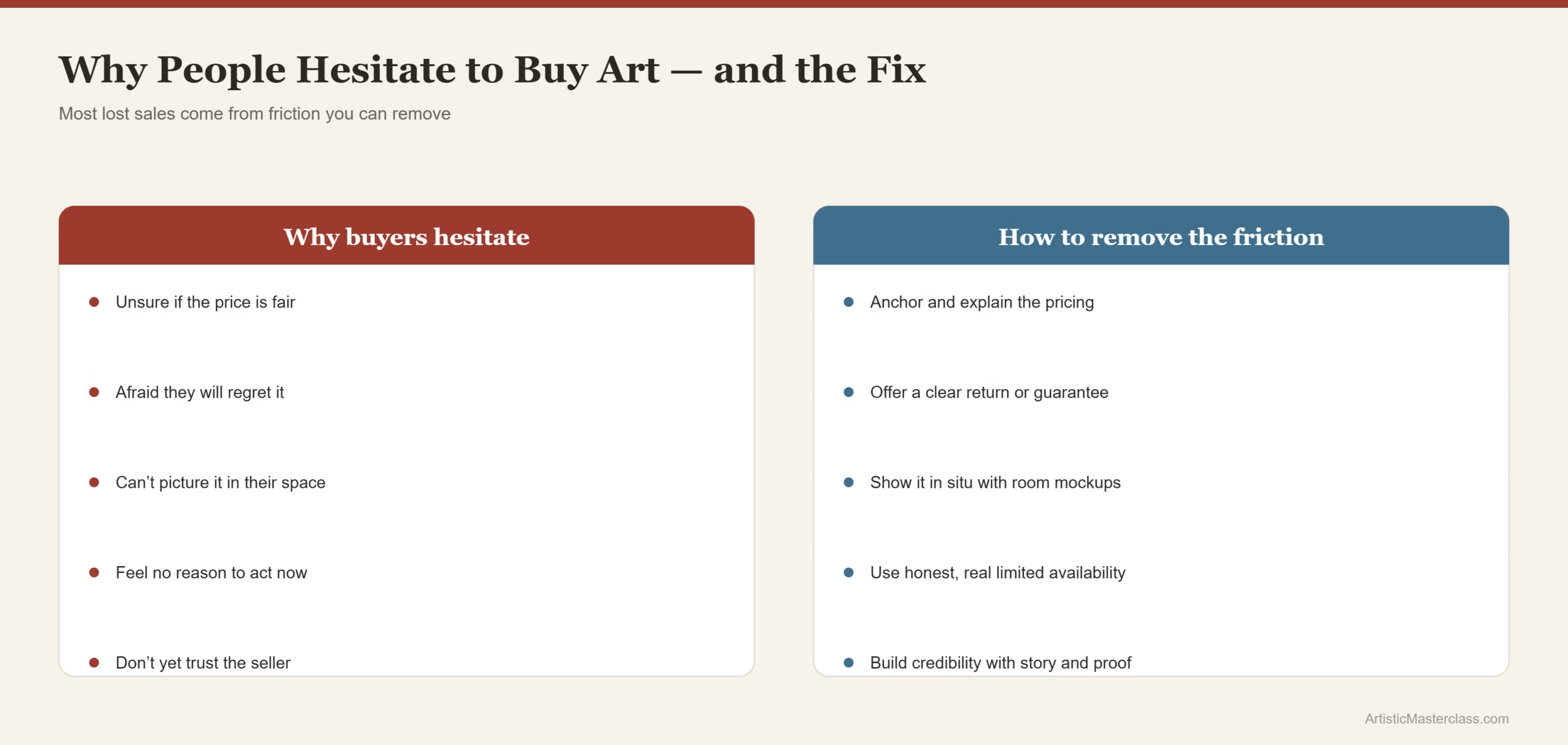
Before we go deep on each one, here’s the whole landscape on a single page. Keep this table handy — once you start watching for these signals in your conversations, you’ll see them everywhere.
| What the buyer says or does | What’s actually going on (the psychology) | What to fix |
|---|---|---|
| “I’ll think about it.” | Decision postponement / regret avoidance | Lower the perceived risk with a return window or approval period |
| “It’s lovely, but…” trailing off | Identity uncertainty — will this say the right thing about me? | Help them see the piece in their own space and give them words to describe it |
| “Do you have anything smaller?” | Loss aversion — the spend feels bigger than the joy | Offer a clear, lower-stakes entry point without discounting the original |
| “What’s your most popular piece?” | Social proof seeking | Make collector validation visible (sold dots, press, exhibitions) |
| Long enthusiastic interest, then total silence | Ambiguity aversion — will I still love it in six months? | Send a 48-hour follow-up that adds context, not pressure |
| Eyes glazing over your portfolio | Choice overload | Curate down to a small, intentional selection |
| “Is this going to hold its value?” | Status quo bias dressed up as a financial question | Speak to the emotional return, not financial speculation |
That table is the article in miniature. The rest of the piece is about each row in detail, with the science behind it and the specific things to change about how you show, price, talk about, and follow up on your work.
Why “People Buy Art with Their Hearts” Is Only Half the Story
Almost every existing article about art sales psychology stops at one idea: art buying is emotional. And it absolutely is. Bethany Crystal, writing about her own art-buying habits, described it as “structured spontaneity” — months of looking, narrowing, daydreaming about an empty wall, and then a final decision made in about ninety seconds on the strength of pure feeling. That’s how most art purchases really happen. Logic does the prep work; emotion makes the call.
But here’s what nobody tells you. Emotion opens the door. Friction is what slams it shut.
When a buyer feels something in front of your painting, you’ve already won the hardest part of the battle. The reason they don’t buy is almost never that they didn’t feel enough. It’s that, in the seconds and minutes after the feeling arrived, something else got in the way — a tiny calculation, a small uncertainty, a quiet voice asking whether this is a good idea. That’s the friction. And friction is what the rest of this article is about, because friction is where you actually have leverage.
Daniel Kahneman and Amos Tversky’s work on prospect theory — the foundation of modern behavioral economics — showed that human decisions about money, value, and risk almost never follow the rational models economists assumed they did. We are loss-averse, anchor-dependent, narrative-driven creatures who systematically misjudge our own future feelings. Once you know that, you stop expecting buyers to behave logically and start designing your sales process around how they actually behave. That’s the shift that changes everything.
So yes, emotion sells art. But friction is what kills the sale. Let’s go through the seven kinds of friction one at a time.
Hesitation #1 — Loss Aversion: Why Spending Hurts More Than Owning Feels Good
Kahneman and Tversky’s most famous finding is also the most useful one for artists. People feel the pain of losing a sum of money roughly twice as strongly as they feel the pleasure of gaining something of equivalent value. Read that again, because it’s the single most important sentence in this article. The pain of spending is psychologically about twice as heavy as the joy of owning.
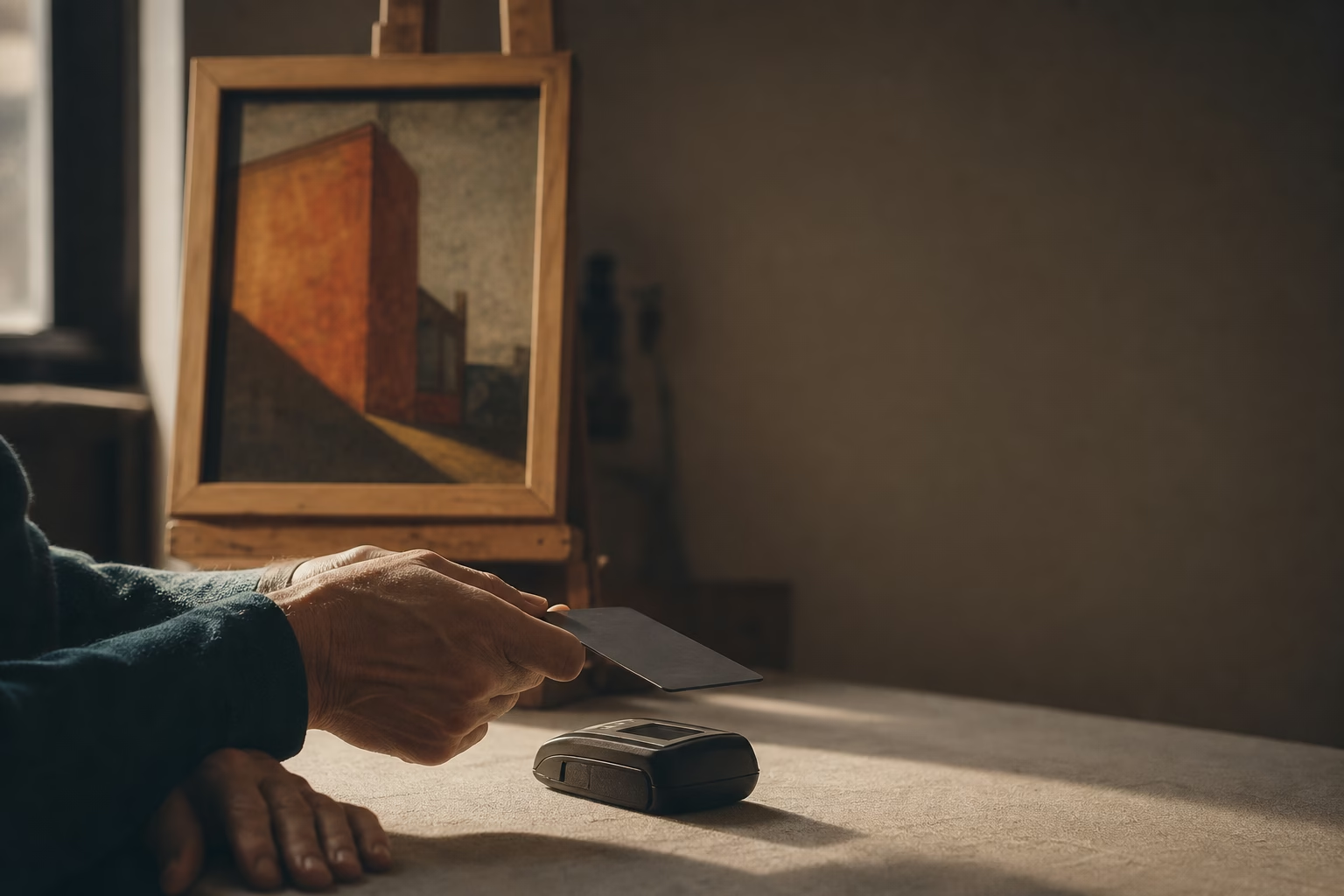
For art — a discretionary, non-utilitarian, often expensive purchase — this asymmetry is brutal. Your buyer is standing in front of a piece they love. The joy of owning it sits in one hand of an internal scale. The pain of writing the check sits in the other. And the check side is weighted twice as heavy by default. No wonder they hesitate.
This is why so many price objections aren’t really about the number. The number is fine. The number is what they spent on a vacation last year without flinching. The problem is that art doesn’t feel like a vacation in the moment of decision. A vacation has a fixed beginning and end and a clear story about what you’re getting. A painting feels open-ended, abstract, unknowable. So loss aversion has more room to do its damage.
The fix is not to lower your prices. Lowering your prices, in fact, often makes hesitation worse — it sends a signal that the work is uncertain, that you’re nervous about it, that there’s something wrong. Buyers read price as quality data, and they’re not entirely wrong to do so. What you want to do instead is rebalance the scale.
Three things tend to work. The first is anchoring — making sure that, before a buyer hears the price of a piece, they’ve already encountered a higher price somewhere in your range. If your $1,800 painting is the first number they see, $1,800 is the anchor. If they see your $4,500 large works first and then meet the $1,800 piece, the $1,800 piece feels like the reasonable choice. This is the same trick that makes the medium-size popcorn at the movies feel like a steal.
The second is reframing the spend over time. A $1,800 painting that lives on your buyer’s wall for the next thirty years costs about five dollars a month to own. Saying that out loud — gently, once, not as a sales line — collapses the loss-aversion math. Suddenly the check side of the scale doesn’t feel quite as heavy.
The third is removing the irreversibility of the decision. A return window of even seven days does extraordinary work on a hesitating buyer’s brain, because it tells them the loss isn’t really a loss — it’s a temporary placement. They can give the painting back. They almost never do, but the option of doing so is what lets them say yes in the first place. Galleries figured this out decades ago. Most working artists still haven’t.
Hesitation #2 — Ambiguity Aversion: When Buyers Can’t Predict Their Future Feelings
There’s a related but distinct cognitive bias called ambiguity aversion, and it’s the reason why “I love it” so often becomes “let me sit with it.” Humans don’t just dislike losing money. We also dislike not knowing how we’re going to feel about a decision later. Given a choice between a slightly worse outcome we can predict and a slightly better outcome we can’t, we’ll usually take the worse one. It’s the emotional equivalent of taking the road we already know.
For art buyers, the ambiguity sounds like this: I love it right now in this gallery, with this lighting, in this mood I’m in. But will I still love it in six months when it’s hanging in my hallway and I walk past it every morning? What if I get sick of it? What if my partner hates it? What if I bought it because I’m in a weird headspace today? They can’t answer any of those questions, so the safest move is to defer the decision indefinitely. Which means walking out.

The signs of ambiguity aversion are subtle but consistent. The buyer asks a lot of “what if” questions. They want to know how other people who bought your work feel about it now. They linger and circle back to the same piece without committing. They suddenly start talking about needing to “see it in the space” or “ask my partner” — not because the partner actually has veto power, but because they’re outsourcing the uncertainty.
The fix is to collapse the future uncertainty into something the buyer can experience now. The two best tools are visualization and approval periods. Visualization means giving them a real picture of the work in a real room — not a generic mockup, but a wall preview using their actual space if you can manage it. AR apps let collectors see your work on their own walls through their phone camera. Some artists send buyers a digital mockup of the piece in a few different room contexts within twenty-four hours of an inquiry. The point is to take “I can’t picture it” off the table.
Approval periods do something similar. Offering a buyer the ability to live with the work for a week, with a no-questions-return option, eliminates the future-feelings problem entirely. They don’t have to predict whether they’ll still love it, because they’re going to find out. Almost no one returns the work. But the option of returning is what makes the yes possible.
Hesitation #3 — Choice Overload: The Iyengar Jam Study, Applied to Your Portfolio
In 2000, Sheena Iyengar and Mark Lepper ran what is probably the most cited experiment in modern decision-making research. They set up a tasting table at a grocery store with twenty-four varieties of jam. People stopped, they tasted, they exclaimed. Then the researchers ran the same experiment with only six jams. Fewer people stopped — but the ones who did were ten times more likely to actually buy a jar.
Choice overload is real, and it does to your portfolio exactly what it did to those jams.
Most artists, when a buyer expresses interest, do the most natural and most counterproductive thing imaginable: they show the buyer everything. The whole portfolio. The whole studio wall. The whole Instagram grid. Look at all the work I have available — surely something here will be the one. And the buyer, faced with sixty pieces of work in twelve different moods and four different sizes, experiences exactly what those grocery shoppers experienced in front of twenty-four jams. Their brain gets tired. The decision starts to feel exhausting. The piece that originally moved them gets blurred together with twelve other pieces that were almost-but-not-quite as moving. And they leave, telling you they need to think about it.
The fix is curation, and it’s harder than it sounds because it requires you to trust that less is more. When a buyer expresses interest in your work, your instinct should not be to broaden the field. It should be to narrow it. Show them six pieces. Show them four. If you’ve had a real conversation with them about what drew them in, show them two — the one they were originally looking at and one carefully chosen alternative that lets them feel like they’re choosing rather than being sold to.
This is also true of how you present work online. The artist Instagram grid with five hundred posts in twelve different styles is the digital equivalent of the twenty-four-jam table. The website with a “shop” page containing forty available originals is the same. Curate. Rotate. Feature. The work that doesn’t make the cut doesn’t disappear forever — it just isn’t competing for attention right now. Your buyer’s brain will thank you, even though they’ll never know why.
Hesitation #4 — Identity Risk: “What Will This Painting Say About Me?”
Here’s a hesitation pattern that almost no existing art-sales advice talks about, and it’s one of the biggest. When someone hangs a piece of original art in their home, they are making one of the most public personal-identity statements available to them. More public than the books on their shelves, more visible than the clothes in their closet, more permanent than the music in their headphones. A painting on the living room wall is a sentence the homeowner is saying to every person who walks into the house, and they know it.
So buyers aren’t just asking “do I like this?” They’re asking “will my partner think this is weird?” and “will my dinner guests get it?” and “is this the kind of art that makes me look thoughtful or pretentious?” and “what does it say about me that I chose this?” These questions are usually unconscious and almost never spoken out loud. But they are the reason your buyer suddenly went quiet, or said the piece was “lovely, but,” or asked if you had something a little less bold.
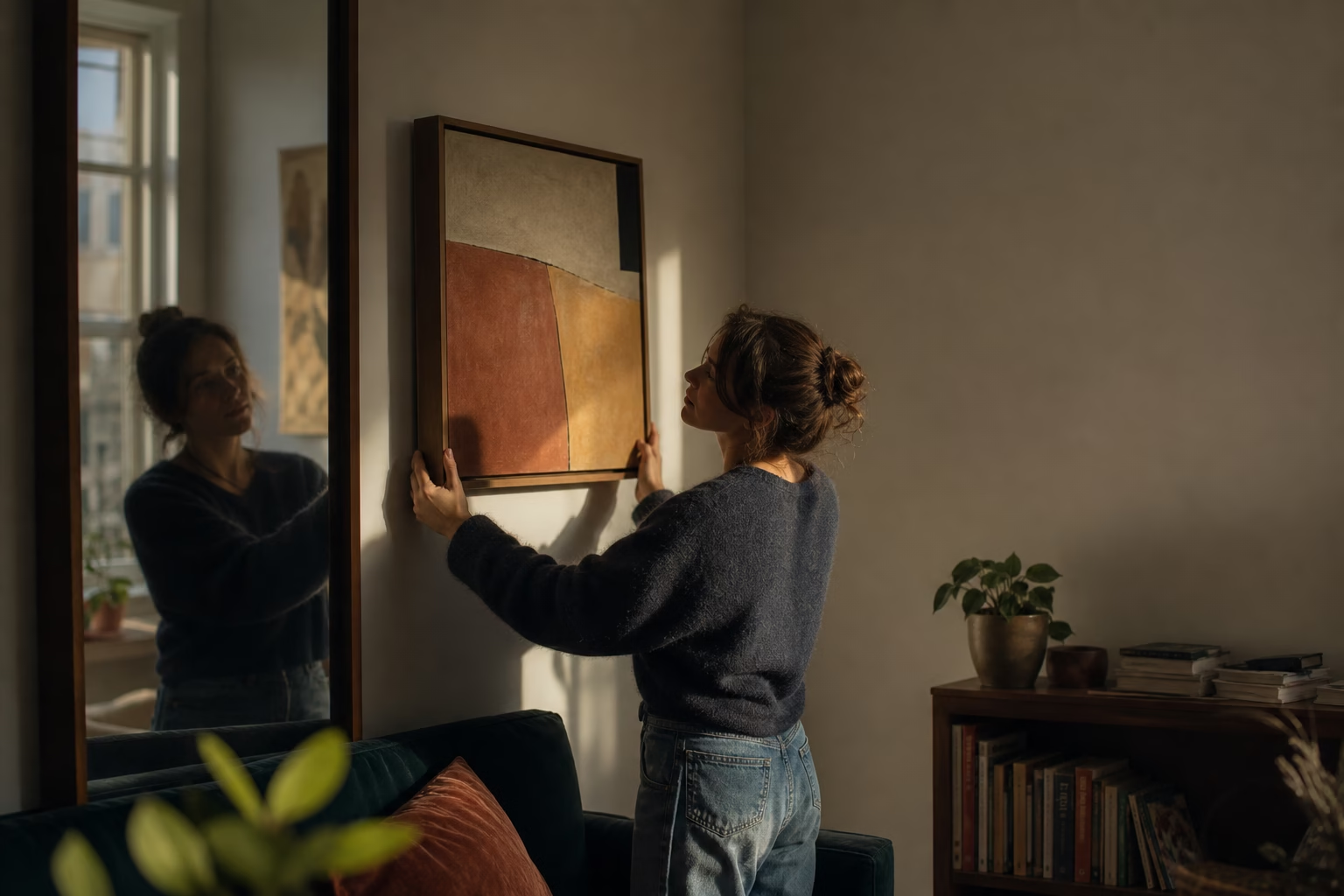
Identity risk is highest with abstract work, with anything emotionally intense, with pieces that have political or religious or sexual undercurrents, and with anything that doesn’t fit the buyer’s existing decor narrative. It’s lowest with landscapes, with anything decoratively safe, and with artists whose name and story are already known and validated.
You can do real work to lower identity risk. The first move is to give buyers language to describe the piece to other people. When you talk about your work, don’t just describe what it is — give the buyer the sentence they’re going to say at their next dinner party when a guest asks about it. “It’s by an artist I met at an open studio in Brooklyn — she works with layered ink and the whole series is about memory and water.” That sentence is a gift. It does identity work for the buyer that they can’t do for themselves, and it makes the piece feel like a story they’re proud to tell.
The second move is to make the artist visible. The reason buyers feel safer purchasing from artists with established reputations isn’t snobbery. It’s that an established reputation lowers the social risk of the purchase. Nobody can criticize your taste for buying a known name. You don’t have to be famous to access this — you just have to be visible. Press mentions, exhibition history, collector testimonials, any public validation at all. These are not vanity signals. They are identity-risk reducers, and they’re doing real work in the buyer’s mind whether or not anyone says so out loud.
Hesitation #5 — Trust Friction: Is This Artist Going to Be Around in Five Years?
Closely related to identity risk, but distinct enough to deserve its own category, is trust friction. Buyers — especially first-time art buyers and especially online — worry about whether the artist they’re buying from is real. Not real in the literal sense, but real in the sense of: are they going to still be making work in five years? Are they going to disappear after I send the money? Is this a serious artist or someone who’s going to abandon the practice and leave my purchase orphaned?
These questions feel small but they kill more sales than almost anything else, particularly in the digital age where most first contact happens through Instagram or a website rather than in a physical studio. The buyer doesn’t know you. They’ve never seen you in a gallery context. They have no way to verify that you’re who you say you are or that the work is what you say it is. So they hesitate, and the hesitation becomes a quiet “no” that you never hear because they never write back.
The trust signals collectors actually look for are surprisingly simple, and almost all of them are within reach of any working artist. A real website with a real bio and a real photograph of you. Exhibition history, even if it’s modest. Press mentions, even if they’re local. Collector quotes, even if they’re paraphrased with permission. A consistent body of work shown over time on social media — not curated to look famous, just consistent enough to prove you’ve been doing this for years and intend to keep doing it. A clear, published return policy. A real shipping address. Anything that says: I am a person, this is my practice, this is not going to vanish.

You don’t have to lie about your career stage. In fact, lying about it is one of the worst things you can do, because buyers can smell it. The right move is to be specific and honest about where you actually are. “I’ve been working in this medium for eleven years. My work is in collections in four countries. Last year I had two solo shows.” That’s a sentence that lowers trust friction without inflating anything. Compare it to: “I’m an emerging artist passionate about my craft.” — which says nothing and triggers exactly the trust-friction response you’re trying to avoid.
Hesitation #6 — The “I’ll Think About It” Trap
This is the most common hesitation phrase in any sales context, and in art sales it has a very specific meaning that almost no one names correctly. When a buyer says “let me think about it,” they are almost never going home to think about it. They are looking for a graceful exit from a conversation that has become emotionally uncomfortable, and they’re using the most polite language available to take it.
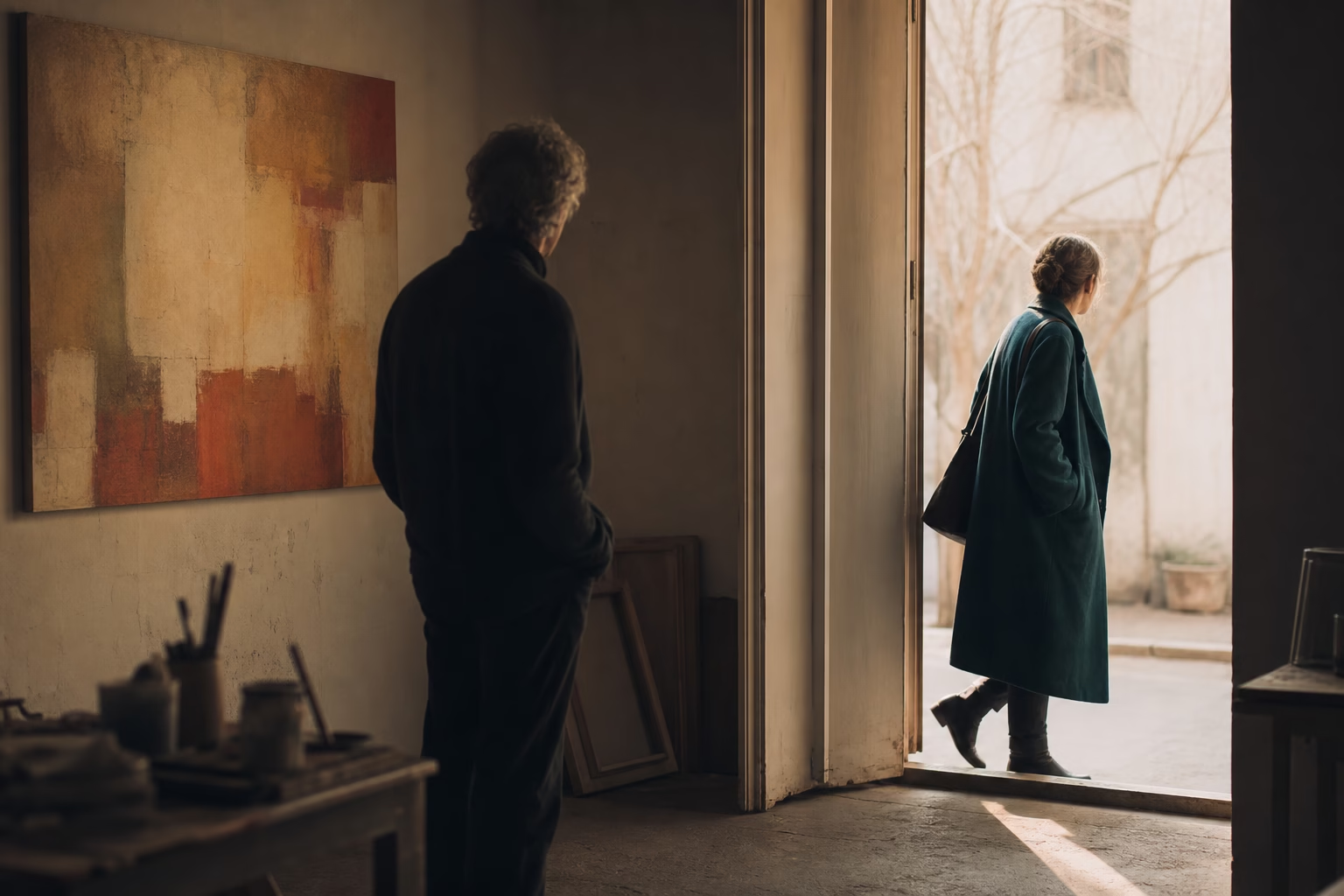
Why uncomfortable? Because the moment they engage seriously with the idea of buying, all the other hesitation patterns we’ve discussed start firing at once. Loss aversion kicks in. Ambiguity about future feelings kicks in. Identity risk kicks in. Trust friction kicks in. The buyer doesn’t have language for any of this. What they have is a sudden, vague sense of pressure and a desire to be somewhere else. So they say the magic phrase that lets them leave with their dignity intact and their relationship with you preserved: let me think about it.
The wrong response is to push. Pushing confirms the discomfort and ensures they’ll never come back. The wrong response is also to give up entirely, because most of the time the buyer genuinely did love the work and would buy it under slightly different conditions.
The right response is the graceful exit followed by the 48-hour follow-up. In the moment, you let them go warmly and without pressure. “Of course — take all the time you need. Can I send you a photo of the piece in a couple of room contexts so you can see it at home? No pressure at all, just so you have it.” You’ve done two things with that sentence. You’ve removed the pressure. And you’ve earned permission to follow up.
Then, within forty-eight hours — not three weeks later, when the emotional moment has dissolved — you send the follow-up. Not “have you decided yet?” Never that. Something with new information. The mockup you promised. A short note about what you were thinking when you painted the piece. A question about where they were thinking of hanging it. The point is to add context without adding pressure, and to keep the conversation alive while the original feeling is still warm enough to act on. Half of the sales that working artists describe as “almost happened” can be recovered with a thoughtful 48-hour follow-up. Most artists never send one.
And if the follow-up doesn’t land — if the buyer goes silent or politely declines — let them go. Genuinely let them go. Don’t follow up again two weeks later. Don’t add them to a nurture sequence. The peculiar thing about letting buyers go cleanly is that a meaningful percentage of them come back on their own, sometimes months later, because the absence of pressure is itself a trust signal. They remember you as the artist who didn’t chase them. That memory is worth more than any sales tactic.
Hesitation #7 — Friction in the Buying Mechanics
Sometimes the psychology is fine and the checkout is broken. This is the hesitation pattern that has the least to do with feelings and the most to do with logistics, and it’s the one that’s easiest to fix because it requires no behavioral skill at all — just an honest audit.
Buyers freeze when they don’t know how shipping works, when they’re not sure whether the price includes framing, when they can’t figure out how to actually pay, when the website asks for too much information at checkout, when they don’t know if there’s tax, when they don’t know if returns are possible, when they don’t know how long delivery will take, when they’re not sure whether to message you on Instagram or email or through a contact form. Every single one of those uncertainties is a small cognitive speed bump, and small speed bumps add up to a buyer who quietly closes the tab.
The fix is the friction audit. Walk through your own buying process as if you were a stranger encountering it for the first time. Try to buy a piece of your own work. Notice every place you have to stop and ask a question. Every one of those is a friction point. Then fix them, one at a time.
Some specific things that punch above their weight: a published shipping cost (or, even better, included shipping for domestic orders), a clear return window stated on the product page, an option for payment plans on anything over a certain price point, multiple payment methods, a one-line statement about how long it takes to ship after purchase, and a single clear way to contact you. Payment plans in particular are powerful — they break loss aversion into smaller monthly pieces and make the decision feel less irreversible. Three monthly payments of $600 is psychologically much smaller than one payment of $1,800, even though the math is identical. That’s not a trick. That’s just how human brains process commitment.
The Hesitation-Recovery Playbook
Now you know the seven patterns. Here’s what to do with them in the actual moments they show up.

In the moment, when you can feel a buyer starting to drift, the single most useful thing you can do is ask a question rather than make a statement. Not “do you want to buy it?” — that’s the close everyone fears. Try “what’s drawing you to this one?” or “where were you imagining it might live?” These questions do two things at once. They give the buyer permission to keep engaging emotionally with the piece, and they give you information about which hesitation pattern is actually firing. If they answer with a story about a room, you’re dealing with visualization. If they answer with a comparison to another piece, you’re dealing with choice overload. If they hesitate before answering at all, you’re probably dealing with identity risk. Each one has a different fix, but you can’t apply the fix until you know which pattern you’re seeing.
In the follow-up, the rule is new context, no pressure. Send something the buyer didn’t have before — a mockup, a note about the piece’s backstory, a relevant detail about the materials, a question about their space. Anything that adds dimension. Never send “just checking in” or “wanted to follow up.” Those are the two most expensive phrases in art sales because they make the buyer feel hunted. The follow-up should feel like a continuation of the conversation, not a sales call.
In the letting-go, the rule is to mean it. If a buyer drifts away, release them with warmth and without resentment. Don’t add them to anything. Don’t follow up a third time. Trust that the cleanest goodbye is the one most likely to bring them back. This is counterintuitive and almost no sales advice tells you to do it, but anyone who has sold art for a few years can tell you it’s true.
Frequently Asked Questions
Why do people hesitate to buy art they love?
Hesitation almost never means the buyer didn’t love the work enough. It usually means a cognitive friction has fired between the feeling and the decision — most commonly loss aversion (the spend hurts more than the joy compensates for), ambiguity aversion (they can’t predict how they’ll feel about it later), or identity risk (they’re worried what the piece will say about them to others). Naming the specific friction is the first step to removing it.
How do I overcome price objections without lowering my prices?
Don’t lower the price — lower the psychological weight of the price. Anchor the buyer with a higher-priced piece first so the target piece feels reasonable. Reframe the cost as a per-month or per-year figure across the lifetime of ownership. Offer payment plans to break the spend into smaller commitments. And add a return window so the decision feels reversible. Lowering the actual number often backfires because buyers read low prices as a quality signal.
What does “I’ll think about it” really mean in art sales?
Almost always, it means the buyer has hit emotional discomfort and is taking the politest exit available. They’re not going home to think about it. They’re escaping a moment that started feeling like pressure. The right response is to release them warmly, earn permission to follow up with something specific (a mockup, a piece of context), and then send that follow-up within 48 hours while the original feeling is still warm.
Should I offer payment plans on original art?
Yes — for any piece above your comfortable impulse-purchase threshold for your typical buyer. Payment plans don’t change the math, but they dramatically change the psychology by breaking one large loss into several smaller ones. Loss aversion is the single most powerful force working against you at the point of sale, and splitting the commitment is one of the cleanest ways to reduce its weight.
How long should I wait to follow up after an inquiry?
Forty-eight hours, give or take. Sooner than that feels pushy. Later than that loses the warmth of the original moment. The follow-up should add something — a mockup, a story, a relevant detail — rather than ask a status question. Never send “just checking in.” That phrase is the fastest way to convert a possible sale into a definite no.
Why do some artists sell easily and others struggle with similar work?
Usually it has very little to do with the work itself and almost everything to do with the trust signals around the work. The artists who sell easily have lower identity risk and lower trust friction in their buyer’s mind because they have visible body of work, consistent presence, modest but real exhibition history, and a clear way to verify they’re real. None of that requires fame. It requires consistency and visibility over time.
Is it pushy to ask if a buyer is ready to commit?
Asking is rarely pushy. Closing is pushy. The difference is that a question gives the buyer information and agency — “what’s drawing you to this one?” — while a close demands a yes-or-no answer that triggers all the hesitation patterns at once. Stay in the question mode for as long as the conversation is alive, and trust that buyers who are ready will tell you so without being asked directly.
How do I make collectors trust me as an emerging artist?
Be specific and honest about where you are. Vague phrases like “emerging artist passionate about my craft” do nothing — they’re the verbal equivalent of a stock photo. Concrete details build trust: how long you’ve been working in your medium, where the work has been shown, who has bought it, what your studio practice looks like. A real bio with a real photograph and a few specific facts beats any amount of self-promotional language.
Does choice overload really apply to art?
Yes, and it’s one of the most under-discussed problems in artist studios. The Iyengar and Lepper jam study found that shoppers were ten times more likely to buy when presented with six options instead of twenty-four. The same principle applies to portfolios, websites, and studio walls. When a buyer expresses interest, the right move is to narrow the field, not broaden it. Show fewer pieces. Trust that less is more.
What’s the best way to reduce buyer anxiety about price?
Three layered moves. First, anchor — make sure the buyer encounters a higher price in your range before the target piece. Second, reframe — break the cost down across the lifetime of ownership so the per-year or per-month figure feels manageable. Third, reverse — offer a return window so the decision doesn’t feel permanent. None of these involve lowering your price, and all of them work on the underlying psychology rather than the surface objection.
Key Takeaways
Buyer hesitation is not a verdict on your work. It is a signal that one of seven specific frictions has fired between the feeling and the decision. Once you can name the friction, you can remove it.
Emotion sells art, but friction kills the sale. Loss aversion makes the spend feel twice as heavy as the joy. Ambiguity aversion makes the future of the decision feel unknowable. Choice overload turns a portfolio into an exhausting puzzle. Identity risk makes the buyer worry what the piece says about them. Trust friction makes them wonder if you’re real. Decision postponement gives them a graceful exit from emotional pressure. And buying-mechanic friction quietly closes the tab when nobody’s looking.
The single most important habit you can build is the 48-hour follow-up — not “just checking in,” but a thoughtful return to the conversation with new context, no pressure, and full permission for the buyer to walk away. Half of the sales you currently lose are recoverable with that one habit.
And underneath all of it, the deepest shift is this: stop treating buyer hesitation as a verdict on your art and start treating it as a conversation that hasn’t finished yet. Most of the time, the silence after the interest is not rejection. It’s a buyer who needed help across the threshold and didn’t get it. The next time you watch someone walk out of your studio saying let me think about it, you’ll know exactly what they meant — and exactly what to do next.
Last updated: April 2026