There is a pattern hiding in plain sight across five centuries of art history. Every time a political order collapsed — every time a king lost his head, a tsar was overthrown, or a colonial government was dismantled by its own people — the art world shifted on its axis within years. Sometimes within months.
The guillotine didn’t just end aristocratic lives in 1789. It ended Rococo flourishes. The pastel pinks, the porcelain cherubs, the frivolous mythological picnics that decorated the walls of Versailles became politically toxic almost overnight — a visual record of the class being destroyed. Within a decade, French painters had invented an entirely new visual language rooted in Roman austerity and republican virtue.
When the Bolsheviks seized power in 1917, the same rupture happened in a single generation but with even greater speed. Academic painting — portraits of nobles, religious allegories commissioned by the Church — lost both its patrons and its cultural legitimacy before the gunfire had stopped. In its place arose some of the most radical abstraction the world had ever seen: Kazimir Malevich’s pure geometric forms, Vladimir Tatlin’s visionary constructivist monuments, bold propaganda posters that looked like the future arriving at speed.
Why does this keep happening? The connection between political revolution and artistic revolution is not coincidence. It follows a logic that, once you understand it, you’ll see everywhere.
This guide traces that logic through six major political upheavals — the American, French, Russian, Mexican, and Civil Rights revolutions, and the global protests of 1968 — exploring not just which movements emerged from each rupture, but why. What happens to artists when the systems that sustained them collapse? What compels them to invent new forms? And what happens when the same revolutionary governments that liberated artists eventually turn and destroy them?
Why Revolutions and Art Are Inseparable
Before tracing the history revolution by revolution, it’s worth establishing the mechanism — the underlying logic that makes these connections so consistent across centuries and continents. Three forces are always at work.
The Patronage Collapse
Art doesn’t emerge from a vacuum. For most of Western history, artists survived through patronage: the Church commissioned altarpieces, aristocrats paid for portraits, royal academies funded history paintings that glorified the monarchy. These patrons didn’t just fund art — they dictated its content, its style, its purpose, and its acceptable subjects.
When a revolution sweeps out the old regime, it sweeps out the patronage system along with it. The French Academy of Fine Arts, which had controlled what could be painted and exhibited in France for over a century, lost its authority when the Revolution dismantled the royal institutions that funded it. Russian artists who had relied on the aristocracy’s commissions found themselves, after 1917, in a world where the aristocracy had been executed or exiled.
Into that vacuum stepped new patrons with new demands. Revolutionary governments understood instinctively — and in some cases explicitly — that they needed art to legitimize the new order, educate the population, and consolidate ideological loyalty. The French Republic commissioned Jacques-Louis David to paint the revolution’s martyrs. The Bolsheviks funded Constructivist designers to create posters, monuments, and propaganda. Mexico’s post-revolutionary government paid Diego Rivera to cover the walls of its public buildings with murals depicting the revolution’s mythology.
Each new patron wanted different art, and artists — needing to survive — produced it.
Trauma, Witness, and the Compulsion to Depict
There’s a second force at work, less institutional and more personal. Artists who live through political revolutions witness extraordinary events: mass violence, social transformation, the dismantling of everything they considered permanent. That experience changes what they feel compelled to make.
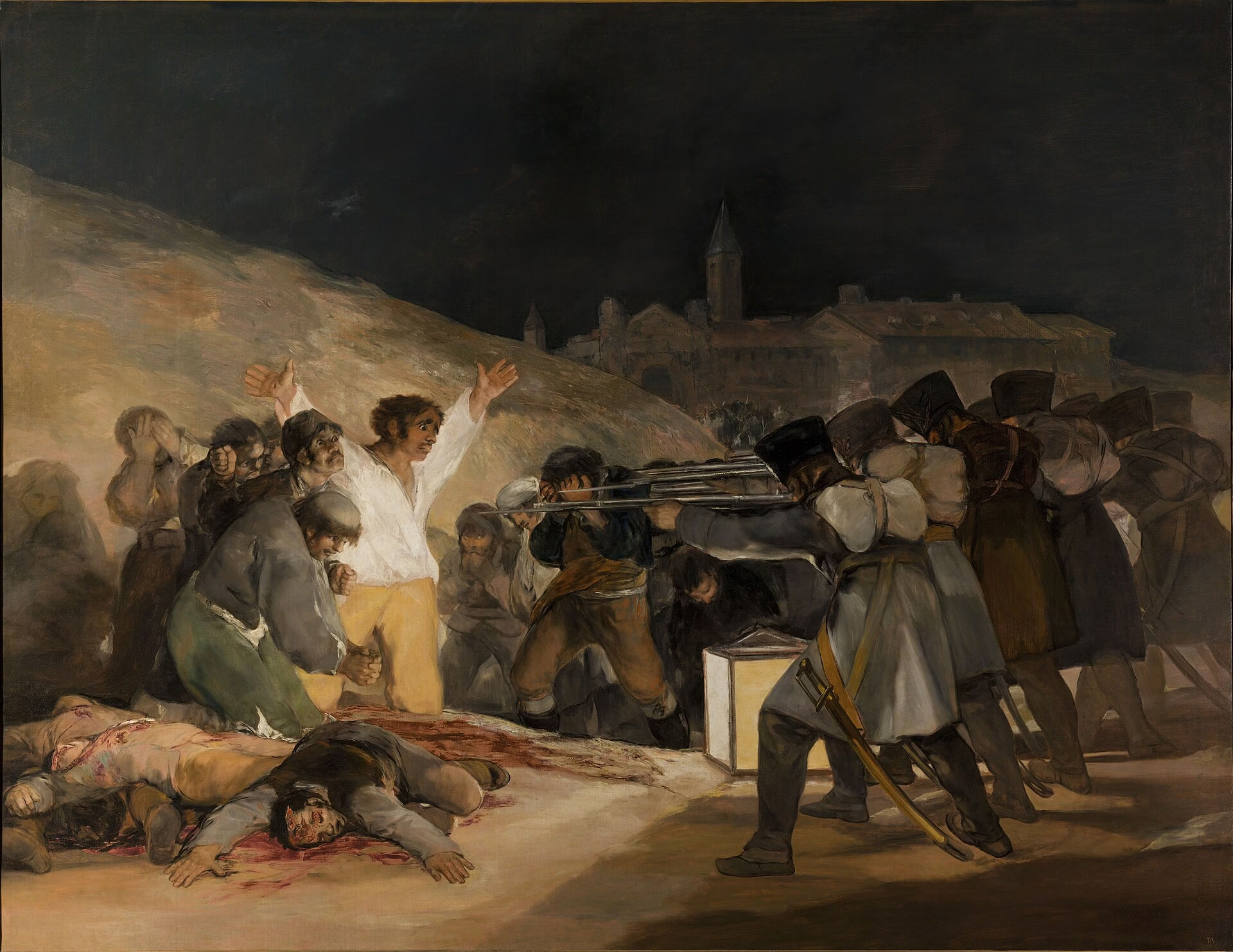
Francisco Goya is perhaps the most dramatic example. In the early years of his career, he was a successful court painter in Spain, producing pleasant tapestry cartoons and elegant royal portraits. Then Napoleon invaded, and Goya watched French soldiers execute Spanish civilians in the streets. The man who had painted playful genre scenes responded with The Disasters of War — a series of etchings so raw, so unflinching in their depiction of atrocity that they were not published until 35 years after his death. The revolution didn’t just change Goya’s subject matter. It broke something open in his understanding of what art was for.
Édouard Manet, sheltering in an art dealer’s shop as Louis-Napoléon’s cavalry charged down the street, never returned to painting as a purely aesthetic exercise. The Impressionism he helped define was not just a formal experiment with light — it was shaped by a man who had looked at dead bodies laid out on the Boulevard for identification, and could not pretend that art existed in a realm separate from political reality.
When you understand this dimension, revolutionary art stops looking like clever ideology and starts looking like necessity.
Art as the Revolution’s Mirror and Megaphone
The third force is purely strategic. New governments reach for art immediately, because they understand what it does: it makes the invisible visible, it gives the revolution a face, it creates the mythology that holds a new society together.
The French Republic needed its citizens to believe in republican virtue, in sacrifice for the common good, in the classical ideals of civic duty that justified the violence of the revolution. Jacques-Louis David’s paintings provided exactly that. The Bolsheviks needed to reach a largely illiterate population spread across a vast empire with the basic ideas of Marxist-Leninist ideology — and Constructivist posters did it. Mexico’s post-revolutionary government needed to build a national identity for a country that had nearly torn itself apart in a decade of civil war — and Diego Rivera’s murals, painted on the walls of government buildings for everyone to see for free, did it.
Art, in these moments, becomes the revolution’s first and most powerful communication medium. Which is also why, when revolutionary governments turn authoritarian, art is among the first things they seize control of.
The French Revolution and the Birth of Neoclassicism (1789–1815)
Rococo’s Fall — Excess Meets the Guillotine
To understand what Neoclassicism was, you have to understand what it was replacing.
Rococo was the visual language of the French aristocracy at its most self-indulgent. Developed in the early 18th century, it favored delicate pastel palettes, asymmetrical ornamentation, and subjects that amounted to elaborately dressed celebrations of aristocratic leisure. Jean-Honoré Fragonard’s The Swing (1767) is its perfect emblem: a laughing young noblewoman in a silk dress suspended in a garden, her shoe flying off her foot as a young man below tries to catch a glimpse up her skirts. It is a painting of pleasure, privilege, and zero consequence.
By 1789, that painting looked like a provocation. The French populace was starving. The aristocracy’s conspicuous display of wealth, captured perfectly in Rococo’s frothy extravagance, had become a political target. When the revolution came, Rococo didn’t just go out of fashion — it became ideologically contaminated, visually associated with the class facing the guillotine.
The rejection of Rococo was, in other words, as much political as aesthetic. What replaced it was a style that looked, deliberately, as different as possible.
Jacques-Louis David — The Painter of the Revolution
Jacques-Louis David is the clearest example in art history of an artist whose biography and politics are inseparable from his visual language.
Trained in the rigorous French academic tradition, David had won the prestigious Prix de Rome and studied classical antiquity in Italy in the 1770s. He came back with an obsession: Greek and Roman republican ideals — civic virtue, sacrifice for the state, moral austerity — expressed through a severe, linear painting style that rejected Rococo’s decorative softness in favor of heroic clarity.
His Oath of the Horatii (1784), painted five years before the Revolution, was already a political statement: three brothers pledging their swords in service to Rome, embodying the revolutionary values of duty, sacrifice, and collective will. When the Revolution arrived, David was ideologically prepared.
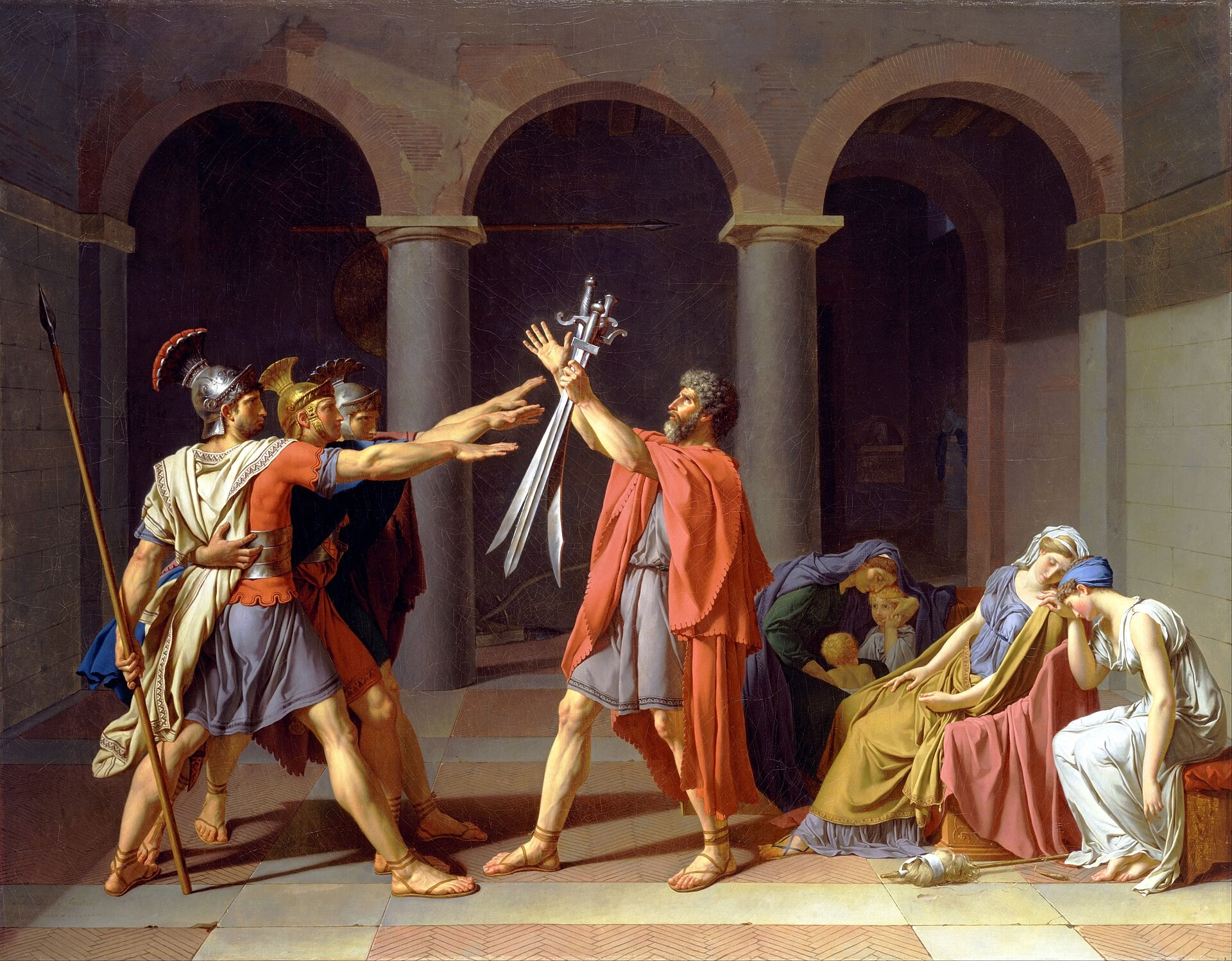
He became the Republic’s chief image-maker. His The Death of Marat (1793) remains one of the most powerful political paintings ever made. Jean-Paul Marat — radical journalist, hero of the working class — had been murdered in his bathtub by Charlotte Corday. David transformed the scene into a secular pietà: Marat’s arm hanging down recalling the dead Christ, his body rendered with classical dignity, the composition bathed in a simple, austere light that strips away everything except the tragedy of a revolutionary martyr. The painting was commissioned by the republican parliament specifically to be displayed in the meeting hall of the National Convention and to rally continued support from French citizens.
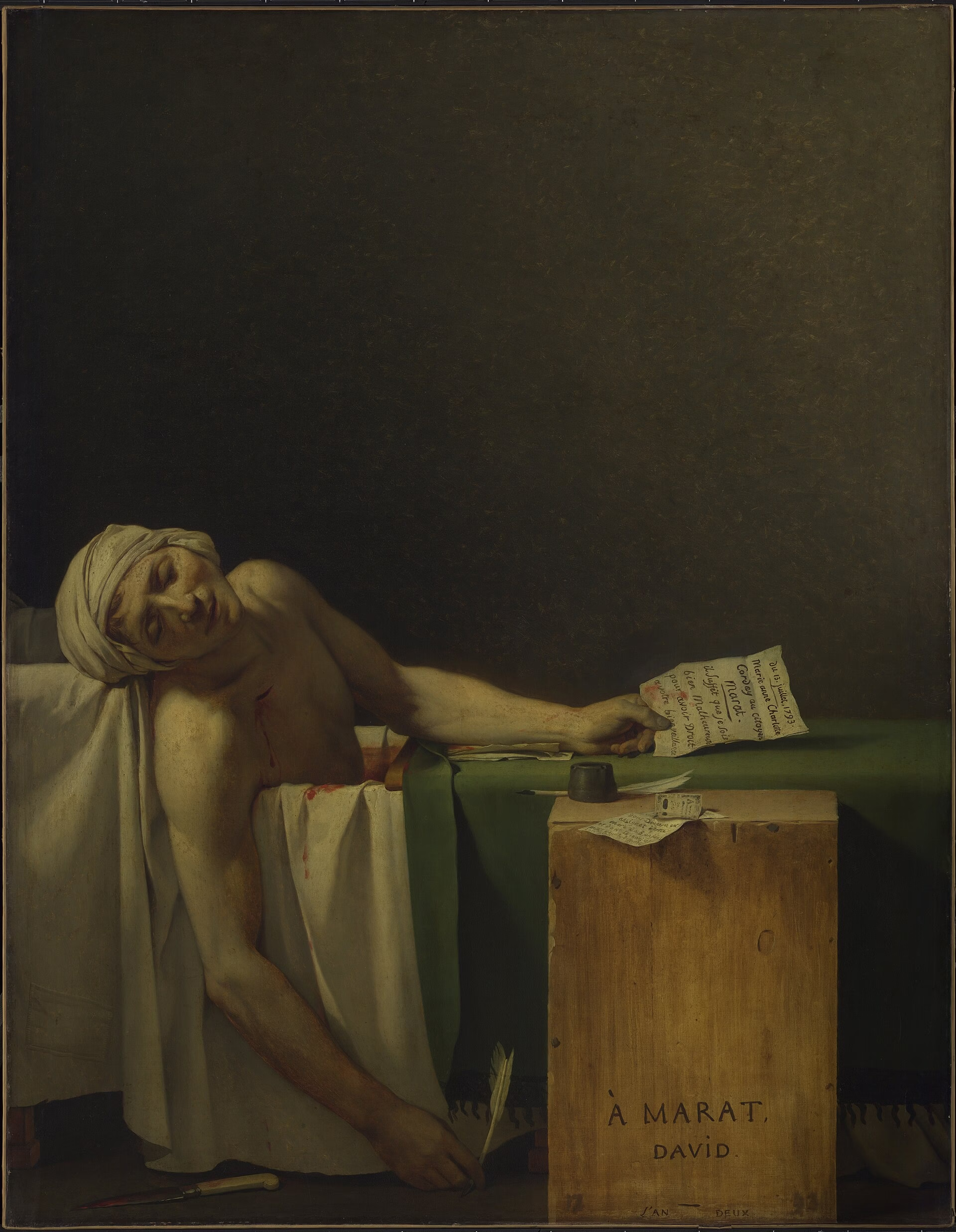
David’s choices weren’t merely aesthetic. The Greco-Roman visual vocabulary he deployed was a deliberate argument: the French Republic was the legitimate heir of classical democracy, its values descended from Athens and Rome, its martyrs as noble as any ancient hero.
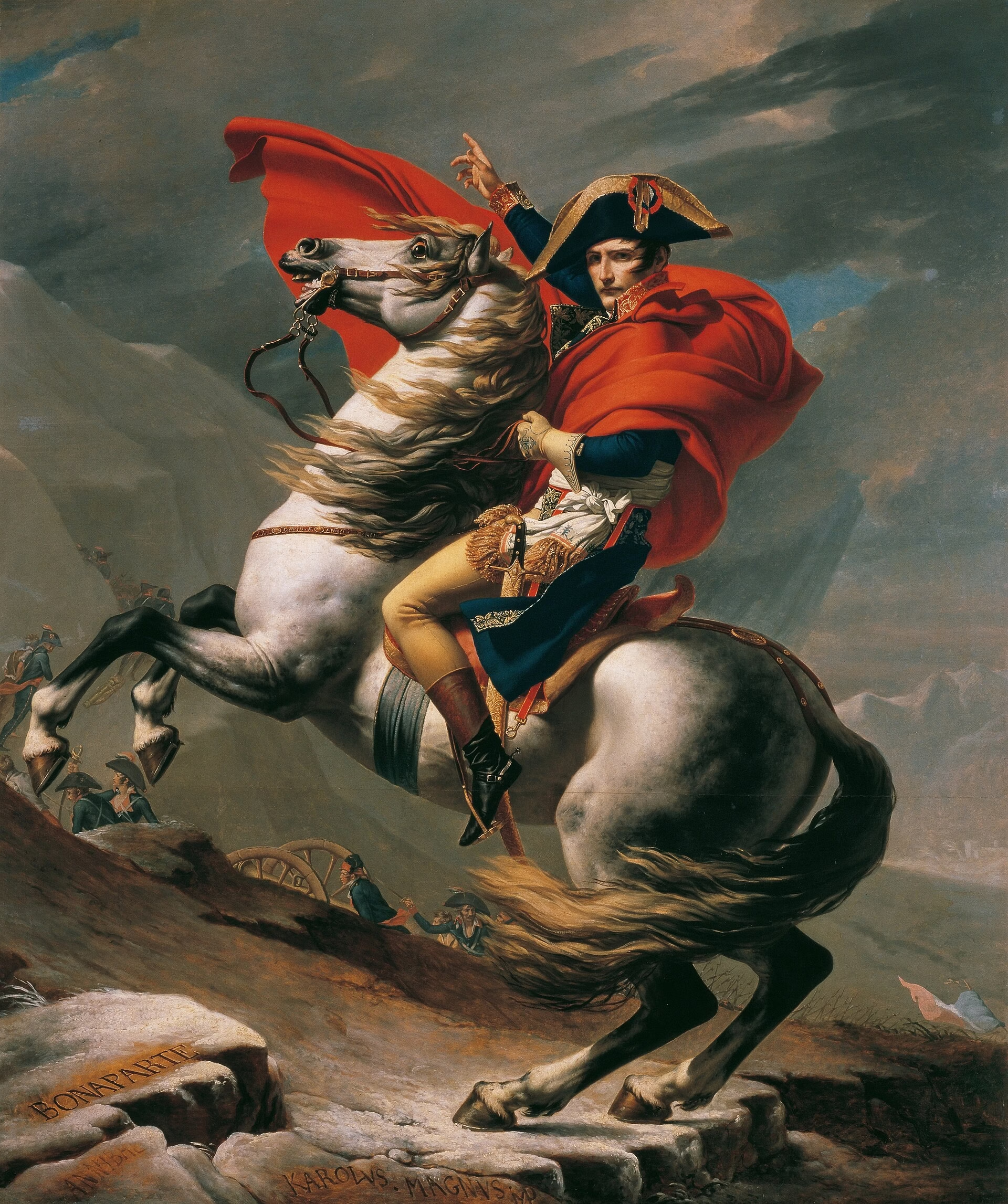
After Napoleon came to power, David adapted again. His Napoleon Crossing the Alps (1801) uses the same heroic visual grammar to manufacture imperial mythology — proof that visual languages developed for revolutions can be repurposed for the authoritarians who follow them.
The Romantic Counter-Response
One revolution can spark multiple art movements, often contradictory ones.
Neoclassicism was the revolution’s official visual language — rational, orderly, rooted in Enlightenment ideals of reason. But the Revolution had also been violent, chaotic, and emotionally overwhelming. It had produced the Terror as well as the Declaration of the Rights of Man. And some artists responded to its emotional reality rather than its ideological claims.
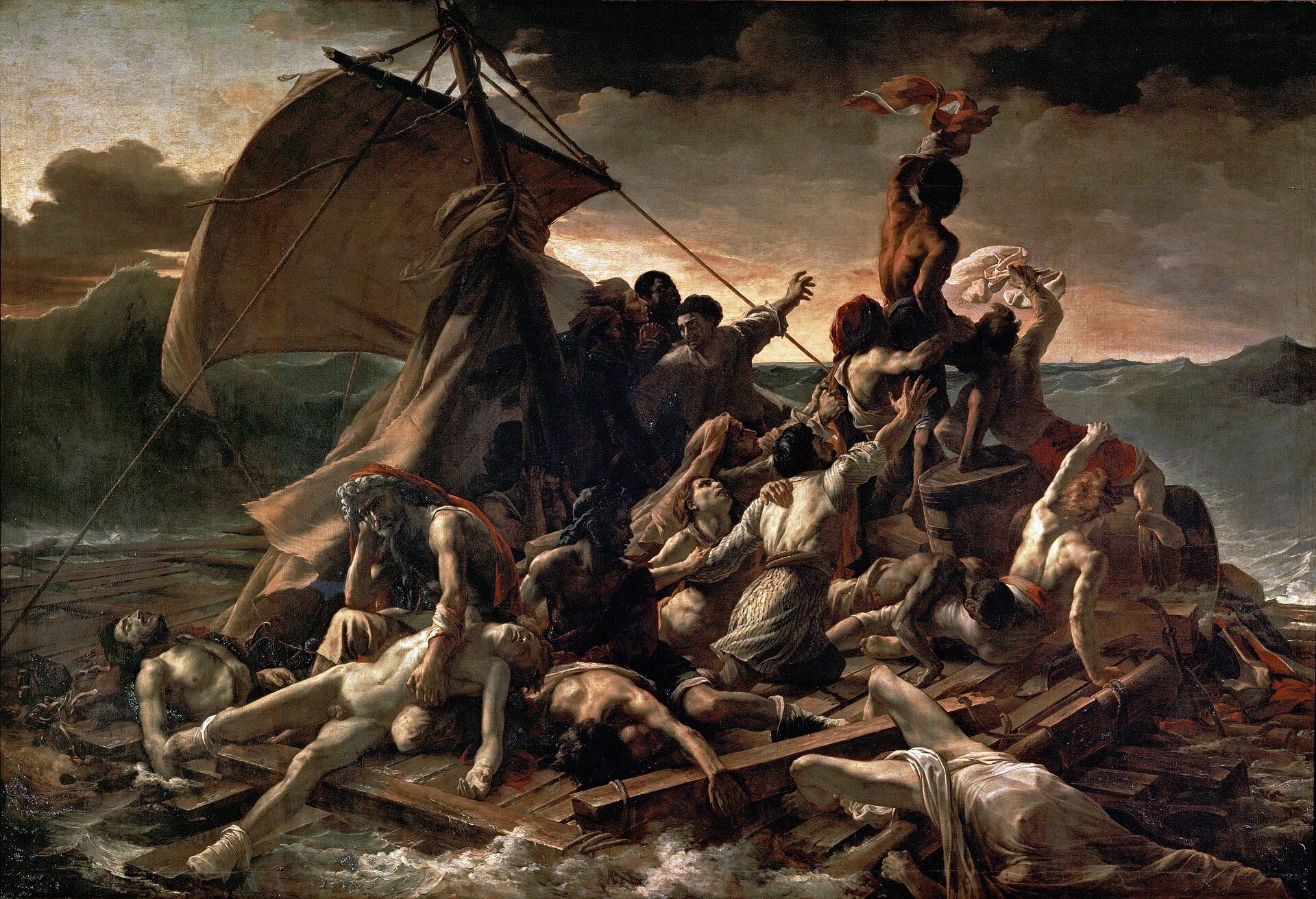
Romanticism — with its emphasis on emotion, individual experience, the sublime, and the irrational — was partly a reaction against Neoclassicism’s cold rationalism, and partly a direct response to the century of upheaval that the Revolution had unleashed. Théodore Géricault’s The Raft of the Medusa (1818–19) depicted a government scandal with operatic horror. Eugène Delacroix’s Liberty Leading the People (1830), painted in response to the July Revolution, fused classical allegory with the raw energy of street fighting.
And Francisco Goya, working in Spain rather than France but living through the same revolutionary upheaval in the form of the Napoleonic Wars, produced work that transcended both movements. His The Third of May, 1808 — French soldiers executing Spanish civilians, the central figure’s white shirt almost glowing against the darkness — is neither Neoclassical nor Romantic. It is simply the truth of what revolution looks like from the receiving end of the bayonet.
The American Revolution and the Visual Language of a New Republic (1776–1830)
The American Revolution produced a subtler but equally deliberate artistic transformation — one focused less on rupture than on invention. And precisely because it was less violent, less total in its social dismantling than the French or Russian revolutions, it offers a fascinating contrast: what does art look like when the revolution succeeds relatively quickly, and the most urgent task becomes building legitimacy rather than tearing down the old order?
The Problem of a Nation Without a Visual History
The founders faced an extraordinary challenge. They needed to create something the French already had: centuries of cultural history, recognizable visual traditions, a shared mythology. America had none of that. It was, in artistic terms, a blank wall — a collection of colonial settlements that had produced competent portrait painters and printmakers but nothing resembling a national visual identity.
The solution was intentional classicism. Greco-Roman visual vocabulary — the architecture of columns and pediments, the portraiture of civic virtue, the iconography of republican ideals — was adopted wholesale as the visual language of the new republic. This wasn’t coincidence or mere fashion. The founders specifically chose Roman republican imagery because it communicated, at a glance, that this was not a monarchy but a republic of reason and civic virtue, its values descended directly from the most admired political experiments of antiquity.
Thomas Jefferson, who was also the new nation’s most sophisticated aesthetic theorist, understood architecture as political argument. His design for the Virginia State Capitol (1788), modeled on the Maison Carrée in Nîmes, France, was the first building in the new republic to make that argument in stone: America’s legislature would meet in a Roman temple because America was Rome reborn. When he designed Monticello and the University of Virginia, he was building a visual vocabulary for an entire civilization.
Gilbert Stuart’s Washington and the Art of Legitimacy
Gilbert Stuart’s Lansdowne Portrait of George Washington (1796) deploys Neoclassical language with remarkable political precision. Washington stands in a pose derived from classical oratory, a ceremonial sword representing democratic rather than military power at his side, a rainbow appearing through storm clouds in the background — the revolutionary war giving way to the peace of the new republic. The composition places him not as a military hero but as a civic leader, simultaneously human and monumental.
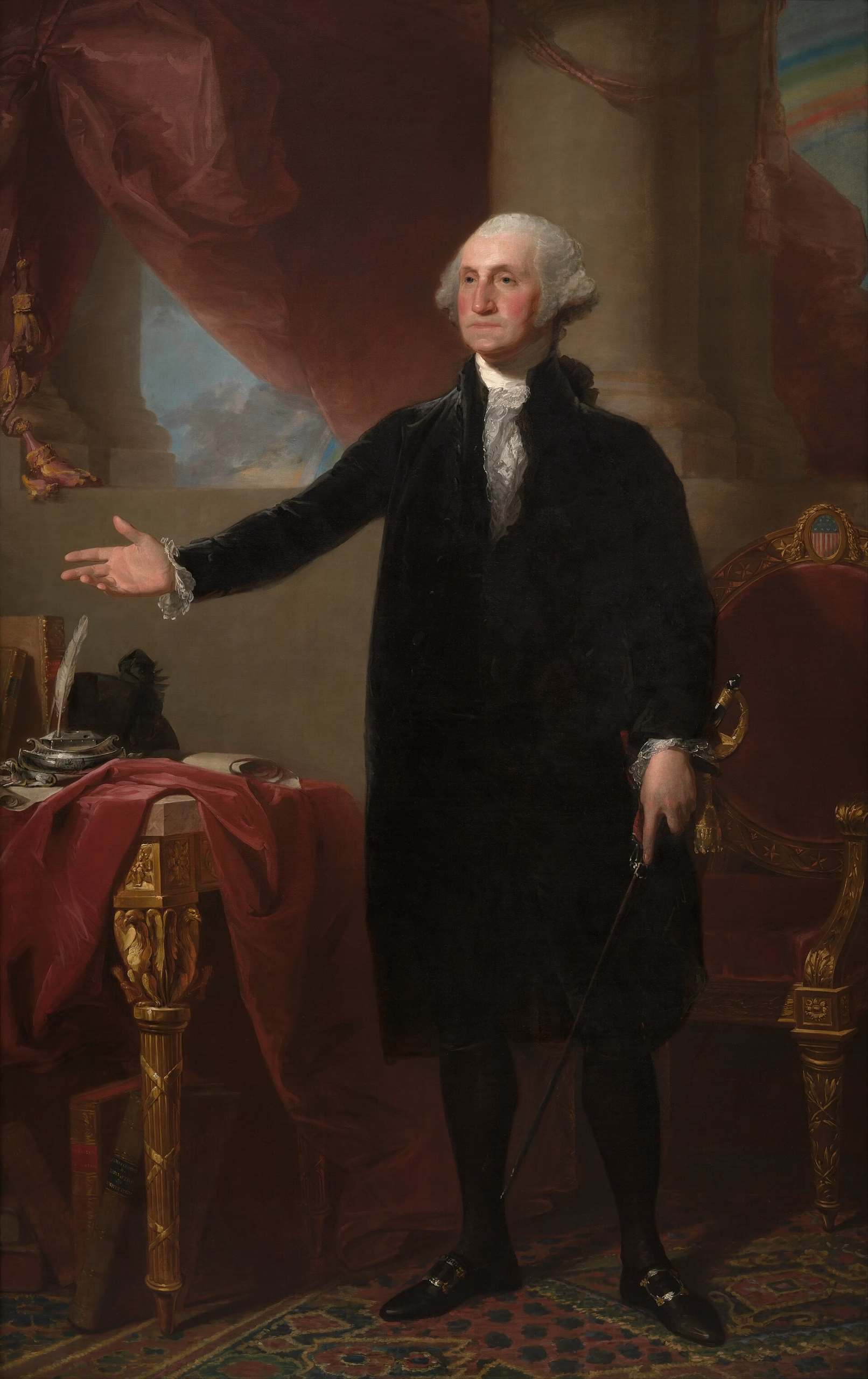
The painting was designed as a diplomatic gift for a British sympathizer, which makes its political calculations even more explicit. Stuart was producing an argument for consumption by a foreign audience: here is your former colony’s leader, as dignified and legitimate as any European monarch, rooted in the same classical tradition that European civilization claimed as its own.
Stuart painted Washington from life only three times, but he produced dozens of replicas of the Lansdowne and Atheneum portraits throughout his career — effectively creating the visual template from which all subsequent images of Washington derive. He had, in a very real sense, invented the face of American democracy. That face was Neoclassical by design: austere, rational, virtuous, heroic without being autocratic.
Prints, Pamphlets, and the Revolution’s Visual Communication
Less exalted but arguably more influential was the role of printmaking in both fomenting and documenting the American Revolution. Political cartoons, broadsides, and illustrated pamphlets — the visual media of the 18th century’s public sphere — shaped popular opinion on both sides of the Atlantic.
Paul Revere’s famous engraving of the Boston Massacre (1770), widely understood to be inaccurate and deliberately inflammatory, is an early American example of visual media as political weapon. The image depicted British soldiers firing in formation on passive civilians — a powerful narrative that bore only passing resemblance to the chaotic street brawl the actual event had been. It was propaganda, but it was effective propaganda, and it helped crystallize colonial resentment into revolutionary energy.
What distinguishes the American case from the French or Russian is this: the revolution didn’t destroy its dominant cultural institutions so much as repurpose and extend them. American artists after independence still trained in European traditions, still aimed at European markets, still used European forms. The novelty lay in the content — the subjects (Washington, the wilderness, democratic ideals), the mythology (republican virtue, manifest destiny), and the aspirations (creating a distinctly American art tradition) were new. The language was borrowed.
The Russian Revolution and the Radical Avant-Garde (1917–1934)
No revolution in the 20th century produced a more dramatic, internationally influential, or ultimately tragic artistic rupture than the Bolshevik Revolution of 1917.
Constructivism — Art as Social Engineering
The Bolshevik approach to art was, from the beginning, ideological. Art was not a luxury, not a reflection of individual genius, and certainly not a decoration for bourgeois drawing rooms. Art was a tool of social transformation — or it was nothing.
Constructivism, which emerged in the early 1920s, took this demand and ran with it into radical territory. Alexander Rodchenko, Varvara Stepanova, and El Lissitzky developed a visual language built from geometric abstraction, industrial materials, and functional design. Photography, typography, and graphic design were as legitimate as painting. The goal was not beauty in the traditional sense but effective communication — art that could build a new society by reshaping how people thought and perceived.
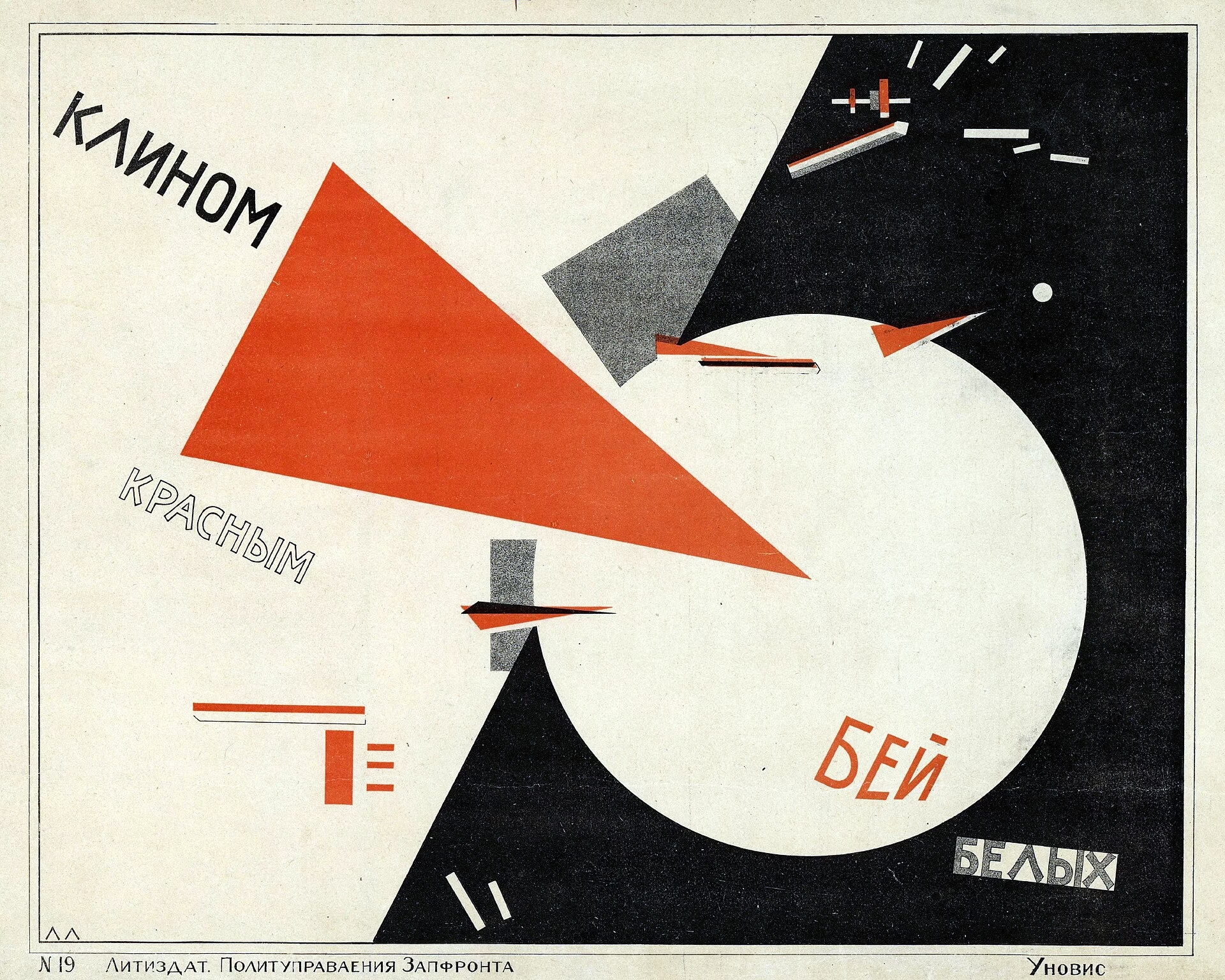
This was a movement that genuinely believed art could engineer human consciousness. It designed posters that looked like the future arriving at velocity, furniture that embodied collectivist values, architecture that would reshape daily life. It also produced Tatlin’s Tower — Vladimir Tatlin’s design for a Monument to the Third International that, had it been built, would have been taller than the Eiffel Tower, rotating on its axis to mark the passage of time. It was never built. But as a symbol of revolutionary aesthetic ambition, nothing equals it.
Suprematism — Malevich and the Pure Square
Running parallel to Constructivism, and in complex tension with it, was Suprematism — Kazimir Malevich’s even more radical proposition that art should be freed entirely from representation, from utility, and from any reference to the material world.
His Black Square (1915), displayed in the corner of a room where religious icons would traditionally hang — a deliberate act of aesthetic sacrilege and replacement — is a painting of pure sensation. A black square on a white ground. Nothing else. Malevich argued that this was not emptiness but the highest form of artistic feeling, liberated from everything that had burdened painting for centuries.
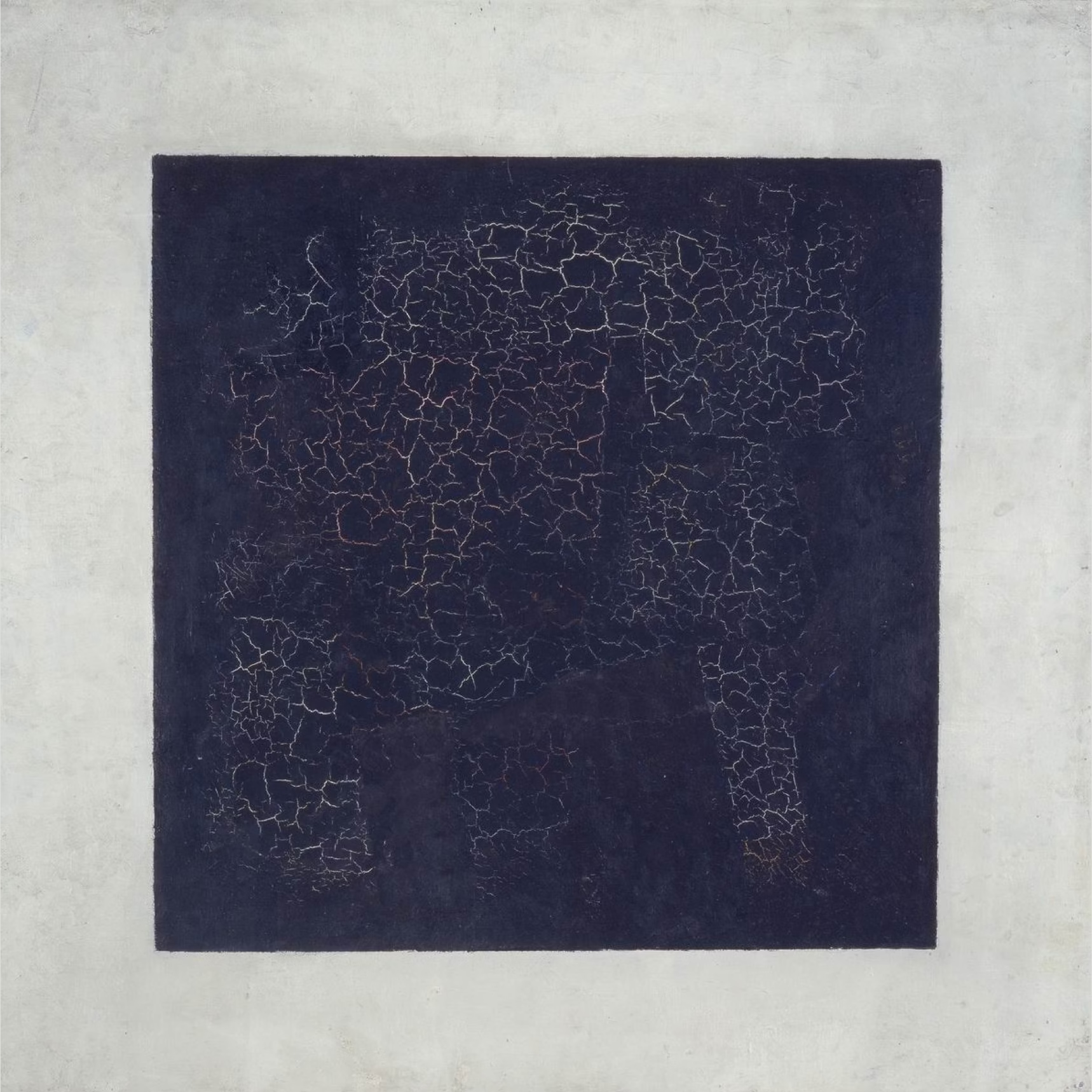
It’s tempting to read Black Square as apolitical — pure formalism, disconnected from the messy world of revolution and ideology. But Malevich understood it as profoundly connected to the revolutionary moment. Old Russia — its Church, its aristocracy, its academic conventions — was being swept away. Black Square was the visual equivalent of that sweeping: a clean slate, pure possibility, form liberated from the past.
When the Revolution Turns on Its Artists
Here is the part of the story that most accounts skip — and it is the most important part.
By the early 1930s, the Soviet avant-garde was being destroyed by the same revolutionary government that had initially celebrated it. Stalin’s consolidation of power brought with it a demand for art that was comprehensible to the masses, celebratory of Soviet achievement, and ideologically unambiguous. Abstraction was formally banned. Socialist Realism — heroic workers, triumphant collective farms, the benevolent leader surveying his people — became mandatory state policy.
Malevich had his studio seized, his work confiscated, and his influence eliminated. He died in 1935, his paintings stored out of public view. Tatlin’s Tower was never built. El Lissitzky spent his later years producing state propaganda. Rodchenko survived by adapting his photographic skills to document Soviet achievements.
The avant-garde that the revolution had birthed was murdered by the revolution’s own successor regime within a generation.
This pattern — revolution liberates art, then authoritarian consolidation destroys it — is one of the most consistent and heartbreaking dynamics in 20th-century cultural history. It would repeat, with variations, in China during the Cultural Revolution, when artists who had embraced the communist movement found their work condemned as counter-revolutionary and were sent to labor camps.
The Mexican Revolution and the Birth of Muralism (1910–1940)
Los Tres Grandes and the State-Sponsored Art Machine
The Mexican Revolution (1910–1920) was a decade of brutal civil war that left over a million dead and Mexico’s national identity in fragments. When Álvaro Obregón’s government finally consolidated power in the early 1920s, it faced an extraordinary challenge: how do you build a unified national consciousness for a country of peasants and indigenous communities, most of whom cannot read, who have just survived a decade of violence?
The answer, proposed by Obregón’s visionary Secretary of Education José Vasconcelos, was public art on a monumental scale. The government would commission murals — enormous, narrative, accessible paintings on the walls of public buildings — that would tell Mexico’s history, celebrate its indigenous heritage, and promote the revolution’s ideals to everyone who walked past.
The artists who responded to this commission — Diego Rivera, José Clemente Orozco, and David Alfaro Siqueiros, known collectively as Los Tres Grandes — created one of the most politically intentional art movements in history.
Rivera’s History of Mexico at the National Palace, painted between 1929 and 1935, is perhaps the movement’s defining achievement: an enormous, sprawling fresco that traces Mexico’s history from pre-Columbian civilization through Spanish conquest, colonial rule, revolution, and into an imagined socialist future. It is propaganda, mythology, art history, and political manifesto simultaneously — and it was painted on the wall of a government building where any citizen could stand and read it for free.
Orozco brought a darker, more ambivalent sensibility to the same walls. Where Rivera celebrated the revolution’s promise, Orozco depicted its costs — the violence, the demagoguery, the gap between revolutionary rhetoric and revolutionary reality. His murals at Dartmouth College and the Palacio de Bellas Artes in Mexico City are full of figures consumed by their own ideologies, leaders becoming tyrants, the masses betrayed by their heroes. He was the revolution’s conscience rather than its cheerleader.
Siqueiros was perhaps the most radical of the three — artistically and politically. He spent 1930 in jail for organizing a communist demonstration, went into exile, and returned to Mexico only to continue painting murals that were explicitly anti-capitalist, anti-imperialist, and anti-fascist. His biography reads like a manifesto: he served as an officer in the Spanish Civil War, was implicated in an assassination attempt on Leon Trotsky, and was imprisoned again from 1960 to 1964 for his political activism. He finished his final major mural, The March of Humanity, in 1971, at the age of 75.
The Rockefeller Center Incident and International Reach
The global reach of Mexican Muralism — and its political contradictions — crystallized in one extraordinary episode.
In 1933, Rivera was commissioned by John D. Rockefeller Jr. to paint a mural in the lobby of the new RCA Building in Rockefeller Center in New York City. The subject was Man at the Crossroads — an allegory of technology and human choice. As the work progressed, Rivera included a portrait of Vladimir Lenin. Rockefeller asked him to remove it. Rivera refused. Rockefeller had the mural destroyed.
The incident encapsulates everything significant about the movement: the collision between Mexican Muralism’s explicit Marxist ideology and American capitalist patronage; the question of whether artists can be both politically committed and commercially employed; the power of the patron to destroy what the artist creates. Rivera later recreated the mural at the Palacio de Bellas Artes in Mexico City, with Lenin’s portrait restored.
The WPA mural programs of the New Deal — American artists painting public buildings across the country in the 1930s as part of Roosevelt’s relief programs — were directly influenced by Mexican Muralism. Rivera’s technique, his belief in art as public communication, and his insistence on indigenous subject matter all flowed northward. The connection between the Mexican and American responses to the Great Depression, mediated through the Muralist movement, represents one of the most significant cross-border aesthetic transfers of the 20th century.

The Civil Rights Movement and the Black Arts Movement (1954–1975)
Political revolutions don’t require the violent overthrow of governments. The American Civil Rights movement was a sustained campaign of nonviolent resistance that constituted, in effect, a cultural and political revolution — and it produced a corresponding artistic revolution with ramifications still unfolding today.
Art as Civil Rights Weapon
The movement understood from its beginning that visual communication was essential. Images — photographs of police violence, of peaceful protesters attacked with fire hoses, of children integrating schools under armed guard — did more to shift white American public opinion than any political speech. The Civil Rights movement was, among other things, a masterclass in the strategic use of visual media.
Artists responded directly. Jacob Lawrence’s Migration Series (1940–41), sixty panels depicting the Great Migration of African Americans from the South to the North, had established a visual language for Black American experience a decade before the movement peaked. His flat, bold forms and compressed compositions drew on Cubist and Constructivist influences to create something distinctly American and distinctly Black — an art historical corrective to the near-total absence of Black life from mainstream American painting.
Norman Rockwell, who had spent decades as America’s illustrator of small-town nostalgia for The Saturday Evening Post, made a remarkable late-career transformation. His The Problem We All Live With (1964), showing six-year-old Ruby Bridges being escorted to a New Orleans school by federal marshals — her white dress immaculate against a wall smeared with racist graffiti and a thrown tomato — is one of the most powerful images of the Civil Rights era. Its power comes precisely from its artistic vocabulary: painted in Rockwell’s signature realist style, the same language he had used to paint apple pies and barbershops, now deployed in service of an indelible civil rights document. The very normality of the technique made the subject’s abnormality — that a child required federal protection to attend a school — impossible to rationalize away.
The Black Arts Movement as Cultural Revolution
The deeper artistic rupture came with the Black Arts Movement, which emerged in the mid-1960s following Malcolm X’s assassination and the radicalization of the Civil Rights struggle. Where earlier civil rights art had argued for integration into existing American cultural institutions, the Black Arts Movement demanded something more fundamental: a distinctly Black aesthetic, a cultural revolution that would create new institutions, new forms, and new standards rather than seeking acceptance within white-dominated ones.
Amiri Baraka (LeRoi Jones) founded the Black Arts Repertory Theatre/School in Harlem in 1965, the movement’s institutional anchor. He argued that Black art should serve Black liberation rather than white aesthetic standards — that art made by Black artists for Black audiences, rooted in African and African-American traditions, was not a subset of American art but its own sovereign tradition.
Emory Douglas, designing graphics for the Black Panther newspaper, created an iconography of Black power and resistance that drew simultaneously on Constructivist design principles, Mexican Muralism, and African visual traditions. His bold, high-contrast images of armed Black men and women, working-class families, and caricatured oppressors reached hundreds of thousands of readers weekly and constituted one of the most politically coherent graphic design programs in American history.
The movement posed a question that reverberated through every art form: for whom is art made, and in whose image? That question — about whose experience art reflects, who controls cultural institutions, and what aesthetic traditions count as legitimate — transformed American culture over the following decades and permanently altered the demographics, pedagogy, and canonical assumptions of American art institutions. No serious survey of American art history written after 1975 looks the same as those written before it, precisely because the Black Arts Movement forced a reckoning with what had been excluded.
The Global Protests of 1968 and Arte Povera
1968 was not one revolution but a global wave of political upheaval that shook established orders from Paris to Prague, from Mexico City to Chicago. Its artistic impact was correspondingly global.
The Situationist International and “Beauty is in the Street”
The most intellectually sophisticated artistic response to 1968 had been building for over a decade before the protests erupted. The Situationist International, founded in Paris in 1957 by Guy Debord and others, combined Marxism, avant-garde art, and social theory into a comprehensive critique of “the spectacle” — Debord’s term for the way capitalist society had turned all of human life into a passive consumption of images.
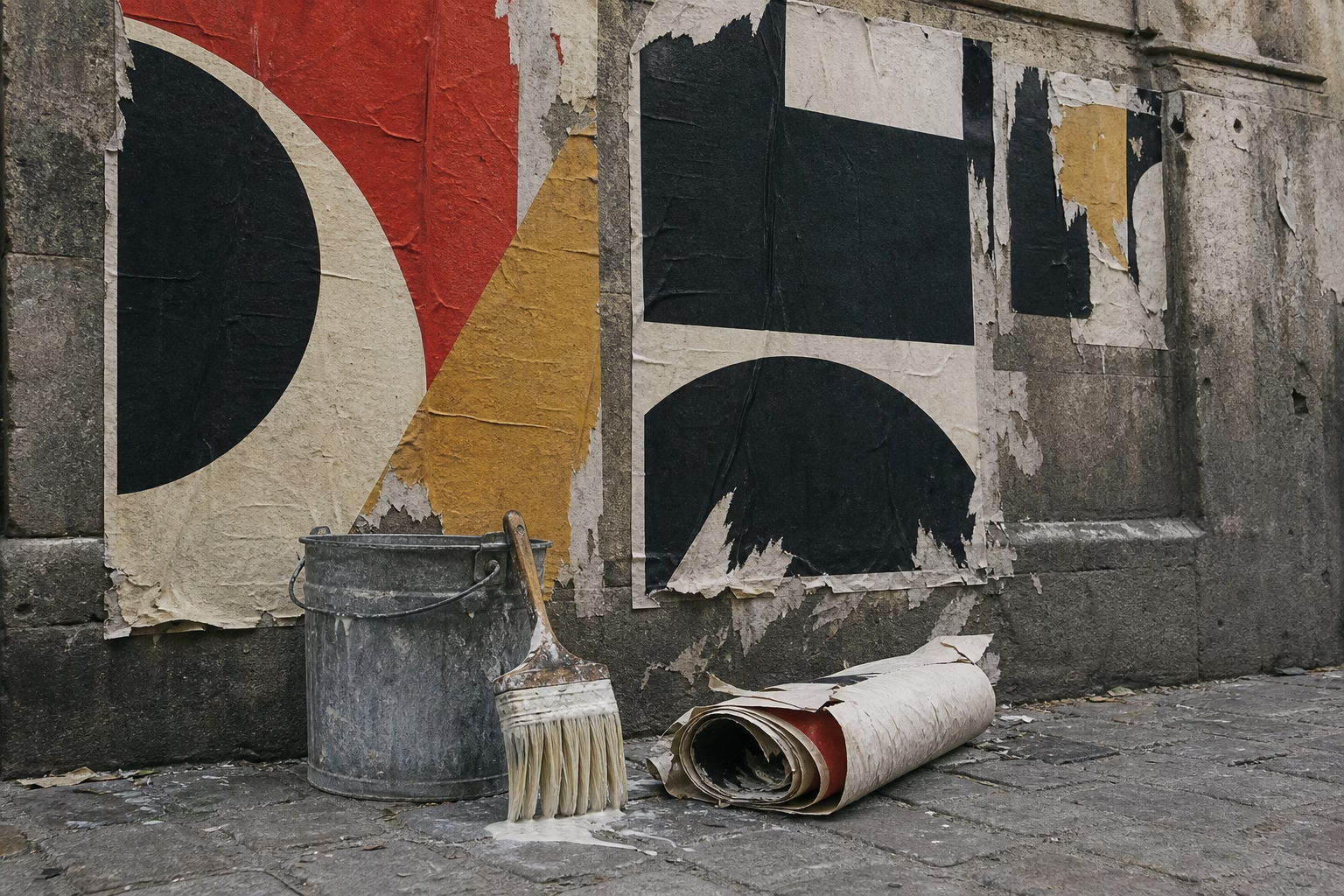
When students and workers took to the streets of Paris in May 1968, the Situationists were ready. Their slogans — L’imagination au pouvoir (“Imagination to power”), Il est interdit d’interdire (“It is forbidden to forbid”), La beauté est dans la rue (“Beauty is in the street”) — turned the walls of Paris into a spontaneous exhibition of political art. The posters produced by students at the École des Beaux-Arts during the protests remain some of the most visually striking political graphics of the 20th century, their bold sans-serif typography and stark imagery drawing directly on Constructivist and Surrealist traditions.
The Situationists contributed something that most previous revolutionary art movements hadn’t: a theoretical framework that named the enemy not as a particular class or government but as the entire system of representation and spectacle that capitalism had built. Their influence ran forward through punk, through hip-hop’s sampling and détournement, through the internet’s remix culture, and ultimately into the meme-based political communication of the present day.
Arte Povera — Refusing the Gallery System
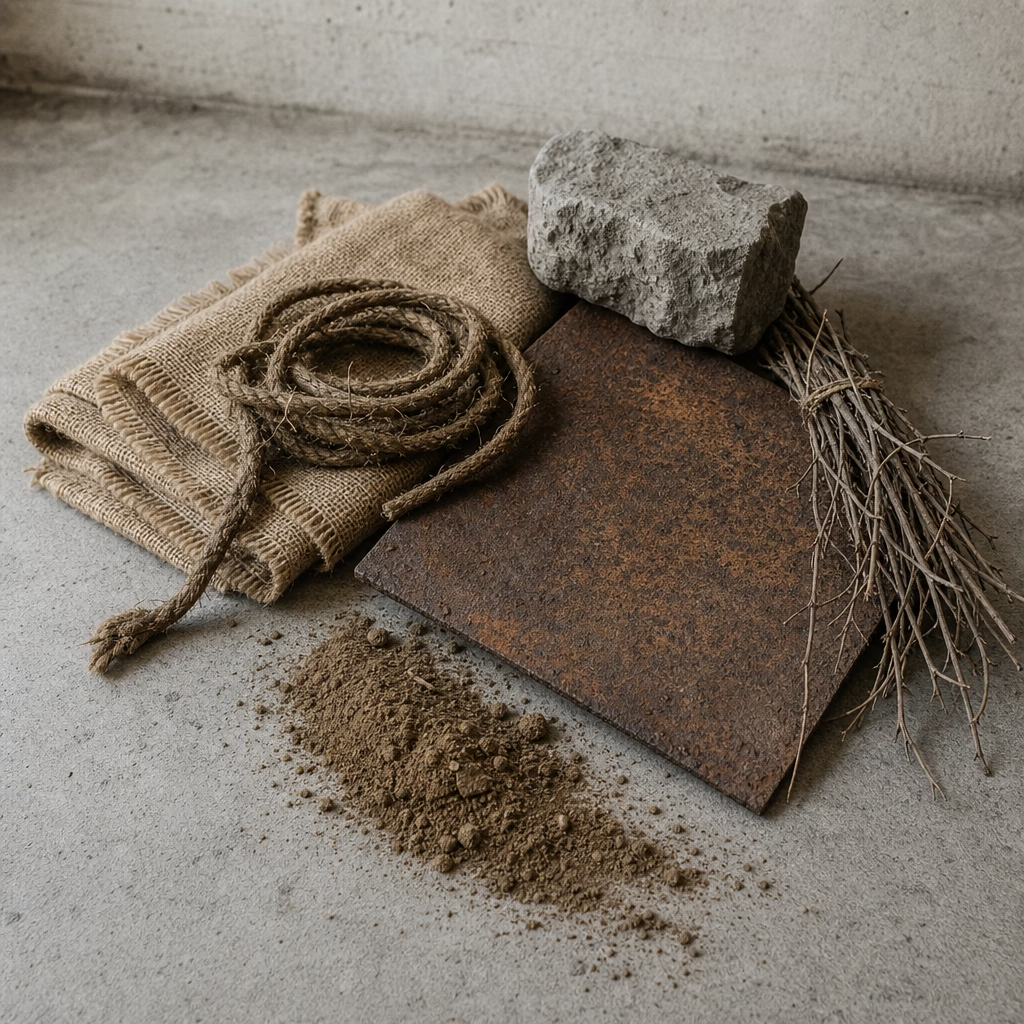
In Italy, the disruptions of 1968 produced a different but related artistic response. Arte Povera (literally “poor art”) emerged in the late 1960s as a rejection of both the commercialized gallery system and the slick, technologically sophisticated aesthetics of American Pop Art and Minimalism.
Artists like Michelangelo Pistoletto, Jannis Kounellis, and Mario Merz used humble, “poor” materials — earth, water, rags, unprocessed metals, live animals, vegetables — to create work that deliberately resisted the art market’s logic of commodity. Pistoletto’s Venus of the Rags (1967), which places a classical marble replica of the Venus de Milo facing a pile of discarded clothing, captures the movement’s essential gesture: the monumental and the discarded, tradition and waste, placed in uncomfortable proximity.
Arte Povera was not revolutionary art in the sense of serving a political movement’s goals. It was more subversive than that — it questioned whether the entire system of art production, distribution, and consumption could be trusted as a vehicle for anything genuinely human in a society organized around spectacle and commodity.
The Pattern Continues — From the Arab Spring to Black Lives Matter
The mechanism identified at this article’s opening has not stopped operating. If anything, digital technology has accelerated it.
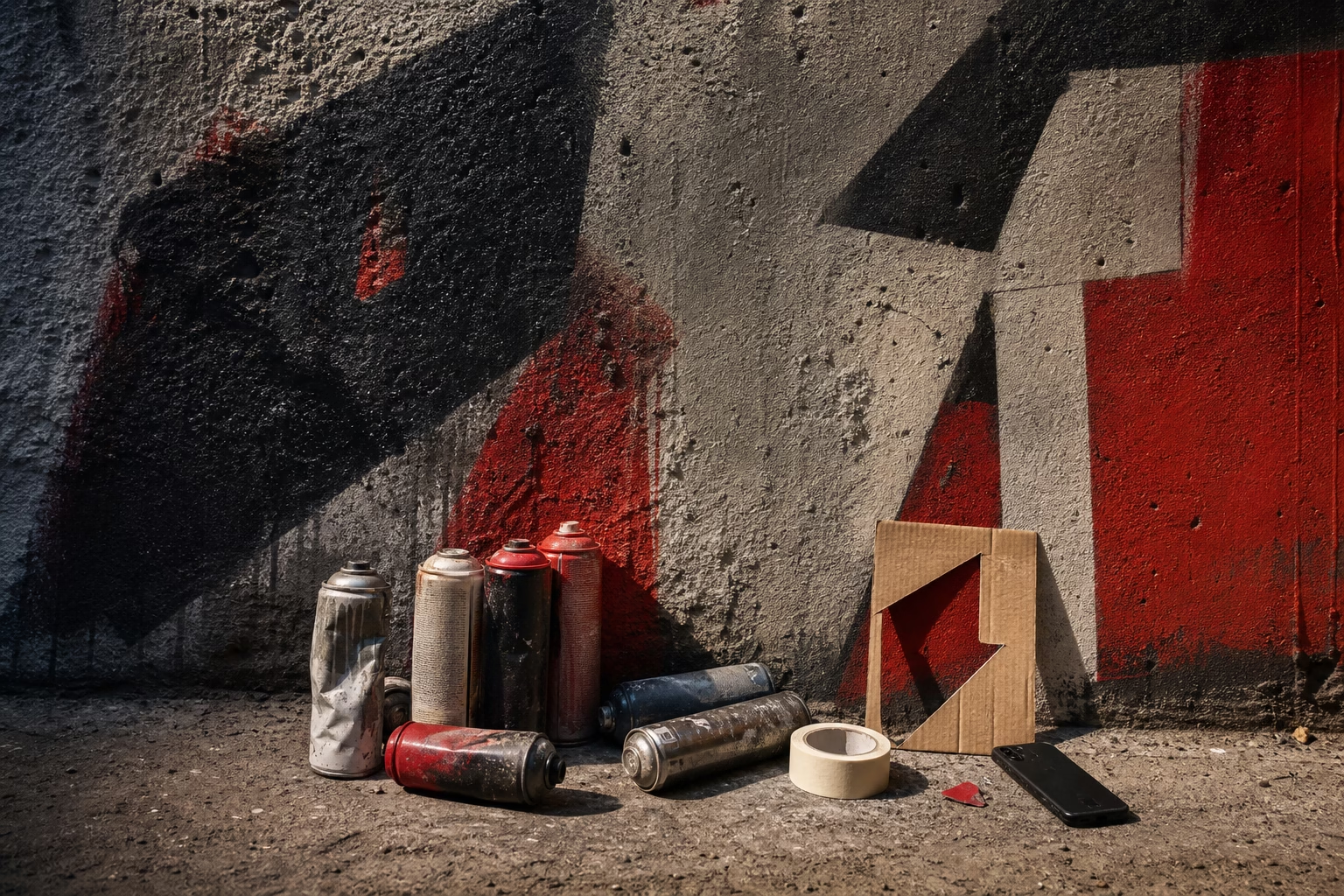
The Arab Spring of 2011 produced a wave of political street art across the Middle East and North Africa, with Cairo’s Mohammed Mahmoud Street becoming an outdoor gallery of revolutionary murals that documented the uprising in real time. When the Egyptian government whitewashed those murals, artists repainted them. The wall became a battle of images, a material conflict over who controlled the revolution’s visual record.
Ai Weiwei, China’s most prominent dissident artist, has spent decades making work that occupies the space between political art and conceptual art — Sunflower Seeds (2010), a carpet of 100 million handcrafted porcelain seeds at the Tate Modern, each one individually made by workers in Jingdezhen, is both a meditation on collective labor and a pointed commentary on China’s Cultural Revolution, during which artists like Wu Guanzhong had their work destroyed and were condemned to hard labor.
The Black Lives Matter movement, which intensified after the police killing of George Floyd in 2020, generated one of the most significant waves of public art in American history — murals, street paintings, protest graphics, and the transformation of public monuments. The visual language it developed — the raised fist, the specific iconography of particular victims — drew consciously on the Black Arts Movement of the 1960s while deploying it through social media at global scale and speed.
Instagram and TikTok have become the 21st century’s equivalent of the revolutionary poster-printing workshops of 1968. The political graphic that once required a printing press and distribution network can now reach millions within hours of creation. The speed has increased; the mechanism — political upheaval generating new visual forms — remains identical.
Frequently Asked Questions
Does every political revolution produce a new art movement?
Not every revolution produces a distinct, named movement — but every significant political rupture changes what artists feel compelled to make and what patrons are willing to fund. The presence of a named movement depends partly on the revolution’s duration and the cultural infrastructure of the society involved. What is consistent is that political upheaval always reshapes the visual culture it produces.
What is the difference between revolutionary art and protest art?
Revolutionary art is typically produced within a revolutionary moment or its immediate aftermath, often with the explicit goal of building the new order — think of David’s paintings of republican martyrs or Rivera’s murals promoting post-revolutionary Mexican identity. Protest art is made from a position of opposition to existing power. The two categories overlap frequently, and the same artist can produce both at different stages of a political struggle.
What happened to the avant-garde under Stalin?
By the early 1930s, Stalinist cultural policy had effectively destroyed the Soviet avant-garde. Abstract art was banned, and Socialist Realism — depicting heroic workers, collective achievements, and the benevolent leadership of the Soviet state in a clear, realistic style — became the mandatory mode. Artists who couldn’t or wouldn’t adapt faced persecution, imprisonment, or the destruction of their work. Malevich had his paintings confiscated; Tatlin’s ambitions for constructivist architecture were never realized; the generation that had produced the most radical visual experiments of the century was silenced within a decade.
How did the French Revolution change the art world?
The French Revolution dismantled the Royal Academy’s control over French art, abolished the traditional system of aristocratic patronage, and created both the ideological demand and the institutional structures for a new visual language. It elevated Neoclassicism from an aesthetic preference to a political manifesto, making Jacques-Louis David the most powerful artist in Europe. It also triggered Romanticism as a counter-response — meaning a single revolution gave birth to two major movements with opposing aesthetics.
Who was the most important artist of the Russian Revolution?
This is genuinely contested. Kazimir Malevich was arguably the most radical and influential in terms of long-term art history — Suprematism’s influence on subsequent abstract art is immeasurable. Alexander Rodchenko’s graphic design work established visual principles still visible in contemporary design. Vladimir Tatlin’s architectural vision remains the movement’s most audacious symbol. El Lissitzky was perhaps the most effective in actually communicating revolutionary ideology through visual form. The honest answer is that the Russian avant-garde was a collective achievement, not a one-person story.
How did the Mexican Revolution influence American art?
Mexican Muralism directly influenced the WPA mural programs of the New Deal, which funded thousands of American artists to paint public buildings during the 1930s. Diego Rivera’s technical approach, his belief in public art as democratic communication, and his emphasis on depicting laborers and historical subjects flowed directly into the American tradition. Several major American artists, including Ben Shahn and Charles White, were profoundly shaped by their engagement with Muralist aesthetics and ideology.
What is the Black Arts Movement?
The Black Arts Movement (roughly 1965–1975) was the cultural wing of the Black Power movement, calling for a distinctly Black aesthetic tradition independent of white Western cultural standards. It encompassed visual art, literature, theater, and music, and argued that art should serve the liberation of Black communities rather than seek validation within mainstream American cultural institutions. Its insistence on the political responsibility of artists, and its challenge to the question of whose experience art reflects, reshaped American culture permanently.
Can art survive political repression?
History suggests that art survives repression through two routes: underground preservation (works hidden, stored, or taken into exile) and the creative adaptation of artists who find indirect or coded ways to express what they cannot say directly. The Soviet avant-garde survived through works stored in basements and eventually recovered; dissident art in the Eastern Bloc developed sophisticated languages of allegory and metaphor. What often doesn’t survive is the institutional infrastructure — the schools, galleries, and publication channels through which movements sustain themselves. Individual works endure; movements can be destroyed.
Key Takeaways
Revolutions don’t just change governments. They destroy the economic and social systems that sustain existing art — the patronage networks, the academic institutions, the ideological frameworks that determine what counts as acceptable subject matter — and force artists to build new ones from the rubble.
Every major revolution examined in this guide produced at least one new art movement. Most produced several, often contradictory ones: the same French Revolution that gave birth to Neoclassicism’s severe rationalism also triggered Romanticism’s passionate emotionalism. The same Russian Revolution that liberated the avant-garde would, within a generation, destroy it.
The mechanism is consistent across five centuries. When power changes hands, art changes hands too — new patrons with new demands, new ideological requirements, new questions about who art is for and what it is supposed to do. Artists who live through revolutions witness events that break open their understanding of what they must make and why.
And the pattern shows no signs of stopping. Wherever political systems rupture today — wherever new movements demand visibility or old orders resist challenge — artists are among the first responders. The murals go up before the politicians have finished speaking. The graphics go viral before the journalists have filed their reports.
The guillotine may be a relic of a more brutal era. But the visual revolution it triggers — that, it seems, is permanent.