
In 2022, a colossal 24-foot installation filled the lobby of the Museum of Modern Art in New York. Refik Anadol’s Unsupervised trained an artificial intelligence on the publicly available metadata of MoMA’s entire collection — 200 years of art history compressed into a fluid, ever-shifting visual dream. Visitors were transfixed. Studies showed the average person spent 38 minutes in front of it, compared to the typical 28 seconds most great artworks receive. The director of MoMA called it “utterly extraordinary.” And then Pulitzer Prize-winning art critic Jerry Saltz weighed in. He called it a half-million dollar screensaver. A giant lava lamp.
That split reaction — mass enchantment versus expert skepticism — captures something essential about the question of AI art curators and aesthetic judgment. The crowds felt something. The machine delivered something. But was it good? And who gets to decide?
These are no longer hypothetical questions for art philosophy seminars. AI is actively curating exhibitions, selecting artworks for museum recommendation engines, and even being formally appointed as the curator of international biennials. At the same time, a rapidly growing body of psychological research is revealing how profoundly human aesthetic judgment is shaped by who — or what — made the art. And philosophers are quietly making the case that there may be structural limits to what any machine can do in this domain, no matter how sophisticated the algorithm.
This article works through all of it: what AI curation actually means in practice, what the experimental research tells us about aesthetic judgment, and what philosophical problems may not have technical solutions. The goal isn’t to declare a winner. It’s to give you a genuinely informed position in one of the most fascinating debates happening across the art world right now.
What AI Curation Actually Means (And What It Doesn’t)
Before diving into whether AI can judge good art, it’s worth establishing what “AI curation” actually refers to — because the term covers a remarkable range of things, from the mundane to the genuinely radical.
The Spectrum: From Recommendation Engine to Autonomous Curator
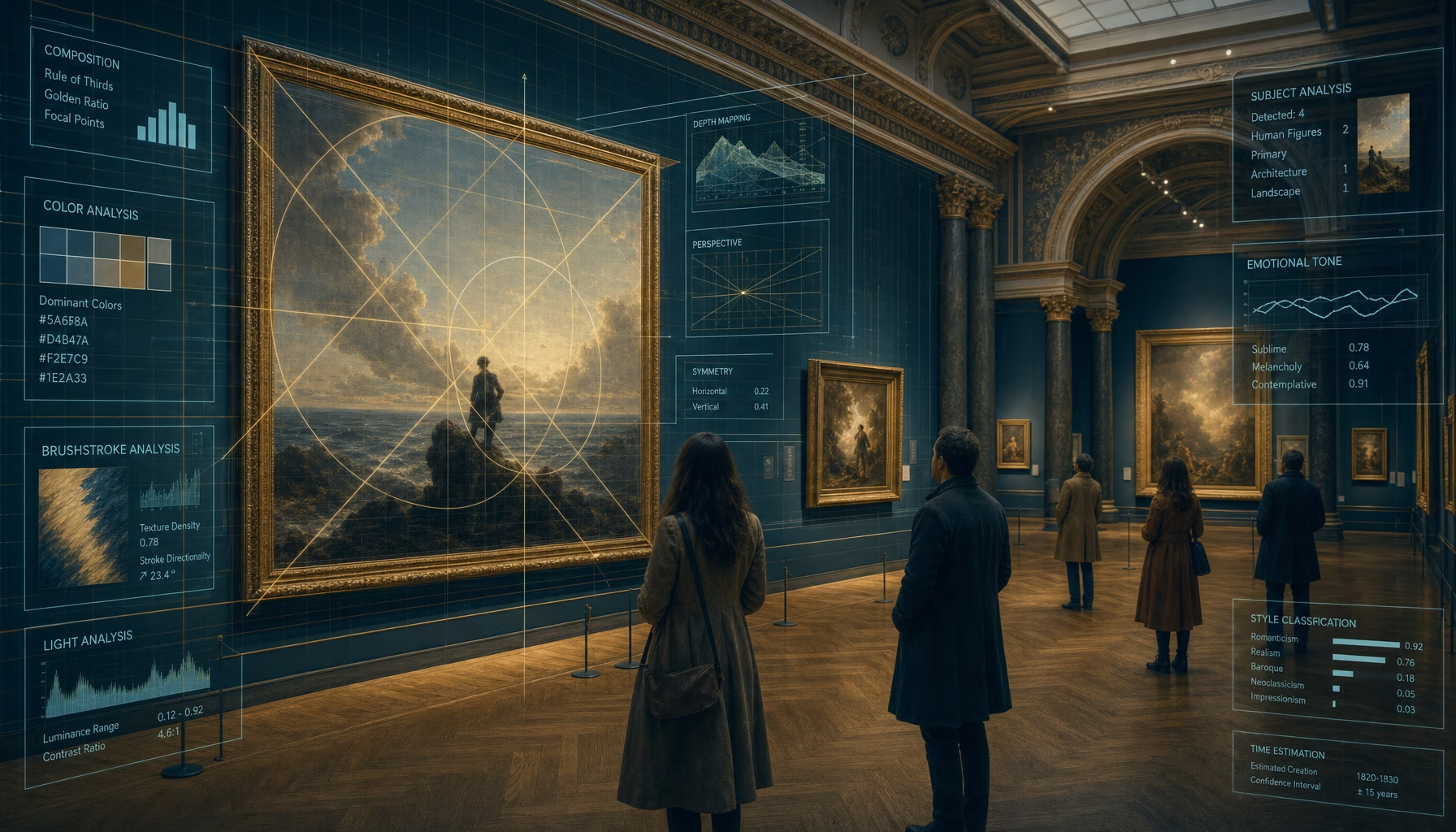
At the practical end of the spectrum, most AI tools in museums today function as sophisticated recommendation and discovery engines. They can search a collection of 200,000 objects in seconds, identify visual similarities between artworks across departments, tag works by formal properties like color, composition, and medium, and surface connections that would take a human researcher months to find. This is genuinely useful. It makes collections accessible to curators, researchers, and visitors in ways that were impossible before.
A step further along the spectrum, AI systems have been used to suggest thematic groupings of works — essentially answering the question “given this set of objects, which ones belong together?” This is where things get more philosophically interesting, because grouping is a curatorial act. When a curator places a Flemish still life next to a contemporary photograph of consumer goods, they are making an argument about art history. Whether an AI grouping constitutes a similar argument, or merely a pattern, is a question worth taking seriously.
At the far end of the spectrum is the genuinely autonomous AI curator — a system that makes independent creative and critical decisions about what an exhibition should include, exclude, and communicate. This is the frontier that has museums most excited and most cautious, and it is where the most important experiments are happening.
What AI Does Well in the Art World
It would be easy to dismiss AI’s role in aesthetics entirely, but that would misrepresent what these systems genuinely accomplish. Convolutional neural networks — the deep learning architecture underlying most visual AI — have demonstrated impressive abilities in several areas directly relevant to curation.
Style classification and artist attribution is one of the clearest successes. AI systems trained on large image datasets can accurately identify artistic movement, period, and often specific artists with remarkable precision. In some cases, AI has flagged potential misattributions in museum collections that human experts later confirmed. The technology that identified visual “fingerprints” in paintings attributed to Leonardo da Vinci or Rubens has opened real conversations about specific works — even if those conversations, as we’ll explore, almost always end with human experts having the final say.
Pattern recognition across scale is another genuine strength. When Tate trained algorithms to search its collection against Reuters news archives in 2016, the project — called “Recognition” — found over 7,000 visual and thematic matches between paintings in the Tate collection and contemporary photographic images. A human researcher with a lifetime to spare could not have done this. The result wasn’t a curatorial statement, exactly, but it was a research tool of significant power.
What AI cannot do well is harder to articulate, but it’s equally real — and it becomes clear the moment you push these systems toward the questions that matter most in curation.
The Museums Already Running the Experiment

This is not speculation. For nearly a decade, major cultural institutions around the world have been testing AI curation in practice, with results that range from genuinely illuminating to quietly cautionary.

Tate’s “Recognition” Project
When Tate Modern launched the “Recognition” project in 2016, it was one of the earliest systematic attempts to use machine learning in a major museum context. The project trained algorithms on the Tate collection and tasked them with finding visual and thematic connections with contemporary news photography from Reuters. The 7,000-plus matches the algorithm generated were striking — it found resonances between historical paintings and current events that created unexpected conversations about art and the world.
What the project revealed was AI’s genuine power as a discovery tool. It also revealed the limits: the algorithm found formal similarities — shared compositions, color relationships, structural echoes. What it could not do was explain why a particular match was meaningful, what argument the juxtaposition made, or what a visitor should feel when confronting it. That interpretive layer, the layer that transforms proximity into meaning, remained entirely the province of human curators.
Harvard’s metaLAB and the Weather Curator
Harvard Art Museums host metaLAB, an experimental research lab that has run some of the most creative AI curation projects in the world. One of the most striking examples used live weather data and a camera feed of the sky above Cambridge, Massachusetts, to continuously select artworks from the museum’s collection. The algorithm linked color data from meteorological readings to color metadata in the collection — when the sky was grey and overcast, it surfaced works with grey-dominated palettes; when sun broke through, the selection brightened accordingly.
It’s an arresting idea. It generates genuinely unexpected pairings, the kind of surprising connections that good curation can produce. But it also illustrates the distinction that will matter throughout this article: the system is sorting, not curating. The weather doesn’t know it’s making an aesthetic argument. Neither does the algorithm. The argument — if there is one — exists in the mind of the viewer who constructs it.
Bucharest Biennial and “Jarvis”
The Bucharest Biennial made international news when it formally appointed an AI — named Jarvis, after the fictional AI in the Iron Man films — as its curator. Built in a Vienna studio called Spinnwerk, Jarvis was designed to generate an initial conceptual hypothesis, then use deep learning on databases from universities, galleries, and art centers to develop an exhibition concept. It would learn from these sources, build up a curatorial thesis using the initial concept as a structural framework, and ultimately make its final selection of artists and works.
The appointment raised immediate and important questions. What does curatorial authority mean when it is exercised by an entity with no stake in the outcome, no social relationships with artists, no embodied sense of what a room feels like? The Biennial’s position was that the experiment itself was the statement — that forcing these questions was the curatorial act, performed by the human decision-makers who chose Jarvis in the first place. There is something to that. But it also sidesteps the question of whether Jarvis’s actual selections constituted aesthetic judgment in any meaningful sense.
Refik Anadol at MoMA: The Defining Case Study
No single example illuminates the limits and possibilities of AI aesthetic engagement better than Unsupervised. Anadol’s team trained an AI system on the publicly available metadata of MoMA’s entire collection — artist names, dates, medium classifications, thematic tags, provenance data. He then wrote algorithms allowing data from one object to evolve into the data of another, generating a continuous flow of imagery that had never existed before but was rooted in the patterns of 200 years of art history.
The public reception was extraordinary. People sat in front of it for 38 minutes on average. Glenn Lowry, who directed MoMA for three decades, called it “deeply satisfying.” The installation became one of the most talked-about museum experiences of the year.
But the critics were more divided. The art press pointed out that Unsupervised did not provide meaningful insight into the collection — it created what one observer described as “a shallow aesthetic presentation of the superficial visual qualities” of the works. It was visually arresting and emotionally engaging. What it wasn’t, arguably, was about anything. It had no thesis. It could not exclude, which meant it could not argue. And without an argument, it might be better understood as a spectacular ambient experience than as curation in any traditional sense.
Jerry Saltz’s screensaver remark stings precisely because it contains a genuine observation. What Unsupervised demonstrates — and what made it so extraordinary — was AI’s ability to process pattern at massive scale and produce something that feels meaningful. Whether it is meaningful in the way a curated exhibition is meaningful is exactly the question this article is working toward.
Training Machines on the Met’s 25 Years of Curation
In 2025, a research team published a study in which they trained four machine learning models on 25 years of Metropolitan Museum of Art exhibitions — 236 exhibitions from 2000 to 2025. The models learned from the patterns of what human curators had historically selected and grouped together, then were tested on their ability to replicate curatorial choices for new hypothetical exhibitions.
The results were genuinely significant: the models performed well above random chance. Given a title and description of a hypothetical exhibition, the system could select appropriate artworks from the Met’s collection with real coherence. The researchers concluded that there is “sufficient information in these exhibitions to construct an artificial intelligence model that replicates past exhibitions with accuracy well above random choices.”
Read that carefully. The models replicate pattern. They learn what curators have historically chosen — not why. The researchers themselves acknowledged that the system could potentially be refined to replicate the style of a specific curator, though they noted this would require far more data than is currently available. The gap between imitating a curatorial pattern and possessing curatorial judgment is the gap this article is fundamentally about.
What the Research Actually Says About AI and Aesthetic Judgment
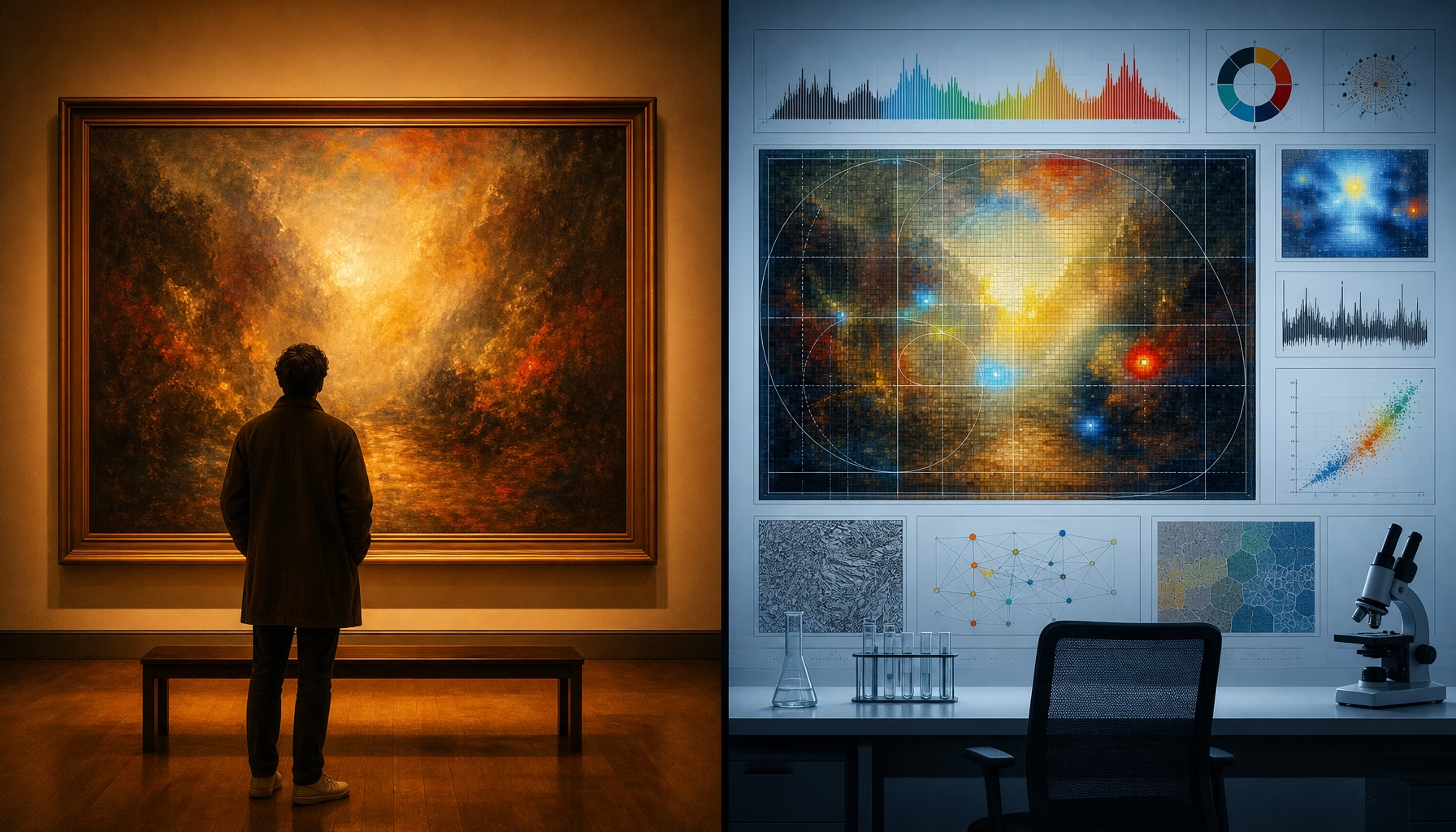
Beyond the museum experiments, a substantial body of experimental psychology research has been quietly accumulating on how humans actually respond to AI-made and AI-selected art. The findings are more nuanced than either side of the debate typically acknowledges.
The Authorship Bias — We Judge Identical Art Differently
The most replicated finding in this field is stark: people consistently rate the same artwork lower when they know it was made by AI rather than a human. This has been demonstrated across multiple studies, cultures, and art forms. When participants are shown identical images, they rate the beauty, worth, profundity, and emotional depth of a work more highly when they believe it was created by a human artist.
A 2009 study by Kirk and colleagues found that people showed greater neural activity in reward centers of the brain when they believed an image came from a gallery rather than a computer — suggesting the difference wasn’t merely an intellectual preference but a measurably different aesthetic experience. In 2025, a study specifically examining what dimensions of aesthetic judgment are most affected found that the bias is strongest for “deeper” criteria — profundity and worth — rather than surface-level properties like basic visual appeal. In other words, people are relatively willing to grant that AI-made work is visually attractive; they are far less willing to grant that it means something.
This has direct implications for AI curation. Even if an AI selects works with technical competence, the fact that the selection was made by an algorithm may color how visitors experience the exhibition. A curated show carries an implicit human endorsement; an AI-curated show carries a different kind of authority — or perhaps no authority at all in the eyes of the visiting public.
The Effort Heuristic — We Value Struggle
Humans have what researchers call an “effort heuristic” when it comes to art: we value work more when we perceive the effort behind it. This is why a painting with visible, meticulous brushwork often strikes us as more impressive than a work that looks effortless, even if we admire ease in other contexts.
This heuristic, research suggests, does not transfer to AI. Participants in a 2023 study evaluated AI artworks as having taken less time to produce and as being worth less money — even when they were told the generation process involved significant computational work, or that multiple AI networks were involved. The effort heuristic seems to operate specifically in response to human effort; when an algorithm does the work, the heuristic simply doesn’t engage.
This is not simply bias to be overcome with better education. It may reflect something genuine about the relationship between effort and meaning. The physical struggle of a painter working through composition problems, the intellectual struggle of a curator deciding what to exclude — these processes are part of what makes the result meaningful. We sense in the work the evidence of choices made under conditions of difficulty. An algorithm, even a computationally intensive one, doesn’t face difficulty in that sense. It faces optimization problems. These are not the same thing.
The Mind-Perception Problem
Research published by Messingschlager and Appel in 2025 identified what may be the deepest psychological mechanism behind our aesthetic bias. When we view art, we are not just responding to the visual object in front of us. We are engaging with the mind that made it — inferring the artist’s intentions, imagining their perspective, constructing a relationship between the work and the person who chose to make it.
The study found that viewers ascribe significantly less “agency” and “experience” to AI as a creative entity than to a human artist. Crucially, both dimensions — agency and experience — appear necessary for full aesthetic appreciation. Agency is what allows an artist to make intentional, purposeful choices. Experience is what allows them to portray a human perspective on the world. Without perceived mind, art loses its dimension as communication. It becomes form, not expression.
This is not an irrational prejudice that AI advances will eventually overcome. It reflects something philosophically real about the nature of art. A painting is interesting partly because a specific person, with a specific history and set of concerns, chose to make it and chose to make it this way rather than another way. The choice is inseparable from the meaning.
When AI Wins Blind — And What That Actually Tells Us
It would be intellectually dishonest to report only results that favor human judgment. Blind studies have repeatedly shown that AI-generated work can outperform human work when origin is concealed.
A 2025 study found that AI-generated abstract art, fine-tuned on a small set of user-provided design images, received higher aesthetic ratings in blind evaluation than human-made designs — across multiple aesthetic dimensions including self-preference and perceived quality. In poetry, research published in Nature found that readers rated AI imitations of Chaucer, Eliot, Plath, and other poets as more moving, more profound, and more beautiful than the poets’ actual work, without knowing the source.
What do we make of this? Two things. First, it confirms that AI has reached a point of formal sophistication where its outputs can genuinely impress on purely aesthetic grounds. This is not nothing. Second — and this is the more important insight — it reveals that aesthetic response is profoundly context-dependent. When we strip away the context of who made something and why, we are left with purely formal properties: rhythm, color, composition, surface. These properties can certainly be optimized by an algorithm. But they are not the whole of what art is or what aesthetic judgment responds to.
To use an analogy from music: a piece of music can be technically flawless and formally beautiful while communicating nothing. We recognize this easily when we hear it — something feels missing. The same may be true of AI-generated or AI-selected art when encountered without knowledge of its origin. The formal properties satisfy; the communicative dimension is absent.
The Philosophical Problem — What Is “Good” Art, Anyway?
To decide whether AI can judge good art, you first have to confront what “good” in art actually means. This turns out to be considerably more complicated than it sounds — and the complications are directly relevant to what AI can and cannot do.
Taste as Cultural and Historical Construction
Aesthetic taste is not a fixed universal. What counts as “good” in art has changed dramatically across periods and cultures, and these changes were not random fluctuations. They reflected social, political, and intellectual shifts in what human communities valued and how they understood their relationship to the world.
The Impressionists were rejected by the Paris Salon. Van Gogh sold almost nothing in his lifetime. Duchamp’s Fountain was literally rejected from the 1917 exhibition of the Society of Independent Artists — refused by the very organization that had promised to show all submitted works without jury. These were not failures of quality. They were failures of institutional recognition at a specific historical moment.
This matters for AI curation in a specific way. An AI trained on historical exhibition data will, by design, encode historical taste. It will learn what curators historically selected — the canonical preferences of a particular institutional tradition. When researchers trained models on 25 years of Met exhibitions, those models were learning not some universal aesthetic standard, but the specific curatorial culture of a specific institution during a specific period. There is no neutral training data in art. All data reflects the taste of the people who made the selection decisions.
This means an AI art curator risks being, by its nature, conservative. It would likely have rejected Fountain. It would have found it anomalous — an outlier in the training data, inconsistent with established patterns. The most transformative moments in art history were precisely the moments that broke the pattern. Whether an AI system can recognize and value pattern-breaking is a genuinely open question, and the answer so far is not encouraging.
The “Game of Meaning” — Why Intent Is Everything
The philosopher John Searle argued, in his famous Chinese Room thought experiment, that a system can process symbols correctly without understanding them. Applied to art, this suggests a crucial distinction: an AI can identify and reproduce the formal properties that have historically been associated with valued art without grasping why those properties matter — what they mean, what they communicate, what argument they make about the human condition.
This connects to what some theorists describe as the “game of meaning” in art. Art is not merely a formal object; it is an act of communication within a cultural conversation. Duchamp didn’t just place a urinal on a plinth — he made an argument about what art is, who controls the definitions, and what institutions do to objects and ideas. That argument was only possible because Duchamp understood the rules of the game and chose to violate them deliberately. His gesture was meaningful because it was intentional, culturally situated, and directed at a specific audience within a specific historical moment.
Can an AI participate in this game? A system that processes symbols without genuinely understanding them — that pattern-matches without comprehension — cannot, in any meaningful sense, play the game of meaning. It can produce outputs that look like moves in the game, just as a very sophisticated language learner can construct grammatically perfect sentences in a language they don’t understand. But the appearance of participation is not the same as participation.
The Negative Space Argument — What AI Structurally Cannot Do
There is a structural feature of AI systems that deserves more attention in this debate than it typically receives. Modern curation — particularly in the context of the white-walled contemporary museum — derives enormous meaning from what is excluded. The white space on the gallery wall is not empty; it is a statement. It says: we chose these works, and not those others. The significance of what is present is amplified by the implied rejection of everything absent.
An AI system that responds to any prompt given to it, that will always fill the space provided, that cannot exercise genuine discretion through refusal, is structurally unable to use this curatorial tool. The problem is not that AI lacks the data to make good selection decisions. It is that an AI cannot abstain in the way that gives curatorial abstention its meaning. When a human curator decides not to include a work, that decision is embedded in a web of relationships — to artists, to institutions, to the historical moment, to their own aesthetic commitments. When an algorithm produces output X rather than Y, it is not deciding; it is optimizing.
The distinction sounds abstract, but its practical consequences are real. Great curation has a point of view. It argues. It risks being wrong. An AI system cannot be wrong in the way a human curator can be wrong, because it does not hold the positions that make wrongness possible.
Connoisseurship as Embodied Knowledge
There is one more dimension of aesthetic judgment that resists algorithmic capture, and it may be the most irreducible of all: the embodied encounter with the work itself.
The Art Newspaper, in a January 2026 analysis of AI and art expertise, made a point that is obvious once you hear it but easy to overlook in discussions of machine learning: “An AI cannot see, smell, taste, hear or feel.” Connoisseurship — the deep expert knowledge that allows a scholar to authenticate a Schiele or attribute a newly discovered canvas — is not just a matter of visual pattern recognition. It involves the physical experience of standing before a work, noting the precise quality of a brushstroke in person that no photograph can capture, feeling the weight of evidence accumulated through years of direct encounter with objects.
An AI trained on digital photographs is working from a representation of art, not from art itself. The quality of that representation depends on the photographer’s skill, equipment, and lighting. Even the best photographs are, as the Art Newspaper noted, not 100% accurate. For an AI to replicate deep connoisseurship, it would need to work from the objects themselves — and even then, it would need the years of accumulated encounter that give human experts their finely calibrated sense of what is right.
This is why the high-profile AI attributions — the Caravaggio Lute Player reversal, the Rubens Bath of Diana claim — have been met with skepticism from leading scholars. In both cases, human experts with deep knowledge of specific oeuvres disputed the AI’s conclusions. The dispute is not about technical capability. It is about the nature of knowledge itself. Pattern recognition in digital images is a different kind of knowledge than connoisseurship built through embodied encounter with physical objects.
The Real Risks — Algorithmic Bias and the Curation Divide
Set aside the philosophical debates for a moment. The most concrete and immediate danger of AI in museum curation is not that it replaces human judgment. It is that it encodes and amplifies existing inequalities in whose art gets seen.

The Tate Bias Finding
In 2021, a Tate Modern audit found that the museum’s AI recommendation systems were promoting male artists in 72% of AI-suggested works — despite the museum’s stated commitment to gender-balanced acquisition policy. This was not the result of malicious programming. It was the result of training an algorithm on historical exhibition data, where male artists were historically overrepresented. The AI learned from the past and reproduced its biases faithfully.
This outcome is not specific to Tate. Any AI trained on historical art world data will reproduce historical art world biases. The Western canon — which dominates most major museum collections — reflects centuries of institutional decisions about whose work was worth collecting, exhibiting, and preserving. An AI that learns from this canon will learn to perpetuate it. Without active intervention to counteract this tendency, AI curation risks entrenching precisely the hierarchies that contemporary curatorial practice has been working to dismantle.
The implications reach beyond gender. The same mechanism will reproduce racial biases, geographic biases, biases toward certain media and certain price points, biases toward work that has already been legitimized by institutional recognition. If AI systems recommend the already-recommended, the already-celebrated, the already-canonized, then their effect on curatorial culture will be conservative in the most limiting sense of that word.
The Digital Curation Divide
A related problem is institutional. Major museums — MoMA, the V&A, the Palace Museum in Beijing — have the budgets, the technical staff, and the digitized collections to develop sophisticated AI curation tools. Regional museums, smaller institutions, and community galleries typically do not. The risk is that AI curation becomes another advantage for the already-advantaged, widening the gap between well-resourced flagship institutions and smaller organizations that lack the computational infrastructure to participate.
Research examining AI implementation across institutions found that many mid-career museum professionals — trained in art history and museum studies rather than data science — feel unprepared to critically evaluate the algorithmic systems being introduced into their institutions. This creates a dependency on external tech consultants who may have limited understanding of curatorial values and goals. When the people who understand curation can’t interrogate the AI, and the people who understand the AI have limited curatorial knowledge, the results are unlikely to serve either discipline well.
Where AI Genuinely Helps — And Where Human Curators Remain Irreplaceable

None of the above is an argument for keeping AI out of museums. The technology is already there, and in many applications it is doing exactly what good tools do: extending human capability without displacing human judgment.
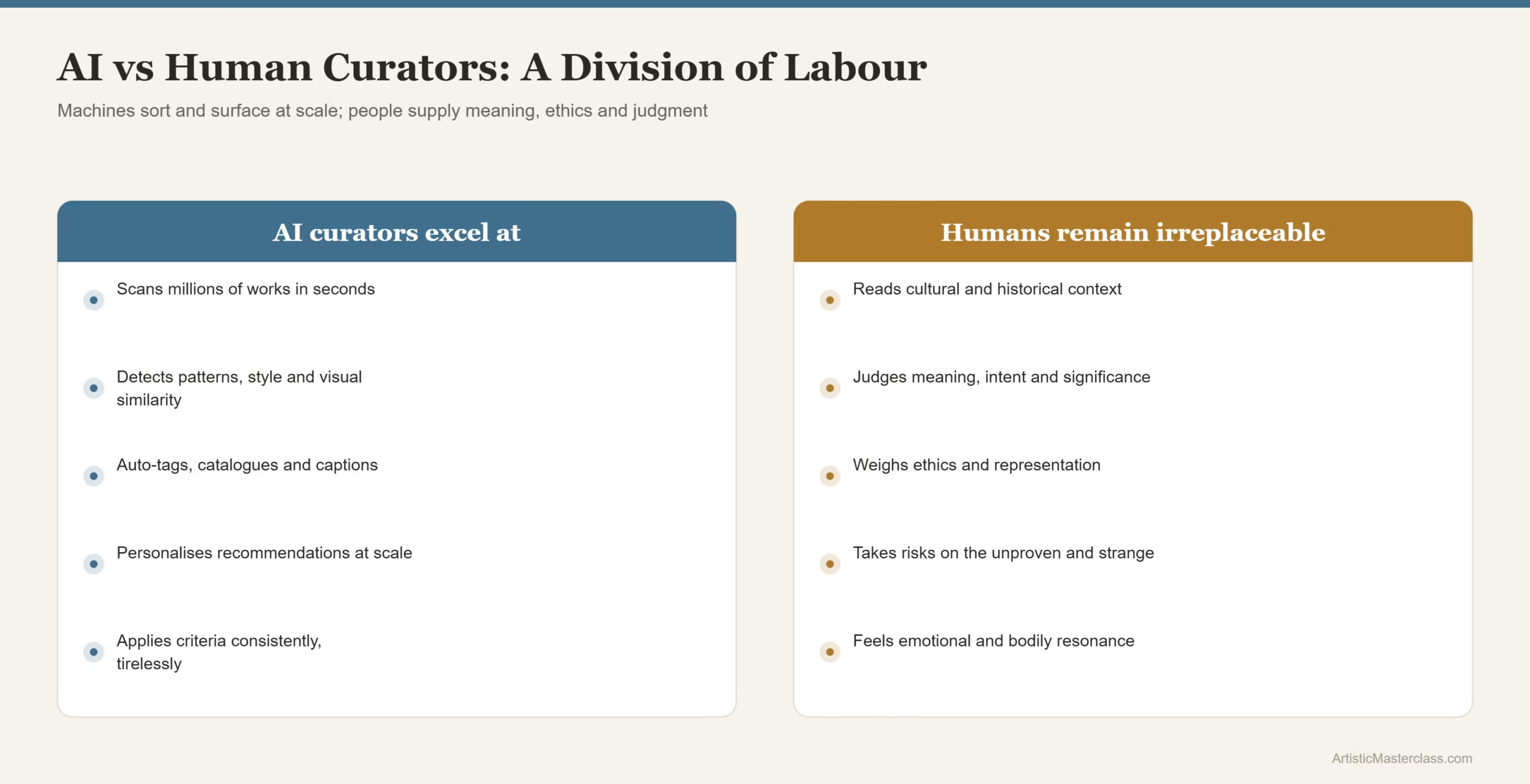
The emerging consensus among museum professionals is that AI works best as a powerful assistant to human curatorial vision, not as a replacement for it. Mike Ellis, director of the museum technology consultancy Thirty8 Digital, put it clearly: “A good, already knowledgeable curator could use AI to augment their knowledge, bring new ideas, frame stuff in different ways and use AI to do a lot of the grunt work.”
“Grunt work” in this context covers a remarkable amount of genuinely valuable territory. AI can make collections discoverable in ways that were impossible before — surfacing overlooked works, enabling searches by visual similarity or formal property, generating multilingual accessibility content, personalizing visitor recommendations. These are not trivial achievements. They make art more accessible to more people, and they free human curators to spend more of their time on the work that only they can do.
The global market for AI-powered museum tools — including tour guide systems, recommendation engines, and collection management AI — was estimated at around $412 million in 2024, with projections suggesting it could reach $2.15 billion by 2033. That growth reflects real institutional demand for these capabilities. But the most thoughtful museum professionals are clear that they are building AI tools to augment curatorial practice, not to replace curatorial judgment.
What is it that human curators do that AI systems cannot replicate? The list is worth stating clearly, because it is easy to lose sight of in the enthusiasm for technological possibility.
Human curators embed art in living cultural meaning — they connect works to the political, emotional, and social reality of the present moment in ways that require being present in that moment, not just trained on its data. They exercise the curatorial “no” with genuine authority — excluding works in ways that make the included works more significant. They navigate the social fabric of the art world — relationships with artists, galleries, critics, and communities — in ways that shape what art gets made and seen in the first place. They adapt their frameworks to the genuinely unprecedented — when confronted with work that breaks all prior categories, a skilled curator can revise their understanding rather than averaging the anomaly back into the existing pattern.
And they encounter art with a body. The physical presence of a work — its scale, its surface, the way it commands space, its smell, its weight of history — is part of what curators respond to. An algorithm that works from metadata and digital images is working from a thin representation of a richer reality. The gap between the representation and the thing itself may be smaller for some works and purposes than others, but it does not close.
Frequently Asked Questions
Will AI replace art curators?
The realistic answer, based on current evidence from museum experiments and professional consensus, is no — not in any meaningful sense. AI is being adopted as a curatorial assistant: a powerful tool for collection discovery, accessibility, and research support. No major institution is planning to cede artistic direction to an algorithm. The more interesting question may be how the role of the human curator evolves as AI takes over more of the analytical and organizational work, freeing curatorial attention for the interpretive and relational dimensions that machines cannot replicate.
Can AI tell the difference between good and bad art?
AI can reliably identify formal properties — composition, color harmony, technical execution, stylistic consistency — that have historically been associated with valued art. It can learn to predict what expert curators have historically selected. What it cannot do is exercise judgment in the fuller sense: it cannot assess whether a work is good for this moment, whether it says something important, whether it takes a risk that matters. “Good” in art is not a stable formal property; it is a relational assessment that depends on context, intention, and the conversation a work enters.
What museums are using AI for curation right now?
The most developed examples include Tate’s “Recognition” visual matching project, Harvard Art Museums’ metaLAB experimental projects, the Metropolitan Museum’s ongoing digitization and collection API work that enabled the 2025 ML curation research, and MoMA’s hosting of Refik Anadol’s Unsupervised. Many institutions are using AI for collection management, visitor recommendation systems, and accessibility tools without framing it explicitly as “curation.”
Is AI-curated art less valuable than human-curated art?
Research suggests that when people know art was AI-selected or AI-generated, they rate it lower across most aesthetic dimensions — especially for criteria related to meaning, profundity, and worth. This “authorship bias” appears to be psychologically robust. Whether this bias reflects something philosophically accurate (art really does mean less when its maker lacks genuine intentionality) or merely an irrational preference that will fade as AI becomes more familiar is one of the genuinely open questions in this space.
What is the “algorithmic bias” problem in art curation?
AI systems trained on historical exhibition and collection data will reproduce the biases embedded in that data. Since major museum collections reflect centuries of decisions that systematically underrepresented women artists, non-Western artists, and artists outside established market channels, AI systems trained on this data tend to recommend more of the same. The 2021 Tate audit — which found 72% male artist promotion despite gender-balanced policy — is the clearest documented example, but the problem is systemic.
Can AI understand artistic intent?
The prevailing view among philosophers, psychologists, and many practitioners is that AI systems process the formal signatures of intent without comprehending intent itself. An algorithm can learn that certain compositional choices are associated with certain artistic movements, that certain materials signal certain intentions, that certain juxtapositions carry certain historical meanings. But understanding why those choices were made — the specific, situated, historically embedded reason a particular artist made this work at this moment — requires a kind of cultural and experiential comprehension that current AI systems do not possess.
How does AI evaluate art technically?
The most common approaches involve computer vision models (often convolutional neural networks) trained to classify visual properties — style, period, medium, composition, color palette. More sophisticated systems use “embedding” representations that place artworks in a multidimensional space where similar works cluster together. These embeddings can be searched to find artworks related to a given input — a text description, another artwork, or even a piece of music. The 2025 Met research used this approach, training models to predict which artworks from the collection matched exhibition descriptions based on the patterns of historical curatorial selection.
What happened when an AI curated the Bucharest Biennial?
An AI named Jarvis was formally appointed as the curator of the Bucharest Biennial, built by a Vienna studio using deep learning on databases from academic and cultural institutions. The AI generated a conceptual hypothesis, developed an exhibition framework through learning, and made final selections of artists and works. The appointment was understood partly as a conceptual statement about curation itself — with the humans who chose Jarvis performing the meta-curatorial act. Critical responses focused more on what the experiment revealed about the nature of curatorial authority than on the quality of Jarvis’s specific selections.
Key Takeaways
The question “can machines judge good art?” turns out to be several different questions nested inside one another, and they have different answers.
Can AI identify formal properties that correlate with valued art? Yes, with increasing accuracy. Can it replicate the patterns of human curatorial selection? Yes, as the Met research demonstrated. Can it generate visually stunning experiences that captivate audiences? The 38 minutes at MoMA suggest yes, emphatically.
Can it exercise aesthetic judgment in the fuller sense — engaging with art as communication, argument, and cultural act? The evidence says no, and the reasons for this go deeper than training data or algorithmic sophistication. They touch on what art fundamentally is: not a formal object to be evaluated against fixed criteria, but an act of meaning-making within a cultural conversation that requires genuine participation to enter.
The most honest position — and, for what it’s worth, the most interesting one — is this: AI is a genuinely powerful pattern-matcher that has reached the edge of something that looks like taste. But taste, in the full sense that curation requires, is not pattern recognition. It is the exercise of judgment by a mind embedded in a history, a body, a set of commitments, and a specific cultural moment. Until AI systems possess something resembling that embeddedness, the curatorial act — the act of saying “this, not that, and here is why it matters” — will remain irreducibly human.
That doesn’t mean AI has no role in the art world. The tools being developed are genuinely valuable, and the best museum professionals are finding ways to use them that amplify rather than diminish curatorial intelligence. The future of art curation is almost certainly collaborative: AI handling the scale that no human can manage, humans handling the meaning that no algorithm can generate.
What it does mean is that the question isn’t really “will AI replace human curators?” — it almost certainly won’t, not because the technology will fail, but because the job requires something the technology does not have. The real question is what happens to our experience of art when the selection process is increasingly mediated by systems that cannot actually enter the conversation art is trying to have.
That question deserves to stay open. And perhaps staying genuinely open to it — uncertain, curious, willing to revise — is itself the most human thing we can do.