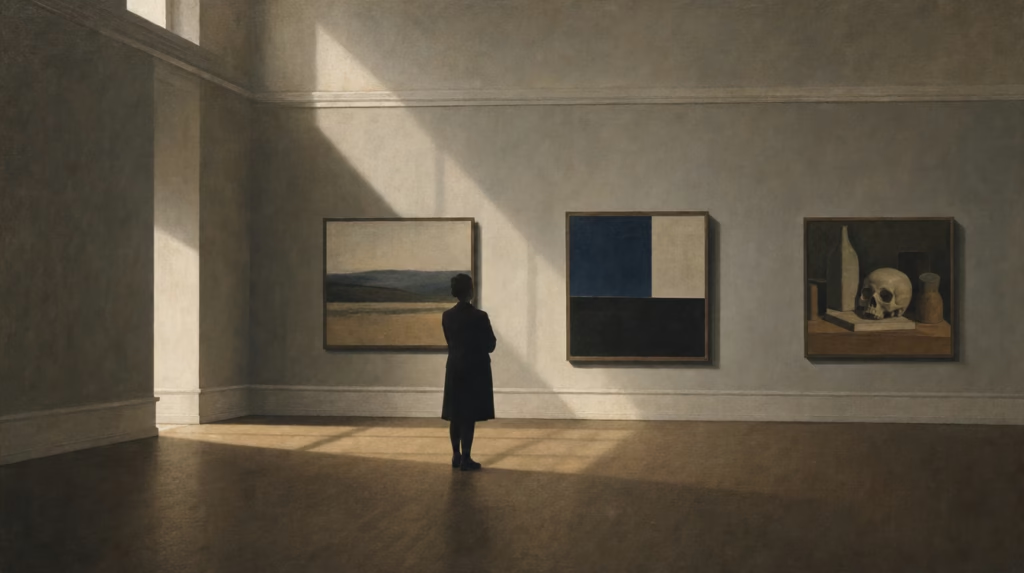
Art ideas and concepts are the recurring theories, values and ways of thinking that artists, critics and historians use to explain what a work means — distinct from the movements that group artists by era and the elements that describe a work’s visual parts. A concept like the readymade or the sublime can run across centuries and styles. This page maps the core conceptual vocabulary of art and links each idea to its own in-depth guide.
Most reference sites bury these ideas inside one giant A–Z glossary, mixed in with techniques, materials and movements, so abstraction sits next to acrylic paint and avant-garde next to aquatint. That is alphabetically tidy and conceptually useless. Tate’s own Art Terms glossary is the most authoritative single list in the field, yet it makes no distinction between a pigment, a period and a philosophy. This hub does the opposite: it isolates the ideas — the load-bearing concepts you actually argue about in a gallery — and organises them by the kind of thinking each one represents.
Concepts, movements and elements are three different things
Concepts, movements and elements answer three different questions about a work, and conflating them is the single most common mistake beginners make. A concept is an idea or theory about what art does (allegory, formalism, the gaze). A movement is a group of artists working in a shared style during a shared period (Cubism, Surrealism, Pop Art). An element is a visual building block you can point at on the surface (line, colour, form). The table below separates them so you always know which one you are talking about.
| Layer | Question it answers | Examples | Where it lives on this site |
|---|---|---|---|
| Idea / concept | What does the work mean or claim? | Abstraction, the sublime, the readymade, allegory, kitsch | This hub — /art/ideas |
| Movement | Who made it, when, and in what shared style? | Impressionism, Dada, Abstract Expressionism | The movements hub — /art/movements |
| Style / genre | What kind of subject or treatment is it? | Portrait, landscape, still life, hyperrealism | The styles hub — /art/styles |
| Element / principle | What visual parts is it built from? | Line, shape, colour, balance, contrast | The elements guide — /learn/elements-of-art |
One idea can travel across many movements: abstraction appears in Cubism, Suprematism, Abstract Expressionism and Colour Field alike. That mobility is exactly why ideas deserve their own pages rather than being trapped inside a single movement’s entry. If you came here trying to understand a specific painting, start with the movements hub for its period, then return here for the ideas it draws on.
How to use this conceptual map
This page is a hub, and each concept below opens with a short definition you can read in ten seconds, then links to a full guide. The fastest way to use it is to scan the six families, find the idea that matches the question in your head — why does this everyday object count as art? (the readymade), why does this empty landscape feel overwhelming? (the sublime), what is that skull doing in the painting? (memento mori) — and follow the link. You do not need to read top to bottom. The families are ordered from the most fundamental ideas (how art pictures the world) to the most specialised (the grammar of composition).
A quick note on consensus: the definitions here follow the positions held by major institutions such as Tate and the Museum of Modern Art, and by Encyclopædia Britannica. Where scholars genuinely disagree — and on ideas like beauty or the avant-garde they often do — the concept’s own page lays out the competing views rather than pretending one answer is settled.
How art pictures the world: representation and abstraction
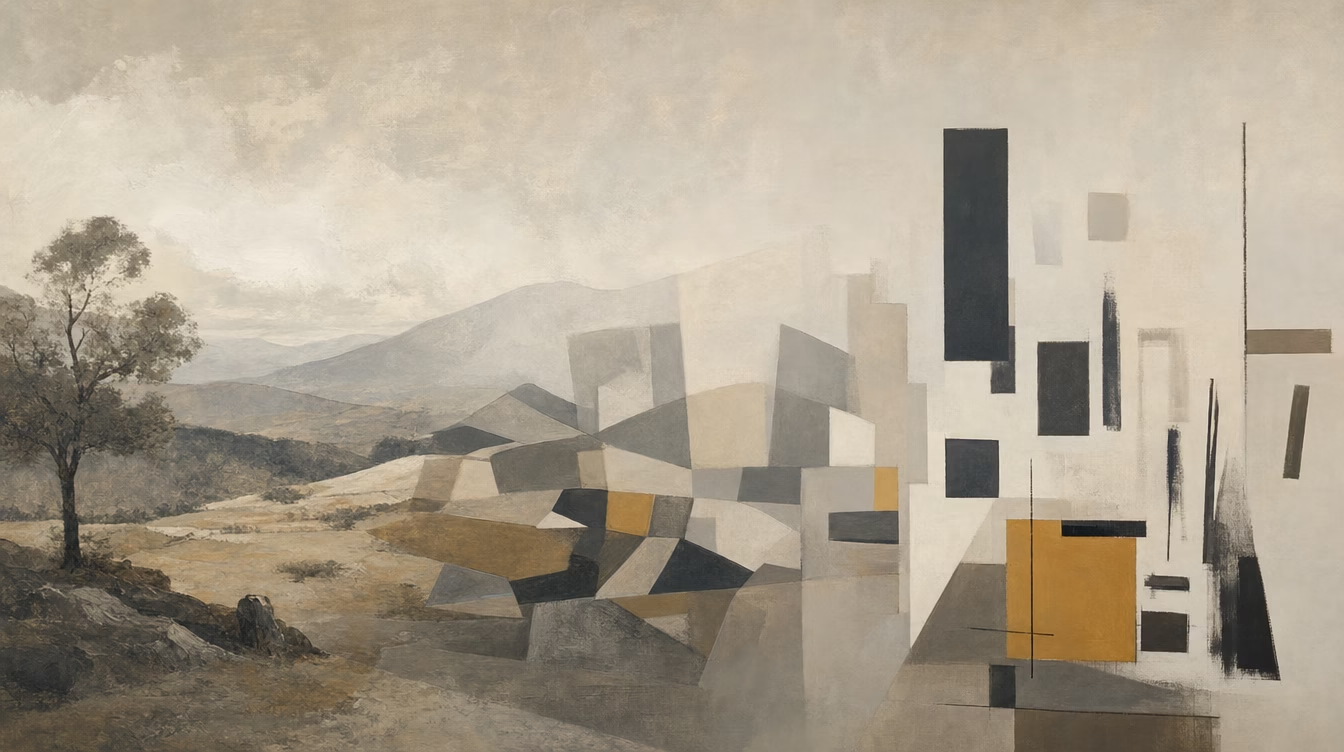
Representation and abstraction are the two poles of how a work relates to visible reality, and almost every other idea in art sits somewhere between them. Representation reaches toward the recognisable world; abstraction pulls away from it. Understanding this axis first makes every later concept easier, because terms like figurative, non-objective and formalism are all positions along it.
Representation
Representation is the depiction of recognisable people, objects or scenes so that a viewer can identify what the image shows. It is the default mode of Western art from antiquity through the nineteenth century, and it covers everything from a Roman portrait bust to a photorealist diner. Representation is not the same as realism — a stylised medieval saint and a hyperreal pencil drawing are both representational, because both point to identifiable subjects. The full guide covers mimesis, illusionism and the long argument over whether art should copy nature at all. Read more in the representation guide.
Abstraction
Abstraction is the simplification, distortion or complete removal of recognisable subject matter so that shape, colour and gesture carry the work instead of likeness. Tate defines abstract art as work that does not try to represent visual reality accurately but uses form and colour to achieve its effect. Abstraction can be partial — Cubism fractures a recognisable figure — or total. It has carried a moral charge since the early twentieth century, often standing for order, purity and spirituality. The abstraction guide traces it from Kandinsky and Mondrian to Colour Field painting.
Non-objective art
Non-objective art is abstraction with no source at all in the visible world — no figure, no landscape, no object behind the marks. It is the most extreme point on the representation–abstraction axis. Kazimir Malevich’s black square and many of Mondrian’s grids are non-objective: they refer to nothing outside the painting itself. Some artists prefer the terms concrete art or pure abstraction, and the distinction from ordinary abstraction is not always obvious in practice. The non-objective art guide explains where the line falls and why it mattered to the early modernists.
What art aims at: aesthetic ideals and values
Aesthetic ideals are the ends a work is reaching for — beauty, awe, refinement, provocation or total immersion — and naming them tells you what a piece is trying to do to you. These six ideas are the values artists and critics invoke when they judge whether a work succeeds, and they have shifted dramatically across history: the eighteenth century prized the sublime and the picturesque, while the twentieth often prized their opposites.
Beauty in art
Beauty in art is the quality that gives a viewer pleasure through harmony, proportion or sensory richness — and it is one of the most contested ideas in the entire field. For most of history beauty was art’s central aim: the ancient Greek sculptor Polykleitos even wrote a treatise, the Canon, prescribing the ideal proportions of the human body. In the twentieth century the avant-garde deliberately rejected it, treating prettiness as a trap. The beauty in art guide covers classical proportion, the idea that beauty is “in the eye of the beholder,” and why modern artists turned against it.
The sublime
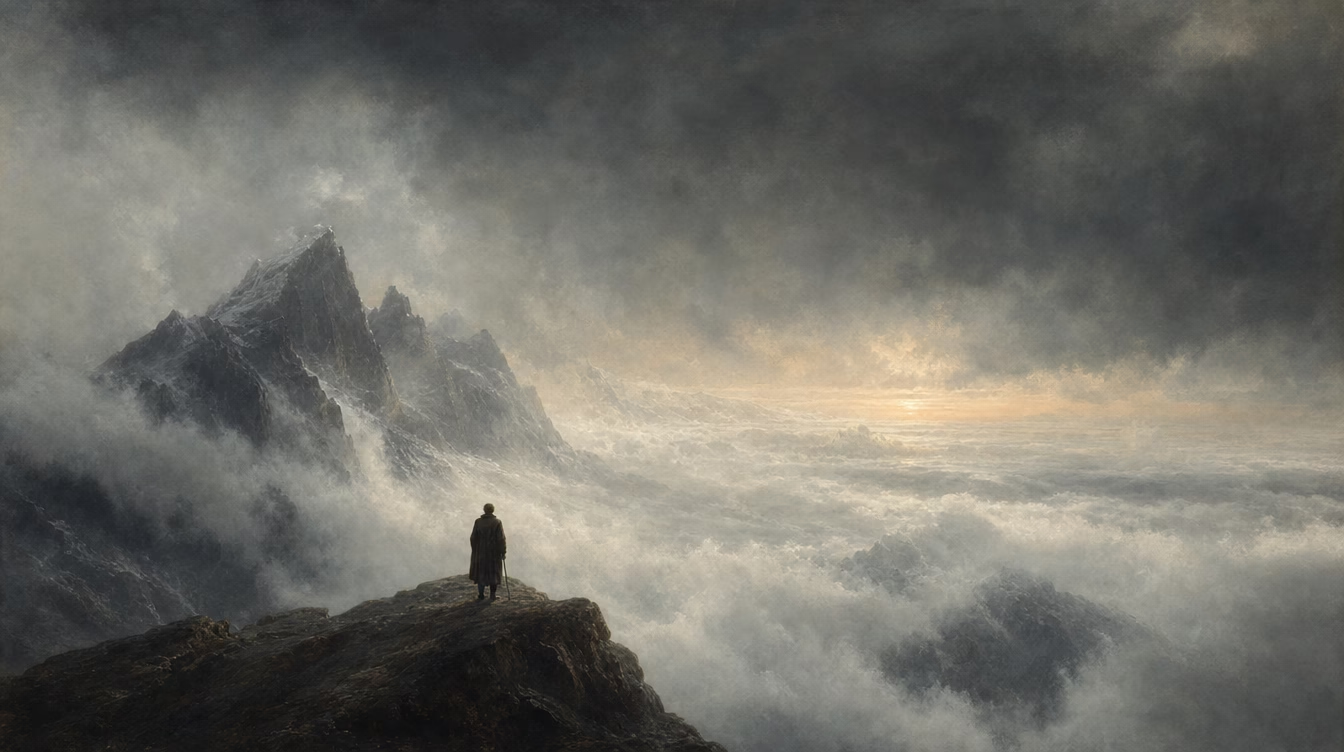
The sublime is the experience of overwhelming greatness, terror or vastness that exceeds what the mind can comfortably take in — the shiver in front of a storm-lit mountain or an endless sea. Eighteenth-century thinkers Edmund Burke and Immanuel Kant separated it sharply from mere beauty: the beautiful pleases, the sublime overpowers. It drives much of Romantic landscape painting, from Turner’s storms to Friedrich’s lone figures. The sublime guide explains the philosophy and its painters.
The picturesque
The picturesque is an eighteenth-century ideal prizing scenes that look like a painting — rough, irregular, varied landscapes with ruins, twisting trees and pleasing asymmetry. It sits deliberately between the smooth beautiful and the terrifying sublime, a middle category invented to describe the cultivated taste for “natural” scenery. The picturesque guide covers its origins in British landscape theory and its influence on garden design and tourism.
Kitsch
Kitsch is art judged to be cheaply sentimental, formulaic or in bad taste — the mass-produced sunset, the weeping clown, the garden gnome. The term carries a built-in value judgement, and twentieth-century critics such as Clement Greenberg used it as the despised opposite of serious avant-garde art. Later artists reclaimed it deliberately: Jeff Koons built an entire career on giant balloon animals and porcelain figurines that weaponise kitsch as a knowing strategy. The kitsch guide untangles the insult from the artistic device.
Art for art’s sake
Art for art’s sake is the belief that a work needs no moral, political or useful justification — that its value lies in its own beauty and form, not in any message or function. The phrase (l’art pour l’art) became the rallying cry of the nineteenth-century Aesthetic movement, against the Victorian demand that art teach or improve. The art for art’s sake guide covers Whistler, Wilde and the doctrine’s long afterlife in formalism.
Gesamtkunstwerk
Gesamtkunstwerk is the “total work of art” — a single creation that fuses many art forms (music, design, architecture, performance) into one immersive whole. The composer Richard Wagner popularised the idea, and it runs through Art Nouveau interiors, the Bauhaus and modern installation art. The gesamtkunstwerk guide traces the ambition to dissolve the boundaries between the arts.
How art carries meaning: reading the image
Reading the image is the work of decoding what a picture says through its symbols, signs and arrangement of looking — and these six ideas are the tools art historians use to do it. A skull is never just a skull; a direction of gaze is never neutral. This family equips you to move from what is shown to what is meant, which is the heart of art-historical analysis.
Iconography
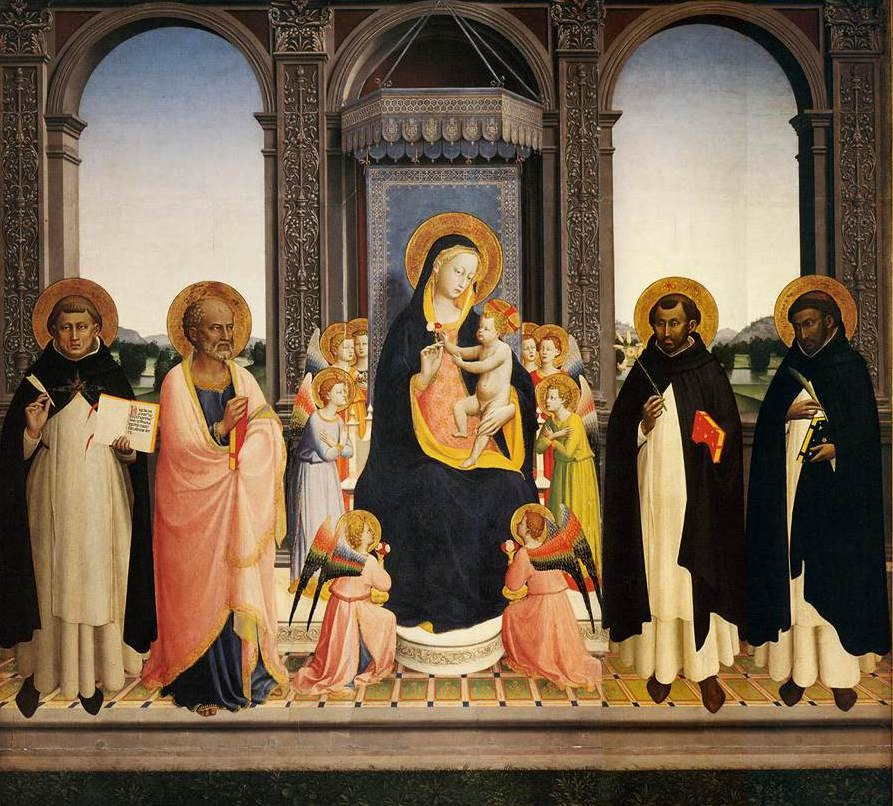
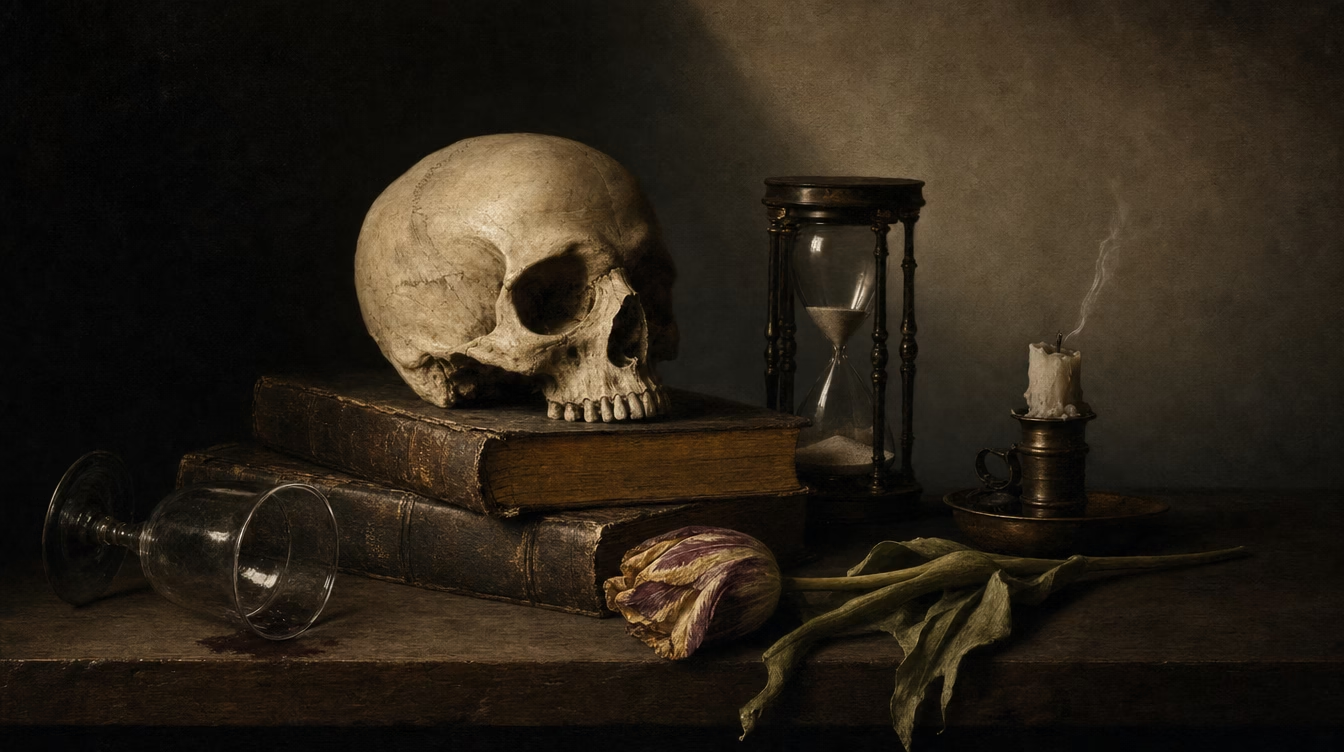
Iconography is the study of the symbols, motifs and subjects in a work and the conventional meanings they carry — a lily for purity, a scale for justice, a dog for fidelity. Pioneered as a rigorous method by Erwin Panofsky, it lets a viewer read a Renaissance altarpiece almost like a text. The iconography guide explains the method and its three levels of meaning.
Semiotics in art
Semiotics in art is the analysis of images as systems of signs, borrowing the linguistic theory of Ferdinand de Saussure and Charles Peirce to ask how visual marks produce meaning. Where iconography catalogues fixed symbols, semiotics studies the underlying mechanics of signification — how a sign, its meaning and its viewer interact. The semiotics in art guide makes the theory usable without the jargon.
Allegory
Allegory is a work in which the literal subject stands for a second, hidden meaning — figures and objects that personify abstract ideas such as Liberty, Time or Vanity. A painting of a blindfolded woman holding scales is rarely about a woman; it is about Justice. The allegory guide covers personification, the difference between allegory and symbol, and how to read a moralising scene.
Memento mori
Memento mori is a type of imagery designed to remind the viewer of the certainty of death — literally “remember you must die” — using skulls, extinguished candles, hourglasses and decaying flowers. It is a moral prompt as much as a decoration, urging reflection on mortality and the vanity of earthly things. The memento mori guide traces the motif from tomb sculpture to still life.
Vanitas
Vanitas is a specific genre of still life, especially in the seventeenth-century Dutch Golden Age, that arranges symbolic objects — skulls, books, musical instruments, wilting blooms — to preach the emptiness of worldly pleasure and the brevity of life. It is the still-life cousin of memento mori, with its own dense symbolic code. The vanitas guide decodes the objects and their messages.
The gaze
The gaze is the idea that how a work invites us to look — and who is positioned as the looker versus the looked-at — carries power and meaning, often along lines of gender. The concept, sharpened by feminist and psychoanalytic theory, underlies the influential notion of the “male gaze” in which women are framed as objects of a presumed male viewer. The gaze guide covers Berger, Mulvey and how to spot it in a painting.
How artists make and remake: strategies of creation
Strategies of creation are the radical methods modern artists use to make art without traditional crafting — by choosing, borrowing or quoting rather than painting or carving. These three ideas overturned the assumption that an artist must fabricate the object by hand, and together they define a huge swathe of twentieth- and twenty-first-century practice.
The readymade
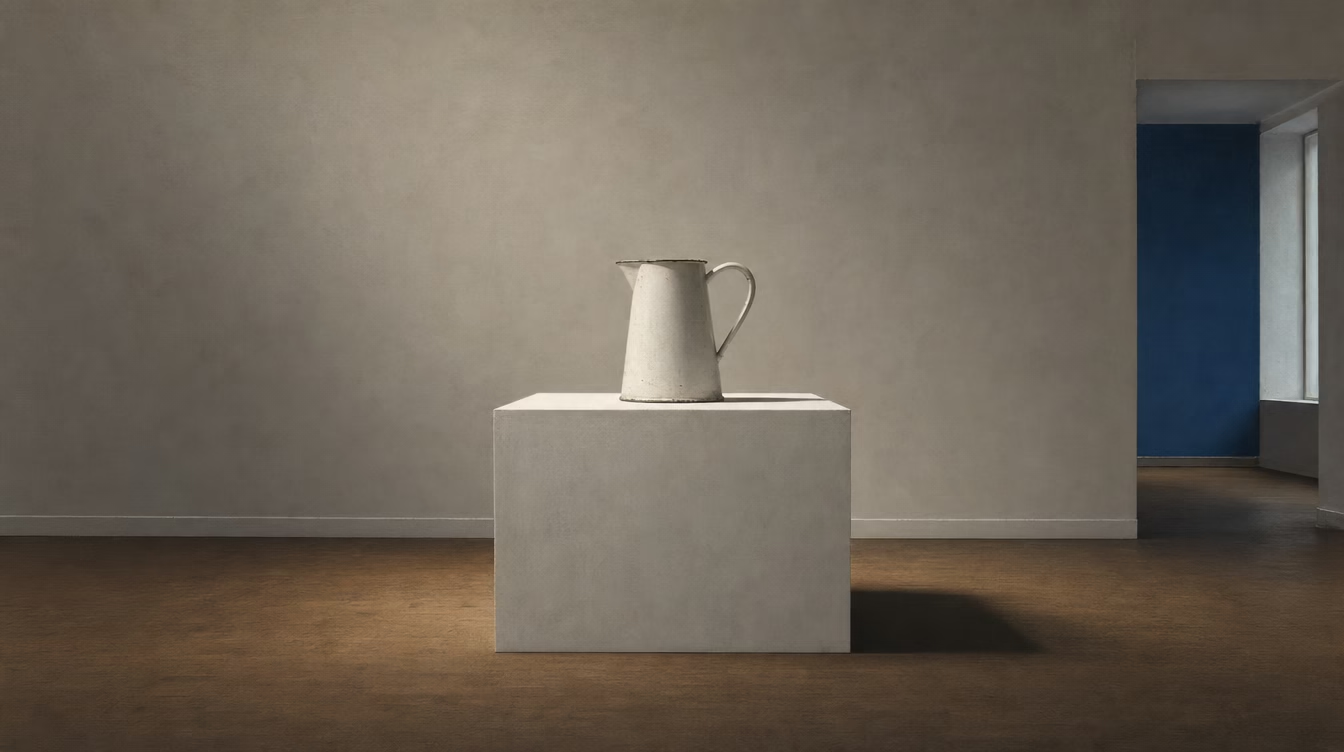
The readymade is an ordinary manufactured object selected by an artist and presented as art, with little or no alteration — the move that shifted the artist from maker to chooser. Marcel Duchamp coined the term for works such as his 1917 urinal Fountain, asserting the principle that what counts as art is defined by the artist’s choice. Tate describes this move from artist-as-maker to artist-as-chooser as a starting point for conceptual art. The readymade guide explains Duchamp’s logic and its enormous consequences.
Appropriation
Appropriation is the deliberate borrowing of existing images, objects or styles into a new work, with little transformation, so that the act of recontextualising becomes the creative gesture. It runs from Cubist collage through to the 1980s, when artists made copying itself the subject. The original usually remains recognisable, which is the point — meaning comes from the new context. The appropriation guide covers its history, its ethics and where it shades into plagiarism.
Pastiche
Pastiche is a work that openly imitates the style of an earlier artist, period or genre — sometimes in homage, sometimes as knowing play, but without the mockery of parody. It became a defining device of postmodern art, which treats the whole history of styles as a wardrobe to borrow from. The pastiche guide distinguishes pastiche from parody, quotation and forgery.
How critics frame art: theories and era-concepts
Theories and era-concepts are the big interpretive frameworks critics use to organise whole periods and to argue about what art should be. These four ideas are less about a single image and more about the story art tells over time — and they are the terms you will meet most often in serious criticism.
Formalism
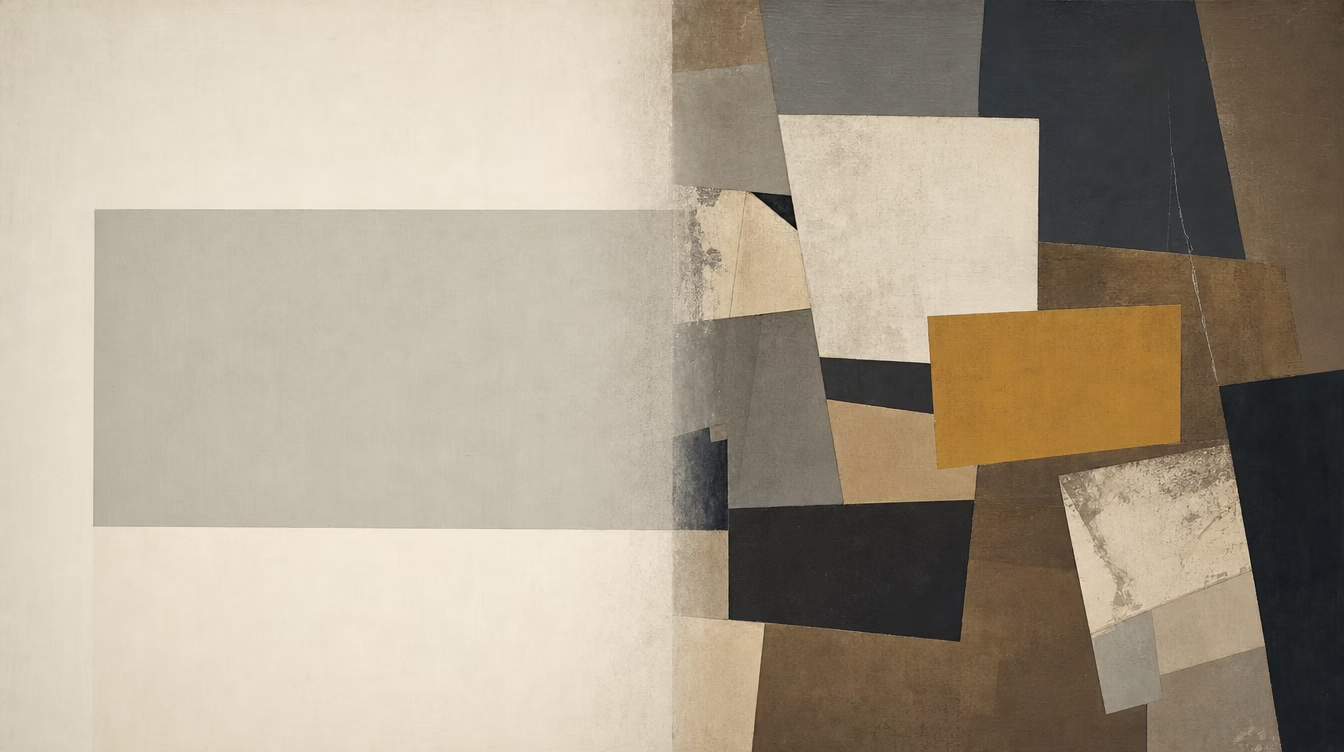
Formalism is the theory that a work’s artistic value lies in its form — line, colour, composition, surface — rather than its subject, story or social context. For a formalist, how a painting is organised matters more than what it depicts. The critics Clement Greenberg and Roger Fry are its most famous champions, and it underwrote much modernist abstraction. The formalism guide covers the theory and the strong reactions against it.
Avant-garde
Avant-garde describes art that is experimental, ahead of its time and deliberately set against established taste and institutions — the “advance guard” pushing into new territory. The term carries both a chronological claim (it comes first) and a combative one (it breaks rules). Its relationship to the mainstream is unstable: today’s avant-garde is tomorrow’s convention. The avant-garde guide traces the idea and its built-in contradiction.
Modernism
Modernism is the broad movement and mindset, roughly 1860s–1960s, in which artists broke with tradition to pursue innovation, abstraction and the qualities unique to each medium. It prized originality and progress, treating art history as a forward march. Modernism is an era-concept — an umbrella over many movements — not a single style. The modernism guide explains its core beliefs and its eventual exhaustion.
Postmodernism
Postmodernism is the set of attitudes that followed and reacted against modernism from the 1970s onward — sceptical of progress and originality, fond of irony, quotation, pastiche and the mixing of “high” and “low” culture. Where modernism sought purity, postmodernism embraces contradiction and borrowing. The postmodernism guide covers its key ideas and why the term remains slippery.
The grammar of composition: formal concepts
Formal concepts are ideas about the arrangement of a work — the underlying compositional structure that organises what you see, regardless of subject. These two sit at the border between the conceptual ideas on this page and the practical elements of art; they are ways of thinking that have hardened into working tools.
Negative space
Negative space is the empty area around and between the subjects of a work — the “background” that is itself an active, shaped part of the composition. Skilled artists treat negative space as a positive design element, using it to balance a picture, direct the eye and create tension; the Japanese aesthetic of ma, the meaningful interval, treats emptiness as the equal of the marks around it. The negative space guide shows how emptiness does compositional work.
The golden ratio
The golden ratio is a proportion of roughly 1 to 1.618 that has been claimed, since antiquity, to produce especially harmonious compositions, and it recurs in discussions of balance and beauty. Its actual presence in famous artworks is often overstated — many supposed examples are coincidental — and the golden ratio guide separates the genuine compositional tool from the myth.
Where these ideas came from: a short history of art’s concepts
The conceptual vocabulary of art was not invented all at once; it accumulated in layers, each era adding the ideas it needed to make sense of its own art. Reading them in rough chronological order turns a flat glossary into a story, and that story is the thing no alphabetical list can give you.
Antiquity and the Renaissance worked mostly with beauty, proportion and representation — art was understood as the skilled imitation of nature, judged by harmony and likeness, and the golden ratio belongs to this inheritance. The Renaissance then layered on iconography and allegory, dense systems of symbol and personification that let a painting carry theological and moral arguments, while the vanitas and memento mori traditions turned still life into sermons on mortality. These are the oldest ideas on this page, and they remain essential for reading any pre-modern work.
The eighteenth century, the age of Enlightenment, introduced ideas about response rather than symbol: Burke and Kant separated the overwhelming sublime from the merely beautiful, and British landscape theory added the picturesque as a cultivated middle taste. The nineteenth century then began to question art’s purpose itself — the doctrine of art for art’s sake declared that a work needed no moral justification, planting the seed of formalism, the belief that form alone carries value.
The early twentieth century is where the vocabulary explodes. Abstraction and non-objective art broke art’s ancient bond with the visible world; the avant-garde made rule-breaking a value in itself; and Duchamp’s readymade detonated the assumption that an artist must make the object by hand, redefining art as a matter of choice. Modernism gathered these impulses under one banner of progress and originality. From the 1970s, postmodernism turned around and questioned that very faith in progress, embracing appropriation, pastiche and kitsch — borrowing and quoting where modernism had demanded purity. Meanwhile critical theory contributed semiotics and the gaze, new tools for analysing how images mean and how they position the viewer. Read this way, the six families on this page are not arbitrary buckets but a record of the questions each age asked of its art.
How art historians actually use these concepts
Art historians use these concepts not as labels to slap on a work but as questions to interrogate it with, and that distinction is what separates analysis from name-dropping. So how do you move from this list to actually reading a painting? You layer the concepts. You might ask of a single Dutch still life: what does it represent (representation)? What do its objects symbolise (iconography, vanitas)? What value is it reaching for (beauty, or a moral seriousness against it)? Which interpretive frame am I using (formalism would ignore the symbols; iconography lives for them)? A good reading uses several concepts at once, and knowing they are separate tools is what lets you pick the right one.
This is also why these ideas resist tidy definition. Several of them — avant-garde, kitsch, beauty — are evaluative, meaning they carry a judgement, and people argue about where they apply. Others, like modernism and postmodernism, name vast territories that scholars still map differently. Where that is true, each concept’s own page presents the disagreement honestly rather than flattening it into a single sentence.
For the periods these ideas run through, see the art movements hub; for the kinds of subject they get applied to, see the art styles and genres hub; and for the foundational question underneath all of them, see what is art. Together those four pages — ideas, movements, styles and the root definition — form the conceptual spine of this site.
[Designer-build graphic to be created: Conceptual map of the six families of art ideas (representation and abstraction, aesthetic ideals, reading meaning, strategies of creation, critic frames, composition) with each family’s concepts branching off.]
Frequently asked questions
What is the difference between an art concept and an art movement?
An art concept is an idea or theory about what a work means or does, such as abstraction or the readymade, while an art movement is a group of artists working in a shared style during a shared period, such as Cubism or Surrealism. One concept can appear across many movements, which is why concepts get their own pages on this site.
What are the most important concepts in art?
The most important concepts in art include representation and abstraction (how a work relates to reality), formalism (judging art by its form), the readymade and appropriation (making art by choosing rather than crafting), and iconography (reading symbols). Which matter most depends on the period and the kind of art you are studying.
Is conceptual art the same as an art concept?
Conceptual art is a specific movement, beginning in the 1960s, in which the idea behind a work matters more than the finished object, whereas an “art concept” is any theoretical idea used to understand art of any era. Conceptual art is one movement built on prioritising ideas; art concepts are the broader vocabulary of ideas themselves.
How do I start understanding art theory without feeling lost?
Start with one concept that answers a question you already have about a specific work, read its short definition, then look at two or three examples of it in real paintings before moving on. Art theory feels overwhelming when approached as a wall of jargon; it becomes manageable when each concept is tied to something you can see.
Are these concepts only relevant to modern art?
No — many of the oldest concepts, such as allegory, memento mori, the sublime and beauty, run through medieval, Renaissance and Baroque art, while others, such as the readymade, appropriation and postmodernism, are distinctly modern. The conceptual vocabulary of art spans its entire history.
Key takeaways
- Art ideas and concepts are theories about what a work means, and they are a different layer from movements (groups of artists), styles (kinds of subject) and elements (visual parts).
- One concept can travel across many movements and centuries, which is why each idea deserves its own page rather than being buried in a single movement’s entry.
- The conceptual vocabulary divides into six families: how art pictures the world, what it aims at, how it carries meaning, how artists make and remake, how critics frame it, and the grammar of composition.
- Reading a work well means layering several concepts at once and knowing which interpretive tool you are using.
- Several key ideas are evaluative or contested; the honest move is to present the disagreement, which each concept’s own page does.