On March 11, 2021, Christie’s auction house sold a digital artwork for $69,346,250. The piece—a collage of 5,000 internet-style images created by an artist known as Beeple—commanded a price higher than works by many classical masters. Just five years earlier, suggesting that memes were art would have been dismissed as absurd.
Yet here we are. Major museums now exhibit meme-based artworks. Galleries represent artists whose primary medium is the internet meme format. Curators write serious scholarly essays about viral content. The art world, long protective of its boundaries and gatekeeping mechanisms, has been forced to reckon with a cultural phenomenon it once ignored.
This transformation reveals something profound about how we create, share, and value culture in the digital age. Memes aren’t just changing what we consider art—they’re challenging who gets to create it, where it lives, and how cultural value is determined.
This guide traces the complete evolution of meme culture’s impact on contemporary art, from its theoretical foundations in 20th-century art movements through institutional acceptance to the NFT revolution and today’s landscape. You’ll discover the artists making this work, the institutions validating it, the economics driving it, and the debates surrounding it.
Table of Contents
Understanding Memes as Cultural Artifacts
Before examining how meme culture is reshaping contemporary art, we need to understand what memes actually are and why they matter beyond making us laugh.
Richard Dawkins and the Origin of “Meme”
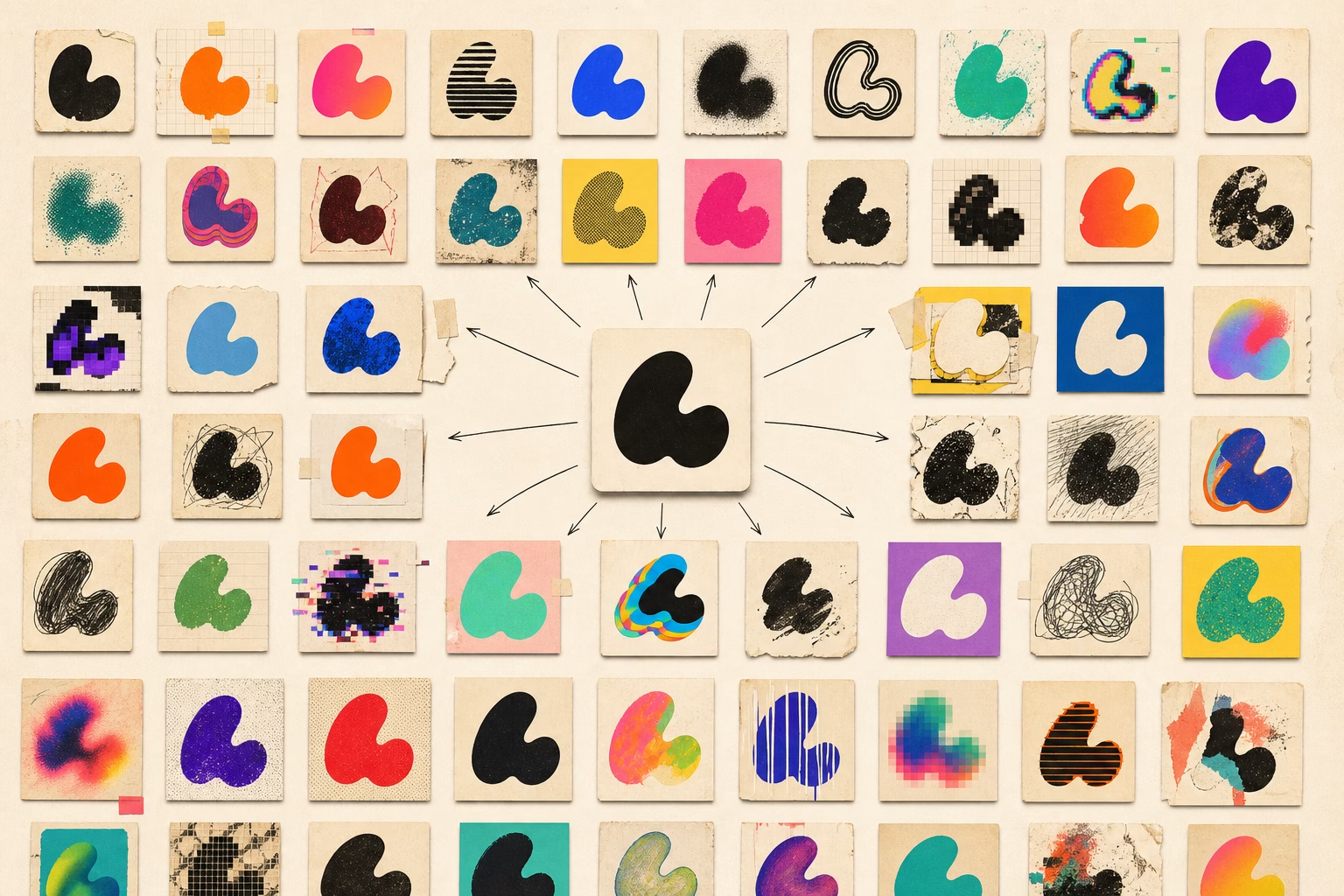
The term “meme” didn’t originate on the internet. British evolutionary biologist Richard Dawkins coined it in his 1976 book The Selfish Gene. Dawkins blended the Greek word “mimeme” (meaning “imitated”) with “gene” to describe units of cultural transmission—ideas, behaviors, or styles that spread from person to person within a culture.
In Dawkins’ framework, memes function as cultural equivalents to biological genes. They replicate, mutate, and compete for survival. A catchy tune, a fashion trend, a religious belief—all are memes in this original scientific sense.
This biological metaphor matters because it explains why certain ideas spread while others die out. Successful memes possess qualities that make them “sticky”—easy to remember, simple to replicate, compelling to share. Sound familiar? That’s exactly how internet memes work.
The Internet’s Transformation of Memetic Culture
Memes existed long before the internet. Fashion trends, advertising slogans, and urban legends all functioned as pre-digital memes. But the internet fundamentally accelerated and transformed memetic culture.
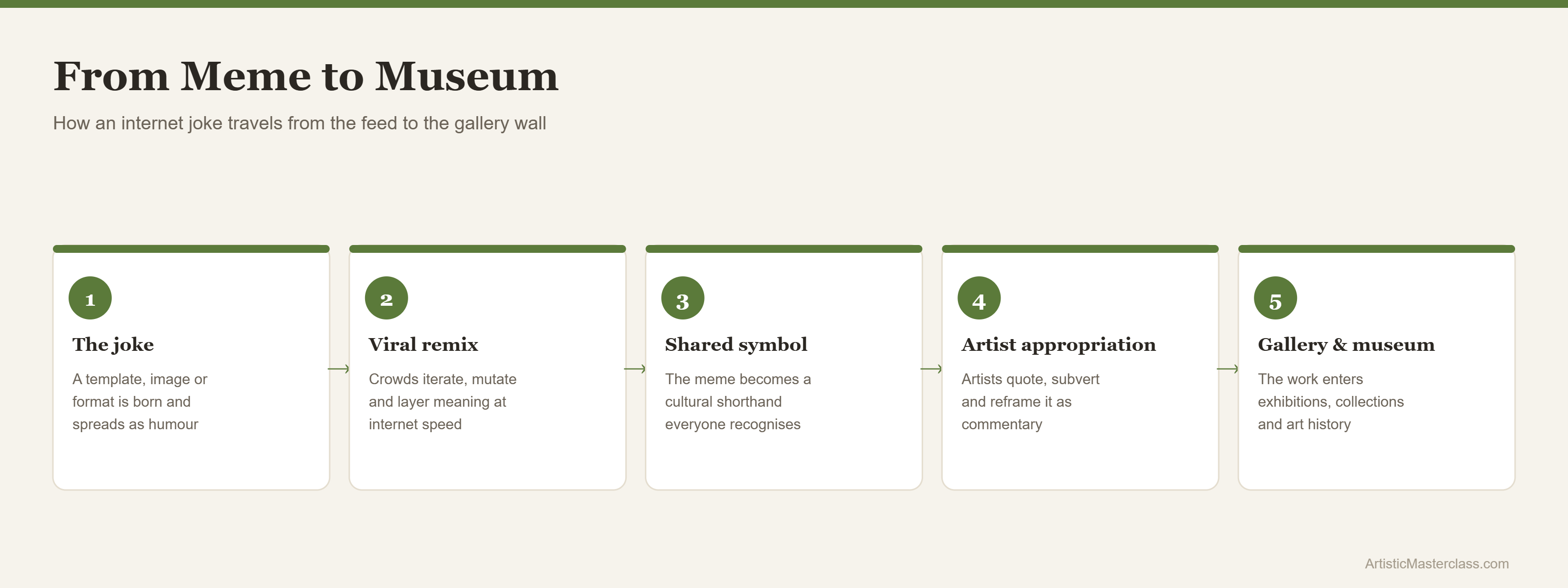
Digital platforms compressed the replication cycle from months or years to hours. A meme could be created in the morning, iterate through hundreds of variations by afternoon, and either go viral or vanish by evening. This speed created something unprecedented: a real-time laboratory for cultural evolution.
Image macros—pictures with text overlay—became the dominant format. Simple templates like “Distracted Boyfriend,” “Drake Approving/Disapproving,” or “Woman Yelling at Cat” provided frameworks that anyone could adapt. The template approach enabled infinite iteration without requiring artistic skill.
Platforms like 4chan, Reddit, Instagram, and TikTok each developed distinct meme cultures. 4chan favored dark, subversive humor. Instagram leaned toward relatable, wholesome content. TikTok introduced movement and sound. Each platform shaped how memes looked, what they said, and who created them.
Why Memes Became Ubiquitous Visual Language
Memes succeeded because they solve a fundamental communication challenge: how to convey complex emotions, cultural commentary, or social observations instantly.
Consider how much information a simple meme communicates. A classical painting paired with the caption “me romanticizing my life while ignoring 47 unread emails and my decaying mental health” accomplishes several things simultaneously:
- References high art (the painting)
- Expresses contemporary anxiety
- Uses self-deprecating humor
- Signals shared experience with others who relate
- Does all this in under 100 characters
This compression of meaning makes memes remarkably efficient. In an attention economy where you have seconds to make an impact, memes cut through noise. They speak in cultural shorthand that feels immediate and authentic.
The democratic nature of meme creation also matters. You don’t need formal training or expensive equipment. A smartphone and free app suffice. This accessibility exploded the number of people creating and sharing visual culture, fundamentally shifting who gets to participate in cultural production.
Key Insight: Memes were always about cultural transmission and replication. The internet didn’t invent this—it just made the process visible, accelerated it dramatically, and gave it a visual vocabulary that billions now speak fluently.
The Art Historical DNA of Memes
Memes didn’t emerge from nowhere. They inherit techniques, philosophies, and rebellious energy from established art movements. Understanding this lineage helps explain why meme culture’s acceptance isn’t as radical as it seems—it’s following a well-worn path.
Dada and the Readymade: Duchamp’s Legacy
In 1917, Marcel Duchamp submitted a urinal to an art exhibition. He titled it Fountain, signed it “R. Mutt,” and challenged every assumption about what qualified as art.
Duchamp’s readymades—ordinary objects declared as art through selection and presentation—asked a revolutionary question: Does art require traditional craftsmanship, or can the idea itself be the art?
His 1919 work L.H.O.O.Q. took this further. Duchamp drew a mustache and goatee on a reproduction of the Mona Lisa. The defacement was the artwork. By appropriating and altering an iconic image, Duchamp created something that looks remarkably like a modern meme.
Consider how meme creators work today. They take existing images—often famous ones—and alter them with text, filters, or digital manipulation. The Mona Lisa herself appears in countless memes, usually with captions about her enigmatic expression or theories about what she’s really thinking.
Duchamp established that appropriation, alteration, and conceptual framing could constitute legitimate artistic practice. Meme artists are his digital descendants.
Pop Art’s Embrace of Mass Media and Popular Culture
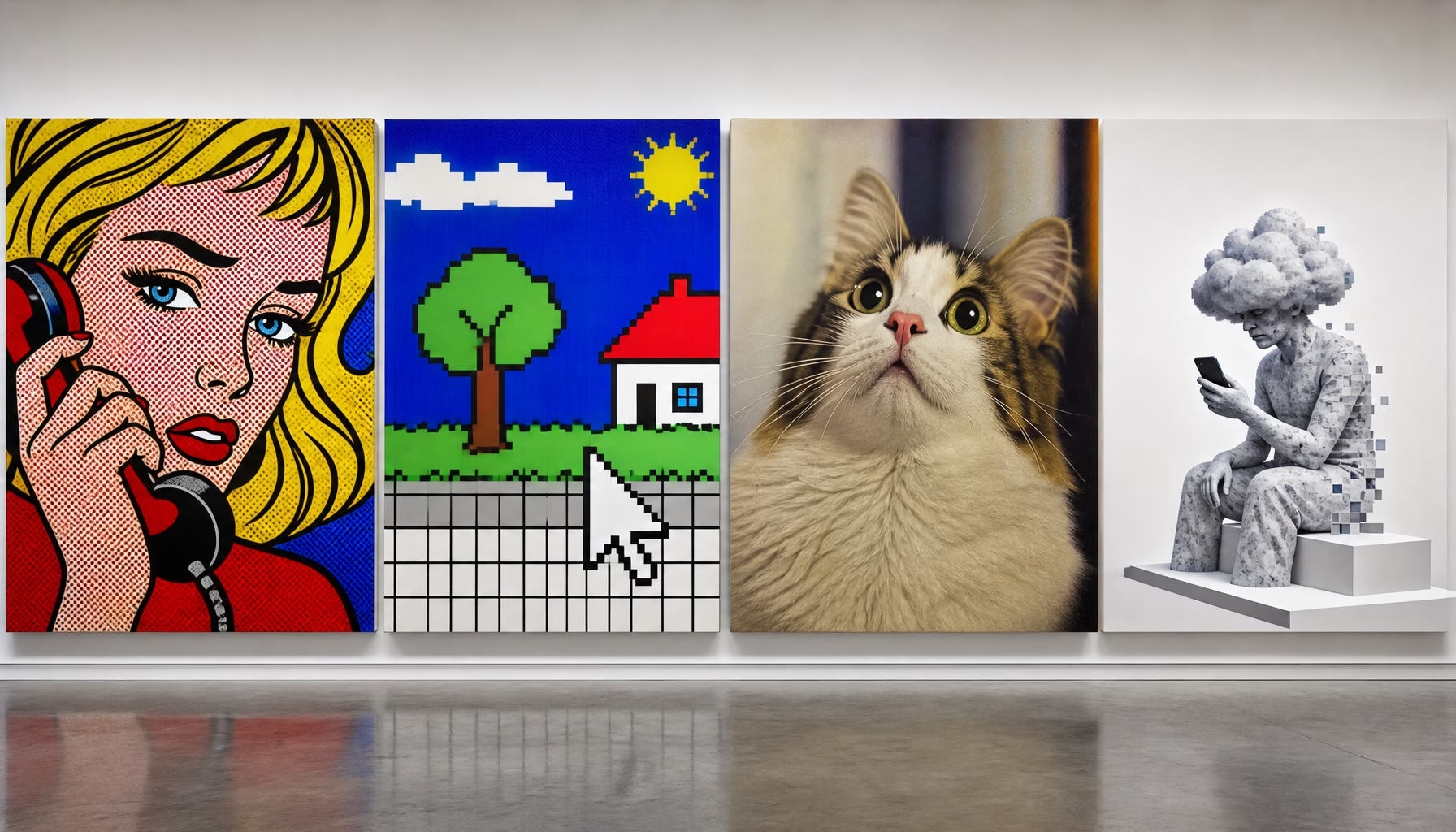
Andy Warhol’s Marilyn Diptych (1962) is essentially a proto-meme. He took a publicity photograph of Marilyn Monroe, silk-screened it repeatedly in different colors, and created art through mechanical reproduction and repetition.
Warhol understood something that meme culture would later prove: in the age of mass media, the most culturally relevant images are those that circulate widely. His Campbell’s Soup Cans weren’t about the cans themselves—they were about recognizability, commercial imagery, and how repetition creates meaning.
Roy Lichtenstein painted enlarged comic book panels, complete with Ben-Day dots and speech bubbles. He took “low” culture (comics) and presented it as “high” art, deliberately blurring the distinction. His works frequently included exaggerated emotion and melodrama—exactly what makes certain memes effective.
The Pop Art movement legitimized several practices central to meme culture:
- Using imagery from mass media and popular culture
- Embracing mechanical reproduction over handcrafted uniqueness
- Finding artistic material in commercial or “lowbrow” sources
- Making cultural commentary through appropriation
- Prioritizing accessibility over exclusivity
When critics dismiss memes as too commercial or too popular to be serious art, they’re repeating the exact arguments used against Warhol and Lichtenstein. Those artists won that battle. Memes are fighting it again.
Conceptual Art and the Dematerialization of the Art Object
In the 1960s, Conceptual artists like Sol LeWitt and Joseph Kosuth argued that the idea behind an artwork mattered more than its physical form. LeWitt created wall drawings from instructions—anyone following the instructions could produce the work. The concept was the art.
This “dematerialization” of art objects has profound implications for memes. A meme doesn’t have an “original” in the traditional sense. The first iteration isn’t more valuable than the thousandth. The meme exists as a concept that manifests through countless reproductions and variations.
Consider the “Distracted Boyfriend” meme template. The original stock photo has value, but that’s not where the meme’s artistic or cultural significance lives. It lives in the collective variations—the thousands of ways people adapted the template to comment on everything from politics to programming languages.
Conceptual art established that reproducibility doesn’t diminish artistic value. In fact, for memes, reproducibility is the value. A meme that doesn’t spread isn’t fulfilling its function.
Performance Art and Ephemeral Participation
Performance art of the 1960s and 1970s brought art into the street, broke down barriers between artist and audience, and accepted ephemerality. Not everything needed to be preserved for posterity. The experience, the moment, the participation mattered more than creating lasting objects.
Memes function similarly. They’re performative in nature—their value lies in circulation, iteration, and collective participation. Anyone can remix them. Most memes have short lifespans, going viral and fading within days or weeks. This doesn’t diminish their impact; it defines their nature.
Like performance art, memes have low stakes. If one fails to connect, so what? Make another. This removes the preciousness that often paralyzes artistic creation. The ephemeral, low-investment nature of memes encourages experimentation and risk-taking.
The collaborative, hackable quality of performance art appears in meme culture too. A meme template is essentially an invitation for others to perform variations. The original creator often becomes anonymous while the template takes on collective ownership.
The Postmodern Toolkit: Irony, Pastiche, and Intertextuality
If you had to summarize postmodernism in one sentence: it’s art that’s self-aware about being art, playfully skeptical of grand narratives, and comfortable mixing high and low culture.
Memes are quintessentially postmodern. They employ:
Irony: The gap between literal meaning and intended meaning. A meme showing a burning building with the caption “This is fine” communicates through ironic contrast.
Pastiche: Mixing elements from different sources. Memes freely combine Renaissance paintings, movie screenshots, news photos, and TV stills in single compositions.
Intertextuality: Deliberate references to other texts or cultural artifacts. Memes often reference other memes, creating layers of meaning accessible only to those versed in meme culture.
Meta-commentary: Memes about memes, or memes about the process of making memes. This self-referential quality is deeply postmodern.
Barbara Kruger’s bold text-over-image works from the 1980s look remarkably like meme formats. Her pieces combined appropriated photographs with provocative text in Futura Bold font, making political statements about power, gender, and consumerism. Replace her messages with internet humor, and you essentially have contemporary memes.
Sherrie Levine photographed photographs by famous photographers and presented them as her own work, questioning originality and authorship. Memes take this even further—they’re built on appropriation and remix culture, often with completely anonymous authorship.
What This Means: When scholars like Darren Wershler (Concordia University research chair) call memes “everyday Conceptualism” and trace their lineage to Man Ray, Walker Evans, and Andy Warhol, they’re not stretching. Meme culture inherited a century of artistic disruption. The tools changed from paint and photography to Photoshop and smartphones, but the underlying artistic strategies remained consistent.
The Democratization Argument: Art for Everyone
The most revolutionary aspect of meme culture isn’t aesthetic—it’s structural. Memes fundamentally challenge who gets to create, distribute, and validate art.
Low-Brow Materials, High-Impact Meaning
Traditional art required significant investment. Want to paint? You need canvases, quality paints, brushes, studio space, and years of training to develop technique. Want to sculpt? Add power tools, materials, and even more space. Photography requires cameras, lenses, darkroom equipment (historically), or expensive editing software.
Creating a meme requires:
- A smartphone (which you already own)
- A free meme generator app or basic photo editing tool
- An idea
- About three minutes
This accessibility transforms who can participate in visual culture creation. A teenager in their bedroom can create something that reaches millions, bypassing every traditional gatekeeper—galleries, critics, curators, auction houses.
Compare the barriers:
| Aspect | Traditional Art | Meme Art |
|---|---|---|
| Initial Investment | $500-$10,000+ for materials | $0 (free apps) |
| Training Required | 4+ years formal education typical | None required |
| Distribution Channels | Gallery representation, exhibitions | Social media (instant, free) |
| Validation Required | Institutional approval, critic reviews | Audience response (likes, shares) |
| Time to Reach Audience | Months to years | Minutes to hours |
This isn’t to diminish the skill involved in traditional art or quality meme creation. But the floor for participation is radically lower. You don’t need permission to begin.
Collective Authorship and Anonymous Creation
Walk into any museum and you’ll see names on every wall label. Artist. Date. Medium. Provenance. Attribution matters in traditional art. Signatures authenticate. Authorship determines value.
Meme culture operates differently. Many of the most successful memes have no identifiable creator. Pepe the Frog originated from Matt Furie’s web comic, but the character evolved through countless anonymous iterations into something Furie never intended and couldn’t control.
The “Distracted Boyfriend” stock photo was taken by photographer Antonio Guillem, but the meme template became public domain in the cultural sense. No one asks permission to use it. No one credits Guillem when sharing variations. The template belongs to everyone.
This collective ownership mirrors folk art traditions more than fine art. Like quilts, crafts, or oral storytelling, memes often emerge from communities rather than individual genius. The distinction between creator and audience blurs. Viewers become creators by sharing, modifying, and spreading variations.
Intentional anonymity serves strategic purposes too. Without personal brand or signature, the meme itself becomes the focus. Ideas compete on merit rather than reputation. This levels playing fields historically dominated by those with institutional access or social capital.
Street Art Parallels: From Vandalism to Galleries
Memes aren’t the first art form to face legitimacy questions while challenging institutional authority. Street art and graffiti traveled this path before.
In the 1970s and 1980s, graffiti was vandalism—period. Artists risked arrest. Cities spent millions removing it. The art establishment dismissed it as destruction of property with no aesthetic value.
Then Jean-Michel Basquiat moved from tagging buildings to showing in galleries. Keith Haring brought street art aesthetics to museums. Banksy became internationally famous while remaining anonymous. Shepard Fairey’s street art campaign became Obama’s iconic “Hope” poster.
By the 2010s, Banksy’s works commanded millions at auction. Major museums collected street art. Cities commissioned murals. What changed wasn’t the art—it was cultural acceptance.
Street art’s legitimization followed a pattern:
- Dismissed as vandalism/worthless (1970s-1980s)
- Countercultural recognition (1980s-1990s)
- Gallery experimentation (1990s-2000s)
- Museum acceptance (2000s-2010s)
- Market validation (2010s-present)
Meme art is following the exact same trajectory, just faster:
- Dismissed as jokes/worthless (1990s-2010s)
- Countercultural recognition (2010s)
- Gallery experimentation (2016-2018)
- Museum acceptance (2018-present)
- Market validation (2020-2021 NFT boom)
The parallel isn’t coincidental. Both street art and memes use guerrilla delivery methods—walls for graffiti, internet for memes. Both bypass traditional gatekeepers. Both face authenticity questions. Both democratize who can create.
When Banksy’s Girl with Balloon self-destructed immediately after selling for $1.4 million at Sotheby’s in 2018, it became the ultimate meme moment—a commentary on art world absurdity that spread instantly across the internet. The boundary between street art and meme culture had dissolved.
The “Democratized Surface” and Political Urgency
Amsterdam-based design collective The Rodina articulated the concept of “democratized surface” in their publication Action to Surface. They argue that in the digital age, visual culture becomes an interactive mirror reflecting society back to itself.
Memes resist norm-culture the same way performance art disrupted Modernism. Through humor and viral distribution, memes incite collective reactions to everyday life while revealing structural problems, paradoxes, and hypocrisies.
The political urgency of accessible visual culture became clear in movements worldwide. In 2017, The Rodina created an “anti-campaign” against far-right Dutch politician Geert Wilders using meme-style graphics that mimicked his party’s visual language. The satirical campaign spread rapidly on social media, contributing to his party’s defeat in the general election.
From Hong Kong’s protest memes to climate activism to Black Lives Matter, visual culture produced by ordinary citizens often proves more effective at spreading messages than professional marketing or traditional media. Memes compress political commentary into shareable formats that cross language barriers and algorithmic feeds.
This isn’t just democratization—it’s a fundamental power shift. When anyone with a smartphone can create visual culture that reaches millions, the monopoly on cultural production breaks down. The art world’s historical role as arbiter of visual culture faces an existential challenge.
Key Insight: Meme culture doesn’t just make art more accessible—it questions whether traditional gatekeeping was ever necessary. If the point of art is cultural expression and communication, memes accomplish both more efficiently than systems requiring gallery representation, critical validation, and institutional approval.
Memes Enter the Gallery: Institutional Legitimization
The journey from internet joke to museum collection required institutional courage. Galleries and museums had to risk their reputations by taking memes seriously. Here’s how it happened.
Early Exhibitions (2016-2018): Testing the Waters
“What Do You Meme?” — London, August 2016
Curator Maisie Post took a risk. She organized the first major exhibition treating memes as art at Copeland Park, a creative hub in South London. The show featured all female artists, mixing Instagram meme creators with traditional practitioners.
Post explained her vision: “It illustrates the transition from a simple ‘internet meme’ to ideas that have transferred from URL into IRL.” She drew parallels between memes and folk art, noting both circulated quickly, slipped out of spotlight rapidly, and shared low-brow production materials with collective ownership.
Two featured artists, Pantyhoe$ and Meme Gold, particularly interested Post: “Neither of them identified as artists—there was no role for the artist to follow and no regulations.” This freedom from traditional artist identity echoed subversive figures like Marcel Duchamp and Jenny Holzer.
The exhibition suggested memes deserved gallery space not despite their internet origins, but because of their cultural impact. By bringing memes offline, Post validated them through the art world’s traditional mechanism—the curated exhibition.
“By Any Memes Necessary” — Los Angeles, February 2017
Ka5sh, the curator behind this Junior High Gallery show, made no apologies. Speaking to Bust magazine, they declared: “These are art pieces and I want people to take what we are doing a little bit more seriously.”
Ka5sh connected memes to the neo-Dada movement: “I remember my friend was saying memes are a part of the neo-Dada movement. And I didn’t know what that meant, but it sounded tight, so I googled it and I feel the same way, like this is the next wave of art. Memes have existed since the beginning of time, says the definition of memes and meme theory, so it’s only fitting for these to be put into galleries. I’m Andy Warhol rn with the mf pop art content memes.”
The Warhol comparison proved apt. Like Pop Art in the 1960s, memes drew from mass culture, embraced mechanical reproduction, and challenged high-art snobbery. Ka5sh understood they were fighting the same battle Warhol fought—and winning it faster.
“Two Decades of Memes” — Museum of Moving Image, Queens, 2018
This marked a crucial shift. The Museum of Moving Image, a respected institution in New York, devoted exhibition space to internet memes.
Brad Kim, curator and editor-in-chief of Know Your Meme, designed the show to elevate memes beyond jokes: “I want to bring [memes] to a level beyond [a joke,] and [show] how they interact with the social affairs in the world.”
Museum Executive Director Carl Goodman articulated the institutional mission: “We’re helping people look at them in a more serious way and document what is significant, influential, or inspirational as we’re living through it.”
That last phrase matters: “as we’re living through it.” Museums typically wait decades or centuries before collecting. By exhibiting contemporary memes, the Museum of Moving Image acknowledged their immediate cultural significance, worthy of preservation and scholarly attention.
Museum Collections and Archives
Exhibitions are temporary. Collections are permanent. When major museums began acquiring digital meme art for their permanent holdings, legitimization deepened.
MoMA (Museum of Modern Art) in New York expanded its digital art collection to include internet artifacts. The British Museum of Design created specific archives for internet culture, recognizing that future historians would need access to these materials to understand early 21st-century visual culture.
Museums faced practical challenges. How do you preserve digital files that depend on specific platforms? What do you collect—the original file, screenshots showing context, documentation of spread and variations? How do you attribute works with anonymous creators?
These curatorial questions themselves validated memes. Museums only wrestle with preservation problems for objects they consider culturally significant. The difficulty of collecting memes didn’t disqualify them—it proved they mattered.
Recent Exhibitions (2020-2025): Mainstream Acceptance
Beeple’s Museum Debut — Castello di Rivoli, Italy, April 2022
When Beeple’s Human One sculpture appeared at Castello di Rivoli Museum of Contemporary Art, it represented his first major museum exhibition. The 7-foot-high work combined physical sculpture with digital NFT components—a generative artwork that changed constantly.
Beeple described it as “the first portrait of a human born in the metaverse.” The museum’s willingness to exhibit this hybrid physical-digital meme-influenced work demonstrated how far institutional acceptance had come. This wasn’t a small experimental space—it was a prestigious Italian contemporary art museum.
“Memememememe” — Media Majlis Museum, Northwestern University, Qatar, 2025
This ambitious exhibition represents the current state of institutional meme art acceptance. Curated by Jack Thomas Taylor and Amal Zeyad Ali, the show examined memes through four conceptual measures: Mass, Length, Time, and Volume.
The exhibition design told its own story. Shepherd Studio transformed the museum space into a laundromat metaphor—representing the endless cycle of meme circulation, the constant churn of digital washing and rewashing cultural content.
Seven artists created new commissioned works specifically for the show: Alia Leonardi, Anne Horel, Cem A., Eman Makki, Mauro C. Martinez, Orkhan Mammadov, and Seo Hyojung. Their pieces offered critical reflections on digital memory, collective identity, and online dissent.
Curator Taylor explained the significance: “This exhibition examines memes not as mere entertainment, but as inheritors of traditional visual communication tactics that serve as both mass media and cultural critique. The provocative imagery and symbolic gestures that have always captured attention continue to do so, only now through the Internet—proving that visual communication strategies remain consistent even as mediums evolve.”
Director Alfredo Cramerotti added: “Through design, scenography, and newly commissioned works, Memememememe invites us to reflect on the true cultural weight and influence of memes—those seemingly trivial fragments that profoundly shape how we perceive and navigate our world.”
Cem A at the Barbican Centre — London, 2022
Perhaps most innovative was Cem A’s exhibition “Hope You See Me as a Friend” at London’s Barbican Centre. Rather than traditional gallery space, Cem A displayed memes on the venue’s information screens throughout the building—the digital displays normally showing event schedules and wayfinding.
This unconventional approach challenged visitors’ expectations. Was this art or information? Protest or exhibition? The ambiguity was intentional. Cem A explained: “If the crack is successful at ‘fooling’ people, it also puts them in an odd position. They might ask: Is this supposed to be an artwork? Was there a protest in the building? Should they tell a member of staff?”
The exhibition referenced an incident at San Francisco’s Museum of Modern Art where visitors mistook a pineapple and glasses left on the floor for an installation, photographing it as art. Cem A: “Visitors are conditioned to accept anything placed in a gallery as artwork, even if they doubt its validity… This is a problematic element of Western exhibition making.”
By placing memes in liminal institutional space, Cem A forced confrontation with questions about art validation, institutional authority, and what contexts make something “art.”
The Role of Art Fairs and Biennales
Major art fairs like Art Basel, Frieze, and FIAC began featuring digital artists whose work engaged with meme culture. Galleries representing these artists could command serious prices, signaling collector interest beyond speculative NFT mania.
While memes haven’t yet dominated Venice Biennale programming, digital art with meme aesthetics increasingly appears. The boundary between “serious” digital art and meme-influenced work continues blurring.
Commercial galleries now represent artists explicitly working with meme formats or meme-adjacent aesthetics. This matters economically—gallery representation means sustained market support, not just viral moment fame.
What This Means: The progression from small London gallery (2016) to major museum commissions (2025) took less than a decade. Compare this to photography’s journey (50+ years from invention to museum acceptance) or even street art (30+ years). Meme culture achieved institutional legitimization at unprecedented speed, suggesting digital natives in curatorial positions are more receptive to internet-originated art forms.
The Artists: Creators Reshaping the Landscape
Behind the theoretical discussions and institutional debates are actual people creating remarkable work. These artists prove that meme art requires vision, skill, and conceptual depth.
Beeple (Mike Winkelmann): The NFT Phenomenon
Born in 1981 in Wisconsin, Mike Winkelmann never imagined becoming the world’s most expensive living digital artist. He started as a graphic designer, developing skills in various digital media through the early 2000s.
On May 1, 2007, Winkelmann began a project that would define his career: Everydays. He committed to creating and posting one piece of digital art every single day. No exceptions. He made art on his wedding day. He made art when his children were born. For over 5,000 consecutive days.
Winkelmann explained the discipline: “I thought it was a beneficial way to sharpen my drawing skills.” Inspired by artist Tom Judd, who drew daily for a year, Winkelmann extended the practice indefinitely. Each year focused on different skills—Adobe Illustrator in 2012, Cinema 4D in 2015.
His artistic style blends dystopian themes with political satire and pop culture references. Works often depict recognizable figures—politicians, celebrities, tech moguls—in surreal, unsettling scenarios. The imagery is simultaneously comical and disturbing, phantasmagoric and culturally astute.
In 2019, luxury fashion house Louis Vuitton collaborated with Beeple on their Spring/Summer collection, integrating his digital works into fabric patterns. This marked one of the first times a major luxury brand worked with a digital artist primarily known for internet-style work.
Then came October 2020. Beeple discovered NFTs. Initially skeptical—”I thought it was just weird crypto sh*t, not my thing”—he soon recognized the technology’s potential to solve digital art’s economic problem.
His early NFT “Crossroad” sold for $66,666, one of the highest prices paid for digital art at the time. Four months later, it resold for $6.6 million.
But the real breakthrough came March 11, 2021. Christie’s auctioned Everydays: The First 5000 Days, a collage of every image from Winkelmann’s daily practice. The final price: $69,346,250. Paid in cryptocurrency (Ether). For a purely digital file.
The sale shattered assumptions. Digital art could command prices rivaling Monet, Picasso, or any traditional master. Major auction houses would sell NFTs. Collectors would pay tens of millions for files they couldn’t hang on walls.
In November 2021, Christie’s sold Beeple’s Human One for $28,958,000. This hybrid sculpture combined physical screens with NFT components, creating a generative work that changed over time. Beeple retained ability to update the artwork remotely—an entirely new relationship between artist and collector.
In March 2023, Beeple opened Beeple Studios in Charleston, South Carolina—a 50,000-square-foot creative space housing offices, labs, and exhibition areas. The studio hosts events for the digital art and Web3 communities. PepeFest 2024 celebrated internet meme culture with live art creation, performances, and community gatherings. His 2024 election night watch party featured live Everydays creation, DJ sets, and attendee competitions.
Beeple’s success forced conversations the art world had avoided. If digital files could sell for $69 million, what did “original” mean? If artists could update artworks after sale, who owned what? If cryptocurrency financed sales, how did traditional art markets adapt?
Critics questioned whether prices reflected artistic merit or speculative mania. Beeple himself acknowledged NFT prices were “absolutely” a bubble, comparing it to the early internet. Yet he defended the artistic value independent of pricing: “When people have an experience that connects with them emotionally, like any other type of medium, any other type of art, then it will click with them.”
Classical Art Meme Creators
Stefano Guerrera built a massive following with his Instagram account “Se i quadri potessero parlare” (If the Paintings Could Talk). The Italian creator adds contemporary captions to classical artworks, making Renaissance paintings comment on modern anxieties.
His approach is deceptively simple: “Art speaks to our everyday life, so if you keep an eye on it you can come up with a funny meme.” But the execution requires deep knowledge of art history, sharp cultural observation, and timing.
What sets Guerrera apart is institutional validation. La Venaria Reale, a major Italian museum, invited him for an official residency. The museum provided historical context about paintings in their collection, and Guerrera created memes specifically for the institution.
Museum representatives explained why: “Memes are a simple and informal language, and can be a useful tool to communicate reality. Using complex and historical paintings is a way to make that more accessible.”
The partnership demonstrated museums recognizing memes’ educational value. Guerrera reports that 80% of his audience is 18-25 years old—an age group museums struggle to attract. His account has exposed hundreds of thousands to artworks they might never have engaged with otherwise.
Meme Painters: Translating Digital to Physical
Alim Smith (@yesterdaynite) does something remarkable: he takes viral memes and paints them in an Afro-surrealist fine art style.
The “Crying Jordan” meme—Michael Jordan’s tearful face photoshopped onto everything—becomes a haunting portrait in Smith’s interpretation. “Confused Nick Young” transforms from gif to carefully rendered surrealist painting. Keisha Johnson, the “Confused Face Girl,” appears against a beautiful sunset in Smith’s acrylic work.
Smith explained his motivation to TIME magazine: “I was inspired by the ways that visual culture and social media connect millions every day. Memes, by themselves, represent a powerful form of art. Powerful, because they are a connector for millions who use the internet each and every day. [It’s] a visual representation of contemporary culture, and specifically Black culture, as it exists in social media.”
By translating ephemeral digital content into permanent physical paintings, Smith makes an argument about value and preservation. These moments of internet culture matter enough to deserve traditional artistic treatment.
Christine Wang doom-scrolls Instagram every morning, looking for memes. The pandemic intensified her practice. She sees memes as “a form of documenting history, sharing experiences, and stepping into a specific viewpoint.”
Her acrylic paintings capture specific pandemic moments—like crying Kim Kardashian in front of a vanity with the text “I miss working.” Wang argues: “Memes are a growing form of reality… our worlds become increasingly less physical and more digital… now more than ever.”
Travis Chapman combines humor and reality in satirical meme paintings. His work treats memes seriously while acknowledging their comic origins—a difficult balance that prevents work from becoming either too precious or too joke-y.
These painters raise fascinating questions. When an ephemeral meme becomes a permanent painting, what changes? Does the joke survive translation to canvas? Does physical form add gravitas or remove playfulness? Can you sell a meme painting without the creator of the original meme image?
Meme Account Critics: Art from Within
Cem A started @freeze_magazine in 2019 during a period of disillusionment with the London art world. The account creates memes critiquing art world practices—from unpaid internships to exclusionary gallery openings to problematic curator behavior.
Freeze’s reach rivals major art institutions: hundreds of thousands of people per month. The account has been discussed in university lectures and covered by The New York Times, The Art Newspaper, and Frieze magazine.
What makes Freeze significant is its dual function. It creates art while critiquing the art world. It builds audiences comparable to museums while operating entirely outside institutional structures. It comments on power dynamics while gaining its own influence.
Cem A explained: “Memes blur the lines between art making and art criticism, which makes them interesting for the art world.” The account evolved from inside jokes to serious institutional critique, addressing topics like sexual misconduct and decolonization.
Memes work as criticism because “humour makes criticism less confrontational and more constructive.” You can say things through satire that would seem harsh in traditional critical writing.
@jerrygogosian takes a more irreverent approach. The account name mashes Jerry Saltz (art critic) with Larry Gagosian (blue-chip dealer)—immediately signaling it targets art world power players.
Recent posts aligned Lindsay Lohan mugshots with “art world crimes” from KAWS’s commercial success to art flipping to Chelsea gallery opening culture. The satire is sharp, the targets specific, the commentary pointed.
The White Pube writes ruthless criticism of gatekeeping, labor abuse, classism, and elitism in the art world. Their Instagram memes distill complex critiques into shareable formats. One notable post called out Western galleries’ performative BLM support while maintaining predominantly white programming.
These accounts demonstrate memes functioning as legitimate critical practice. They reach audiences traditional art criticism never could, influence discourse in real ways, and hold institutions accountable through public pressure.
Joan Cornellà and the Meme Aesthetic
Spanish artist Joan Cornellà creates deeply disturbing cartoons in bright, cheerful colors. Smiling characters engage in horrific acts. The contrast between cutesy aesthetic and dark content creates immediate meme potential.
Cornellà’s work appears in galleries and art fairs worldwide. He’s exhibited in Barcelona, Los Angeles, Seoul, and beyond. His images circulate virally on social media, often without attribution—classic meme behavior.
What’s interesting about Cornellà is that he intentionally creates in a “meme aesthetic.” The works are designed for social sharing, formatted for smartphone screens, and built around concepts that translate across languages. He’s an artist who embraced meme culture’s distribution mechanisms while maintaining gallery presence.
His commercial success—books, merchandise, exhibitions—proves meme aesthetics can sustain professional artistic careers without requiring traditional art market validation.
What This Means: These artists represent different approaches to meme culture in art. Beeple works primarily digitally, selling through NFTs. Classical meme creators like Guerrera collaborate with institutions. Meme painters like Smith translate digital to physical. Critic accounts like Freeze blur art-making with commentary. Cornellà builds gallery careers with meme-ready work. No single path dominates. The field remains open, experimental, and rapidly evolving.
The NFT Revolution: Economic Legitimization
Nothing validated meme and digital art faster than blockchain technology. NFTs solved a problem that had plagued digital artists for decades: how to create scarcity and prove ownership for infinitely reproducible files.
The Problem NFTs Solved for Digital Art
Before NFTs, digital art faced a fundamental economic challenge. When files can be copied infinitely with no loss of quality, what makes one copy more valuable than another? How do you create “originals” for art that exists as data?
Physical paintings have originals. Even photographs and prints have editions. But a JPEG is a JPEG. The file you download is identical to the file on the creator’s computer. This perfect reproduction destroyed traditional scarcity-based art market economics.
Collectors didn’t buy digital art because they couldn’t own it meaningfully. Sure, you could commission a piece, but nothing prevented the artist from selling identical copies to others. Museums couldn’t collect digital art effectively for similar reasons.
Blockchain technology offered a solution: non-fungible tokens. An NFT is a unique identifier on a blockchain (typically Ethereum) that points to a specific digital file. The token itself is one-of-a-kind, even if the underlying file can be copied.
Think of it like this: Anyone can print a Mona Lisa poster, but only one institution owns the actual painting. NFTs created that same dynamic for digital files. Anyone can screenshot a Beeple artwork, but only one person owns the NFT—the certified, provable “original.”
Additionally, NFTs enabled automatic royalties. Smart contracts could ensure artists received a percentage of every resale, solving another longstanding problem where artists profited only from initial sales while collectors made fortunes reselling.
Christie’s and the Auction House Breakthrough
March 11, 2021 changed everything. Christie’s, the 255-year-old auction house, sold Beeple’s Everydays: The First 5000 Days for $69,346,250.
This wasn’t just expensive—it was the third-highest price ever paid for work by a living artist. Only Jeff Koons and David Hockney had achieved higher prices. Beeple joined Monet, Picasso, and Warhol in the record books.
The sale made headlines worldwide, far beyond art world publications. Mainstream media covered it as a watershed moment. The New York Times, The Wall Street Journal, CNN—everyone asked: What just happened?
Several factors made this sale historically significant:
First purely digital NFT at major auction house. Christie’s had sold NFT art before (Block 21 in October 2020 for $130,000), but that included a physical painting. This was purely digital.
Payment in cryptocurrency. The buyer could pay in Ether, not just traditional currency. This validated cryptocurrency as legitimate payment for high-value art.
New collector demographic. The buyer, known as Metakovan, came from crypto wealth, not traditional art collecting. This brought new money and new perspective to art markets.
Institutional validation. When Christie’s stakes its reputation on something, the art world pays attention. This wasn’t some experimental digital gallery—this was one of the most prestigious auction houses on earth.
The sale forced conversations. Could digital files really be worth tens of millions? Was this art or speculation? Did price equal quality? Were traditional gatekeepers losing control?
Critical responses revealed art world anxiety. Some celebrated democratization and recognition of digital art. Others questioned whether Beeple’s work merited such valuations. Many suspected bubble dynamics.
The 2020-2021 NFT Boom
Beeple’s sale didn’t happen in isolation. It crowned a market explosion that began in late 2020.
October 2020: Beeple sells “Crossroad” NFT for $66,666—at the time, an extraordinary price for digital art.
February 2021: “Crossroad” resells for $6.6 million—a 10,000% return in four months.
March 2021: The $69 million Christie’s sale.
Throughout this period, NFT platforms like OpenSea, Nifty Gateway, and Foundation saw explosive growth. Artists who’d struggled to monetize digital work suddenly sold pieces for thousands or millions.
Why did this happen in 2020-2021 specifically?
Pandemic factors: Lockdowns meant more time online. Physical art galleries closed. Digital spaces became primary cultural venues. People sought connection through online communities.
Cryptocurrency boom: Bitcoin and Ethereum reached all-time highs. Crypto-wealthy individuals sought ways to spend gains. NFTs provided that outlet.
Economic conditions: Near-zero interest rates made traditional savings unattractive. Stimulus payments gave people expendable income. Speculation seemed rational when standard investments offered minimal returns.
FOMO dynamics: Fear of missing out drove buying. Stories of overnight crypto millionaires created urgency. If someone made millions flipping JPEGs, why not you?
The market achieved astonishing numbers. In 2021, NFT sales totaled approximately $25 billion. OpenSea processed over $14 billion in trading volume. Celebrities from Paris Hilton to Snoop Dogg entered the market.
Projects like CryptoPunks (10,000 unique pixel art characters) and Bored Ape Yacht Club (10,000 unique ape illustrations) sold for hundreds of thousands each. These weren’t art in traditional senses—they were profile pictures, status symbols, club memberships. But they used digital art aesthetics and NFT technology.
Post-Boom Reality (2022-2025)
Markets correct. By mid-2022, the NFT bubble had deflated significantly. Trading volumes dropped 90%+ from peak. Projects that sold for six figures became worthless. The speculation had outpaced sustainable value.
However, the correction didn’t erase NFT art’s legitimacy. It separated serious art from speculative collectibles.
What survived:
Museum interest: Major institutions continued acquiring NFT art for permanent collections. The speculation crash didn’t change curatorial opinion about cultural significance.
Serious collectors: People who bought for artistic merit rather than quick flips remained engaged. Prices stabilized at more sustainable levels.
Artist careers: Digital artists who built reputations during the boom maintained them after. Beeple continues creating and exhibiting. Others found gallery representation.
Technical infrastructure: The technology for creating, selling, and displaying NFT art matured. Problems around environmental impact (proof-of-stake replacing proof-of-work) got addressed.
What didn’t survive:
Speculative projects: Most cash-grab NFT collections became worthless.
Hype pricing: Six-figure sales for mediocre work disappeared.
Mainstream attention: Media coverage dropped as stories became repetitive.
The current state (2025) looks more like a normal art market. Some NFT art sells well because it’s good art that happens to use blockchain technology. Most doesn’t, just like most traditional art doesn’t sell.
What NFTs Mean for Meme Culture
NFTs created complex dynamics for meme culture specifically.
On one hand, they enabled meme creators to monetize viral work. If your meme reached millions, you could potentially sell NFT versions to collectors who wanted to “own” a piece of internet history.
On the other hand, this seems antithetical to meme culture’s nature. Memes are about free sharing, collective ownership, and viral spread. Adding financial stakes and ownership claims feels like missing the point.
The Pepe the Frog situation illustrates this tension. Matt Furie created Pepe for his web comic. The character became a meme, then a hate symbol (co-opted by extremist groups), then an NFT phenomenon. Furie sold Pepe NFTs for significant sums while simultaneously fighting to reclaim the character from hate groups.
Does monetization corrupt memes’ democratic nature? Or do artists deserve compensation for creating culturally significant work?
There’s no consensus. Some argue NFTs destroyed meme culture’s soul by introducing profit motives. Others counter that artists shouldn’t work for free just because their medium is accessible.
Beeple articulated the art-versus-collectible debate: “There’s a lot of distinction between the different things people are doing in the NFT space, with some people looking towards a more baseball-type, collectible thing rather than the art side of things. Then there are people who are trying to make serious work that, in my opinion, is no different from any other artist working in any other medium.”
The distinction matters. CryptoPunks and Bored Apes are collectibles using digital art aesthetics. Beeple’s Everydays are artworks using NFT technology for authentication. Both can coexist, but they serve different purposes.
Environmental concerns also arose. Early NFT systems (proof-of-work Ethereum) consumed enormous energy. Each transaction burned electricity equivalent to days of household use. This made NFTs difficult to defend ethically.
The shift to proof-of-stake Ethereum (completed in 2022) reduced energy consumption by over 99%. This largely resolved environmental objections, though the issue remains for NFTs on less efficient blockchains.
What This Means: NFTs provided economic legitimization that decades of theoretical arguments couldn’t achieve. When Christie’s sells your work for $69 million, questions about artistic validity become harder to sustain. The technology created markets for digital and meme-influenced art, funding artists and attracting institutional attention. The speculative bubble was destructive, but the underlying infrastructure remains valuable for artists seeking sustainable careers in digital media.
Critical Perspectives: Resistance and Debate
Not everyone celebrates meme culture’s artistic ascent. Legitimate critiques deserve consideration, and ongoing debates remain unresolved.
The Gatekeeping Debate
Traditional curators and critics often express skepticism about meme art’s quality. Their concern isn’t entirely about elitism—it’s about standards.
Art critic Dean Kissick, writing in Spike magazine, articulated discomfort with what he called the “triumphant procession of popular things.” His argument: “As someone who grew up hating popular things, who turned to art as a child because I felt alienated by popular culture, my classmates, the country I was growing up in, society, and so forth, I can’t feel happy about that.”
For decades, contemporary art served as refuge from mainstream culture’s perceived iniquities. It provided space for counternormative values, politics, and identities. A place to cultivate taste outside commercial pressures and popular appeal.
If memes—the ultimate popular culture—become accepted as serious art, what happens to that refuge?
Kissick’s concern echoes historical debates. When photography emerged, painters dismissed it as mechanical reproduction lacking artistry. When Pop Art celebrated commercial imagery, abstract expressionists saw betrayal of artistic seriousness. When street art entered galleries, purists declared it sold out.
Each time, the art world eventually absorbed the new form. But each time, something was lost—a certain outsider status, a separation from mass culture.
Martin Herbert (ArtReview) framed the question thoughtfully: “The hard thing to determine is whether you’re trying to maintain some perceived standard, or if you’ve become traditionalist, or if, more simply, you’re a snob.”
That uncertainty is productive. Not all resistance to meme art comes from snobbery. Some comes from genuine concern about whether popularity equals quality, whether market success indicates artistic merit, whether gatekeepers serve useful filtering functions.
The counterargument: gatekeeping has historically excluded worthy art forms and marginalized artists. Photography, jazz, comics, street art—all faced institutional resistance before acceptance. Gatekeepers were wrong before. Why trust them now?
“But Is It GOOD Art?” — The Aesthetic Question
Set aside institutional acceptance and market prices. Look at the actual work. Is meme art aesthetically good?
This question requires acknowledging that not all memes are created equal. Most aren’t art at all—they’re jokes, social commentary, or visual communication. The question is whether the best meme art demonstrates qualities we associate with good art: skill, vision, originality, emotional impact, conceptual depth.
Consider Beeple’s work. His technical skills are undeniable—the rendering, composition, and visual effects require mastery of complex software. His conceptual consistency (daily creation for 5,000+ days) shows dedication rivaling any traditional practice. His cultural commentary engages seriously with contemporary issues.
But does the work have aesthetic staying power? Will Beeple’s satirical images of politicians and pop culture figures matter in fifty years? Or are they too tethered to specific moments?
Classical art history suggests work tied to specific contemporary events often dates poorly. Yet Daumier’s political cartoons retained significance. Warhol’s celebrity portraits transcended their subjects. It’s possible for topical work to achieve timeless quality.
Formal analysis of meme art often gets neglected. When we analyze traditional art, we discuss composition, color, line, form, technique. Meme art deserves the same scrutiny.
Effective memes employ sophisticated visual strategies:
Typography: Font choice, size, placement, contrast create hierarchy and tone.
Image selection: Which base image works depends on facial expressions, cultural recognition, composition.
Cultural layering: The best memes operate on multiple levels—surface humor, cultural reference, social commentary.
Timing: Memes depend on context. The same image with identical text succeeds or fails based on when it’s posted.
This isn’t accidental. Creating truly viral, culturally resonant memes requires skills—not traditional painting or sculpture skills, but legitimate creative abilities.
The comparison to photography is instructive. Early photography critics said: “Anyone can push a button. Where’s the skill?” A century later, we recognize photography as legitimate art requiring vision, technical mastery, and creative judgment. The same will likely prove true for meme creation.
Commercialization and Artistic Integrity
Does monetization corrupt meme culture’s democratic nature?
Traditional meme culture operated on gift economy principles. Creators made memes for internet points—likes, shares, recognition—not money. The joy was in participation, contribution to collective culture, making people laugh.
When memes become commodified—sold as NFTs, featured in paid exhibitions, used in commercial campaigns—something fundamental changes.
Banksy faced this exact critique. He made street art critiquing capitalism and consumerism, then sold pieces for millions. Critics called this hypocrisy. Defenders argued artists deserve compensation and market success doesn’t invalidate critique.
The same tension applies to meme art. If memes succeed by being freely shareable, does charging for “ownership” contradict their nature? Or should artists who create culturally significant work profit from it?
There’s a class dimension too. Saying artists shouldn’t monetize work is easier for those with financial security. Many digital artists struggled for years creating valuable cultural content while unable to pay rent. NFTs provided first opportunity to earn sustainable income.
The ethical question isn’t whether monetization happens—it’s whether it maintains integrity. Can meme artists sell work without betraying democratic accessibility? Can they participate in markets without becoming purely commercial?
Some navigate this by offering free versions alongside paid collector editions. Others donate portions of sales to causes. Some reject commercialization entirely, keeping work free as matter of principle.
No consensus exists, and that’s probably healthy. Art has always negotiated tensions between creative freedom and economic necessity, accessibility and exclusivity, gift and commodity.
The Popular Culture Problem
Can something be both wildly popular and artistically significant?
Historical examples suggest yes. Shakespeare was popular entertainment in his day—and remains culturally significant. Jazz started as popular dance music—now it’s taught in conservatories. The Beatles dominated pop charts—music scholars now analyze their innovations.
But these examples achieved popularity, then gained artistic legitimacy later. Memes seek simultaneous validation. They want to be both viral internet content and serious contemporary art. That’s trickier.
The anxiety about popularity in art stems from modernism’s separation of high and low culture. “Serious” art was difficult, challenging, not immediately accessible. “Popular” culture was entertainment, escapism, commercially driven.
Postmodernism theoretically collapsed that hierarchy. Pop Art embraced commercial imagery. Conceptual Art questioned whether aesthetic pleasure mattered. Yet the hierarchy never fully disappeared—it just became more complex and subtle.
Memes challenge it differently than predecessors. They don’t just reference popular culture (like Pop Art) or critique it (like Conceptual Art). They are popular culture, making them from within the phenomenon itself.
This creates discomfort for those who see art’s value in opposition to mainstream culture. If art simply reflects back what’s already everywhere, what critical distance does it provide?
The counterargument: the most culturally significant art has always engaged its contemporary moment. Medieval cathedral art was popular religious imagery. Dutch Golden Age paintings showed domestic life. Impressionism captured modern Paris. Art that ignores its cultural context becomes irrelevant.
Environmental and Ethical Concerns
The environmental impact of NFTs created genuine ethical dilemmas for artists who cared about climate change.
Early NFT systems (proof-of-work Ethereum) had carbon footprints equivalent to small countries. Creating or selling a single NFT could consume more electricity than an average household used in months. Artists literally contributed to climate crisis to sell their work.
The art world had faced environmental questions before—oil paint toxicity, sculpture material sourcing, artwork shipping carbon costs—but never at this scale or visibility.
Some artists refused NFTs on environmental grounds despite economic benefits. Others felt conflicted, wanting to monetize work but not wanting to burn the planet.
The September 2022 transition of Ethereum to proof-of-stake reduced energy consumption by 99.95%. This mostly resolved the environmental objection—though NFTs on other blockchains still use energy-intensive systems.
The episode revealed how new technologies in art create unforeseen ethical challenges. Digital art seemed “clean” compared to physical materials, until blockchain infrastructure exposed hidden costs.
It also demonstrated market responsiveness to ethical pressure. Enough artists and collectors demanded sustainable systems that developers prioritized the transition. This showed the NFT art community could self-correct when confronted with legitimate criticisms.
What This Means: These critiques shouldn’t be dismissed as snobbery or resistance to change. They represent genuine philosophical debates about art’s purpose, standards, and relationship to culture. The questions—about quality, commercialization, popularity, ethics—don’t have simple answers. Engaging them seriously strengthens meme art’s position more than defensively dismissing all criticism.
Memes as Art World Critique
Memes serve a fascinating dual purpose. They’re both created as art and used to critique art institutions. This makes them uniquely positioned to comment on the very system attempting to absorb them.
Instagram Meme Accounts as Critical Platforms
@freeze_magazine reaches hundreds of thousands of people monthly—comparable to major museums. But unlike museums, Freeze operates without institutional funding, board oversight, or curatorial committees. Just one person creating memes critiquing the art world.
The account addresses topics traditional art criticism often avoids or handles delicately: unpaid internships exploiting young workers, exclusionary gallery opening culture, sexual misconduct in art institutions, economic inequality between artists and gallerists, nepotism in curator appointments, performative diversity efforts.
Freeze contributed to scholarly meme theory by presenting Meme 500, a project with Open Space Contemporary pushing boundaries of meme analysis while remaining accessible to general audiences. The account has been discussed in university lectures and covered by publications including The New York Times and Frieze.
Cem A explained the strategy: “Humour makes criticism less confrontational and more constructive.” You can say things through satire that would provoke defensiveness if said directly. A meme about art world exploitation gets shared and laughed at, spreading critique further than a serious essay would reach.
@jerrygogosian takes a more chaotic approach. The mashup name (Jerry Saltz + Larry Gagosian) signals willingness to satirize the art world’s biggest names. A recent post matched Lindsay Lohan’s mugshots with “art world crimes”: KAWS’s commercial success, art flipping, Chelsea gallery openings, institutional nepotism.
The account highlights absurdities that insiders recognize but rarely vocalize publicly. Gallery openings serving expensive wine while paying interns nothing. Critics writing fawning reviews for dealers who advertise in their publications. Artists making political work while benefiting from exploitative economic systems.
The White Pube combines ruthless art criticism with meme formats. Their content calls out racism, classism, ableism, and gatekeeping throughout the art world. One notable meme pointed out the hypocrisy of Western institutions posting Black Lives Matter solidarity statements while maintaining predominantly white programming, staff, and collections.
Their honest reviews, essays, and social media posts redefine what deserves attention, challenging institutional authority to determine value and relevance.
@cancel_art_galleries functions like a Glassdoor for art institutions. Anonymous submissions call out problematic galleries, museums, and curators. Information that would be too risky for individuals to share publicly appears as memes, providing warnings and accountability.
Lowering Class Barriers
The art world has always had invisible class boundaries. Knowing which galleries matter. Understanding how to talk about art. Having time for unpaid internships. Affording graduate school. These barriers exclude talented people without connections or resources.
Meme accounts democratize insider knowledge. They explain, through humor, how the art world actually works. What MFA programs really offer. Why gallery representation matters. How auction houses operate. Which institutions have problematic labor practices.
According to fans of accounts like Freeze and Jerry Gogosian, this “lets people in on private jokes made at the expense of artists and galleries.” Suddenly, the mystique dissipates. The art world isn’t some rarefied space for elites—it’s recognizably human, with the same problems as other industries: exploitation, inequality, hypocrisy.
This demystification threatens institutional power. When everyone can see behind the curtain, maintaining exclusive authority becomes harder.
The Pandemic Effect
COVID-19 accelerated meme culture’s critique of art institutions.
When museums closed in March 2020, they scrambled to create online experiences. Most failed miserably. Virtual exhibitions that simply posted images of artworks online without the spatial, social, or curatorial context that made physical exhibitions work.
Meanwhile, meme accounts thrived. Their content was designed for digital consumption. Their formats worked perfectly on locked-down audiences’ phones. Their humor addressed pandemic anxiety in ways museum content couldn’t.
One Freeze meme perfectly captured the dynamic: an image of garlic bread compared to fancy restaurant food, labeled “memes during quarantine” versus “museums’ online exhibitions.” The message was clear: when forced to compete purely on digital terms, museums lost to internet-native content.
This revelation shook institutional confidence. If museums couldn’t compete with meme accounts online, what did that mean for their cultural authority? Were they relevant only because of physical space and accumulated prestige?
Some institutions learned. They began hiring social media teams who understood internet culture. They partnered with meme creators. They admitted their digital strategies needed radical rethinking.
From Critique to Collaboration
The most interesting development is museums collaborating with meme creators rather than resisting them.
La Venaria Reale invited Stefano Guerrera for an official residency, providing access to their collection and historical research support. The museum recognized his 80% young audience (18-25) represented demographics they struggled to reach.
Rather than seeing memes as threats to serious art appreciation, the museum understood them as engagement tools. Guerrera’s followers might come for funny captions, but they’re seeing the artworks. They’re learning about Renaissance painting techniques, historical context, and cultural significance—just packaged in accessible language.
This represents a profound shift from gatekeeping to genuine democratization. Instead of insisting people come to art on institutions’ terms, institutions are meeting audiences where they are.
The shift benefits everyone. Museums reach new demographics. Meme creators gain legitimacy and resources. Audiences discover art through formats they already enjoy.
But it also creates tensions. When institutions co-opt critique, they neutralize it. A museum hiring meme creators to mock other institutions while ignoring problems in their own organization deflects rather than addresses legitimate criticism.
The most effective art world meme critique maintains independence. Accounts like Freeze succeed because they’re not beholden to institutions they critique. The moment they depend on institutional funding or approval, the critical edge dulls.
What This Means: Memes function as effective institutional critique precisely because they operate outside institutional control. They can say things traditional art critics can’t without risking access, advertising revenue, or employment. This outsider position provides freedom to identify problems that insiders prefer ignoring. As memes get absorbed into institutions, maintaining that critical independence becomes the key challenge.
The Social Media Effect: Platforms as Galleries
Instagram, TikTok, and other platforms fundamentally changed where art lives and how it circulates. For meme art especially, social media isn’t just distribution—it’s the primary exhibition space.
Instagram as Primary Exhibition Venue
Traditional artists maintain Instagram accounts to promote gallery shows and studio sales. Meme artists create directly for the platform. Instagram is their gallery.
Brad Troemel (@bradtroemel) exemplifies this approach. With 92,000 Instagram followers, Troemel produces work specifically for the platform—intricate visual essays, political cartoons, and conceptual pieces designed for smartphone screens.
He doesn’t use Instagram to promote external work. Instagram is the work. His creative output lives entirely on the platform, funded through Patreon supporters who pay for access to his account. This bypasses galleries entirely—direct artist-to-audience monetization.
The economics matter. Traditional gallery representation typically gives galleries 50% commission. Patreon takes about 8%. Troemel keeps dramatically more of his income while building direct relationships with supporters.
His follower count exceeds many physical galleries’ monthly visitors. His reach rivals small museums. Yet he operates without institutional oversight, curatorial committees, or exhibition budgets.
This independence allows different content. Troemel’s work targets the MFA system, galleries, art publications, and institutional structures with satire that would be difficult to show in those very institutions. Platform-native distribution creates freedom from traditional gatekeepers.
The Instagrammable Art Phenomenon
Museums noticed younger visitors photographing artworks more than viewing them. Rather than resist, some leaned in.
Immersive experiences like Teamlab, Meow Wolf, and countless “Instagram museums” create spaces optimized for photography. The goal isn’t contemplation—it’s content creation. Visitors become photographers and sharers, turning their experience into social media posts.
This creates interesting dynamics. The artwork’s success gets measured partly by Instagram engagement. How many people post it? How widely does it spread? Artworks become backdrops for selfies and generators of shareable content.
Critics worry this reduces art to mere content—optimized for likes rather than aesthetic experience or conceptual depth. Defenders argue this simply adapts to how people engage culture in digital age.
Meme culture complicates the dynamic further. Some artworks are intentionally meme-like, designed to be photographed, captioned, and shared. The artwork anticipates its transformation into social media content. The artist makes meme templates, not just static pieces.
Where does the artwork end and the social media content begin? This boundary collapse challenges traditional distinctions between artwork and documentation, creation and circulation, artist and audience.
Meme Velocity and Viral Mechanics
Meme circulation operates differently than traditional art world circulation.
A gallery exhibition might run two months. Museum shows might tour for years. Artwork moves through established channels: galleries, auction houses, collections. Progress is measured in decades.
Memes circulate in hours. A format might dominate for days, get iterated hundreds of times, then vanish. Next week, no one remembers it. The lifecycle compresses dramatically.
This velocity changes creative relationships. Traditional artists can spend months or years on single pieces. Meme creators who do that miss the cultural moment. Relevance requires speed.
The best meme artists balance quality and velocity. They create quickly enough to catch moments while maintaining conceptual depth and visual impact. This requires different skills than traditional artistic practice.
Algorithmic amplification accelerates spread. A single share by a major account can launch a meme to millions. Platform algorithms favor engagement, so content that prompts reactions spreads faster regardless of quality.
This creates tension. Artistic merit and viral success don’t always align. Sophisticated, challenging work might spread slowly. Immediately accessible jokes might explode. The mechanisms selecting what spreads optimize for different criteria than traditional art curation.
Classical Art Memes and Museum Marketing
Museums discovered memes could drive engagement with collections.
Accounts like @classical_art_memes_official attract millions of followers by pairing Renaissance and Baroque paintings with contemporary captions. “When you’re trying to maintain composure but your friend says something ridiculous in public” overlaid on a painting of someone trying not to laugh.
These work because they make old art feel immediate. The paintings aren’t remote historical objects—they’re templates for expressing current experiences. Viewers relate to emotions depicted centuries ago.
Museums initially treated this as unauthorized use of their collections. Then they realized the marketing value. Free promotion reaching younger demographics they struggled to attract.
Some museums created official meme accounts or partnered with popular creators. The Getty Museum invited people to recreate artworks with household objects during pandemic lockdowns, generating thousands of meme-like submissions.
Educational potential exists alongside marketing. People scrolling memes absorb information about artists, historical periods, and techniques without realizing they’re learning. The humor provides entry point to serious art engagement.
Critics worry this trivializes art, reducing complex works to joke formats. Supporters argue anything making art more accessible and less intimidating serves positive function.
A 2022 MDPI study analyzed emotional engagement with art memes versus traditional museum visitor posts on Instagram. The research found memes often generated higher emotional engagement and reached broader audiences, demonstrating quantifiable impact on how people interact with art online.
What This Means: Social media platforms haven’t just changed art distribution—they’ve changed what art can be. Meme art is created for screens, optimized for sharing, measured by engagement metrics, and experienced primarily through social media rather than physical space. This represents a fundamental shift in how art exists and functions in culture, creating new possibilities while raising questions about depth, preservation, and the nature of artistic experience.
The Future of Meme Art in Contemporary Culture
Where does meme culture’s reshaping of contemporary art lead? Several trends suggest possible futures.
Institutional Integration Continues
Museums will likely expand digital art and meme culture collections. The precedent is established—major institutions collect this work. The question is scale and focus.
Expect dedicated digital art departments at major museums over the next decade. Specialized curators with expertise in internet culture. Exhibition spaces designed for digital and screen-based work. Educational programming explaining meme culture and digital art movements.
Academic programs will formalize meme studies. Art schools already teach digital art. Future curricula will likely include meme culture specifically—its history, techniques, cultural contexts, and critical frameworks.
This mainstreaming creates both opportunities and risks. Opportunities: sustained support, resources, preservation, legitimacy. Risks: loss of subcultural energy, institutional constraints, absorption into systems memes critique.
AI-Generated Memes and Authorship Questions
Artificial intelligence now generates convincing memes. Systems trained on millions of examples can produce new variations indistinguishable from human-created content.
This raises profound questions:
Who is the artist? The AI developer? The person who prompted the generation? The AI itself? The collective internet culture that provided training data?
What is originality? If AI can generate infinite variations on templates, does any single iteration have special value?
How does attribution work? When creation becomes frictionless, does authorship matter?
These aren’t hypothetical. AI-generated art already appears in galleries and museums. As systems improve, distinguishing human from machine creation becomes impossible.
For meme culture specifically, AI might accelerate the trend toward collective, anonymous creation. If anyone can generate professional-quality memes with simple prompts, individual creator identity matters even less.
Alternatively, human creativity might become more valued precisely because it’s distinguishable from algorithmic output. The best meme artists might be those who demonstrate uniquely human perspectives, humor, and cultural insight that AI can’t replicate.
The Post-NFT Landscape Stabilizes
The speculative NFT bubble of 2020-2021 won’t return. But the technology remains useful for specific applications.
Serious digital artists will continue using NFTs for authentication and sales. Collectors interested in actual art rather than speculation will buy work because they value it, not because they expect 10,000% returns.
Prices will stabilize at levels reflecting artistic merit more than hype. Some NFT art will appreciate like traditional art—slowly, based on artist reputation, historical significance, and aesthetic quality. Most won’t.
Environmental concerns are largely resolved through proof-of-stake systems. As remaining blockchains transition to sustainable methods, ethical objections diminish.
Museums have figured out how to display NFT art effectively. Digital screens in galleries, virtual exhibition spaces, and hybrid physical-digital presentations work well. The technical challenges of collecting and showing digital art have mostly been solved.
What emerges is NFT art as one option among many. Some digital artists use it; others don’t. It’s a tool, not a movement.
Backlash and Correction Possibilities
Every artistic revolution faces counter-revolution. Pendulum swings are historically inevitable.
Possible backlash scenarios:
Return to craft: Reaction against digital ease could drive renewed interest in traditional media requiring physical skill and materials. “Slow art” movements emphasizing handwork and craftsmanship.
Anti-screen sentiment: As digital saturation increases, people might crave non-screen experiences. Physical artworks that can’t be reproduced digitally gain value.
Quality correction: Current acceptance of meme art might lead to market saturation and quality degradation. Subsequent correction could raise standards dramatically, excluding all but exceptional work.
Generational shift: Digital natives currently in their 20s-30s drive meme art acceptance. Future generations might reject it as “millennial/Gen Z art,” preferring entirely different forms.
Economic crisis: Art markets depend on excess capital. Economic downturns typically hit contemporary art hardest. Speculative categories like digital/meme art could collapse.
These aren’t predictions—they’re possibilities. Understanding historical patterns suggests current trends won’t continue linearly. Disruption, correction, and evolution are inevitable.
Global Perspectives and Cultural Differences
Most discussion of meme art centers on Western institutions—American and European museums, galleries, auction houses, critics.
But meme cultures exist globally, often with distinct aesthetics, humor, and references. Chinese meme culture differs from American. Japanese meme culture has unique characteristics. Arabic meme culture operates within different cultural and political contexts.
As art world globalization continues, expect non-Western meme cultures influencing contemporary art discourse. Artists from cultures with different meme traditions will bring fresh perspectives.
Hungary’s art scene, for example, has embraced digital meme culture with young artists freely working with memes, digital filters, glitch aesthetics, and social media formats. Similar movements exist across Asia, Latin America, Africa, and the Middle East.
The Western-centric narrative of meme art’s legitimization might be just one story. Other narratives with different trajectories, institutions, and contexts could reshape understanding of what meme art means globally.
What This Means: The future of meme art in contemporary culture remains open. Institutional integration seems likely to continue, but the form this takes—and whether meme culture retains vitality while gaining legitimacy—remains uncertain. New technologies like AI will create challenges and opportunities. Economic, cultural, and generational shifts will reshape what’s valued and how. The only certainty is continued evolution.
Frequently Asked Questions
Are memes actually art or just internet jokes?
They can be both, and the distinction isn’t always clear or necessary. Academic art theory, museum acceptance, and auction prices support classifying some memes as art. However, this doesn’t erase their origin and primary function as humorous internet content.
The best meme art successfully operates on multiple levels—entertaining while making cultural commentary, being immediately accessible while containing conceptual depth. Not all memes are art, just as not all paintings are art. But the medium has proven capable of producing work that meets any reasonable definition of artistic expression.
What museums have exhibited memes?
Museum of Moving Image (New York) hosted “Two Decades of Memes” in 2018. Media Majlis Museum (Northwestern University in Qatar) presented “Memememememe” in 2025. Barbican Centre (London) exhibited Cem A’s work in 2022. Castello di Rivoli (Italy) showed Beeple’s work in 2022.
Major institutions like MoMA and the British Museum of Design have also collected digital meme art for their permanent archives. Additionally, galleries like Copeland Park (London) and Junior High (Los Angeles) held early exhibitions validating memes as artistic practice in 2016-2017.
How much do meme NFTs sell for?
The range is enormous—from under $100 to Beeple’s record $69,346,250 for Everydays: The First 5000 Days. Most serious meme art NFTs sell for $1,000-$100,000.
Beeple’s “Crossroad” initially sold for $66,666, then resold four months later for $6.6 million. His “Human One” sold for $28,958,000 at Christie’s in 2021. These represent the high end of a highly speculative market with extreme price variation. The 2020-2021 NFT boom created unsustainable pricing that corrected significantly by 2022-2023.
Who was the first meme artist?
This depends on how you define “meme artist.” Andy Warhol and Marcel Duchamp created proto-memes using appropriation and repetition techniques. For the internet era, early digital artists like Beeple (who started his Everydays project in 2007) were pioneers. However, memes emerged from anonymous collective creation on platforms like 4chan, making attribution of “first” impossible.
The collaborative, anonymous nature of meme culture means individual creator identity often matters less than the collective phenomenon. Many influential memes have no identifiable creator.
Why do critics compare memes to Pop Art?
The parallels are substantial. Both use mass media imagery as primary material. Both blur distinctions between high culture and popular culture. Both embrace repetition and mechanical reproduction rather than unique handcrafted objects. Both make art accessible to wider audiences rather than preserving exclusivity.
Andy Warhol’s Marilyn Diptych functionally operates like a meme template—repeated images with color variations. Roy Lichtenstein’s comic book paintings appropriated popular imagery the way memes appropriate viral content. Pop Art demonstrated that commercial and popular culture could provide legitimate artistic material, establishing precedent for memes doing the same.
Do you need artistic training to create meme art?
For basic memes, no—accessibility is central to their democratic appeal. Anyone with a smartphone and free app can create memes, requiring no formal training.
However, for meme ART (work accepted in galleries, museums, and serious collections), artists typically demonstrate strong conceptual frameworks, unique aesthetic visions, cultural insight, or technical skills developed through extensive practice. Beeple spent years developing digital art skills. Artists like Alim Smith combine meme formats with traditional painting expertise. Cem A understands art world structures deeply enough to critique them effectively.
While barriers to entry are low, creating culturally significant meme art requires the same dedication, vision, and development as any artistic practice.
Are memes copyright infringement?
This is legally complex. Many memes use copyrighted images but may qualify as fair use under copyright law because they transform original material through commentary, parody, or new context.
Fair use analysis considers purpose, nature of use, amount used, and effect on market value. Memes that comment on or parody original images have stronger fair use claims. However, there’s no blanket protection—each case depends on specific facts.
Artists selling meme work must navigate copyright carefully. Some use only original imagery or public domain works to avoid issues. Others rely on fair use transformation. Legal risk varies significantly based on how images are used and whether profit is involved.
What’s the difference between meme art and viral content?
Intentionality and artistic vision distinguish them. Meme ART uses meme format as artistic medium with conceptual depth, cultural commentary, or aesthetic innovation. The creator approaches it as art practice, even if sharing it freely.
Viral content spreads widely but may lack artistic intention. A random funny photo that goes viral isn’t necessarily art—it’s just popular. However, overlap exists. Intentional art can go viral, and viral content can be retrospectively recognized as art.
The distinction often becomes clear in presentation and context. Work shown in galleries, discussed by critics, collected by museums typically gets treated as art. Purely social media content without those frameworks typically doesn’t, even if visually similar.
Will memes still be considered art in 50 years?
If institutional acceptance continues—through museum collections, academic study, and art historical scholarship—then yes. Photography and street art faced similar legitimacy questions and are now established art forms.
Digital preservation and archiving will be crucial. If early memes survive in accessible formats, future scholars can study them. If not, much of this cultural moment might be lost.
The strongest argument for lasting legitimacy: memes represent genuinely new artistic practice enabled by digital technology and internet culture. They’re not just old forms in new media—they’re fundamentally different in creation, circulation, and function. That historical significance should ensure recognition, regardless of individual works’ aesthetic merit.
How do meme artists make money?
Multiple revenue streams exist:
NFT sales: Direct sales of tokenized digital artworks to collectors.
Gallery representation: Traditional gallery exhibition and sales of meme-related work.
Commissions: Custom meme creation for brands, publications, or individuals.
Social media monetization: Patreon subscriptions, sponsorships, platform creator funds.
Licensing: Allowing use of meme work in advertising, products, or media.
Collaborations: Partnerships with fashion brands (like Beeple x Louis Vuitton), corporate campaigns, or cultural institutions.
Speaking and workshops: Teaching meme creation, giving talks about internet culture.
Merchandise: Selling prints, clothing, or products featuring meme artwork.
Most meme artists combine multiple streams rather than relying on single source. The diversification provides stability in unpredictable markets.
Key Takeaways
Institutional acceptance is real and expanding. Major museums, auction houses, and galleries now exhibit and collect meme-based art, validating it beyond theoretical debates. This legitimization happened remarkably fast—less than a decade from first gallery exhibitions to museum acquisitions.
Economic validation through NFTs was transformative. Blockchain technology solved digital art’s “original” problem, enabling collector markets. While the 2020-2021 speculative bubble distorted the market, the underlying infrastructure remains valuable for digital artists seeking sustainable careers.
Art historical precedent matters significantly. Memes didn’t emerge from nowhere—they inherit techniques from Dada, Pop Art, Conceptual Art, and Performance Art. This lineage gives them legitimate artistic credentials and helps explain why acceptance happened relatively quickly once institutions made the connections.
Democratization has real impact but clear limits. Anyone can create memes with minimal resources, genuinely lowering barriers to cultural production. However, creating meme ART that achieves institutional recognition still requires conceptual depth, technical skill, or unique vision beyond simply using the format.
Memes serve dual function as art and critique. They simultaneously create new art and critique existing art world structures. This unique position makes them powerful tools for challenging gatekeeping, elitism, and exclusionary practices while participating in the very systems they criticize.
Social media platforms are genuine exhibition spaces. Instagram, TikTok, and other platforms function as primary galleries for meme art, not just promotion channels. This fundamentally changes how art circulates, who sees it, and how success is measured.
Debates remain productively unresolved. Questions about quality standards, commercialization’s impact, environmental concerns, and tensions between popularity and artistic merit continue without consensus. These ongoing discussions strengthen the field by preventing complacency.
The future depends on sustained quality and evolution. Long-term acceptance requires that meme art continues producing work of genuine artistic merit, not just novelty or speculation. As the medium matures, standards will likely rise, and only artists demonstrating real vision will maintain relevance.
Conclusion
The journey of memes from internet jokes to museum-worthy contemporary art represents more than institutional acceptance of a new medium. It reflects fundamental shifts in how we create, share, and value culture in the digital age.
Just as photography, film, and street art eventually gained legitimacy despite initial resistance, memes are following a well-worn path from cultural margins to institutional centers. What makes meme art’s rise particularly significant is its democratizing force. Unlike previous art movements that required specialized training, expensive materials, or institutional access, meme creation remains genuinely accessible to anyone with a smartphone and internet connection.
This accessibility challenges centuries of gatekeeping while raising important questions about artistic standards and critical evaluation. When anyone can create and share visual culture that reaches millions, traditional systems for validating and valuing art face genuine pressure to adapt or become irrelevant.
The NFT revolution accelerated acceptance by solving digital art’s economic challenges, though debates about speculation versus artistic value persist. Major museums now collect meme art, curators organize meme exhibitions, and artists like Beeple command prices rivaling traditional masters. These developments are neither accident nor fad—they represent recognition that memes constitute legitimate contemporary artistic practice with cultural significance worth preserving and studying.
Whether meme art’s institutional acceptance represents lasting cultural shift or temporary fascination remains to be seen. What’s certain: memes have permanently altered the contemporary art landscape, forcing reconsideration of who gets to create art, what qualifies as artistic expression, and how cultural value is determined in our digital present.
The art world will continue evolving as technology, economics, and culture shift. Memes might fade or transform into something new. New forms might emerge that make current debates seem quaint. But the questions meme culture raises—about accessibility, authenticity, value, and validation—will remain relevant regardless of which specific forms dominate future conversations.
For now, meme culture has reshaped contemporary art in ways impossible to ignore. The boundaries have shifted. The gatekeepers have adapted. And art, as always, reflects the world that creates it—in this case, a world where millions communicate daily through shareable images, where virality matters as much as virtuosity, and where the distinction between high and low culture has collapsed so completely that maybe it never made sense in the first place.