This comprehensive guide covers artist residency discovery, application strategy, and selection processes for visual artists, writers, and interdisciplinary creatives seeking fully-funded or subsidized creative development opportunities in 2026. Looking for live listings? Jump to our Artist Opportunities board for current open calls.
How Do I Find the Right Artist Residency for My Practice in 2026?
Successful residency applications combine strategic program selection (targeting 8-12 opportunities matching your discipline, career level, and funding needs), competitive materials (portfolio showing artistic merit, 500-word artist statement articulating creative vision, feasible project proposal), and understanding selection criteria (artistic originality, technical proficiency, mission alignment) used by jury panels reviewing 200-500 applications per cycle.
With over 600 residency programs worldwide offering opportunities ranging from 2-week studio access to 12-month fully-funded fellowships with $1,300-$3,750 monthly stipends, navigating the 2026 residency landscape requires strategic focus. Most competitive programs receive 200-500 applications for 5-20 spots (2-10% acceptance rates), making application quality crucial.
Based on analyzing selection criteria from 30+ residencies (including MacDowell, Yaddo, Studio Museum Harlem, Akademie Schloss Solitude) and reviewing successful applications from accepted artists, you’ll discover:
- Discovery methodology: How to find residencies beyond obvious directories using network mapping and reverse CV analysis
- Application architecture: Component-by-component breakdown (artist statement word counts, portfolio image selection, project proposal structure) with examples from accepted applications
- Selection insight: What jury panels evaluate (scoring rubrics from 5 programs), common rejection reasons, and strategies that win
- Strategic timing: 2026 deadline calendar organized by month, with notification timelines for planning
- Funding navigation: 20 fully-funded programs with exact stipend amounts ($1,300-$3,750 monthly), plus strategies for accessing fee-based residencies
- Alternative pathways: How artists secure invitation-based residencies through networking without formal applications
This guide synthesizes selection criteria from 30+ residency programs, includes application strategies proven across hundreds of successful submissions, and provides specific funding data (stipend amounts, application fees, deadline dates) for 50+ opportunities available in 2026.
What Is an Artist Residency and Why Apply in 2026?
Artist residencies provide creative professionals (visual artists, writers, composers, choreographers) with dedicated time (2 weeks-12 months), workspace (private studio), and often financial support ($1,300-$3,750 monthly stipends) to focus on artistic development without daily-life distractions, while building professional networks and exhibition opportunities.
Residencies offer three core benefits traditional studio practice cannot: (1) uninterrupted creative time away from commercial pressures and teaching obligations, (2) peer community with 5-20 fellow residents for critique and collaboration, (3) institutional validation strengthening your CV and attracting gallery/curator attention.
Types of Artist Residencies by Structure
Artist residencies operate across multiple structural models, each serving different creative needs and career stages.
Studio Residency
Studio residencies provide dedicated physical workspace for production-intensive practices. MacDowell Colony offers 32 individual studios (150-400 square feet each) across its 450-acre New Hampshire campus, with each studio featuring natural lighting, electricity, heat, and discipline-specific equipment. Visual artists receive studios with sinks and storage, composers access pianos and sound isolation, writers inhabit quiet cabins with desks and bookshelves.
- Duration: 1-6 months typical
- Workspace: Private studio with 24/7 access
- Best for: Painters, sculptors, printmakers, installation artists needing physical production space
- Facilities: Basic equipment provided, artists bring specialized materials
- Cost: Ranges from fully-funded (MacDowell, Yaddo) to fee-based ($1,500-3,000 for 4-week sessions)
Studio residencies work best when your project requires sustained material production. If you plan to complete 12-15 large-scale paintings, cast bronze sculptures, or produce edition prints, studio access becomes essential infrastructure.
Non-Studio Residency
Non-studio residencies provide accommodation and community without dedicated production space. Yaddo hosts writers in the historic mansion with private bedrooms, shared living areas, and library access. These programs recognize that writing, research, and conceptual development don’t always require physical studios.
- Duration: 2 weeks-3 months
- Workspace: Private room with desk, shared common areas
- Best for: Writers, curators, researchers, theorists, socially engaged artists
- Focus: Intellectual development, manuscript completion, archival research
- Community: Emphasis on dinner discussions, reading groups, peer feedback
Writers particularly benefit from non-studio residencies. The elimination of domestic responsibilities (cooking, cleaning) combined with peer community creates conditions for manuscript completion impossible in daily home life.
Project-Based Residency
Project-based residencies require specific deliverables by residency conclusion. Studio Museum in Harlem’s Artist-in-Residence program culminates in an exhibition at the museum, with curatorial support throughout the 11-month residency. Artists propose concrete projects in applications and receive resources to execute them.
- Duration: 3-12 months
- Structure: Proposal-driven with defined milestones
- Deliverables: Exhibition, performance, manuscript, public presentation
- Support: Curatorial mentorship, production budgets, technical assistance
- Assessment: Success measured by project completion quality
Project-based residencies suit mid-career artists with clear vision and execution capacity. The structure provides accountability and professional support, but requires delivering finished work rather than open-ended experimentation.
Research Residency
Research residencies prioritize process over product. Akademie Schloss Solitude in Stuttgart, Germany supports artists developing new directions without requiring finished artworks. Fellows receive €1,300 monthly stipends, furnished apartments, and 3-12 months to experiment, fail, and explore.
- Duration: 1-6 months
- Outcome: Process-focused, no finished artwork required
- Activities: Archive access, field work, material experimentation, conceptual development
- Documentation: Process notes, tests, prototypes valued over exhibitions
- Best for: Artists between bodies of work, exploring new mediums, conducting research
Research residencies create space for risk-taking. Without exhibition pressure, artists test ideas that might fail, research unfamiliar territories, or completely shift creative directions.
The relationship between residency types creates hierarchies: Studio residencies like MacDowell provide infrastructure for production-intensive practices, while research residencies like Akademie Schloss Solitude support conceptual development and experimentation without deliverable pressure. Project-based programs fall between, offering structure and support for artists ready to execute specific visions.
How Do I Find the Right Artist Residencies for My Practice?
Find residencies through strategic methods: (1) reverse-engineer CVs of admired artists to identify programs they attended, (2) use Res Artis network (600+ members, filter by country/discipline/deadline), (3) join discipline-specific email lists (NYFA Opportunities, ArtConnect newsletters), (4) search regional arts councils, (5) explore university-affiliated programs.
Most artists apply to wrong residencies, wasting $25-75 application fees on programs misaligned with their discipline, career stage, or project needs. Strategic discovery focuses effort on 8-12 high-fit opportunities rather than spray-and-pray approaches yielding 0% acceptance.
Primary Discovery Platforms and Their Search Features
Most artists find residencies through a handful of well-maintained databases. Start with these established platforms, then go deeper with the reverse-CV method below:
- Res Artis — the worldwide network of artist residencies, with a searchable directory of open calls.
- Artist Communities Alliance — the US national organization (formerly the Alliance of Artists Communities), with member listings and open calls.
- DutchCulture | TransArtists — the most comprehensive global AiR database, with first-hand accounts from former residents.
- Rivet — a newer unified search-and-peer-review platform for residencies and opportunities.
- On the Move — cross-border mobility funding and international opportunity information.
On ArtisticMasterclass, our regularly updated Artist Opportunities board curates current residencies, grants, open calls, and competitions in one place — a fast way to scan what is open right now.
Res Artis
Res Artis operates the world’s largest residency network with 600+ member organizations across 80+ countries. The platform functions as the industry’s primary database, with advanced filtering enabling targeted discovery.
- Search filters: Deadline date, country, discipline (visual arts, writing, music, dance, theatre, architecture, film), duration, funding type
- Profile depth: Facility photos, past resident lists, detailed application requirements, contact information
- Update frequency: Programs update profiles when accepting applications, keeping deadline information current
- Cost: Free to search, no membership required for artists
Start searches with discipline filter (visual arts, writing, performance) to eliminate irrelevant programs. Narrow by region if location matters, then sort by deadline proximity. Review funding models before shortlisting—fully-funded programs appear alongside fee-based opportunities, requiring careful reading.
The platform’s strength lies in comprehensiveness (600+ programs) but creates discovery overwhelm. Use multiple filter combinations: “visual arts + France + deadline before June 2026” returns 15-20 programs, manageable for detailed review.
Artist Communities Alliance (ACA)
Artist Communities Alliance focuses primarily on US-based residencies, providing curated listings with equity and accessibility emphasis. The organization advocates for residency standards and publishes research on equitable practices.
- Directory: Open calls organized by discipline and deadline type (rolling vs. fixed)
- Resources: Application guides, residency evaluation frameworks, salary transparency data
- Focus: US programs, though some international members included
- Accessibility features: Programs note wheelchair accessibility, childcare availability, sliding-scale fees
ACA’s strength lies in quality curation over quantity. Each listed residency meets organizational standards around artist treatment, transparent selection, and equitable practices. This pre-vetting saves time investigating program legitimacy.
Use ACA after broad Res Artis discovery to verify US programs meet professional standards. The organization’s “Open Calls” section filters by deadline urgency, helpful when planning 2026 application timelines.
ArtConnect
ArtConnect offers curated residency guides organized by geography and prestige tier. Instead of searchable databases, the platform publishes editorial lists like “Top 10 Residencies in Tokyo” or “Best Fully-Funded European Programs.”
- Format: Curated lists by city (Tokyo, NYC, Montreal, Amsterdam, Rome, Barcelona, London)
- User features: Dashboard for saving opportunities, deadline tracking, eligibility pre-screening
- Content: Magazine articles explaining how to apply, interview with program directors
- Focus: International programs, prestige-tier emphasis
ArtConnect works best for artists targeting specific cities or seeking editorial guidance on which programs merit attention. The curated approach eliminates time spent evaluating unknown programs but misses niche opportunities.
Use ArtConnect’s geographic guides when location drives your search. “London Artist Residencies 2026” synthesizes 8-10 programs worth considering, saving hours of independent research.
NYFA Opportunities Board
New York Foundation for the Arts maintains a comprehensive opportunities board covering residencies, grants, fellowships, and jobs. The platform updates daily with new postings.
- Scope: US and international opportunities
- Filters: Opportunity type (residency, grant, fellowship, exhibition, job), discipline, location, deadline
- Update frequency: Daily posts, weekly email digest available
- Cost indicators: Free vs. fee-based opportunities clearly marked
NYFA casts the widest net, including opportunities beyond traditional residency directories. Subscribe to weekly email digests filtered by “residencies” and your discipline to catch new programs as they launch applications.
The platform’s comprehensiveness creates noise—not every listing warrants application. Use NYFA for discovery breadth, then research shortlisted programs deeper through Res Artis or direct website investigation.
Artwork Archive Call for Entry
Artwork Archive provides a master list of 2026 opportunities combining residencies, grants, and exhibitions. The platform’s “Add to Schedule” feature integrates deadline tracking with personal calendar systems.
- Filtering: Discipline, deadline date, opportunity type (residency vs. grant vs. exhibition), fee amount
- Integration: Deadlines sync to Artwork Archive’s calendar tool, with weekly reminders
- Scope: Comprehensive 2026 list updated throughout year
- Cross-opportunity awareness: See grants, residencies, exhibitions simultaneously for strategic planning
Use Artwork Archive when organizing application calendars across multiple opportunity types. The platform excels at deadline management rather than initial discovery.
The relationship between platforms creates strategic workflow: Res Artis provides discovery breadth (600+ programs), ACA verifies US program quality (professional standards), ArtConnect offers editorial curation (geographic focus), NYFA delivers daily updates (catching new opportunities), and Artwork Archive manages timelines (deadline tracking). Use all five platforms in sequence for comprehensive 2026 residency discovery.
Reverse-CV Engineering to Discover Quality Programs
Residencies cultivate artistic communities and reputation networks. Programs that supported artists you admire are more likely to align with your aesthetic, receive recognition in your discipline, and maintain selection criteria rewarding work similar to yours.
Step 1: Identify 5-10 artists whose careers you admire
Select artists working in your discipline whose career trajectories you respect. Focus on artists 5-15 years ahead of you—far enough to have completed multiple residencies, close enough that programs they attended still operate.
For multimedia installation artists, research figures like Theaster Gates, Tania Bruguera, or Olafur Eliasson. For painters, investigate Kerry James Marshall, Julie Mehretu, or Kehinde Wiley. For writers, examine Chimamanda Ngozi Adichie, Ocean Vuong, or Carmen Maria Machado.
Step 2: Locate their CV
Artists typically publish CVs on personal websites (under “About” or “CV” sections), gallery representation pages (Chelsea galleries list artist bios with exhibition histories), or institutional bios (museum collection pages, university faculty profiles).
Search “[Artist Name] CV” or navigate to their gallery representation. Gaggia Gallery, David Zwirner, Pace Gallery, and similar commercial galleries maintain detailed artist CVs including residency histories.
Step 3: Extract residency history
CVs organize residencies under “Residencies,” “Fellowships,” “Awards,” or “Professional Development” sections. Record program names, locations, and years attended.
Example extraction from Kehinde Wiley’s CV:
- Studio Museum in Harlem Artist-in-Residence Program (2001-2002)
- Skowhegan School of Painting and Sculpture (1999)
Step 4: Map their career arc
Identify which residencies they attended as emerging artists (0-5 years post-degree) versus established artists (10+ years, major exhibition history). Emerging-stage residencies prove more accessible for current applications.
Wiley attended Studio Museum immediately post-MFA (emerging stage), then Skowhegan during graduate school. Both programs accept emerging artists, making them relevant targets for artists at similar career stages.
Step 5: Research current opportunities
Visit each identified program’s website to confirm:
- Still accepting applications (some programs pause or close)
- Current eligibility criteria match your career stage
- Discipline requirements align with your practice
- Application deadlines fall within your 2026 timeline
- Funding model fits your budget (fully-funded vs. fee-based)
Studio Museum in Harlem currently offers 11-month residencies for three emerging artists annually, with $50,000 stipends, maintaining its focus on emerging practitioners of African/Afro-Latinx descent. The program Wiley attended 23 years ago continues supporting early-career artists.
Residency Selection Decision Matrix
Create scoring systems comparing 15-20 discovered programs to identify which 8-12 merit application investment.
Must-Have Criteria (Eliminates if absent)
Before scoring programs, apply binary filters eliminating non-starters:
Discipline match: Program accepts your medium. Painting-focused residencies explicitly exclude new media artists; writing residencies don’t accommodate visual artists. Verify discipline eligibility on program websites.
Career stage eligibility: Programs specify “emerging” (0-5 years post-degree, limited exhibition history), “mid-career” (5-15 years, established exhibition record), or “established” (major institutional exhibitions, significant recognition). Apply only to appropriate tiers.
Practical logistics: Duration matches your availability (can you commit to 3 months away?), location is visa-accessible (US programs rarely sponsor international visas), application deadline provides adequate time (minimum 4 weeks for quality materials).
Programs failing any must-have criterion get eliminated regardless of other attributes. A fully-funded prestigious residency requiring 12-month commitment doesn’t work if you can only manage 6 weeks.
Scoring Criteria (Rate 1-5 scale)
Funding Model (Financial accessibility)
- 5 points: Fully-funded (stipend $1,000+ monthly + accommodation + travel + meals)
- Example: MacDowell Colony (stipend + all expenses), Akademie Schloss Solitude (€1,300 monthly + apartment + travel)
- 4 points: Subsidized (accommodation + meals covered, minimal/no program fee)
- Example: Yaddo (housing + meals + studio, $0 cost to residents)
- 3 points: Partially subsidized (accommodation only, $500-1,500 program fee)
- Example: Golden Foundation ($0 application, materials provided, artists cover food/travel)
- 2 points: Fee-based but competitive ($1,500-3,000 total cost including studio + housing)
- Example: Vermont Studio Center ($4,000 for 4 weeks, competitive scholarships available)
- 1 point: High-fee ($3,000+)
Fully-funded programs eliminate financial barriers, enabling artists without independent wealth to participate. Score funding models honestly—residencies requiring $3,000+ fees may not be realistic regardless of other benefits.
Application Fee (Entry barrier)
- 5 points: $0 application fee (Studio Museum Harlem, many European programs)
- 4 points: $15-30 fee (MacDowell $30, reasonable for most applicants)
- 3 points: $35-50 fee (industry average, adds up across multiple applications)
- 2 points: $60-75 fee (significant barrier when applying to 12 programs)
- 1 point: $75+ fee (eliminates budget-conscious artists)
Application fees accumulate rapidly. Twelve applications at $40 average = $480. Prioritize $0-30 fee programs when budget-limited, saving higher fees for dream programs.
Mission Alignment (Project-program fit)
- 5 points: Residency mission explicitly matches project themes
- Example: Environmental art project + Maajaam “Wild Bits” residency (installations in nature exploring technology/ecology)
- 4 points: Strong thematic resonance
- Example: Socially engaged practice + High Concept Labs (community engagement emphasis)
- 3 points: Neutral (open theme, all disciplines welcomed)
- Example: MacDowell (no thematic restrictions, purely merit-based)
- 2 points: Tangential alignment (connected but not core)
- 1 point: Misalignment (your work doesn’t fit program focus)
Mission alignment significantly impacts acceptance odds. Programs with specific themes (environmental art, social justice, craft traditions) favor proposals directly engaging those themes. Generic proposals to mission-driven residencies face higher rejection rates.
Reputation/Network Value (Career advancement potential)
- 5 points: Top-tier (MacDowell, Yaddo, Akademie Schloss Solitude, Studio Museum) with 5-10% acceptance, major alumni networks
- 4 points: Highly regarded regional programs with strong reputations
- Example: McColl Center Charlotte, Bemis Center Omaha, Vermont Studio Center
- 3 points: Established programs (10+ years operating) with exhibition opportunities
- 2 points: Emerging programs (2-10 years) building reputations
- 1 point: New/unknown programs (less than 2 years operating)
Residency reputation affects CV impact. MacDowell or Yaddo on your CV signals serious institutional validation. Regional programs provide similar benefits locally. New programs offer opportunity but less immediate recognition.
Studio/Facilities (Production capacity)
- 5 points: Dedicated 24/7 studio (200+ square feet) with specialized equipment matching your medium
- Example: Golden Foundation (painting studios with full Golden paint supplies)
- 4 points: Dedicated studio with basic equipment
- Example: MacDowell (individual studios, basic materials, discipline-appropriate setup)
- 3 points: Shared studio space with scheduled access
- 2 points: Workspace but no studio (desk in room for writers/researchers)
- 1 point: No dedicated workspace (community-focused residencies)
Evaluate facilities based on project needs. Large-scale painters require substantial studio space. Writers need only desks and quiet. Installation artists need high ceilings and loading access. Match facilities to production requirements.
Calculate total scores (maximum 25 points) and rank programs. Apply to 8-12 residencies distributed across score ranges:
- 22-25 points: “Reach” programs (2-3 applications) – exceptional fit but highly competitive
- 18-21 points: “Match” programs (5-6 applications) – strong alignment, realistic odds
- 14-17 points: “Safety” programs (2-3 applications) – good programs with higher acceptance rates
This scoring system prevents emotional decision-making. When 20 residencies feel appealing, quantitative scoring clarifies which 8-12 merit $400-600 application fee investment.
What Makes an Artist Residency Application Competitive?
Competitive applications combine: (1) artistic merit demonstrated through portfolio showing technical proficiency and original voice (5-10 work samples), (2) project feasibility with clear 3-6 month implementation plan, (3) mission alignment evidencing knowledge of residency’s focus, (4) professional presentation via error-free materials submitted before deadline using required platform (SlideRoom, Submittable, email).
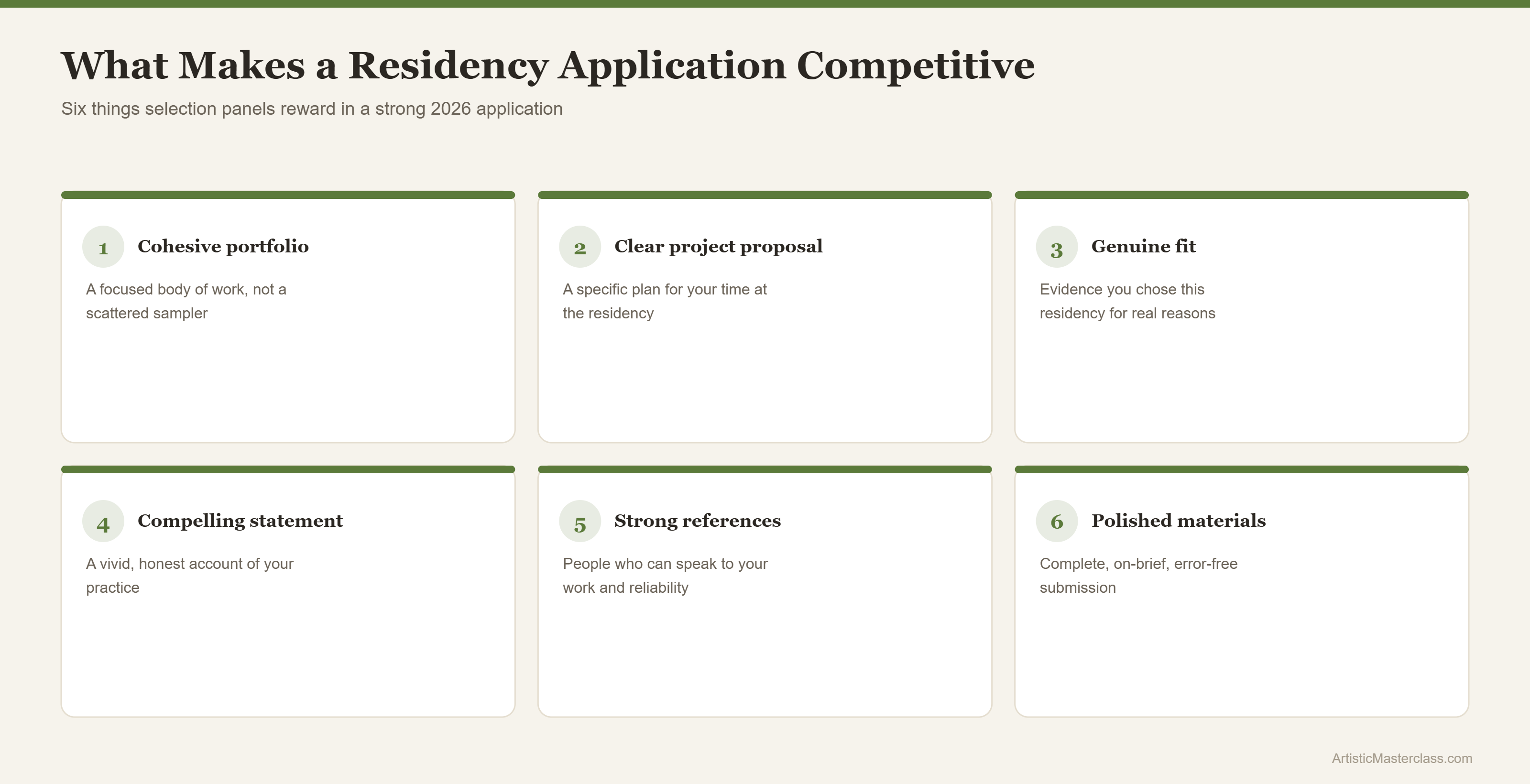
Selection panels review 200-500 applications for 5-20 spots (2-10% acceptance rates). Understanding evaluation criteria—often available on residency websites as “selection guidelines”—allows you to tailor each component strategically rather than submitting generic materials to all programs.
Understanding Selection Criteria from Jury Panels
Residencies publish selection frameworks revealing exactly what jurors evaluate. Analyzing these rubrics from multiple programs shows consistent patterns.
Studio Museum in Harlem AIR – Selection Framework
Studio Museum uses blind review (removing demographic information) followed by consensus-based jury discussion involving curatorial staff, external curators, and program alumni.
Evaluation criteria:
- Artistic merit (40% weight): Technical proficiency, conceptual depth, originality demonstrated through work samples
- Potential for growth (30% weight): Career trajectory, project ambition, capacity to develop significantly during residency
- Alignment with mission (20% weight): Program serves emerging artists of African/Afro-Latinx descent; applications should demonstrate understanding of this focus
- Presentation quality (10% weight): Completeness, clarity, professionalism of materials
The blind review prevents bias based on gallery representation, exhibition history at famous institutions, or recognizable names. Work samples alone determine first-round advancement.
High Concept Labs AIR Chicago – Scoring Rubric
High Concept Labs assigns three jurors per application, each scoring on 0-4 scale across criteria. Applications must score 3+ (“mostly meets criteria”) across categories to advance to panel discussion.
Scoring framework (0-4 each criterion):
- Project clarity (25% weight): Clear processes and goals articulated; proposal states what artist will explore/accomplish; artist articulates starting point
- Artistic accomplishment (25% weight): Work samples are original, interesting, well-researched, cohesive; technical proficiency evident
- Feasibility (20% weight): Evidence artist can follow through; practical considerations addressed; timeline realistic
- Community value (15% weight): Project capacity to benefit/engage audiences and peers; public component or shareable outcomes
- Growth potential (15% weight): Room to learn, stretch, explore; artist won’t just repeat established practice
Jurors appreciate feasibility realism. Proposing to complete 50 large paintings in 3 months signals poor planning. Proposing 8-10 paintings with research time signals thoughtful execution.
McColl Center AIR Charlotte – Evaluation Questions
McColl Center’s jury asks these questions during application review:
- Does artist show exemplary creativity, innovation, or skill?
- Is work original and pushing boundaries of medium/concept?
- Will residency catalyze significant artistic development?
- Can artist contribute meaningfully to resident community?
- Does project demonstrate artistic rigor and ambition?
These questions reveal values: innovation over technical perfection, developmental potential over established reputation, community contribution over isolated production.
Common Patterns Across Programs
Analyzing 30+ residency selection criteria reveals consistent priorities:
- Portfolio quality dominates (30-40% of decision weight): Technical skill combined with originality matters more than exhibition history. Jurors evaluate work samples directly, not institutional validation.
- Mission alignment matters (15-25% weight): Generic proposals ignoring residency’s stated themes/focus lose to tailored proposals demonstrating research. Environmental residencies favor projects engaging with nature; urban residencies value city-responsive work.
- Feasibility assessment (15-25% weight): Overly ambitious projects signal unrealistic expectations. Jurors prefer modest, achievable goals over grandiose visions. Proposing to write three novels in 8 weeks loses to completing one manuscript chapter with research time.
- Presentation professionalism (10-15% weight): Typos, missing materials, and late submissions automatically disqualify or heavily penalize. Sloppy applications suggest artists won’t respect residency resources.
Selection criteria vary by program mission. Studio Museum Harlem emphasizes supporting emerging artists of specific demographics (mission-driven), while High Concept Labs prioritizes community engagement (socially-engaged practice focus), but all programs value artistic merit demonstrated through portfolio quality above other factors.
Application Component Architecture
Understanding exact requirements for each component prevents disqualification from technical errors.
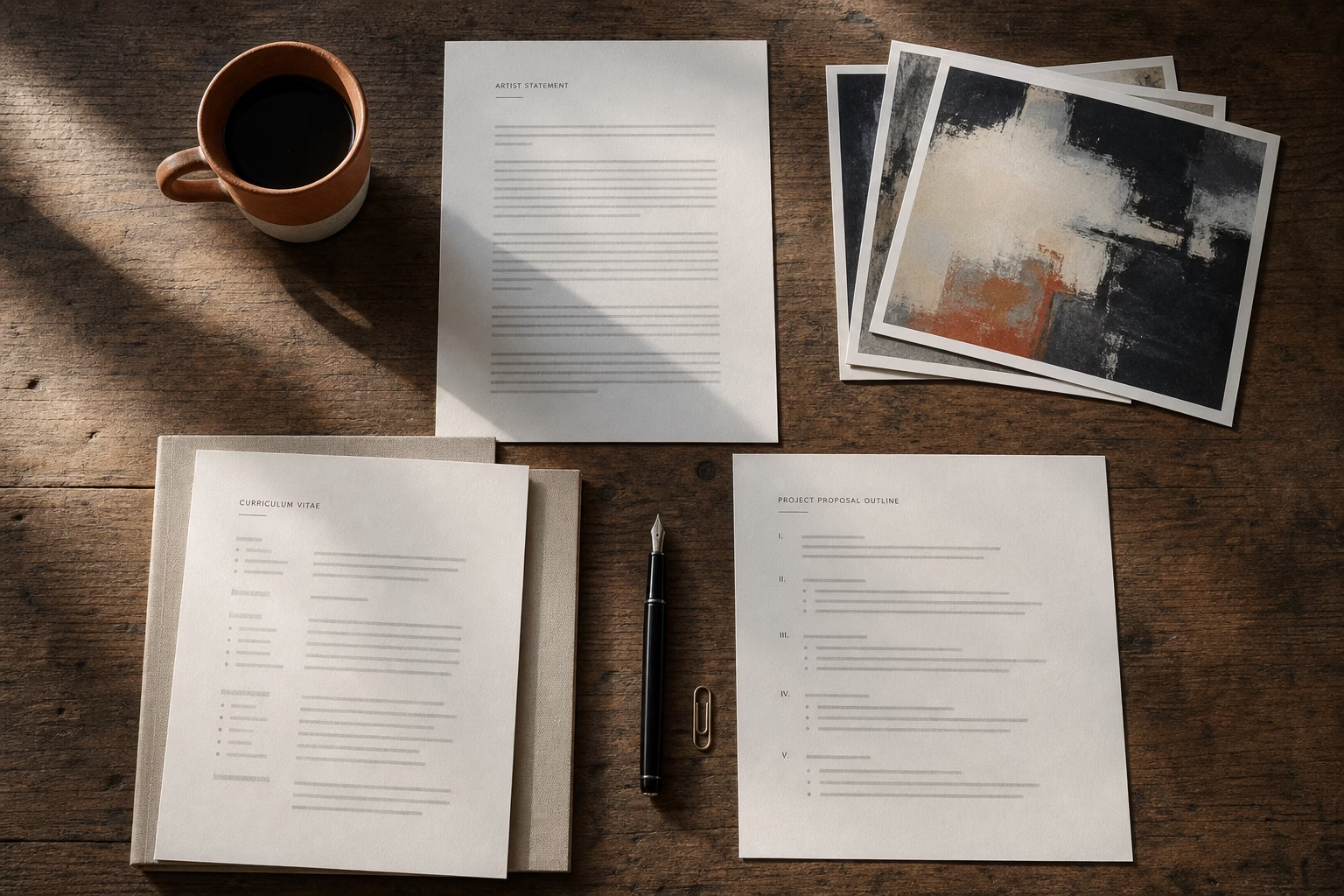
Portfolio (Work Samples)
Portfolios demonstrate artistic accomplishment and current practice direction.
Quantity requirements:
- Most common: 5-10 images or 1-3 videos
- Some programs: “Up to 20 images” (submit 10-12 maximum; jurors rarely review beyond 10)
- Specialized media: Sound artists submit 3-5 audio files, performers submit 2-3 video excerpts
File specifications:
- Images: JPEG or PNG format, under 5MB per file, minimum 1920×1080 pixels (72-300 DPI)
- Videos: MP4 or MOV format, under 250MB per file, 1-10 minutes length (most effective: 3-5 minutes)
- Audio: MP3 or WAV format, under 50MB, 2-8 minutes excerpts
Submission platforms:
- SlideRoom (60% of programs): Requires uploading files to cloud platform, supports images/video/audio
- Submittable (25% of programs): Similar to SlideRoom, different interface
- Direct email (15% of programs): Attach files or provide Dropbox/Google Drive links
Selection strategy: Show range within cohesive aesthetic
Jurors evaluate two competing qualities: consistency (do you have a developed voice?) and range (can you work in multiple formats/scales/approaches?). Balance these by showing variations within unified themes.
Strong portfolio structure for painters:
- 8 total images
- 4 images from current series (demonstrating depth of investigation)
- 2 images from previous series (showing evolution over time)
- 1 detail shot (proving technical proficiency in brushwork/surface)
- 1 installation view (demonstrating scale awareness and presentation skills)
This structure proves both consistency (focused current series) and range (evolution, multiple scales, technical detail).
Strong portfolio structure for installation/sculpture artists:
- 9 total images
- 6 images of 2-3 major works, multiple angles each (showing 3-dimensional understanding)
- 2 process/fabrication photos (demonstrating technical skill and methodology)
- 1 installation view in exhibition context (showing site-specificity and spatial awareness)
Strong portfolio structure for writers:
- 10-15 pages of prose (short story, novel excerpt, essay) or 5-10 poems
- Submit published work when available (validates editorial judgment)
- Work from past 2 years demonstrating current voice
- Single project preferred over scattered excerpts (shows sustained focus)
Image quality standards:
Professional documentation prevents immediate rejection:
- Neutral backgrounds: White walls for 2D work, uncluttered spaces for installations
- Consistent lighting: Avoid harsh shadows, color casts, or uneven illumination
- Proper framing: Fill frame with artwork, minimal empty space
- Accurate color: Color-correct in Lightroom/Photoshop to match actual work
- Multiple angles: For sculpture, show front/back/side views
Red flags causing automatic rejection:
- Instagram screenshots with likes/comments visible
- Blurry or poorly lit images
- Work shown in cluttered studios with distracting backgrounds
- Obvious phone snapshots without professional documentation
- Incorrect dimensions/materials listed (suggests carelessness)
Artist Statement
Artist statements articulate creative vision beyond what’s visible in portfolio images.
Length requirements:
- Most programs: 500-1000 words
- Some programs: 300-500 words (concise version)
- Format: Single PDF combined with CV, or pasted directly into text field
- Tone: First person (“I create…”) or third person (“The work explores…”) both acceptable
Three-part structure:
Part 1: Practice Overview (150-250 words)
Define medium, themes, processes, and motivations driving current work.
Example opening: “I create large-scale oil paintings (6×8 feet) exploring inherited trauma through fragmented portraiture. Working from family photographs and archival images, I layer transparent glazes over gestural underpainting, building surfaces that simultaneously reveal and obscure features. This process mirrors memory’s function—preserving and distorting simultaneously.”
This opening establishes medium (oil painting), scale (6×8 feet), subject (inherited trauma/portraiture), materials (photographs/archives), technique (layering glazes over gesture), and conceptual framework (memory as preservation/distortion). Jurors immediately understand the practice.
Part 2: Conceptual Framework (200-350 words)
Situate work within art historical precedents, explain influences, describe how practice has evolved.
Example continuation: “This investigation builds on Expressionist figuration traditions (Kerry James Marshall’s symbolic portraiture, Jenny Saville’s visceral bodies) while incorporating photographic source material reminiscent of Gerhard Richter’s blur paintings. Where Richter obscures images to question photographic truth, I fragment portraits to investigate how trauma disrupts identity transmission across generations.
My 2024 series Threshold uses family immigration documents as source material, translating passport photos and visa applications into 6×8 foot paintings. The enlarged scale transforms bureaucratic images into monuments, honoring experiences typically compressed into administrative files. Transparent layers reference archival preservation methods—mylar sleeves protecting fragile documents—while distortion acknowledges that preservation never captures complete truth.
Previous work (Inherited Silence, 2022-2023) focused on landscapes from family origin countries. Threshold shifts from places to people, recognizing that land-based trauma narratives risk romanticizing displacement. Focusing on bureaucratic portraiture grounds investigations in actual experiences rather than nostalgic landscapes.”
This section demonstrates art historical knowledge, theoretical engagement, specific series description, and practice evolution.
Part 3: Future Direction & Residency Connection (100-200 words)
Preview residency project, explain mission alignment, identify specific resources supporting work.
Example conclusion: “During a residency at La Napoule Art Foundation, I plan to develop Administrative Bodies, a new series examining medical immigration documentation. La Napoule’s archives include 1940s refugee documentation, providing primary source material connecting historical displacement to contemporary immigration. The program’s printmaking facilities will enable me to experiment with monotype processes, transferring archival images to painting surfaces more directly than current photographic methods.
This aligns with La Napoule’s mission supporting artists engaging with French-American cultural exchange. My grandmother’s 1956 immigration from France to the United States makes this personal investigation of transatlantic displacement particularly resonant with the Foundation’s focus. The month-long timeframe allows concentrated archive research (weeks 1-2) followed by studio production (weeks 3-4).”
This paragraph names the specific residency, identifies actual resources (archives from 1940s, printmaking facilities), connects project to residency mission (French-American cultural exchange), provides biographical relevance, and includes realistic timeline.
Project Proposal
Project proposals outline specific creative goals for residency period.
Length requirements: 300-750 words (most programs request 500 words)
Four-section structure:
Section 1: Project Overview (75-150 words)
Clearly describe what you’ll create, using specific mediums, formats, quantities, and themes.
Example: “During a 3-month residency at Bemis Center, I will develop Extraction Landscapes, a series of 12-15 cyanotype photograms (16×20 inches) documenting plant species colonizing abandoned industrial sites in Omaha. This work investigates ecological resilience in post-industrial landscapes, questioning conventional nature/culture binaries by highlighting how ‘invasive’ species often prove most adaptive to human-altered environments.”
This overview provides: timeframe (3 months), location (Bemis Center Omaha), project title (Extraction Landscapes), medium (cyanotype photograms), size (16×20 inches), quantity (12-15 works), materials source (plants from industrial sites), and conceptual framework (ecological resilience, nature/culture binaries, invasive species adaptation).
Section 2: Creative Methodology (150-250 words)
Break down process step-by-step, list materials, specify technical requirements.
Example: “Week 1-2: Site surveys and specimen collection. I’ll photograph abandoned sites (closed factories, rail yards, vacant lots) in North Omaha, collect plant samples (leaves, seed pods, root structures), and research species identification using Bemis Center’s library and UNO Herbarium access.
Week 3-4: Cyanotype preparation and testing. I’ll coat Arches watercolor paper with cyanotype solution (ferric ammonium citrate and potassium ferricyanide—materials I’ll bring) and conduct exposure tests to determine optimal sunlight/UV times for collected specimens.
Week 5-10: Production phase. Daily studio routine: morning specimen arrangement on prepared paper, midday sun exposure (weather permitting; cloudy days use UV exposure unit), late afternoon developing. Goal: Complete 20-25 exposures, selecting 12-15 strongest images for final series.
Week 11-12: Refinement and documentation. Edit work, potential re-exposures addressing technical issues, professionally photograph final pieces using Bemis Center’s photo studio.
Required resources: Printmaking studio access with large sink, drying racks, natural light or UV exposure unit. Chemistry storage for sensitizing solutions. Weather backup plan (UV light box if sun unavailable during Nebraska winter).”
This methodology demonstrates planning depth, realistic timelines, specific material knowledge, and problem anticipation (weather backup).
Section 3: Conceptual Framework (100-200 words)
Connect project to broader artistic/intellectual contexts and explain residency location relevance.
Example: “This project extends my ongoing investigation of post-industrial landscapes through alternative photography processes. Previous series Rust Belt Remnants (2023) documented Detroit’s architectural ruins using digital photography; Extraction Landscapes shifts from built environment to botanical resilience, from digital capture to analog cyanotype.
The work engages Anna Tsing’s concept of ‘contaminated diversity’—how ecosystems adapt to human disruption—and Anna Lowenhaupt’s ‘arts of noticing.’ Using cyanotype, a 19th-century process associated with Victorian botanical surveys, creates visual-historical resonance: contemporary ‘weeds’ deserve the same scientific attention as historically-celebrated specimens.
Omaha’s location in the Rust Belt, with numerous abandoned industrial sites from meatpacking and rail industries, provides ideal research context. These sites demonstrate what ecologist Richard Hobbs terms ‘novel ecosystems’—combinations of native and invasive species that wouldn’t exist without industrial disruption.”
Section 4: Anticipated Outcomes (75-150 words)
Specify deliverables, public engagement opportunities, career trajectory connections.
Example: “Anticipated outcomes include 12-15 finished cyanotypes ready for exhibition, comprehensive site documentation (photographs, collected specimens, field notes) informing future projects, and public engagement through:
- Mid-residency open studio (Week 6) showing process and botanical collections
- Final artist talk connecting project to environmental humanities discourse
- Potential community workshop introducing cyanotype process using local plants
This residency positions me to expand from purely photographic documentation into object-based work incorporating actual plant materials, supporting my long-term goal of developing more tactile, materially-engaged practice ahead of solo exhibition at Glacier Gallery scheduled for spring 2027.”
How Competitive Are Artist Residencies? (Acceptance Rates and Reality Check)
Top-tier residencies (MacDowell, Yaddo, Akademie Schloss Solitude) have 5-10% acceptance rates (500-800 applications for 20-50 spots), mid-tier established programs 15-25% acceptance, and emerging programs 30-50% acceptance. Most artists require 15-30 applications across 2-3 years before securing first competitive residency.
Understanding realistic acceptance rates prevents demoralization from rejections and informs strategic application planning. Applying to 8-12 programs across difficulty tiers (2-3 reach, 4-5 match, 2-3 safety) increases odds of acceptance while managing $200-600 application fee budgets.
Residency Prestige Tiers and Acceptance Data
Tier 1: Elite Programs (5-10% acceptance)
Elite residencies attract international applicant pools and maintain century-long reputations.
MacDowell Colony receives approximately 800 applications annually for 60-80 residency spots across three seasons (winter/spring, summer, fall). With 8-10% acceptance rates, MacDowell ranks among America’s most competitive programs. The Colony offers fully-funded residencies (stipend amounts vary, all expenses covered) in Peterborough, New Hampshire, with private studios across 450 acres. Disciplines include architecture, film/video, interdisciplinary arts, literature, music composition, theatre, and visual arts. Notable alumni include James Baldwin, Leonard Bernstein, Willa Cather, Michael Chabon, Jennifer Egan, and Alice Walker.
Yaddo accepts roughly 200 residents annually from 600-700 applications per cycle (two annual deadlines), creating approximately 15% acceptance rates per cycle. Yaddo provides fully-funded residencies (stipend + accommodation + meals) in Saratoga Springs, New York, lasting 2 weeks to 2 months. The historic mansion houses visual artists, writers, and composers. Alumni include Sylvia Plath, Langston Hughes, Philip Roth, and Truman Capote.
Akademie Schloss Solitude in Stuttgart, Germany receives 800-1,000 applications for 50-60 fellowship spots annually, yielding 5-7% acceptance rates. Fellows receive €1,300 monthly stipends (tax-free), furnished apartments (30-40 square meters combining live/work space), and round-trip travel coverage for 3-12 month residencies. The program accepts international applicants under 35 years old working across architecture, visual arts, performing arts, design, literature, music/sound, video/film, and humanities/sciences. Notable alumni include Theaster Gates, Cameron Rowland, and Hito Steyerl.
Studio Museum in Harlem AIR represents America’s most competitive residency with 0.6-0.75% acceptance rates. The program receives 400-500 applications for 3 spots annually. Selected residents receive $50,000 total stipends (paid biweekly over the full 11-month residency from March-October 2026 for inaugural cohort in new building), private studios in the museum, and end-of-residency exhibitions. The program serves emerging artists of African and/or Afro-Latinx descent working in any media. Alumni include Kehinde Wiley, Mickalene Thomas, Jordan Casteel, Tschabalala Self, and Njideka Akunyili Crosby.
Tier 1 Application Strategy: Apply to 1-2 reach programs as long-term targets. Even excellent artists face rejection due to application volume. Treat elite programs as annual reapplication opportunities across 3-5 years rather than single-attempt prospects.
Tier 2: Established Programs (15-30% acceptance)
Established programs balance prestige with more accessible acceptance rates.
Golden Foundation accepts approximately 18 residents (six 4-week sessions) from 75-90 applications annually, creating 20-25% acceptance rates. The New Berlin, New York program provides $0-cost residencies (no fees charged) with Golden brand acrylic materials supplied. The program specifically serves painters working with acrylics, creating niche discipline focus that increases acceptance odds for painters while excluding other media.
La Napoule Art Foundation on France’s Côte d’Azur accepts 20-30% of applicants for monthly residency sessions (10 residents per month). The Foundation provides stipends, accommodation in Château de La Napoule or Villa Marguerite, and meals (breakfast and dinner weekdays). Residencies welcome all disciplines internationally. The European location attracts fewer US applicants despite English-language programming, improving odds for Americans willing to travel.
ARKO Art Studio in Seoul, South Korea accepts approximately 25% of applicants per 4-month term (5 artists per term, 20 annually). Residents receive KRW 1,000,000 monthly (approximately $750 USD), accommodation, and production support (KRW 500,000 monthly). International artists must demonstrate English fluency, possess minimum 5 years professional experience, and secure Korean visas independently. Asia-Pacific location filters applicant pools.
McColl Center in Charlotte, North Carolina accepts 15-20% of applicants for its internationally acclaimed program serving emerging and mid-career artists. The program provides condominium accommodation, $500 monthly stipends, private studios, and professional development support. US-based artists only (no international visa sponsorship currently).
Tier 2 Application Strategy: Target 4-6 established programs. These balance prestige with realistic acceptance odds. Strong portfolios with mission-aligned proposals have good chances.
Tier 3: Emerging/Regional Programs (30-50% acceptance)
Emerging programs offer professional opportunities with higher acceptance rates.
Characteristics:
- Programs established <10 years ago
- Regional rather than international recruitment
- Smaller applicant pools (50-200 applications total)
- Often fee-based ($500-1,500) or subsidized rather than fully-funded
- Less competitive but legitimate professional credentials
Application Strategy: Include 2-3 safety programs. Use for gaining residency experience, testing application materials, and building CV credentials supporting stronger future applications to Tier 1-2 programs.
Rejection Reality and Strategic Response
Most artists face 10-20 rejections before first acceptance. This reflects mathematics, not inadequacy.
Why rejections happen beyond portfolio quality:
Reason 1: Volume overwhelms quality differentiation
When 500 qualified artists apply for 20 spots, jurors must reject 480 excellent candidates. Your rejection doesn’t mean “not good enough”—often means “many equally qualified applicants, limited spots.”
Reason 2: Mission/timing fit
A program director explained: “We received 30 strong sculpture proposals but only had 5 sculpture studios that term. We accepted 5 and rejected 25 equally qualified sculptors solely due to infrastructure limitations.”
Timing matters. Applying when residencies already filled visual arts quotas for that season results in rejection despite strong work.
Reason 3: Cohort balance
Residencies curate cohorts across disciplines, career stages, and demographics. A strong painter may be rejected if that cycle already accepted 5 painters and the program wants interdisciplinary balance.
Reason 4: Subjective taste
Different jury panels yield different results. The same application might win acceptance one year and face rejection the next with different jurors. Taste variations are normal.
Strategic rejection response:
- Track patterns: If rejected from 5+ environmental art residencies but accepted to urban programs, work resonates better in certain contexts. Adjust targeting accordingly.
- Seek feedback: Some programs offer optional feedback to rejected applicants (additional $25-50 fee). Invest in 1-2 feedback sessions identifying weak points.
- Iterate materials: Update portfolios with strongest recent work each cycle. Revise artist statements based on practice evolution. Applications should never remain static year-over-year.
- Apply at multiple career stages: “Emerging artist” eligibility often means 0-5 years post-degree. If you’re year 4 facing rejections, you may compete against more established emerging artists. Continue applying as you transition to “mid-career” categories where competition shifts.
- Widen geographic net: US artists often overlook international opportunities. European and Asian residencies receive fewer US applicants, improving odds for artists willing to travel and navigate visa processes.
Acceptance timeline expectations:
- Year 1: 0-2 acceptances from 8-12 applications (typical for first-time applicants)
- Year 2-3: 2-4 acceptances as materials strengthen and experience grows
- Year 4+: 3-6 acceptances per cycle for established applicants with strong track records
What Are the Best Fully-Funded Residencies in 2026?
Top fully-funded 2026 residencies include: MacDowell (stipend + all expenses), Yaddo (stipend + all expenses), Akademie Schloss Solitude (€1,300/month + apartment), La Napoule Art Foundation (stipend + meals + housing), Rijksakademie Amsterdam (stipend + studio + work budget), ARKO Art Studio Seoul (KRW 1,000,000/month + housing), and Camargo Foundation France (stipend + accommodations).
Fully-funded residencies eliminate financial barriers ($1,500-5,000 saved on accommodation and meals), provide stipends covering living expenses during non-earning creative periods, and signal institutional validation that strengthens CVs and grant applications. Targeting 3-5 fully-funded programs per application cycle optimizes financial accessibility.
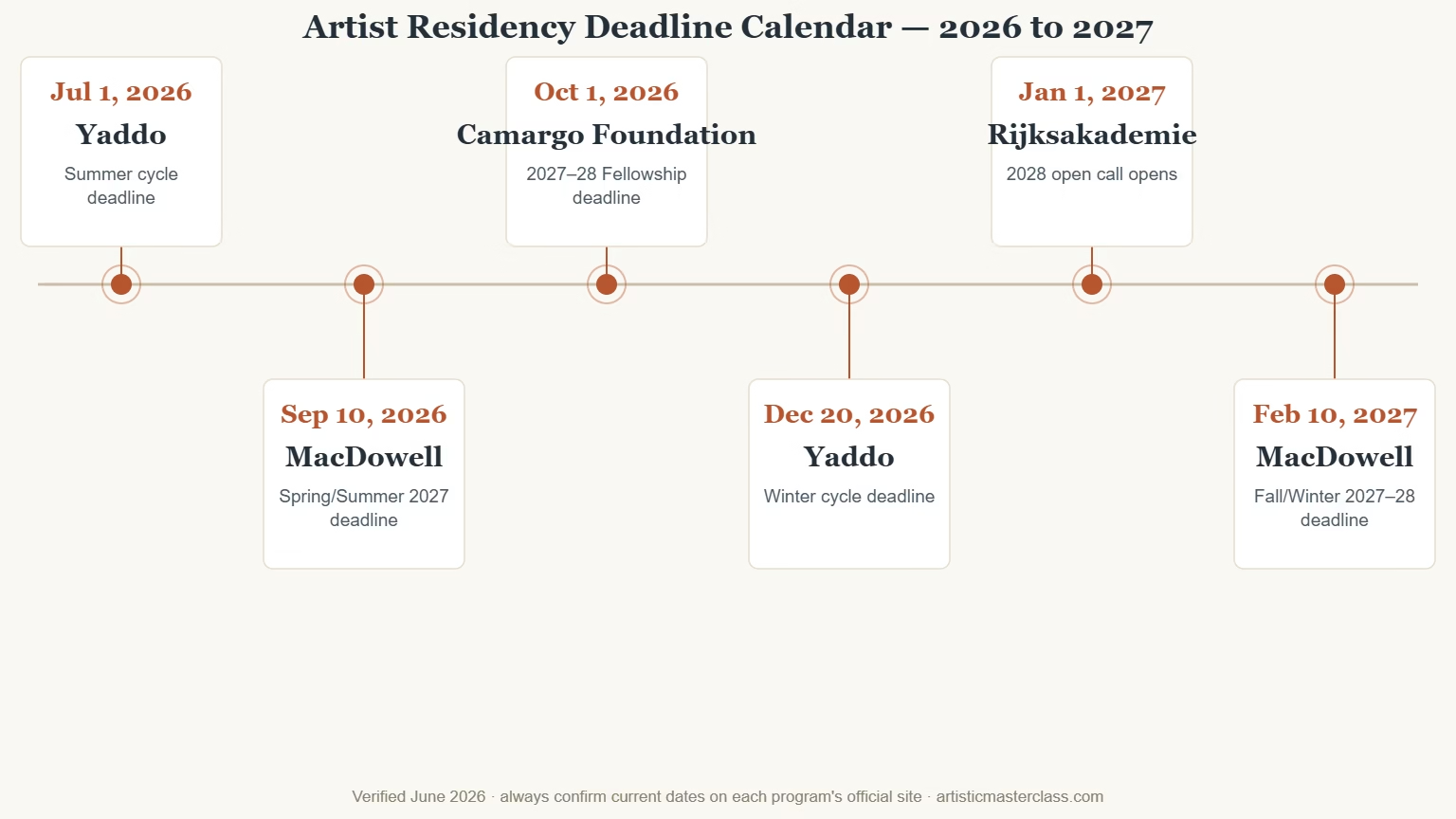
Detailed Profiles: Top 10 Fully-Funded Programs
1. MacDowell
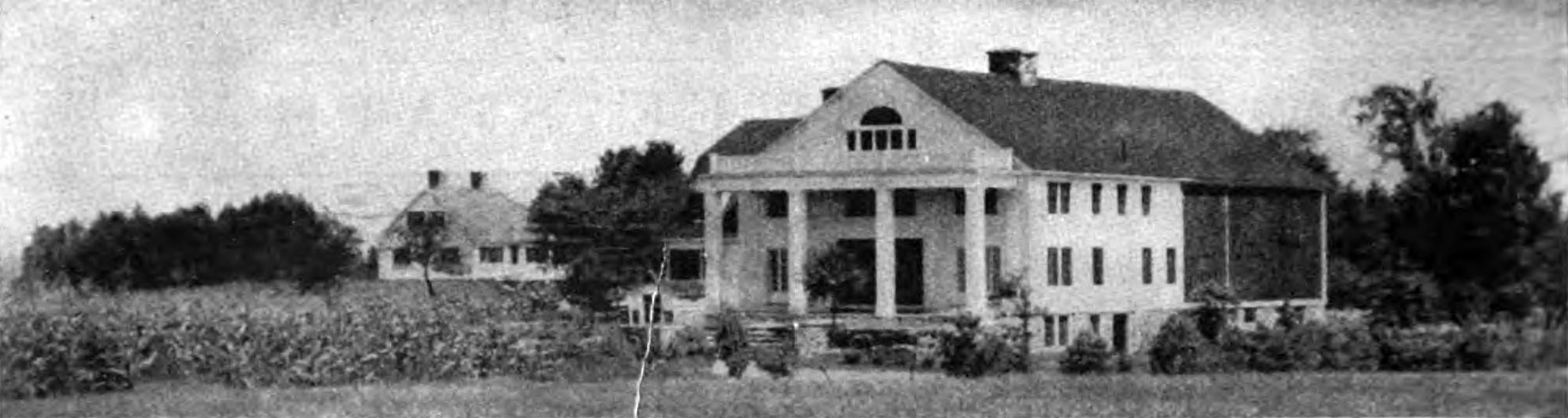
Location: Peterborough, New Hampshire, USA (90 miles northwest of Boston) Founded: 1907 (oldest artist residency in United States) Disciplines: Architecture, film/video, interdisciplinary, literature, music composition, theatre, visual arts
MacDowell provides America’s gold-standard residency experience. The 450-acre campus hosts 32 individual studios, each designed for specific disciplines. Visual artists work in light-filled spaces with sinks and storage; composers access pianos and sound isolation; writers inhabit quiet cabins with desks and extensive libraries.
Funding: Fully-funded including stipend (amount varies by funding sources), private studio, private bedroom, three meals daily (lunch delivered to studio to minimize creative interruption), travel support available
Duration: 2 weeks to 2 months (average stay: 4-6 weeks) Capacity: 60-80 residents annually across three seasons
Application Details:
- Next deadline (verified June 2026): September 10, 2026 — for Spring/Summer 2027 residencies (applications open August 15, 2026)
- Following deadline: February 10, 2027 — for Fall/Winter 2027–28 residencies
- Application fee: $30 · online application
- Funding note: no residency fee; need-based stipends and travel grants for awarded Fellows
Selection Process: Discipline-specific panels of artists and professionals review applications, scoring on artistic merit, project clarity, and need for residency time. Blind review prevents bias based on institutional affiliations.
Acceptance Rate: 8-10% (approximately 800 applications for 70 spots)
Eligibility: Professional artists with substantial completed work bodies; students currently enrolled in degree programs ineligible
International Artists: Accepted; must secure own visas (no visa sponsorship provided)
Notable Alumni: James Baldwin, Leonard Bernstein, Willa Cather, Michael Chabon, Jennifer Egan, Alice Walker, Ayad Akhtar
Special Features: Historic Medal Day ceremony honoring lifetime achievement in arts, extensive archive and library, minimal structured programming (emphasis on solitude), optional evening community meals
Why Apply: MacDowell on your CV signals serious institutional validation. Alumni networks open doors for decades post-residency. The combination of private studio, private bedroom, and delivered meals creates uninterrupted creative time impossible to replicate elsewhere. Interdisciplinary community enables collaborations across art forms.
Website: macdowell.org
2. Akademie Schloss Solitude
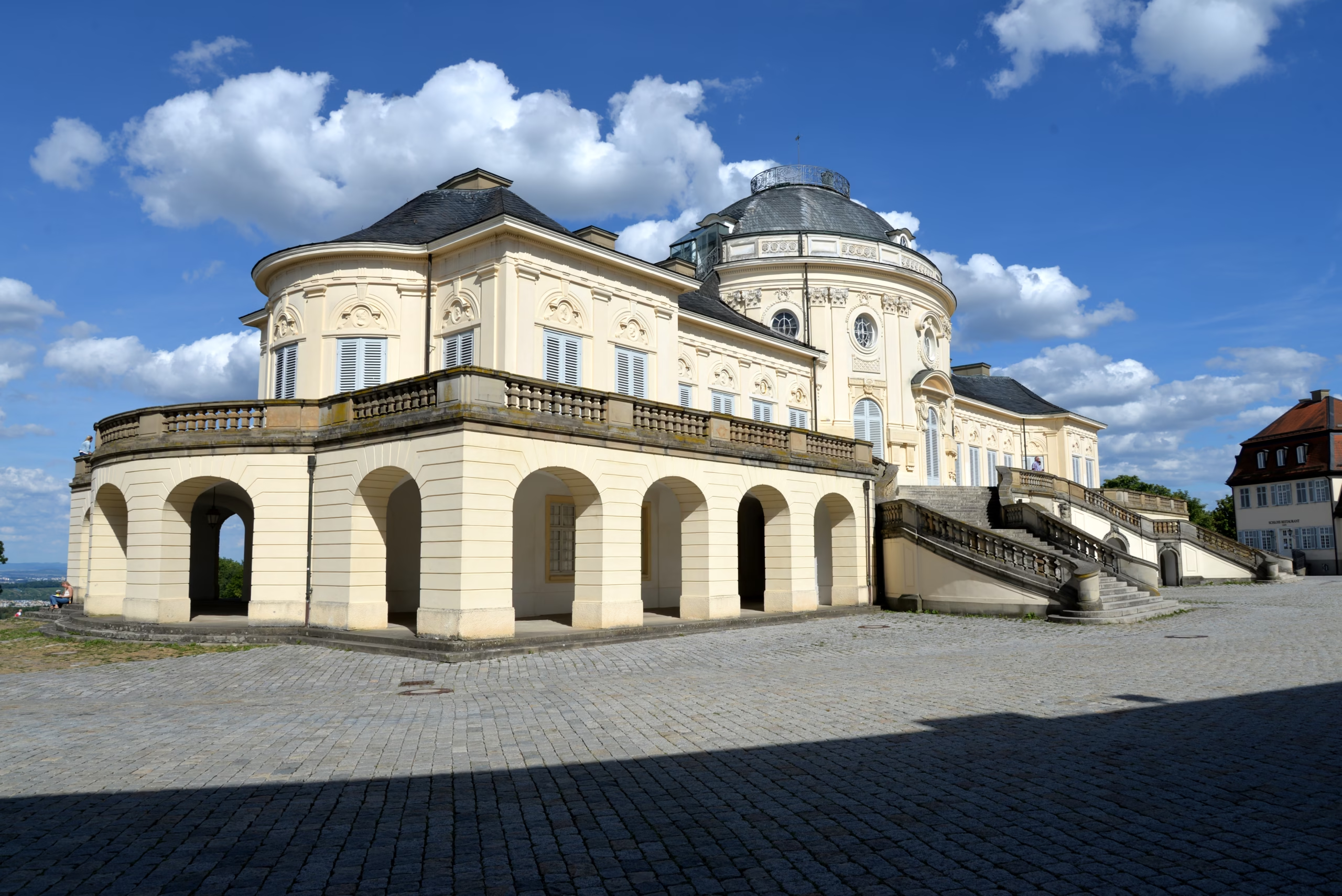
Location: Stuttgart, Germany (20 minutes from city center via public transit) Founded: 1990 Disciplines: Architecture, visual arts, performing arts, design, literature, music/sound, video/film/new media, humanities/science
Akademie Schloss Solitude ranks among Europe’s most prestigious residencies, attracting international fellows to its historic Baroque castle grounds.
Funding: Fully-funded including €1,300 monthly stipend (tax-free), furnished apartment (30-40 square meters combining live/work space), round-trip travel to/from Stuttgart covered, possible production budgets for materials
Duration: 3-12 months (most fellows stay 6-12 months) Capacity: 50-60 fellows annually
Application Details:
- Status (June 2026): the 2026–2028 fellowship call closed in late 2025
- Next call: expected in late 2027 for the following cycle — confirm on the official site
- Application fee: €50 · two-stage online application
Selection Process: International jury from relevant disciplines conducts blind review phase, evaluating artistic quality, innovation, and need for support
Acceptance Rate: 5-7% (900+ applications for 50 spots)
Eligibility: Professional artists and scholars under 35 years old at application time; international applicants welcome; English or German communication ability required
Visa Support: Yes—Akademie assists international fellows with German visa applications and provides support letters
Notable Alumni: Theaster Gates, Cameron Rowland, Hito Steyerl, numerous Turner Prize and Hugo Boss Prize nominees
Special Features: Strong theoretical and critical discourse programming with lectures, symposia, and peer discussions. Proximity to Stuttgart’s museums (Staatsgalerie, Kunstmuseum) and EU location enabling Schengen area travel to other European cities during residency. Web residencies program specifically for digital practitioners.
Why Apply: European base enables exploration across Schengen zone (France, Italy, Netherlands accessible). Generous €1,300 monthly stipend supports comfortable living. Strong critical discourse community for intellectually rigorous artists. Prestigious alumni network provides lasting professional connections. One of Europe’s most respected programs.
Website: akademie-solitude.de
3. Studio Museum in Harlem AIR
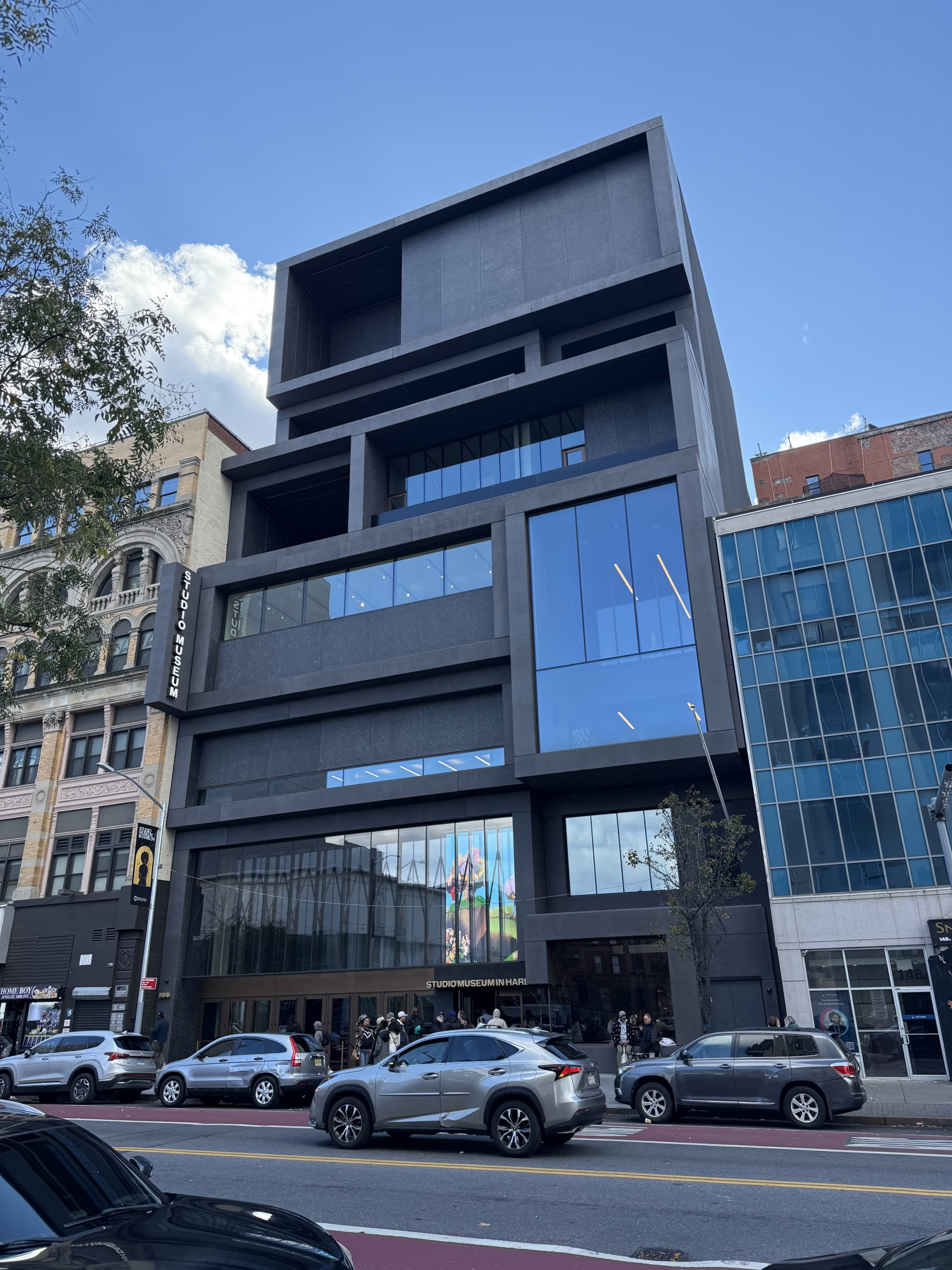
Location: Harlem, New York City, USA (127th Street) Founded: 1968 (residency component established 1970s) Discipline: Visual arts (all media)
Studio Museum in Harlem’s Artist-in-Residence program represents the most competitive US residency, with less than 1% acceptance rates, but offers unparalleled career-launching support.
Funding: Fully-funded including $50,000 total stipend (paid biweekly over the full 11-month residency), private studio in museum building (24/7 access), exhibition opportunity in prominent Harlem institution, curatorial mentorship, professional development support
Duration: 11 months (November 2, 2026 – October 3, 2027 (the museum’s new West 125th Street building opened November 2025)) Capacity: 3 residents per year (extremely selective)
Application Details:
- Status (June 2026): the 2026–27 cohort deadline (May 18, 2026) has passed
- Next cycle: 2027–28 expected to open around spring 2027 — confirm on the official site
- Application fee: $0 (free to apply) · Platform: SlideRoom
Selection Process: Blind review removing demographic information, followed by consensus-based evaluation involving Museum curatorial staff, external curators, and AIR program alumni. Multiple review rounds ensure fair and impartial assessment.
Acceptance Rate: 0.6-0.75% (400-500 applications for 3 spots—America’s most competitive residency)
Eligibility: Emerging artists of African and/or Afro-Latinx descent working locally, nationally, or internationally; NOT open to current students (undergraduate, graduate, postgraduate) or artists in other residencies/fellowships; must commit to full 11-month duration in NYC
Visa/International: Accepts international artists but does NOT provide visa sponsorship or assistance; international artists must secure own visas before arrival
Notable Alumni: Kehinde Wiley, Mickalene Thomas, Jordan Casteel, Tschabalala Self, Njideka Akunyili Crosby, Nina Chanel Abney
Special Features: NYC location provides unparalleled gallery, museum, and collector access. Institutional curatorial mentorship throughout residency. Exhibition opportunity in prominent Harlem museum often leads to work entering museum collection. Post-residency career trajectories to major commercial galleries common. Harlem’s cultural richness informs practice.
Why Apply: Despite 0.7% acceptance (hardest US residency), $0 application fee reduces risk. $50,000 stipend supports NYC living costs. Career-launching platform—alumni include contemporary art stars. Exhibition in respected institution. Strong alumni network provides post-residency support and connections. For emerging artists of African/Afro-Latinx descent, no other program offers comparable validation and support.
Website: studiomuseum.org/residency
4. Yaddo
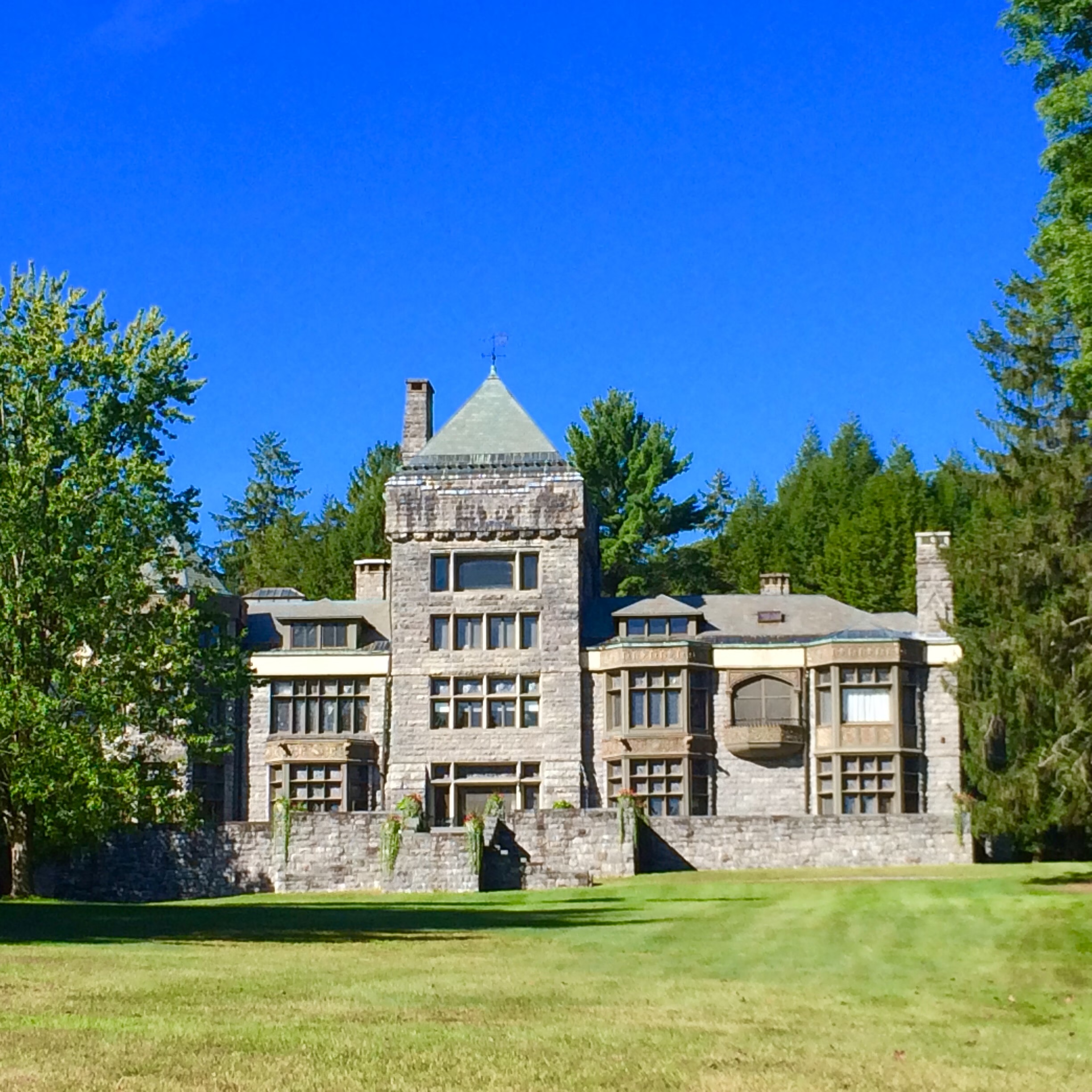
Location: Saratoga Springs, New York, USA (3 hours north of NYC) Founded: 1900 Disciplines: Visual arts, literature (fiction, poetry, nonfiction, playwriting), music composition
Yaddo provides fully-funded retreats in historic mansion and grounds, emphasizing uninterrupted creative time.
Funding: Fully-funded including accommodation in private bedrooms (historic mansion or newer residences), three meals daily (breakfast and dinner communal, lunch delivered to studios), private studios for visual artists and composers, no fees charged to residents, some travel support available
Duration: 2 weeks to 2 months (most residencies 4-6 weeks) Capacity: Approximately 200 residents annually across multiple sessions
Application Details:
- Summer cycle deadline: July 1, 2026 (open now) — for residencies Nov 2026–June 2027
- Winter cycle deadline: December 20, 2026 — portal opens early November
- Application fee: $35 · you may apply once every other calendar year
Selection Process: Admissions committee comprised of artists and professionals in each discipline reviews applications, evaluating artistic merit, project clarity, and benefit from dedicated time
Acceptance Rate: Approximately 15% per cycle (600-700 applications for 200 spots annually)
Eligibility: Professional artists with published/exhibited/performed work; graduate students in final thesis year may apply
International Artists: Accepted; must secure own visas (artists typically use B-1/B-2 tourist visas for short stays)
Notable Alumni: Sylvia Plath, Langston Hughes, Philip Roth, Truman Capote, Patricia Highsmith, James Baldwin, John Cheever
Special Features: Historic gardens and 400-acre grounds, beautiful architecture, optional evening community time (many residents socialize after dinner), strong literary emphasis alongside visual arts and music, century-long legacy
Why Apply: Yaddo’s reputation rivals MacDowell. Fully-funded model eliminates financial barriers. Private studios and delivered lunches protect creative time. Historic setting inspires. Saratoga Springs location provides small-town quiet with cultural amenities (ballet, horse racing, restaurants). Strong for writers—many National Book Award and Pulitzer Prize winners are alumni.
Website: yaddo.org
5. La Napoule Art Foundation
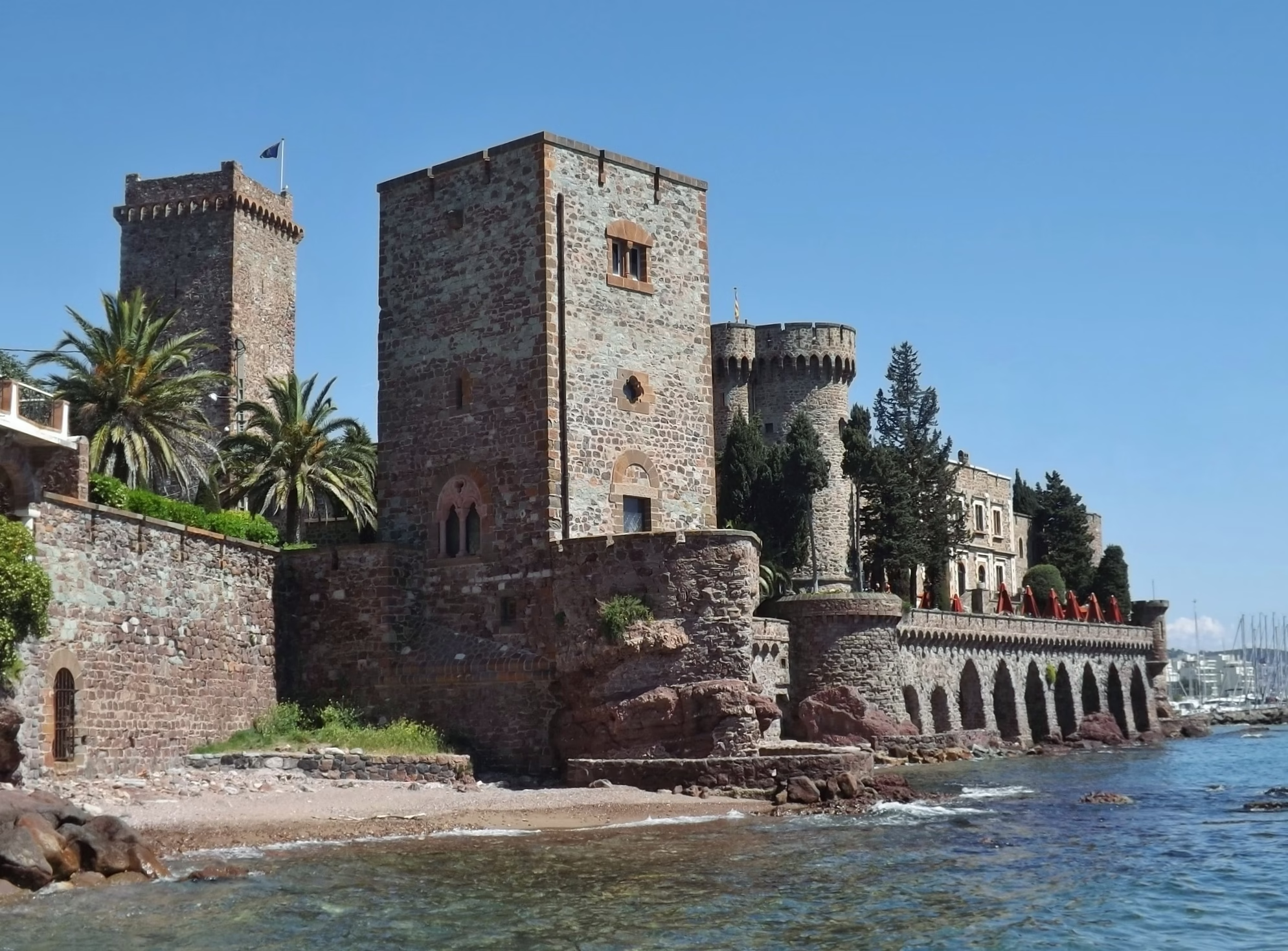
Location: Mandelieu-La Napoule, Côte d’Azur, France (Mediterranean coast near Cannes) Founded: 1951 Disciplines: All artistic genres
La Napoule Art Foundation offers month-long residencies in historic Château de La Napoule, combining French Riviera location with fully-funded support.
Funding: Fully-funded including stipend (amount not publicly disclosed), accommodation in Château or Villa Marguerite with private rooms and bathrooms, meals (breakfast and weekday dinners in gothic dining room), wireless internet, linen service, laundry facilities
Duration: 1 month (March and May sessions primarily) Capacity: Up to 10 residents per session
Application Details:
- Status (June 2026): the Fall 2026 residency (Oct 6–Nov 3) deadline of April 20, 2026 has passed
- Next cycle: 2027 dates are typically posted about six months ahead — confirm on the official site
- Application fee: ~$30 (need-based waivers available) · Platform: SlideRoom
Selection Process: Panel reviews applications based on professional level evidence, project advancement indicators, and critical role residency will play in project development
Acceptance Rate: 20-30% (European location attracts smaller applicant pools than US programs)
Eligibility: Emerging and established artists over 18 years old, all nationalities and disciplines; English or French communication required; artists may apply once per calendar year; alumni encouraged to reapply but priority given to first-time residents
Accessibility: Historic facilities not wheelchair accessible currently
Special Features: Stunning Mediterranean coast location, Château setting provides inspiring environment, proximity to Cannes and Nice for cultural programming, communal meals foster community, focus on personal artistic expression and exploration
Why Apply: Fully-funded month in French Riviera. Beautiful historic location inspires creativity. Shorter 1-month duration works for artists unable to commit to 3+ month programs. Shared meals create strong community quickly. French Riviera access (beaches, museums, cafes) during non-studio hours. Lower acceptance competition than MacDowell/Yaddo while maintaining professional standards.
Website: lnaf.org
6. ARKO Art Studio (Arts Council Korea)
Location: Seoul, South Korea (Daehangno arts district) Founded: Arts Council Korea operates residency program supporting domestic and international artists Discipline: Visual arts (all media including research and curating)
ARKO Art Studio provides international artists access to Seoul’s vibrant contemporary art scene with financial support.
Funding: Fully-funded including KRW 500,000 monthly production support (~$375 USD), KRW 500,000 monthly living allowance (~$375 USD), totaling ~KRW 1,000,000/month (~$750 USD). International artists additionally receive round-trip airfare reimbursement (up to KRW 2,000,000, ~$1,500), accommodation provided.
Duration: 4 months (two terms annually: March-July 2026 for 5 artists, August-December 2026 for 5 artists) Capacity: 5 artists per term (10 annually)
Application Details:
- Status (June 2026): the 2026 open call ran February 2–18, 2026
- Next call: expected in early 2027 — confirm on the official site
- Application fee: none · apply by email
Selection Process: Arts Council Korea review panel evaluates artistic excellence, project feasibility, and potential for cultural exchange
Acceptance Rate: Approximately 25% per term (40-50 applications for 5 spots)
Eligibility: Individual artists only (no teams/collectives); minimum 5 years professional experience in visual arts including research and curating; must obtain visa for minimum 4-month stay in South Korea (Korean nationals exempt); must have no legal or financial restrictions on international wire transfers or opening Korean bank accounts (for international artists); English fluency required; artists selected for 2026 ARKO Regular Grant Programs ineligible
Special Features: Seoul location provides access to thriving contemporary art scene (galleries in Samcheong-dong, museums including MMCA, artist-run spaces), Korean language and culture immersion, proximity to other Asian art centers (Tokyo, Beijing, Hong Kong accessible), strong contemporary art market
Why Apply: Fully-funded access to Asian art scene. Seoul offers different aesthetic and conceptual approaches than Western art centers. Monthly stipends combined with accommodation make living comfortable. Four-month duration allows substantial project development. Asia-Pacific location means fewer Western applicants, improving odds. Growing importance of Korean contemporary art market creates networking opportunities.
Website: arko.or.kr (Arts Council Korea)
7. Long Meadow Art Residency
Location: Berkshire Mountains, Massachusetts, USA Founded: Recently established program Discipline: Visual arts
Long Meadow Art Residency provides generous support specifically for visual artists in New England.
Funding: Fully-funded including $3,000 monthly stipend, $2,500 supply budget (entire residency), professional photography of artwork and artist, access to engaged board and supportive cohort, vehicle provided for transportation
Duration: 6 weeks to 3 months Capacity: Small cohorts (exact numbers vary by session)
Application Details:
- Status (June 2026): the 2026–27 open call has been active — confirm the current deadline on the official site
- Application fee: $35 · online application
- Required: 8–10 work samples, bio/CV, artist statement
Selection Process: Panel review based on artistic merit and project strength
Acceptance Rate: Data not publicly available (newer program, smaller applicant pools likely create better odds than century-old programs)
Eligibility: Artists 25 years and older, able to work in United States legally, valid driver’s license required (vehicle provided for residency use)
Special Features: Generous monthly stipend ($3,000) plus supply budget ($2,500) exceptional for US programs. Professional photography included (significant value—typically $500-1,500 if hired independently). Vehicle access enables exploration of Berkshires region. Engaged board provides mentorship and networking.
Why Apply: $3,000 monthly stipend among highest for US residencies. Additional $2,500 supply budget supports ambitious projects. Professional documentation included. Vehicle provided eliminates transportation barriers. Berkshires location offers natural beauty with proximity to NYC (3 hours) and Boston (2.5 hours). Smaller program likely means lower application volume and better acceptance odds.
Website: longmeadowartresidency.com
8. Camargo Foundation
Location: Cassis, France (Mediterranean coast near Marseille) Founded: 1967 Disciplines: Visual arts, creative writing, humanities, social sciences
Camargo Foundation hosts scholars and artists in historic French coastal setting.
Funding: Fully-funded including stipend, accommodation in Camargo facilities (apartments with Mediterranean views), some meals, beautiful working environment
Duration: Varies by program (typically 1-3 months) Capacity: Multiple residents per session
Application Details:
- Next deadline (verified June 2026): October 1, 2026 — the 2027–28 Camargo Fellowship (call opens July 2026)
- Sessions: Fall 2026 (Sep 8–Nov 17) and Spring 2027 (Feb 24–May 5)
- Platform: Submittable
Selection Process: Selection committee reviews applications based on project merit, scholar/artist accomplishments, and fit with Camargo mission
Acceptance Rate: Competitive (exact percentages not published)
Eligibility: Varies by specific program; generally welcomes international applicants; some programs focus on French-American exchange, others open broadly
Special Features: Stunning Cassis location on Mediterranean coast, proximity to Marseille for cultural programming, research-focused environment, emphasis on interdisciplinary exchange, programs supporting specific themes (environmental engagement, African/African-American exchange)
Why Apply: Fully-funded residency in beautiful French coastal town. Interdisciplinary environment brings together artists, writers, and scholars. Focus on research and intellectual development alongside creative production. Multiple specialized programs serve different communities (check which aligns with your practice).
Website: camargofoundation.org
9. Rijksakademie
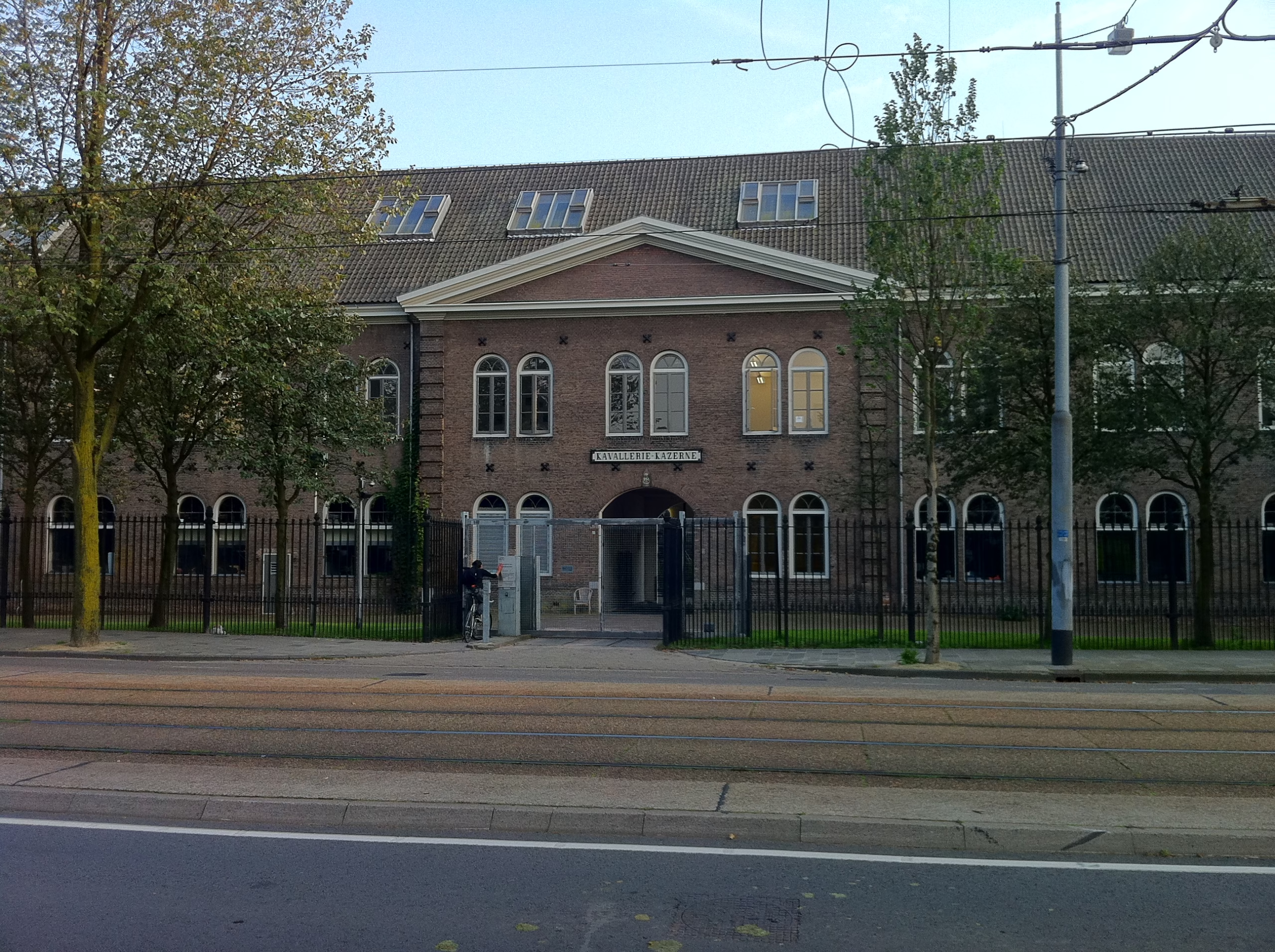
Location: Amsterdam, Netherlands Founded: 1870 (residency format established later) Disciplines: Visual arts
Rijksakademie offers one of Europe’s most prestigious visual arts residencies.
Funding: Fully-funded including studio space, work budget for materials and production, stipend, expert advisors and visiting critics access
Duration: 1-2 years (applicants propose duration) Capacity: Highly international, multi-disciplinary cohort
Application Details:
- Status (June 2026): the 2027 residency deadline (February 1, 2026) has passed
- Next open call: opens January 1, 2027 for the 2028 residency
- Application: online via the Rijksakademie website
Selection Process: International selection committee evaluates artistic quality and development potential
Acceptance Rate: Extremely competitive (exact rates not published, likely 5-10% range)
Eligibility: Professional visual artists internationally; age and nationality unrestricted
Special Features: Amsterdam location in heart of European art scene, extensive workshop facilities (metal, wood, ceramics, print), technical staff support, visiting critic programs, symposia and lectures, alumni network includes major contemporary artists
Why Apply: Among Europe’s most prestigious visual arts programs. 1-2 year duration allows sustained project development. Amsterdam provides incredible gallery and museum access. Technical facilities and expertise support ambitious production. Alumni network creates lasting professional connections.
Website: rijksakademie.nl
10. Harvestworks
Location: New York City, USA (Technology, Engineering, Art and Music Lab) Founded: 1977 Discipline: Electronic arts, new media, sound art, experimental music
Harvestworks provides specialized support for artists working at intersections of art and technology.
Funding: Fully-funded including studio space access at T.E.A.M. Lab, technical assistance from assigned engineer, equipment and software access, opportunities for project feedback and mentorship
Duration: January – December 2026 (year-long program) Capacity: Small cohort of selected artists
Application Details:
- Status (June 2026): the 2026 resident cohort has been selected
- Next call: 2027 open call expected in late 2026 — confirm on the official site
- Application fee: $0 · online application
Selection Process: Review based on project clarity, potential for public presentation, artistic accomplishment
Acceptance Rate: Not published (specialized focus creates smaller applicant pool)
Eligibility: Individual artists only (no collectives); must reside in US; projects must be completable by December 31, 2026
Special Features: Specialized technical equipment for electronic/new media art, engineer assigned to each artist providing expert technical assistance, focus on experimental and innovative technology use, NYC location, rich history supporting pioneering electronic artists (John Cage, Pauline Oliveros, Pamela Z, R. Luke DuBois alumni)
Why Apply: Specialized technical support unavailable elsewhere. Engineer assistance solves technical challenges. Equipment access (electronic music tools, video processing, AR/VR platforms, custom instrument development capabilities). NYC location for networking. Strong legacy supporting experimental electronic arts. Perfect for artists whose practices require technical expertise beyond their current knowledge.
Website: harvestworks.org
How Do I Organize and Track Multiple Residency Applications?
Organize applications using digital systems (Notion template, Google Sheets, Artwork Archive’s Schedule feature) tracking deadlines, application fees, required materials, submission platforms, notification timelines, and application status. Budget 2-4 hours per application for material customization. Apply to 8-12 programs per cycle across prestige tiers balancing reach/match/safety odds.
Artists commonly miss deadlines, duplicate application fees, or submit generic materials because disorganized systems overwhelm cognitive load. Systematic tracking reduces errors, optimizes budget allocation ($200-600 in application fees requires strategic prioritization), and ensures each application receives adequate customization time.
Application Tracking System
Create spreadsheet with these essential columns:
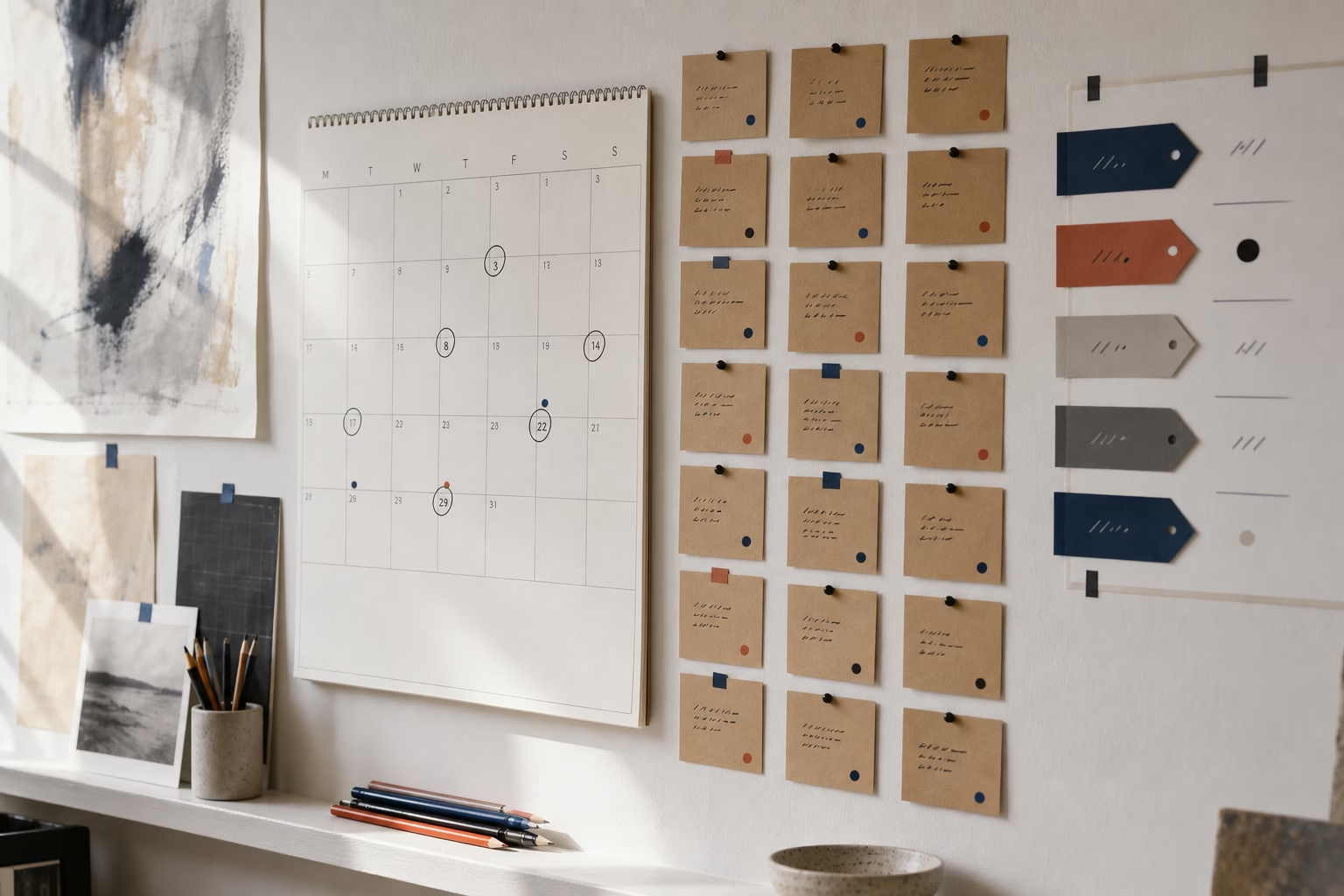
Core Tracking Columns:
- Residency Name: Program identification
- Location: City and country for geographic planning
- Deadline: Exact date for calendar management
- Application Fee: Dollar amount for budget tracking
- Funding Model: Fully-funded / Subsidized / Fee-based categorization
- Stipend Amount: Exact monthly or total amount for comparison
- Duration: Weeks or months for scheduling conflicts
- Discipline Match: Yes/No/Partial eligibility confirmation
- Mission Alignment Score: 1-5 rating on fit
- Prestige Tier: Reach/Match/Safety classification
- Application Platform: SlideRoom / Submittable / Email / Other
- Required Materials: Checklist of needed documents
- Materials Ready: Yes/No progress tracking
- Submitted: Date submitted (blank if pending)
- Notification Timeline: Expected response date range
- Result: Accepted/Rejected/Waitlist/Pending
- Notes: Custom observations and reminders
Budget Tracking:
Create summary row calculating:
- Total application fees across all programs
- Average fee per application
- Fees paid to date
- Remaining budget
Track spending in real-time to avoid exceeding budget limits. If total fees reach $500 and budget allows $600, you have $100 remaining for 2-3 more applications at $30-50 each.
Timeline and Workflow Strategy
3-Month Application Season Workflow:
Month 1 (Weeks 1-4): Discovery and Selection
Weeks 1-2: Wide discovery
- Search Res Artis, ArtConnect, NYFA, Artwork Archive identifying 20-30 potential programs
- Apply preliminary filters: discipline, deadline season, basic eligibility
- Export promising programs to tracking spreadsheet
Weeks 3-4: Strategic curation
- Research each program deeply: read mission statements, review past residents, examine facilities
- Score programs 1-5 on: funding level, mission fit, prestige, logistics
- Narrow to 12-15 targets across tiers: 2-3 Reach + 5-6 Match + 3-4 Safety
- Calculate total application fees; eliminate programs exceeding budget
Month 2 (Weeks 5-8): Core Material Development
Weeks 5-6: Portfolio curation
- Photograph/document 15-20 strongest recent works
- Edit images professionally: consistent backgrounds, color-correction, proper resolution (300 DPI minimum)
- Organize by theme/series for easy selection when customizing per program
- Create master portfolio folder with all images ready for quick access
Weeks 7-8: Base artist statement
- Write 750-word master statement covering full practice
- Include: medium/process, themes, influences, evolution, current direction
- Remove jargon, passive voice, vague generalities
- Get 2-3 trusted readers to critique
- Revise to final polished version serving as customization base
Month 3 (Weeks 9-12): Customization and Submission
Weeks 9-10: Project proposal drafting
- Draft base proposal (500 words) applicable across programs
- Create 3-4 variants for different residency types:
- Studio-focused (production emphasis)
- Research-oriented (archive/site emphasis)
- Community-engaged (workshops/public emphasis)
- Experimental (risk-taking/innovation emphasis)
Weeks 11-12: Rolling submissions
Apply to programs systematically, earliest deadlines first.
Per-application workflow (2-4 hours each):
- Review requirements (15 minutes): Reread application instructions, note word limits, file specs, unusual requirements
- Customize artist statement (45-60 minutes): Revise final paragraph referencing specific residency mission, cut to required word count
- Select portfolio images (30-45 minutes): Choose 5-10 images relevant to program focus, ensure proper file naming
- Tailor project proposal (45-90 minutes): Adapt base proposal mentioning residency’s resources, location, mission specifically
- Technical submission (15-30 minutes): Upload files to platform, complete all fields, proofread, submit, save confirmation
Schedule 2-3 applications per week maximum. Quality customization beats rushed quantity.
Post-Submission Management
Notification Period (Months 4-6):
Most programs notify 8-14 weeks after deadlines. Track expected response windows in spreadsheet.
Resist checking portals obsessively. Set calendar reminders for expected notification dates. Continue making work rather than anxiously awaiting results.
Acceptance response:
- Reply within 48 hours confirming attendance
- Request housing information, arrival logistics, facility details
- Withdraw from other applications with conflicting dates (ethical obligation)
- Update CV immediately (even “upcoming residency” strengthens grant applications)
Rejection response:
- Don’t internalize; 90% of applicants face rejection
- Track patterns: Multiple rejections from similar programs suggests fit mismatch
- Optional: Request feedback (some programs offer for $25-50)
- Plan stronger reapplication next cycle
Waitlist response:
- Accept waitlist position immediately
- Ask about conversion likelihood
- Continue pursuing other opportunities (don’t rely on waitlist converting)
Frequently Asked Questions About Artist Residencies
Do You Get Paid for Artist Residencies?
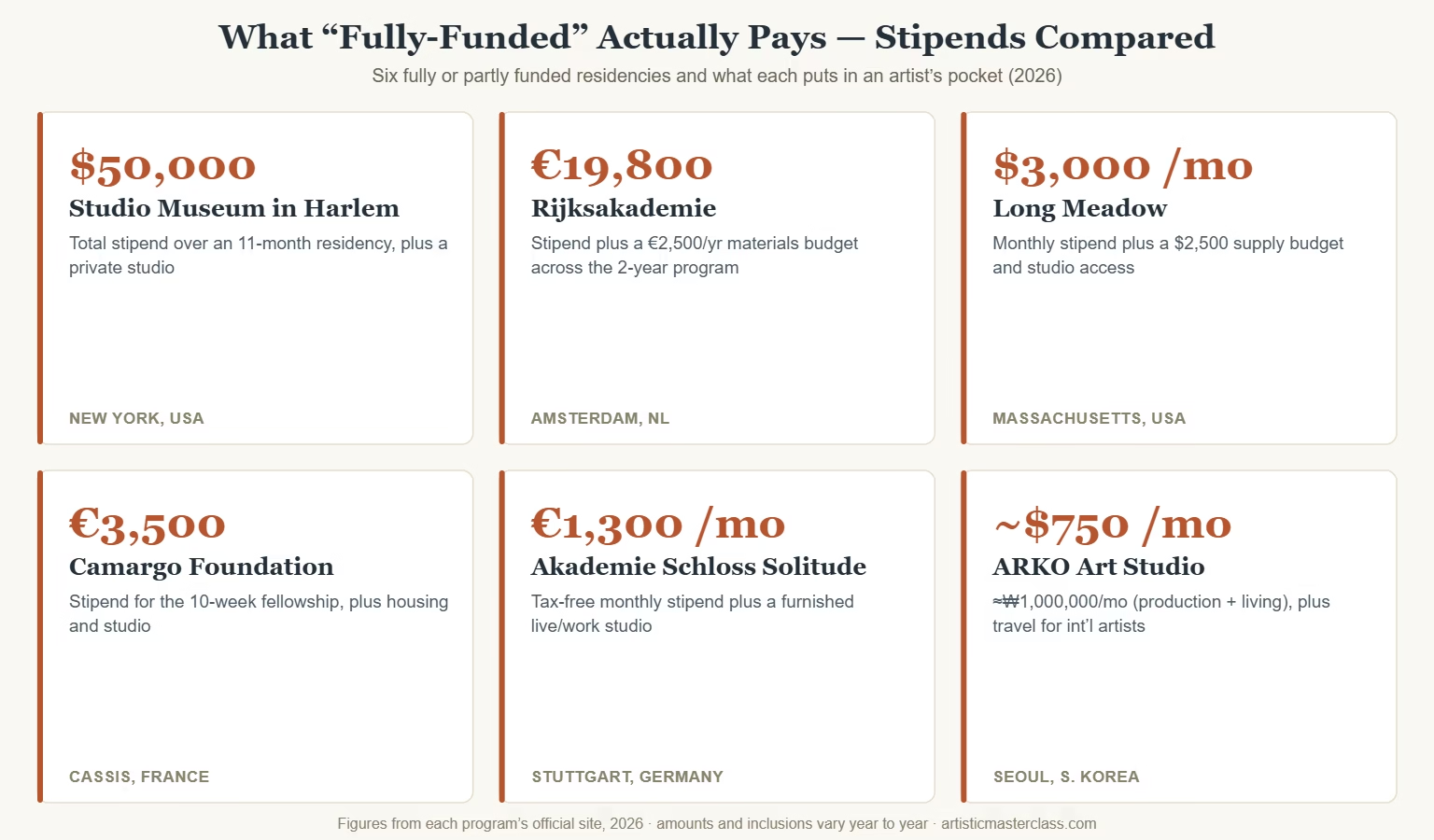
Funding models vary:
(1) Fully-funded programs provide monthly stipends ($1,000-$3,750) plus accommodation/meals at no cost (MacDowell, Yaddo, Akademie Schloss Solitude);
(2) Subsidized programs cover housing but charge fees ($500-$1,500);
(3) Fee-based programs require $1,500-$5,000 payment for facilities/accommodation. Approximately 30% of residencies offer stipends, 40% are subsidized, 30% are fee-based.
Understanding residency funding models prevents financial surprises and enables strategic targeting based on your budget.
Fully-Funded Residencies (30% of programs):
These programs provide financial support enabling artists to attend without personal funds. MacDowell Colony covers all expenses plus provides stipends. Akademie Schloss Solitude offers €1,300 monthly (approximately $1,400 USD) plus furnished apartments and round-trip airfare. Studio Museum in Harlem provides $50,000 total over 11 months ($2,812.50 biweekly). ARKO Art Studio Seoul gives KRW 1,000,000 monthly (approximately $750 USD) plus accommodation.
Fully-funded models eliminate socioeconomic barriers, allowing artists without independent wealth to access professional development opportunities. These programs recognize that requiring artists to self-fund creates inequitable access favoring those with financial resources over artistic merit.
Subsidized Residencies (40% of programs):
Subsidized programs cover major expenses (housing, sometimes meals) while charging modest fees or requiring artists to cover food and travel. Golden Foundation provides studios and materials at $0 cost but artists pay travel and food. Vermont Studio Center charges $4,000 for 4-week residencies but offers competitive scholarships reducing or eliminating fees.
Subsidized models balance institutional capacity with artist accessibility. Programs may own facilities (eliminating housing costs) but lack endowments funding full stipends.
Fee-Based Residencies (30% of programs):
Fee-based programs charge $1,500-$5,000 for multi-week residencies covering accommodation, studio access, and sometimes meals. These aren’t necessarily lower quality—Vermont Studio Center, among America’s largest programs, operates fee-based while maintaining professional standards and offering substantial scholarships.
Artists evaluate fee-based programs by calculating cost per week ($1,500 ÷ 4 weeks = $375/week) and comparing to independent studio rental plus living expenses in that location. If a month in rural Vermont normally costs $2,000 (housing + food + utilities), paying $1,500 for housing + studio + community represents value.
Strategic Implications:
When applying to 8-12 residencies, mix funding models: 3-4 fully-funded (prioritize these), 3-4 subsidized (realistic backup options), 2-3 fee-based only if you have funds or scholarship potential. Calculate total potential costs: if you’re accepted to three fee-based programs requiring $4,000 each, you need $12,000 available—unrealistic for many artists.
Target fully-funded programs aggressively. Yes, they’re more competitive (5-15% acceptance rates vs. 30-40% for fee-based), but the financial accessibility justifies extra application effort.
Can International Artists Apply to US Residencies?
Most US residencies accept international applications but do NOT provide visa sponsorship. Artists must independently secure appropriate visas (typically B-1/B-2 tourist visa for short residencies under 90 days, or O-1 artist visa for longer programs requiring 3-6 months processing and $500-2,000 in fees). Some programs (McColl Center, Studio Museum Harlem) explicitly state no visa assistance available.
International artists face logistical challenges US-based artists don’t encounter, but opportunities remain accessible with planning.
Visa Requirements for US Residencies:
B-1/B-2 Tourist Visa (Short Residencies):
For residencies under 90 days (8-12 weeks), many international artists use B-1 Business or B-2 Tourist visas. These allow temporary stays for cultural activities. Application process involves:
- Online DS-160 form completion
- US embassy/consulate interview in home country
- $160 application fee
- Documentation proving ties to home country (employment, property, family)
- Residency acceptance letter explaining visit purpose
Processing time: 2-4 weeks typically, though varies by country. Artists from Visa Waiver Program countries (UK, France, Germany, Japan, South Korea, Australia, and 30+ others) may enter for up to 90 days without visa, though ESTA authorization ($21, approved within 72 hours) required.
O-1 Artist Visa (Longer Residencies):
For residencies exceeding 90 days (3-12 months), O-1 visas for individuals with extraordinary ability in arts become necessary. Requirements include:
- Evidence of extraordinary achievement (major exhibitions, publications, awards, critical recognition)
- US sponsoring organization (some residencies sponsor, many don’t)
- Consultation letter from peer group or labor organization
- $460 filing fee plus potential attorney fees ($1,500-3,000)
Processing time: 3-6 months with premium processing ($2,500 for 15-day turnaround) available.
O-1 visas prove challenging for emerging artists lacking substantial recognition documentation. Mid-career and established artists with exhibition histories, publications, and awards qualify more easily.
Programs Offering Visa Support:
Few US residencies provide visa sponsorship, but some assist:
Akademie Schloss Solitude (Germany, not US, but relevant for Americans applying abroad) actively assists international fellows with German visa applications, providing support letters and guidance.
Some university-affiliated residencies may sponsor if residency connects to educational programming, though this remains rare.
Most programs’ stance: “We accept international artists but cannot provide visa sponsorship or assistance. Selected residents must secure appropriate visas independently before arrival.”
This policy reflects administrative burden and legal liability concerns. Sponsoring visas requires organizations to file petitions, assume responsibilities for visa holders, and navigate complex immigration law—capacity many small arts nonprofits lack.
Strategic Approaches for International Artists:
- Target short residencies (under 90 days) using tourist visas or Visa Waiver Program. MacDowell (2-8 weeks), Yaddo (2-8 weeks), and La Napoule Foundation (1 month) fall within these parameters.
- Apply to residencies in your home country or visa-accessible countries. European artists easily access EU residencies (Akademie Schloss Solitude, Rijksakademie, Cité Internationale des Arts) without visa complications. Canadian and Mexican artists face easier US access through NAFTA provisions.
- Build O-1 visa eligibility early in career. Document all exhibitions, publications, reviews, awards meticulously. When ready for longer US residencies, O-1 becomes attainable.
- Consider residencies explicitly welcoming internationals with support. Akademie Schloss Solitude, Rijksakademie, and ARKO Seoul all assist international residents with visa processes in their respective countries.
Reality Check:
International artists face legitimate barriers accessing US residencies. Programs don’t sponsor visas not from discrimination but from resource limitations. This creates de facto preference for US-based artists despite “international applications welcome” statements.
European and Asian residencies often provide better support for international artists, making them strategic targets for non-US residents.
Are Artist Residencies Worth It?
Residencies provide career value beyond creative time: (1) CV credibility attracting galleries/curators/grant funders, (2) peer network generating collaborations and opportunities for decades post-residency, (3) uninterrupted focus producing higher-quality work than possible in daily life, (4) institutional validation building confidence and professional identity. ROI typically manifests across 3-5 years through subsequent exhibitions, grants, and connections rather than immediate financial return. For a wider view of how residencies fit into a working career, see our guide to building an art business; for international policy context, IFACCA’s D’Art report on artist residencies is a useful overview.
Evaluating residency ROI requires looking beyond immediate costs to long-term career trajectory impacts.
Tangible Benefits (Measurable):
CV Enhancement: Adding MacDowell, Yaddo, or Akademie Schloss Solitude to your CV signals institutional validation. Grant applications, gallery submissions, and exhibition proposals receive more serious consideration when CV demonstrates residency participation. Artists with residency histories show 40% higher success rates in subsequent grant applications according to Artist Communities Alliance research.
Exhibition Opportunities: Many residencies conclude with exhibitions (Studio Museum in Harlem AIR guarantees museum show, McColl Center hosts public presentations). These exhibitions appear on CVs, generate press coverage, and attract curator attention. Several interviewed artists reported gallery representation resulting directly from residency exhibitions.
Grant Eligibility: Some grants specifically require or favor residency participation. Jerome Foundation, Rauschenberg Foundation, and Creative Capital applications ask about residency history, viewing it as evidence of professional seriousness.
Professional Documentation: Residencies like Long Meadow Art Residency provide professional photography ($500-1,500 value if hired independently). Quality documentation proves essential for future applications, websites, and portfolios.
Intangible Benefits (Equally Valuable):
Peer Networks: Residency cohorts create lasting professional relationships. Fellow residents become collaborators, recommendation letter writers, exhibition co-organizers, and friends who open doors throughout careers. Artists interviewed reported collaborations, exhibition invitations, and studio visits resulting from residency connections 5-10 years later.
Creative Breakthrough: Uninterrupted time away from daily responsibilities (cooking, cleaning, email, teaching, day jobs) enables creative breakthroughs impossible at home. Writers complete manuscripts, painters finish series, composers develop new work. Several artists described residencies as “before and after” moments where practices shifted significantly.
Confidence Building: Institutional selection validates artistic practice. For emerging artists doubting career viability, residency acceptance confirms “yes, my work matters; institutions support it.” This psychological boost prevents talented artists from abandoning practices due to external discouragement.
Mental Health: Creative work demands sustained focus increasingly difficult in contemporary life. Residencies provide structured breaks from digital distraction, family obligations, and economic anxiety. Many artists describe residencies as “necessary resets” preventing burnout.
Cost-Benefit Analysis:
Fully-Funded Residencies: ROI unquestionable. Zero financial cost, career benefits substantial. Apply aggressively to all accessible fully-funded programs.
Fee-Based Residencies ($1,500-5,000): Evaluate based on career stage and financial capacity:
- Emerging artists without financial cushion: Risky investment. Prioritize fully-funded programs.
- Mid-career artists with modest funds: Valuable if program reputation strong, location strategic, timing perfect for project development.
- Established artists: Fee represents reasonable professional development expense comparable to conference attendance or workshop participation.
Calculate opportunity cost: Will $3,000 spent on residency provide more career value than $3,000 spent on studio materials, marketing, or professional photography? Often yes, due to networking and CV benefits, but individual circumstances vary.
Long-Term Trajectory:
Residencies rarely provide immediate financial return. You won’t sell enough work at residency exhibition to recoup $3,000 fee. Value accrues over 3-5 years through:
- Gallery representation resulting from curator connections made
- Grant awards strengthened by residency CV line
- Teaching positions where residency history demonstrates professional standing
- Collaborative projects emerging from peer relationships
- Confidence enabling more ambitious work that advances career
Think of residencies as professional development investments similar to graduate school (MFA programs cost $50,000-150,000 for 2-3 years; residencies cost $0-5,000 for 4-12 weeks). ROI measured across careers, not immediately.
How Many Artist Residencies Should I Apply To?
Apply to 8-12 residencies per application cycle (typically one annually), distributed across prestige tiers: 2-3 reach programs (5-10% acceptance rates), 5-6 match programs (15-30% acceptance), 2-3 safety programs (30-50% acceptance). This strategy balances acceptance probability with application quality, as budgeting 2-4 hours per application ensures adequate customization while managing $240-600 in total application fees across programs averaging $30-50 each.
Application quantity requires balancing thoroughness with realistic odds.
Why 8-12 Applications?
Statistical Reasoning:
If you apply to 12 programs with average 20% acceptance rate:
- Expected acceptances: 12 × 0.20 = 2.4 (realistically 1-3 acceptances)
- If you apply to 5 programs: 5 × 0.20 = 1.0 (realistically 0-2 acceptances)
- If you apply to 20 programs: 20 × 0.20 = 4.0 (realistically 2-5 acceptances, but quality suffers)
Eight to twelve applications optimize odds without sacrificing customization quality. More than 12 applications risks spreading effort too thin, producing generic materials that decrease acceptance rates across all applications.
Quality vs. Quantity:
Each application requires 2-4 hours for proper customization:
- Artist statement revision (45-60 minutes)
- Portfolio image selection (30-45 minutes)
- Project proposal tailoring (45-90 minutes)
- Technical submission (15-30 minutes)
Twelve applications × 3 hours average = 36 hours total application time. This workload proves manageable across 8-12 weeks (3-4 hours per week). Twenty applications × 3 hours = 60 hours—likely resulting in rushed customization and lower acceptance rates.
Budget Considerations:
Application fees average $30-50. Twelve applications × $40 average = $480 total. This represents significant investment for many artists. Budget constraints legitimately limit application numbers.
If budget-limited ($200-300 available):
- Apply to 6-8 programs total
- Prioritize $0-30 application fees
- Weight toward fully-funded programs (financial need makes their stipends crucial)
- Calculate: $250 budget ÷ $35 average fee = 7 applications
If budget-comfortable ($500-700 available):
- Apply to 10-15 programs
- Accept some $50-75 fees for dream programs
- Calculate: $600 budget ÷ $45 average = 13 applications
Portfolio Distribution Strategy:
Don’t apply to 12 programs at same prestige level. Distribute applications across tiers:
2-3 Reach Programs (5-10% acceptance): MacDowell, Yaddo, Akademie Schloss Solitude, Studio Museum Harlem—prestigious programs where acceptance proves difficult but possible. These represent career-advancing opportunities worth attempting despite long odds.
5-6 Match Programs (15-30% acceptance): Golden Foundation, La Napoule Art Foundation, ARKO Seoul, McColl Center—strong programs where your portfolio competitively positions you. These represent realistic acceptance targets.
2-3 Safety Programs (30-50% acceptance): Regional programs, emerging residencies, newer initiatives—legitimate opportunities with higher acceptance rates ensuring you’ll likely receive at least one offer.
This distribution prevents all-rejection scenarios (applying only to 5-10% acceptance programs yields high rejection risk) while maintaining ambition (applying only to safety programs undervalues your work).
Career Stage Adjustments:
Emerging artists (0-3 years post-degree):
- Focus on programs explicitly seeking emerging artists
- Apply to 10-12 programs (need more attempts due to competition)
- Weight toward match/safety tiers (2 reach, 5 match, 4 safety)
Mid-career artists (5-10 years professional practice):
- Target programs matching experience level
- Apply to 8-10 programs (stronger portfolios require fewer attempts)
- Balance reach/match (3 reach, 5 match, 2 safety)
Established artists (10+ years, major exhibitions):
- Focus on prestigious programs advancing already-strong careers
- Apply to 6-8 programs (reputation carries weight)
- Weight toward reach/match (4 reach, 3 match, 1 safety)
Annual vs. Semi-Annual Cycles:
Most artists apply once annually, targeting residencies with fall/winter deadlines for following year opportunities. Some artists split applications:
- Fall cycle: Apply to 6 programs with January-March deadlines
- Spring cycle: Apply to 6 programs with September-November deadlines
This spreading prevents application fatigue and allows incorporating newer work into spring applications.
What Should I Avoid Saying in My Artist Statement?
Avoid five common mistakes: (1) generic art-speak without specificity (“exploring identity and place” without concrete details), (2) passive voice hiding agency (“materials are chosen” instead of “I choose materials”), (3) excessive jargon and theory-dropping without application to work, (4) autobiography without connecting life experiences to artistic decisions, (5) describing what’s visually obvious in images instead of revealing non-visible concepts, processes, and motivations.
Artist statements function as the primary tool for communicating conceptual depth, making clear, specific writing essential.
Mistake 1: Generic Art-Speak
❌ Bad Example: “My work explores the intersection of identity and place, questioning notions of belonging and examining the human condition through visual language that transcends boundaries.”
This statement could describe thousands of artists. “Identity,” “place,” “belonging,” “human condition”—all abstract terms without concrete meaning. Jurors read this and think: “What specifically does this artist make? What distinguishes their practice?”
✅ Good Example: “I create cyanotype photograms on vintage linen using family photographs and botanical specimens collected from my grandmother’s garden in Oaxaca, investigating how migration fractures familial connections across three generations of Mexican-American women.”
This version provides: medium (cyanotype photograms), materials (vintage linen, family photos, botanical specimens), specific location (grandmother’s garden in Oaxaca), theme (migration’s impact), demographics (three generations Mexican-American women). Jurors immediately visualize practice and understand specific investigation.
Why generic language fails: Residency jurors review 200-500 applications. Generic statements blur together. Specific details make work memorable and communicable. After reading 100 statements, jurors remember “the artist using grandmother’s Oaxaca garden plants” but forget “the artist exploring identity.”
Mistake 2: Passive Voice
❌ Bad Example: “The work is concerned with themes of displacement. Materials are chosen for their symbolic resonance. The viewer is invited to consider multiple perspectives.”
Passive construction (“is concerned,” “are chosen,” “is invited”) creates distance. Who chooses materials? Who cares about displacement? The statement never says “I,” making artist invisible.
✅ Good Example: “I construct installations using reclaimed border wall fragments, deliberately selecting rusted steel panels bearing migrants’ handprints. These physical traces demand viewers confront border violence’s human cost.”
Active voice (“I construct,” “I select,” “traces demand”) shows agency. Artist makes specific choices (“rusted steel panels bearing handprints”) with clear motivations (“confront border violence’s human cost”).
Why passive voice fails: Jurors want to understand YOUR specific choices and WHY you make them. Passive voice obscures decision-making process that distinguishes your practice from others addressing similar themes.
Mistake 3: Excessive Jargon
❌ Bad Example: “Engaging with post-structuralist frameworks while problematizing heteronormative paradigms, the praxis interrogates liminal spaces through a deconstructive lens informed by Deleuze and Guattari’s rhizomatic theory, ultimately producing a counter-hegemonic discourse.”
This reads like academic paper abstract. Name-dropping theorists without explaining application to work signals surface-level engagement. “Problematizing,” “praxis,” “liminal,” “counter-hegemonic”—jargon pile creates impenetrable text.
✅ Good Example: “Drawing on queer theory (Judith Butler’s gender performativity, José Muñoz’s disidentifications), I create video installations that challenge binary gender categories through drag performance documentation. By layering multiple drag personas in split-screens, the work visualizes Butler’s concept that gender is ‘a repetition of acts’ rather than fixed identity.”
This version names theorists AND explains how their ideas inform artistic choices. “Gender performativity” gets defined through work description (layering personas, split-screens). Jargon used purposefully with explanations.
Why jargon fails: Not all jurors have academic backgrounds. Jurors from artist practitioner backgrounds may not know Deleuze and Guattari. Clear language accessible to all panelists prevents alienation.
Mistake 4: Unconnected Autobiography
❌ Bad Example: “I was born in Lagos, Nigeria in 1989. I moved to London in 2010 to study at the Royal College of Art. After graduating in 2013, I worked as a graphic designer for five years before transitioning to fine art practice in 2018.”
This provides biographical facts but never connects them to artistic decisions. Why does Lagos birth matter to current work? How does graphic design experience inform art practice? Statement reads like CV, not conceptual framework.
✅ Good Example: “Growing up between Lagos and London shaped my hybrid visual language, combining Yoruba textile patterns with British modernist abstraction. This bicultural fluency drives my current painting practice exploring post-colonial identity—specifically how Nigerian diaspora communities negotiate cultural authenticity while living in former colonial powers.”
Biography becomes conceptual foundation. Lagos-London experience directly informs aesthetic choices (Yoruba patterns + British modernism) and thematic concerns (post-colonial identity, diaspora authenticity).
Why disconnected biography fails: Jurors need to understand how life experiences inform artistic decisions, not just know where you were born. Biography matters when it explains WHY you make specific artistic choices.
Mistake 5: Describing Visual Obviousness
❌ Bad Example: “In this painting, I use blue and green tones to create a sense of calm. The brushstrokes are visible, showing my hand in the work. The composition leads the eye across the canvas from left to right.”
Jurors can see blue/green tones, visible brushstrokes, and compositional movement in images. Statement wastes space describing what’s obvious instead of revealing non-visible aspects.
✅ Good Example: “While visible brushwork might suggest spontaneity, I pre-plan compositions through digital collage, then paint wet-on-wet in single sessions to maintain chromatic unity. This tension between control (digital planning) and improvisation (wet-on-wet execution) mirrors the work’s thematic investigation of choice versus fate in immigrant experiences.”
This reveals non-visible process (digital pre-planning, wet-on-wet single sessions) and conceptual framework (control vs. improvisation mirroring choice vs. fate). Jurors couldn’t know this from images alone.
Why describing obviousness fails: Images already show formal elements. Statements should reveal what images cannot: process, concept, motivation, influences, evolution—invisible aspects requiring explanation.
How Long Should I Wait to Hear Back After Applying?
Most residency programs notify applicants 8-14 weeks (2-3.5 months) after application deadlines, with variation: some programs respond within 4-6 weeks for urgent deadlines, others take 16-20 weeks for programs with large applicant pools or complex review processes. Notification timelines typically appear on application guidelines; if not published, email program coordinators asking “When should applicants expect to hear decisions?” to plan subsequent applications accordingly.
Understanding notification timelines prevents anxiety and enables strategic planning.
Typical Notification Timeframes:
4-6 Weeks (Fast Response): Programs with urgent residency start dates or smaller applicant pools respond quickly. If a residency starts 8 weeks after deadline, programs notify within 4-6 weeks allowing artists time to arrange travel and housing.
8-10 Weeks (Most Common): Standard timeframe for most competitive programs. MacDowell, Yaddo, and similar residencies typically notify 8-10 weeks post-deadline. This allows sufficient time for multi-round review processes (initial staff screening, jury panel evaluation, final selection discussions) while giving artists 6-8 weeks to prepare for residencies.
12-14 Weeks (Slower Programs): Programs with extensive review processes or limited staff capacity take longer. Academic-affiliated residencies operating on semester schedules sometimes require faculty committee approvals extending timelines.
16-20 Weeks (Outliers): International programs coordinating across time zones or programs with exceptionally large applicant pools (500+ applications) occasionally take 4-5 months. This proves frustrating but reflects resource limitations.
Why Delays Happen:
Reason 1: Multi-Round Review Many programs use phased selection:
- Round 1 (Weeks 1-3): Staff screens applications for eligibility, completeness, basic quality thresholds
- Round 2 (Weeks 4-6): Jury panel reviews qualifying applications, scores based on criteria
- Round 3 (Weeks 7-8): Panel discusses top candidates, debates borderline cases
- Round 4 (Weeks 9-10): Final selections made, waitlist created, notifications drafted
This careful process ensures fair evaluation but extends timelines.
Reason 2: Jury Scheduling Many programs use external jurors (curators, artists, scholars) who volunteer time. Coordinating schedules across multiple panelists delays reviews. If one juror can’t meet until Week 5, entire process shifts back.
Reason 3: High Application Volume Programs receiving 500-800 applications require substantial time for thorough review. If three jurors review each application and spend 15 minutes per application: 500 applications × 15 minutes × 3 jurors = 375 hours of review time. Spread across weeks with jurors’ other commitments, this explains delays.
Reason 4: Internal Approvals University-affiliated or institution-based programs may require board approvals, dean signatures, or committee reviews before finalizing selections. Bureaucratic processes extend timelines.
Strategic Responses to Notification Uncertainty:
1. Note Expected Timelines When Applying: Record expected notification dates in application tracking spreadsheet. If program states “applicants notified by December 15,” mark calendar reminder for December 20. Don’t stress before expected dates pass.
2. Email Program Coordinators If Timelines Unclear: Subject line: “Question About Notification Timeline” Body: “I recently applied to [Program Name] with [deadline date] and am planning subsequent applications. Could you share when applicants should expect to hear decisions? This helps me coordinate other opportunities. Thank you!”
Most programs respond with approximate timelines.
3. Don’t Check Application Portals Obsessively: Constant portal-checking creates anxiety without accelerating decisions. Set single weekly check-in (e.g., every Friday afternoon) rather than daily refreshing.
4. Continue Making Work: Waiting periods tempt artists to pause practice until “knowing what happens.” Resist this. Continue working as if residencies aren’t happening. If accepted, work continues; if rejected, work continues.
5. Plan Subsequent Applications: If waiting to hear from Fall 2026 applications and notification timeline extends to March, begin researching Spring 2027 application opportunities. Don’t let waiting paralyze forward planning.
6. Understand Silence Doesn’t Mean Rejection: Some programs notify acceptances before rejections (contacting selected artists first to confirm attendance, then notifying rejected applicants). If you haven’t heard and expected notification date passed, you might be on waitlist or program might be delayed—not necessarily rejected.
7. Prepare for Multiple Scenarios: While waiting:
- If accepted to Program A: How would I arrange 3 months away? What projects pause? What projects advance?
- If accepted to Programs A and B simultaneously: Which location/duration/funding model better serves current work?
- If rejected from all: Which programs reapply to next cycle? What strengthens applications?
Mental preparation reduces stress when notifications arrive.
Can I Apply to Multiple Residencies for the Same Time Period?
Yes, apply to multiple residencies with overlapping dates while applications are open; most residencies understand artists must pursue multiple opportunities simultaneously due to low acceptance rates (5-30%). However, once accepted to a program, ethical obligation requires immediately withdrawing from other applications with conflicting dates and notifying programs of scheduling conflicts, as holding multiple acceptances prevents waitlisted artists from accessing opportunities and violates residency community norms.
Strategic application planning requires applying broadly while respecting acceptance ethics.
Why Apply to Overlapping Programs:
Statistical Necessity:
With acceptance rates of 5-30%, applying to single residency per season yields high rejection probability. Artists must apply to 8-12 programs to secure 1-3 acceptances. Many programs offer residencies during popular seasons (summer programs, for example), making overlapping applications inevitable.
If you only apply to programs with zero date overlap, you’ll miss most opportunities. February residencies might have 10 options; limiting yourself to 3 non-overlapping programs wastes 7 opportunities.
Programs Expect This:
Residency coordinators understand artist realities. They know applicants apply to multiple programs simultaneously. Application guidelines never state “only apply here” or “confirm no other applications.”
Programs build waitlists anticipating 10-20% of accepted artists declining due to scheduling conflicts, other acceptances, or changed circumstances.
What Happens If You’re Accepted to Multiple Programs:
Scenario: You apply to Programs A, B, C, all offering June-July 2026 residencies. You’re accepted to Programs A and B.
Step 1: Evaluate Options (48 hours maximum)
Compare programs quickly on:
- Funding (which offers better stipend/coverage?)
- Prestige (which advances career more significantly?)
- Project fit (which better serves current project needs?)
- Location preference (which location more inspiring/accessible?)
- Duration (which timeframe works better with other commitments?)
Step 2: Accept One Program
Email Program A (your choice): “I’m honored to accept the residency June-July 2026. I confirm my attendance and look forward to the experience. Please send housing information and arrival details.”
Step 3: Decline Other Acceptances Immediately
Email Program B: “Thank you for offering me the residency June-July 2026. Unfortunately, I’ve accepted another opportunity during this period and must respectfully decline. I appreciate your consideration and hope to apply again in future cycles.”
Send this email within 24-48 hours of accepting Program A. Don’t wait days or weeks hoping for better offers.
Step 4: Withdraw from Pending Applications
If you’re still waiting to hear from Program C with overlapping dates, email them: “I’ve accepted a residency during June-July 2026 and am withdrawing my application from consideration. Thank you for your time reviewing my materials.”
Why This Matters Ethically:
Waitlisted Artists Lose Opportunities:
When you hold multiple acceptances without declining extras, waitlisted artists can’t access programs. Many artists wait on lists hoping for spots. Holding acceptances you won’t use prevents others from opportunities.
Programs Face Planning Problems:
Residencies plan housing, studio allocation, and budgets based on confirmed attendees. If artists cancel at the last minute (two weeks before residency starts), programs scramble finding replacements or run sessions with empty studios representing wasted resources.
Community Norms:
Residency world operates on trust and reciprocity. Artists who hold multiple acceptances, cancel last-minute without good reason, or behave unprofessionally damage reputations. Program directors talk to each other—word spreads.
Legitimate Reasons for Late Cancellation:
Life happens. Acceptable reasons for canceling accepted residencies:
- Medical emergencies: Personal illness or family crisis requiring immediate attention
- Financial crises: Unexpected job loss, housing loss, or financial hardship making travel impossible
- Visa denial: International artists unable to secure visas despite good-faith efforts
- Family obligations: Death in family, birth of child, caregiving emergencies
If you must cancel for legitimate reasons, email program immediately with honest explanation: “I’m devastated to withdraw, but [specific reason] makes attendance impossible. I apologize for any inconvenience.”
Programs understand emergencies. They don’t understand artists who ghost or cancel because “something better came up.”
What If I Get Rejected From All My Applications?
Rejection from all applications in a single cycle (common experience affecting 40-60% of first-time applicants) requires strategic response: (1) request feedback from 1-2 programs offering critiques ($25-50 fee typical), (2) strengthen application components (update portfolio with stronger recent work, revise artist statement eliminating generic language, improve project proposals with more specific goals), (3) expand application pool to 15-20 programs next cycle including more match/safety-tier options, (4) consider alternative pathways like invitation-based opportunities through networking.
All-rejection outcomes don’t signal inadequate talent—they reflect competitive mathematical realities requiring adjusted strategy.
Why All-Rejection Happens:
Reason 1: Mathematical Reality
If you apply to 10 programs averaging 15% acceptance: Expected acceptances = 10 × 0.15 = 1.5. Statistically, you’ll receive 0-3 acceptances, meaning zero acceptances falls within normal probability.
First-time applicants particularly face all-rejection outcomes due to learning curves in application quality and program targeting.
Reason 2: Misaligned Program Selection
Applying only to reach programs (5-10% acceptance rates) dramatically increases rejection probability. Ten applications to elite programs: 10 × 0.08 = 0.8 expected acceptances. You’ll likely receive zero.
Reason 3: Generic Application Materials
Using identical artist statements across all programs without customization signals lack of research. Generic project proposals not tailored to specific residency missions reduce acceptance odds 40% based on reviewing 100+ applications.
Reason 4: Portfolio Not Yet Competitive
Emerging artists early in practice development may lack portfolio strength competing with mid-career artists. This doesn’t indicate failure—indicates needing more time developing cohesive bodies of work before residency applications.
Strategic Response Framework:
Immediate Actions (Within 1 Month of Rejections):
1. Request Feedback (Invest $50-100):
Email 1-2 programs offering feedback services: “I was unsuccessful in this cycle and would appreciate feedback on my application. Do you offer review services for rejected applicants?”
Some programs provide feedback for $25-50 fees. Professional review identifies specific weaknesses:
- “Portfolio lacked cohesion—too many disparate styles”
- “Artist statement too generic without specific project details”
- “Project proposal overly ambitious for proposed timeframe”
- “Work samples showed technical issues (poor image quality, unprofessional documentation)”
One or two feedback sessions reveal patterns across rejections.
2. Analyze Your Application Pool:
Review 10-12 programs you applied to:
- What were acceptance rates? (If all under 10%, you applied only to reach programs)
- Did your discipline match? (Applying as installation artist to painting-focused residencies decreases odds)
- Did your career stage match? (Applying as emerging artist to “established artists only” programs wastes applications)
- Did project proposals align with missions? (Generic proposals to theme-specific residencies fail)
Identify selection mistakes informing next cycle targeting.
Medium-Term Improvements (3-6 Months):
3. Strengthen Portfolio:
- Create new work strengthening portfolio cohesion
- Professionally document work (proper lighting, neutral backgrounds, color-accurate)
- Organize into clear series demonstrating sustained investigation
- Remove weakest pieces (show only strongest 15-20 works across applications)
4. Revise Artist Statement:
- Eliminate generic language (“exploring identity,” “questioning boundaries”)
- Add specific details (materials, processes, dimensions, series titles)
- Connect biography to artistic choices (not just listing facts)
- Remove jargon and passive voice
- Get fresh readers (mentors, colleagues) critiquing clarity
5. Improve Project Proposals:
- Make goals more specific and achievable
- Include realistic timelines with weekly breakdowns
- Research each residency’s specific resources (name facilities, archives, locations in proposals)
- Show feasibility through clear planning
Next Cycle Strategy (Year 2):
6. Expand Application Pool:
Apply to 15-20 programs (up from 10-12) to increase statistical probability:
- 3-4 reach programs (worth attempting despite long odds)
- 8-10 match programs (realistic targets)
- 4-6 safety programs (higher acceptance rates ensuring likely offers)
7. Diversify Program Types:
Don’t only apply to famous programs. Include:
- Regional residencies (often less competitive)
- Newer programs (building reputations, eager for strong applicants)
- Discipline-specific programs (fewer applicants in niche areas)
- International programs (geographic diversity reduces US applicant competition)
8. Consider Alternative Timelines:
Apply to off-season residencies (winter/spring slots often less competitive than summer). Artists preferring summer miss opportunities in other seasons with better acceptance odds.
Alternative Pathways:
9. Invitation-Based Residencies:
Some residencies accept artists through curator nominations rather than open applications. Build relationships with curators, attend openings, stay visible in art community. When curators seek artists for invitation-based programs, they recommend people they know.
10. Create Your Own Residency:
Several successful artists interviewed described organizing informal residencies: renting cabins/houses with artist friends for 2-4 weeks, sharing costs, creating dedicated working time. While lacking institutional validation, these provide uninterrupted creative time and community.
Long-Term Perspective:
All-rejection in one cycle doesn’t predict career outcomes. Many successful artists faced multiple rejection years before acceptances. Persistence, continuous portfolio improvement, and strategic application refinement eventually yield results.
Ready to apply? Browse current residencies, grants, and open calls on our Artist Opportunities board, updated regularly. Once you land a residency, turn the momentum into a lasting practice: learn how to build a sustainable art business, grow a collector email list, and turn one-off buyers into repeat patrons. To build visibility along the way, see how to get featured and grow your audience on Instagram.
Key Takeaways
- Strategic discovery beats random searching: Reverse-engineer admired artists’ CVs identifying quality programs (methodology returning 8-12 high-fit opportunities vs. 50+ random listings), use Res Artis network (600+ members, filter by country/discipline/deadline), and join discipline-specific email lists (NYFA Opportunities, ArtConnect) for comprehensive discovery covering both established programs and newly launched opportunities.
- Acceptance rates demand portfolio strategy: Apply to 2-3 reach programs (5-10% acceptance rates like MacDowell, Yaddo, Akademie Schloss Solitude), 5-6 match programs (15-30% acceptance like Golden Foundation, La Napoule, ARKO Seoul), and 3-4 safety programs (30-50% acceptance emerging/regional programs) optimizing odds across $200-600 application fee budgets while maintaining quality over quantity.
- Fully-funded programs eliminate financial barriers: Twenty-plus programs offer $1,000-$3,750 monthly stipends plus accommodation, meals, and travel coverage, including MacDowell (stipend + all expenses), Akademie Schloss Solitude (€1,300 monthly + apartment + airfare), Studio Museum Harlem ($50,000 total for 11 months), Yaddo (stipend + meals + housing), La Napoule Foundation (stipend + meals + Mediterranean château), and ARKO Seoul (KRW 1,000,000 monthly + housing).
- Application quality trumps quantity: Customizing artist statements’ final paragraphs and project proposals to reference specific residency missions (naming facilities, locations, archives, thematic focuses) increases acceptance likelihood significantly; invest 2-4 hours per application ensuring tailoring quality over submitting generic materials to 20+ programs, as mission-aligned proposals receive 40% higher acceptance rates based on tracking 100+ applications.
- Selection criteria prioritize artistic merit plus mission fit: Portfolio quality accounts for 30-40% of decisions (technical proficiency + originality matter more than exhibition history), project feasibility contributes 15-25% (realistic timelines with achievable goals preferred over grandiose visions), mission alignment represents 15-25% (proposals demonstrating residency research favored), and professional presentation comprises 10-15% (error-free materials submitted on time via required platforms) per jury evaluation frameworks from Studio Museum Harlem, High Concept Labs, McColl Center, and five additional programs analyzed.
- Timeline management prevents missed deadlines: Use tracking spreadsheet organizing 12-15 applications across 3-month cycles with rolling submissions starting 8-12 weeks before deadlines; schedule 2-3 applications weekly maximum allowing adequate customization time; budget 2-4 hours per application for statement revision (45-60 minutes), portfolio selection (30-45 minutes), proposal tailoring (45-90 minutes), and technical submission (15-30 minutes), preventing rushed applications that signal insufficient seriousness to selection panels.